

Robocalls are a massive problem in the U.S., with 4.5 billion calls hitting phones monthly. These calls aren’t just annoying – they’re often scams. To fight back, five key entities work to enforce the Telephone Consumer Protection Act (TCPA), which imposes fines of $500 to $1,500 per violation. Here’s how they tackle the issue:
- Federal Trade Commission (FTC): Manages the Do Not Call Registry and has recovered $178 million in penalties.
- Federal Communications Commission (FCC): Issues fines (up to $299 million) and disconnects violators from telecom networks.
- Department of Justice (DOJ): Files lawsuits, securing bans and penalties for offenders.
- State Attorneys General: Enforce state and federal laws, targeting VoIP providers and telemarketers.
- ReportTelemarketer.com: Helps individuals report violations and pursue legal action for free.
These groups, along with consumer reports, have cut robocalls by over 50% since 2021. Keep reading to learn how each agency operates, their successes, and how you can report violations.
1. Federal Trade Commission (FTC)
Role in Enforcing TCPA Penalties
The Federal Trade Commission (FTC) plays a critical role in protecting consumers from fraudulent and unwanted calls under the Telephone Consumer Protection Act (TCPA). This is largely achieved through the enforcement of the Telemarketing Sales Rule (TSR), which aligns with the Telemarketing and Consumer Fraud and Abuse Prevention Act and incorporates many of the same protections as the TCPA. The FTC doesn’t just focus on telemarketers – it also targets the broader networks that enable illegal robocalls. This includes VoIP service providers, lead generators, and so-called "consent farms" that trick consumers into giving permission for calls.
By early 2026, the FTC had initiated 151 enforcement actions against companies violating rules on Do Not Call, robocalls, and caller ID spoofing. These actions resulted in over $178 million in civil penalties and $112 million in restitution. A notable case occurred in July 2023, when the FTC pursued Fluent, LLC, a lead generator responsible for selling over 620 million deceptive telemarketing leads. The company was fined a $2.5 million civil penalty and was banned from facilitating robocalls.
Collaboration with Other Agencies or Industry Groups
The FTC works hand-in-hand with more than 100 federal and state partners through Operation Stop Scam Calls. This initiative includes collaborations with the Department of Justice and attorneys general from all 50 states.
"Today, government agencies at all levels are united in fighting the scourge of illegal telemarketing. We are taking action against those who trick people into phony consent to receive these calls and those who make it easy and cheap to place these calls."
- Samuel Levine, Director of the FTC’s Bureau of Consumer Protection
The FTC also collaborates with USTelecom to trace illegal calls and shares daily consumer complaint data to improve call-blocking technologies. In September 2023, the FTC and the Federal Communications Commission (FCC) renewed a Memorandum of Understanding to strengthen cross-border enforcement efforts through the Unsolicited Communications Enforcement Network.
Effectiveness in Combating Robocall Violations
Since the launch of the Do Not Call Registry in 2003, the FTC has taken legal action in 173 lawsuits against 570 companies and 449 individuals. These efforts have resulted in nearly $400 million in penalties and settlements. The registry itself now includes more than 258 million telephone numbers.
The FTC has shown it can adapt to emerging threats. In September 2025, for example, Citizens Disability agreed to pay a $1 million penalty after making millions of illegal telemarketing calls. The agency has also made it clear that new technologies, such as AI-generated voices, are not exempt from compliance.
"There is no AI exemption to the laws on the books."
- FTC Chair Lina Khan
These enforcement efforts are bolstered by tools that make it easy for consumers to report violations.
Accessibility for Consumers to Report Violations
Consumers can report violations through DoNotCall.gov, ReportFraud.ftc.gov, or by calling 877-FTC-HELP. Even if you’re not registered on the Do Not Call list, you can still file a complaint. The FTC encourages providing details such as the caller ID number, date, and time of the call, even if the number appears to be spoofed. This information helps investigators track calling patterns and identify scammers.
sbb-itb-a8d93e1
2. Federal Communications Commission (FCC)
Role in Enforcing TCPA Penalties
The Federal Communications Commission (FCC) plays a key role in enforcing the Telephone Consumer Protection Act (TCPA), focusing on investigating violations and imposing penalties. This includes addressing calls made without prior written consent and those targeting numbers listed on the National Do Not Call Registry. A major part of their efforts involves issuing cease-and-desist orders to U.S.-based voice providers, effectively targeting the systems that enable illegal robocalls. For example, in 2021, an international robocall network made billions of illegal calls to over 500 million numbers in just three months. This led to a record-breaking $299 million fine issued in August 2023. Additionally, after the FCC ordered U.S. voice providers in July 2022 to block this scam traffic, the volume of such calls plummeted by 99%. To further tighten regulations, the FCC has proposed new rules requiring do-not-call and consent-revocation requests to be honored within 24 hours and limiting how multiple marketers can rely on a single consumer’s consent.
These enforcement efforts are bolstered by partnerships and collaborative measures.
Collaboration with Other Agencies or Industry Groups
The FCC works closely with other federal agencies and industry stakeholders to tackle illegal robocalls. It collaborates with the Federal Trade Commission (FTC) through joint policy forums to align strategies against robocalls and caller ID spoofing. A key part of this partnership involves sharing consumer complaint data with telecommunications providers and industry groups daily. This data supports the development of technologies for call-blocking and call-labeling. Additionally, the FCC participates in nationwide enforcement sweeps with law enforcement to identify and shut down illegal telemarketing operations. These joint efforts enhance the FCC’s enforcement approach while complementing its consumer-focused initiatives.
Accessibility for Consumers to Report Violations
The FCC provides a centralized online complaint portal at consumercomplaints.fcc.gov, where consumers can report unwanted calls, texts, and caller ID spoofing. When filing a complaint, users should select "unwanted calls/texts" as the main category, then specify the issue – such as "all other unwanted calls/messages" or "my own number is being spoofed" – to ensure accurate categorization. The portal also allows users to include international numbers in the "Additional Information" section.
"We do not resolve individual unwanted call or text complaints, but your complaint provides valuable information that we use to inform policy decisions and as the basis of potential enforcement actions against those violating our rules." – Federal Communications Commission
Although the FCC does not address individual complaints directly, the data gathered through these reports is vital for shaping policies and supporting enforcement actions against violators.
Why Robocalls Are Almost Impossible to Stop | WSJ
If you are targeted by these calls, you can report robocall violations to help authorities take action.
3. Department of Justice (DOJ)
The Department of Justice (DOJ) plays a crucial role in advancing efforts to combat illegal robocalls by focusing on targeted litigation.
Role in Enforcing TCPA Penalties
As the primary litigation arm for federal agencies, the DOJ works to enforce penalties under the Telephone Consumer Protection Act (TCPA). Acting on behalf of the Federal Trade Commission (FTC), the DOJ files civil complaints and proposed orders in U.S. District Courts. These actions target critical players in the telemarketing ecosystem, such as "consent farm" lead generators that manipulate consumers into agreeing to calls, and Voice over Internet Protocol (VoIP) providers that facilitate billions of illegal calls reaching Americans.
The DOJ takes both civil and criminal actions, aiming for permanent bans on telemarketing activities and imposing hefty penalties. By early 2026, the FTC and DOJ together had initiated 151 enforcement actions addressing violations of Do Not Call regulations and robocall laws, recovering more than $178 million in civil penalties.
Collaboration with Other Agencies or Industry Groups
In July 2023, the DOJ joined forces with several agencies in "Operation Stop Scam Calls", a nationwide initiative. This multi-agency effort included the FTC, FCC, Social Security Administration Office of the Inspector General, U.S. Postal Inspection Service, and attorneys general from all 50 states. Together, they launched over 180 enforcement actions against entities responsible for billions of illegal robocalls and over 700 million fraudulent telemarketing leads.
These partnerships have significantly amplified the impact of legal actions against robocall violations.
Effectiveness in Combating Robocall Violations
The DOJ has demonstrated its effectiveness through high-profile cases. For instance, in July 2023, the DOJ pursued three major cases that resulted in severe penalties:
- Fluent, LLC: Fined $2.5 million for using deceptive tactics to trick consumers into consenting to robocalls and selling over 620 million leads.
- Solar Xchange LLC: Penalized $13.8 million (partially suspended) for making tens of millions of calls to numbers on the Do Not Call list.
- Yodel Technologies, LLC: Ordered to pay $1 million after making 1.4 billion calls, including 500 million to Do Not Call numbers using soundboard technology.
All three companies received permanent bans on telemarketing activities. These actions, alongside broader efforts by the FTC and DOJ, have led to the recovery of over $394 million from 167 cases, with courts ordering defendants to pay more than $2 billion in total across all cases.
This aggressive litigation underscores the DOJ’s commitment to holding violators accountable and reducing the prevalence of illegal robocalls.
4. State Attorneys General
State Attorneys General play a key role in enforcing federal robocall laws at the state level. They have the authority to impose civil penalties under the Telephone Consumer Protection Act (TCPA) and the Truth in Caller ID Act (TICA), while also pursuing injunctive relief through the Telemarketing Sales Rule (TSR). In 2022, all 51 attorneys general, including the District of Columbia, united to form the Anti-Robocall Litigation Task Force, creating a collective effort to combat illegal robocalls.
Role in Enforcing TCPA Penalties
State AGs can bring enforcement actions in both state and federal courts, often forming multi-state coalitions to amplify their impact. For instance, in 2020, seven state AGs from both parties filed a federal lawsuit against John Spiller and his company, Rising Eagle, accusing them of using illegal robocalls to sell health insurance. This case aligned with an FCC enforcement action that levied a $225 million fine against the same defendants.
The task force has shifted its focus to intermediate VoIP wholesalers that facilitate illegal robocall traffic, rather than just targeting the telemarketers themselves. In August 2025, New York Attorney General Letitia James, along with 50 other AGs, sent warning letters to 37 voice service providers, including Alpha Stream and DigitalOcean LLC, for failing to comply with FCC traceback and mitigation rules. Additionally, the task force notified 99 downstream providers about their connections to non-compliant actors.
Collaboration with Other Agencies or Industry Groups
State AGs work closely with federal agencies like the FTC, DOJ, and FCC through Memoranda of Understanding (MOUs) that enable information sharing and coordinated investigations. They also collaborate with the Industry Traceback Group (ITG), an FCC-designated entity tasked with tracing spoofed robocalls back to their origins.
Under initiatives like "Operation Stop Scam Calls", state AGs have engaged in joint enforcement actions to combat robocall violations. Connecticut Attorney General William Tong underscored the importance of this teamwork:
"We are cracking down on the country’s worst scam enablers."
- Connecticut Attorney General William Tong
Effectiveness in Combating Robocall Violations
The collective efforts of state AGs have yielded measurable results. In 2025, the state AG Task Force issued three rounds of warning notices to 50 VoIP wholesalers. These actions, combined with federal partnerships, have led courts to order over $2 billion in penalties across robocall cases.
Despite these successes, the problem remains significant. In 2023, consumers reported losing more than $1.2 billion to scams carried out through robocalls and text messages. Ohio Attorney General Dave Yost emphasized the critical role consumers play in the fight against robocalls:
"Our secret weapon is consumers – whom we urge to continue reporting illicit robocalls, so we can sever these unwanted illegal robocallers’ connection once and for all."
- Ohio Attorney General Dave Yost
These outcomes highlight the value of consumer participation in reporting violations.
Accessibility for Consumers to Report Violations
Consumers can report robocall violations directly to their State Attorney General’s office through dedicated online portals. For example, Connecticut residents can file complaints at www.ct.gov/agcomplaints. These reports are vital, as they help AGs identify trends, launch investigations, and build cases against violators.
When filing a report, consumers should provide details like the date, time, caller ID, and any callback numbers. Even if the number appears spoofed, reporting is still important. State AGs and their federal partners use calling patterns and traceback data to trace the origin of illegal robocalls.
5. ReportTelemarketer.com
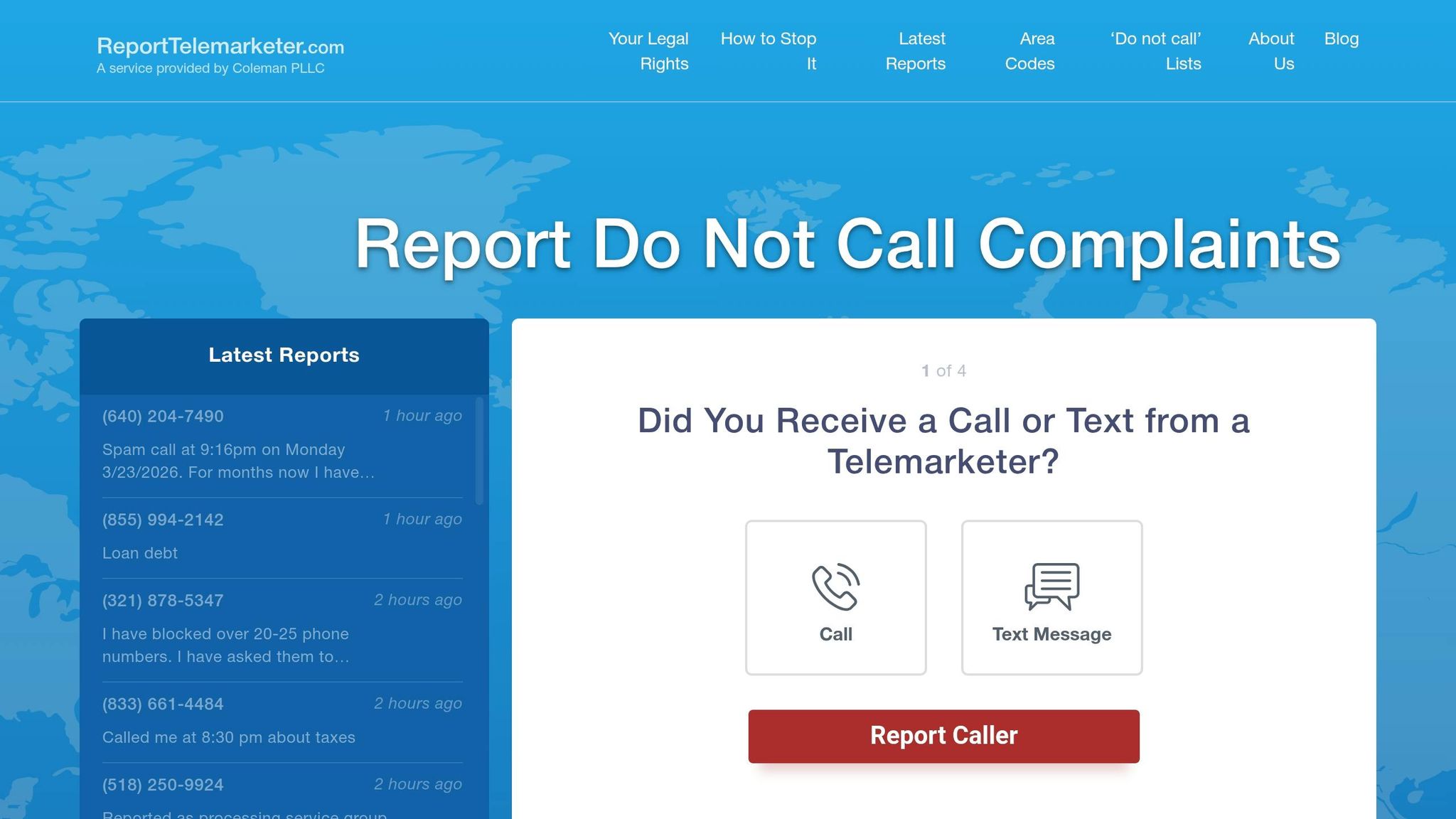
ReportTelemarketer.com is a service designed to help consumers take legal action against telemarketers who violate the Telephone Consumer Protection Act (TCPA). Created by Stefan Coleman, it provides a free system where users can document unwanted calls and texts. The platform’s legal team steps in to investigate these reports, send cease-and-desist letters, and file formal complaints when necessary.
Much like federal agencies, ReportTelemarketer.com relies on consumer-submitted data to address robocall violations effectively.
Role in Enforcing TCPA Penalties
This service transforms consumer complaints into actionable legal cases. When telemarketers violate TCPA rules – such as making automated calls, leaving prerecorded messages, or sending texts without prior written consent – ReportTelemarketer.com uses its investigative tools to track patterns and identify the perpetrators. Consumers are encouraged to keep detailed records, including the date, time, caller identity, and a brief summary of the call, as well as any voicemail recordings.
Effectiveness in Combating Robocall Violations
The platform excels at identifying illegal telemarketing patterns, even when caller ID information is falsified or spoofed. By carefully analyzing call data, it can trace the origins of these calls and reveal the entities responsible. This includes uncovering lead generators and VoIP providers that facilitate illegal telemarketing.
Accessibility for Consumers to Report Violations
ReportTelemarketer.com complements government efforts by empowering individuals to report violations directly. Accessible through its website, https://reporttelemarketer.com, the service is entirely free. When legal action is taken, attorney fees are recovered from the telemarketers, not the consumers. Additionally, the platform publicly lists reported telemarketers while ensuring user privacy is strictly maintained.
Agency Comparison Table
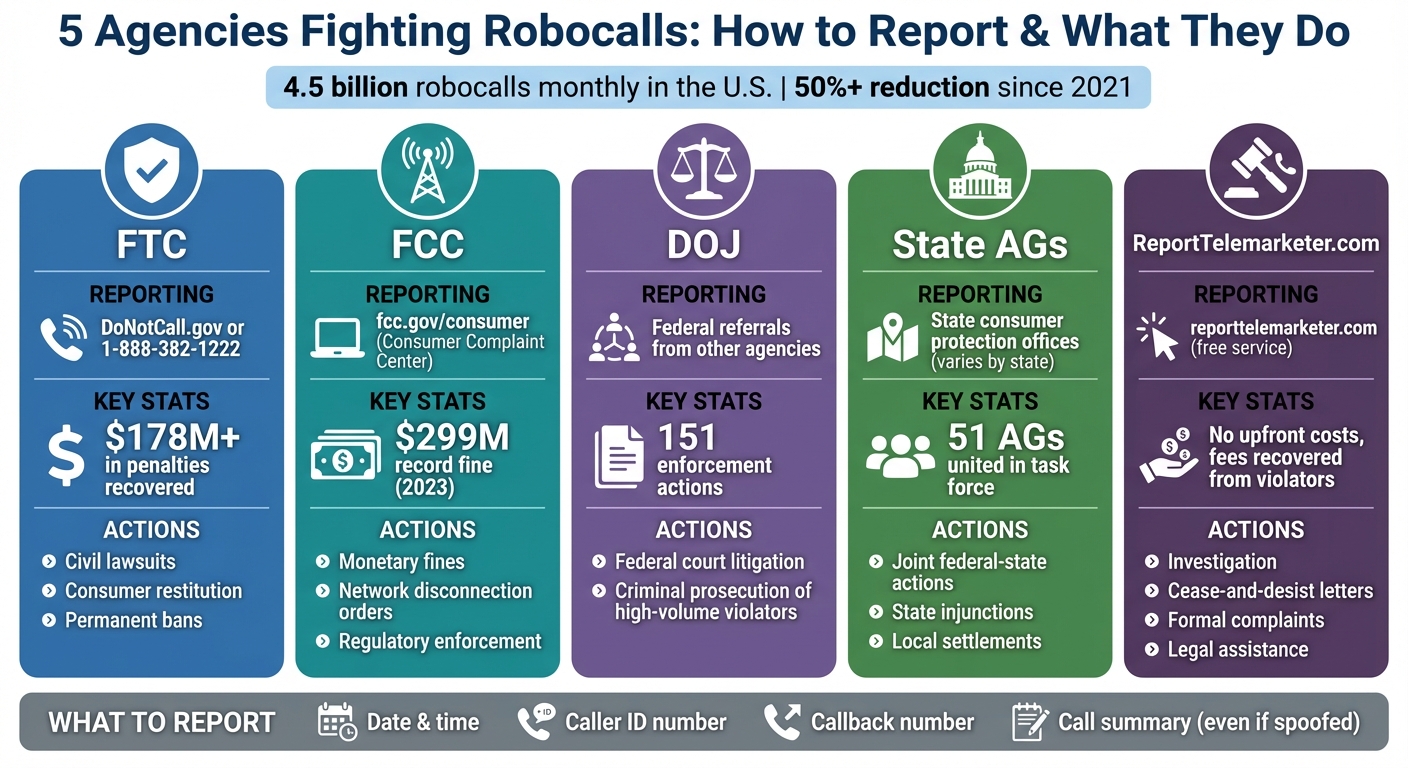
5 Agencies Fighting Robocalls: Reporting Methods and Enforcement Actions
Each agency tackling robocall violations employs distinct methods for reporting and enforcement. Here’s a breakdown of their approaches to help you understand how they handle unwanted calls.
The Federal Trade Commission (FTC) allows consumers to file complaints through DoNotCall.gov or by calling 1-888-382-1222. The FTC has successfully imposed penalties totaling more than $178 million.
The Federal Communications Commission (FCC) focuses on regulatory measures and technical solutions. Complaints can be submitted via the FCC’s Consumer Complaint Center at fcc.gov/consumer. Notably, on March 12, 2026, the FCC Enforcement Bureau disconnected a provider from the U.S. phone network for violating robocall regulations. The FCC’s actions include fines and orders to cut off non-compliant providers.
The Department of Justice (DOJ) handles litigation in federal courts, typically following referrals from other agencies. These cases are often listed as "U.S. v. [Company]" in court records.
State Attorneys General operate through state-specific consumer protection offices and frequently collaborate with federal agencies on joint enforcement efforts.
ReportTelemarketer.com provides free legal assistance for reporting unwanted telemarketing calls and texts. The platform investigates complaints and takes action by sending cease-and-desist letters or filing formal complaints, all without charging upfront fees.
Here’s a quick comparison to guide you through the reporting options:
| Agency | Reporting Methods | Contact Information | Enforcement Actions |
|---|---|---|---|
| Federal Trade Commission (FTC) | Online form or phone registration | DoNotCall.gov; 1-888-382-1222 | Civil lawsuits, penalties (over $178 million recovered), consumer restitution, permanent bans |
| Federal Communications Commission (FCC) | Online Consumer Complaint Center | fcc.gov/consumer | Monetary fines, network disconnection orders, regulatory enforcement |
| Department of Justice (DOJ) | Federal referral from other agencies | justice.gov | Federal court litigation, criminal prosecution of high-volume violators |
| State Attorneys General | State consumer protection offices | Varies by state | Joint federal-state actions, state-level injunctions, local settlements |
| ReportTelemarketer.com | Online reporting platform | https://reporttelemarketer.com | Investigation, cease-and-desist letters, formal complaints, legal assistance at no upfront cost |
Conclusion
Tackling illegal robocalls requires a united effort across various government levels. Agencies like the FTC, FCC, DOJ, and State Attorneys General, along with platforms such as ReportTelemarketer.com, each focus on dismantling specific parts of the robocall network. For example, initiatives like Operation Stop Scam Calls brought together over 100 federal and state law enforcement partners to address the issue from all angles – targeting telemarketers, lead generators collecting consumer data, and VoIP providers enabling these calls.
"Our secret weapon is consumers – whom we urge to continue reporting illicit robocallers, so we can sever these unwanted illegal robocallers’ connection once and for all."
- Dave Yost, Ohio Attorney General
Consumer reports play a crucial role in this fight. Every complaint submitted to DoNotCall.gov, the FCC Consumer Complaint Center, or ReportTelemarketer.com helps agencies track illegal call patterns, trace spoofed numbers, and build cases against offenders. These efforts have already led to significant refunds for victims of scams. Since 2021, combined enforcement actions and consumer vigilance have contributed to a decline in reported telemarketing violations.
When reporting a violation, include key details like the number called, the displayed caller ID, any callback information, and the date and time of the call. Even spoofed numbers can provide clues for agencies to track down the real source and take action.
FAQs
Which agency should I report a robocall to first?
You should report robocalls to the Federal Trade Commission (FTC) first. The FTC is responsible for enforcing the Do Not Call Registry and actively pursues legal action against those who violate it. They are a crucial resource for handling robocall complaints and helping to shield consumers from these intrusive calls.
What details should I collect to report a robocall effectively?
To report a robocall properly, you’ll need to collect some essential information that can assist authorities in investigating. Make sure to note:
- The caller’s phone number, including the area code.
- The exact date and time the call came through.
- The type of call or message content, whether it was a recorded message or a live person.
- Details about the caller’s identity or claims, such as the name they used or the company they claimed to represent.
Having these details ready strengthens your report and helps in the fight against illegal robocalls.
Can I still report robocalls if my number isn’t on the Do Not Call list?
Yes, you can report robocalls even if your number isn’t registered on the Do Not Call list. By reporting these calls to agencies like the FTC, you contribute to efforts aimed at reducing illegal robocalls and holding the offenders responsible. Filing complaints plays a key role in the fight against robocall violations.

