
If you’re tired of illegal telemarketing calls, here’s what you need to know: There are several agencies where you can report violations, each handling specific types of complaints. The FTC, FCC, State Attorney General Offices, CFPB, BBB, and ReportTelemarketer.com all play distinct roles in combating unwanted calls.
Key Highlights:
- FTC: Focuses on scams, fraud, and violations of the National Do Not Call Registry.
- FCC: Addresses technical violations like robocalls, caller ID spoofing, and robotexts.
- State Attorney General Offices: Handle state-specific violations and offer mediation.
- CFPB: Specializes in financial-related telemarketing issues.
- BBB: Mediates disputes with businesses and tracks scams.
- ReportTelemarketer.com: Offers direct legal action against violators at no cost.
Each agency has its own reporting methods and enforcement actions, so understanding where to file your complaint ensures the best results. Below, we’ll break down what each agency handles, how to report violations, and what outcomes you can expect.
1. ReportTelemarketer.com
Types of Telemarketing Violations Handled
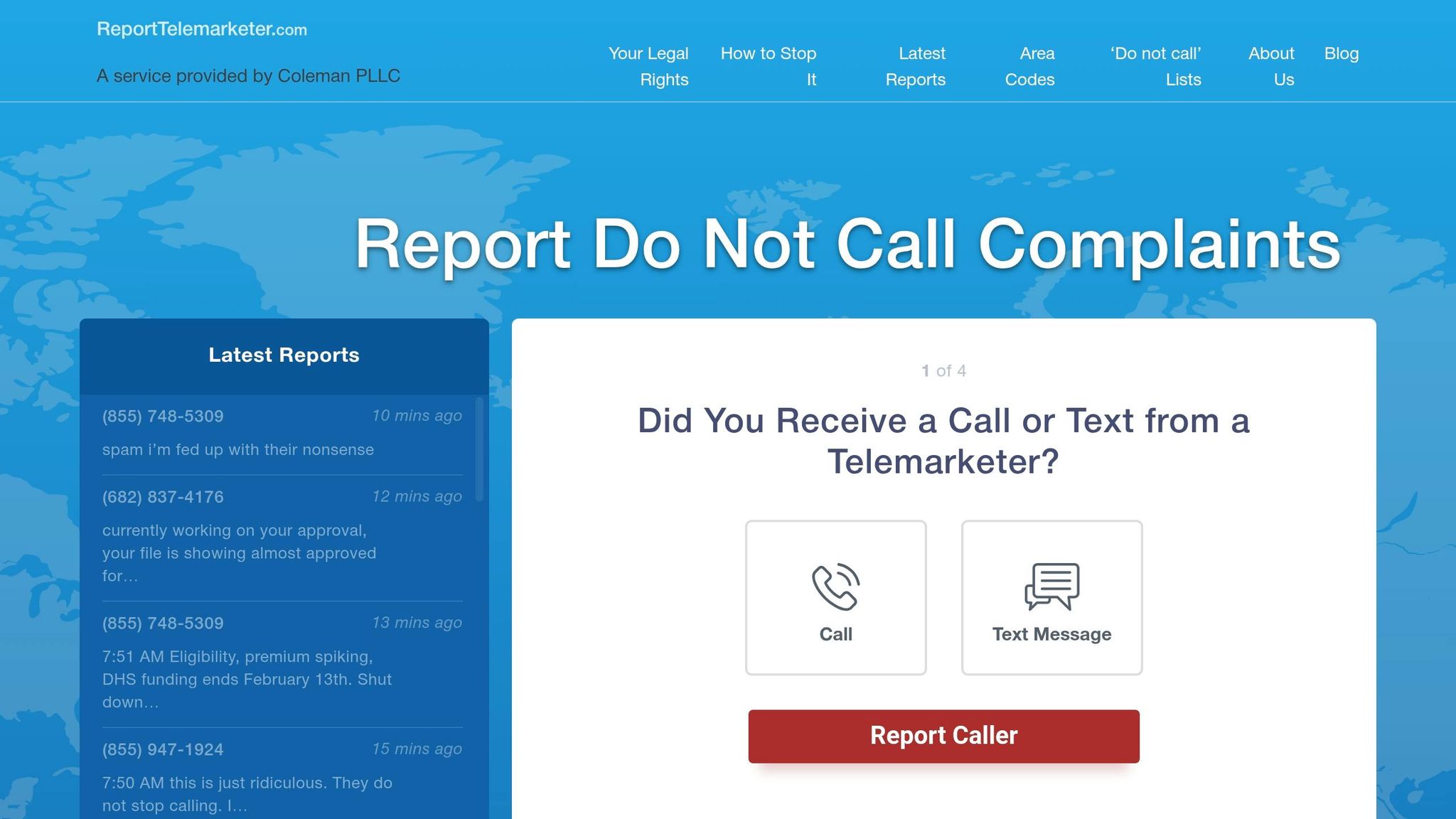
ReportTelemarketer.com focuses on tackling violations under the Telephone Consumer Protection Act (TCPA). This includes everything from unauthorized use of autodialers to unsolicited robocalls. The platform also enforces compliance with the Do Not Call Registry and addresses fraudulent practices like caller ID spoofing aimed at deceiving consumers. By pinpointing these violations, the platform ensures a clear path for consumers to take action.
Reporting Process and Ease of Filing Complaints
Filing a complaint is simple with ReportTelemarketer.com’s user-friendly online system. Consumers can report unwanted calls or texts quickly, and once submitted, the platform investigates using advanced tools to uncover violations of consumer protection laws. Best of all, the service is completely free – users don’t pay anything out of pocket. Attorney fees, when necessary, are recovered directly from the telemarketers. This hassle-free process makes it easy for individuals to seek justice.
Enforcement Actions and Outcomes
After completing an investigation, the platform takes action by sending cease and desist letters or filing formal complaints against violators. Led by founder Stefan Coleman, the legal team brings years of experience in telemarketing cases to halt illegal activities and help consumers recover money. Unlike federal agencies that often use complaints to guide policy, ReportTelemarketer.com focuses on resolving individual cases and taking direct action against offenders.
sbb-itb-a8d93e1
2. Federal Trade Commission (FTC)
Jurisdictional Focus
The Federal Trade Commission (FTC), based in Washington, D.C., operates eight regional offices across the United States: Atlanta, Chicago, Cleveland, Dallas, Los Angeles, New York, San Francisco, and Seattle. Through its Consumer Sentinel Network, the FTC collaborates with more than 2,000 civil and criminal law enforcement agencies, sharing consumer reports to tackle fraud and other violations effectively.
Types of Telemarketing Violations Handled
The FTC enforces over 70 federal laws, with a particular focus on violations of the National Do Not Call Registry, which included more than 258 million registered numbers as of January 2026. The agency also targets illegal robocalls made without consent, scams involving government impersonation, and fraudulent schemes such as fake loan offers and gift card scams. Additionally, the FTC enforces the Telemarketing Sales Rule (TSR), which outlines the standards telemarketers must follow.
Reporting Process and Ease of Filing Complaints
The FTC has made filing complaints straightforward. For violations of the Do Not Call Registry, visit donotcall.gov. For scams, head to ReportFraud.ftc.gov, and for identity theft, use IdentityTheft.gov. You can also call their helpline at 1-877-FTC-HELP (382-4357).
"They handled my fraud report quickly and clearly. The process was smooth and stress-free." – Sarah Mitchell, a small business owner
Even if no financial loss occurs, the FTC encourages individuals to report incidents. These reports help uncover larger patterns of misconduct and enable the FTC to act decisively. By simplifying the reporting process, the agency empowers consumers to contribute to broader enforcement efforts.
Enforcement Actions and Outcomes
Consumer reports play a critical role in the FTC’s investigations and enforcement actions. These efforts can lead to civil penalties, permanent bans from telemarketing, and refunds for consumers. For instance:
- September 2025: Citizens Disability, LLC faced a $1 million fine for millions of illegal telemarketing calls that misrepresented Social Security Disability Insurance services.
- January 2024: EduTrek, LLC was ordered to pay $28.7 million in penalties and was permanently barred after making millions of calls to numbers on the Do Not Call Registry.
- February 2025: The FTC issued $2.6 million in refunds to small businesses deceived by false claims about fees and cost savings from First American Payment Systems.
Between 2021 and late 2024, unwanted telemarketing calls dropped by over 50%, highlighting the impact of the FTC’s enforcement efforts. These actions demonstrate the agency’s commitment to protecting consumers and holding violators accountable.
3. Federal Communications Commission (FCC)
Jurisdictional Focus
While the FTC concentrates on consumer fraud and managing the Do Not Call Registry, the FCC oversees the technical side of telecommunications. Operating as a federal agency with authority across the U.S., the FCC enforces laws like the Telephone Consumer Protection Act (TCPA) and the Truth in Caller ID Act (TICIDA). These regulations aim to address telemarketing violations and apply to all phone carriers and service providers nationwide.
Types of Telemarketing Violations Handled
The FCC works to prevent unwanted communications, with a particular focus on robocalls, including those using AI-generated voices. Without prior written consent, such calls are illegal. The agency also investigates caller ID spoofing, where false information is used to deceive or harm recipients. Other areas under its purview include robotexts (commercial texts sent via autodialers), junk faxes, and calls made outside the legally permitted hours (before 8 a.m. or after 9 p.m.).
Reporting Process and Ease of Filing Complaints
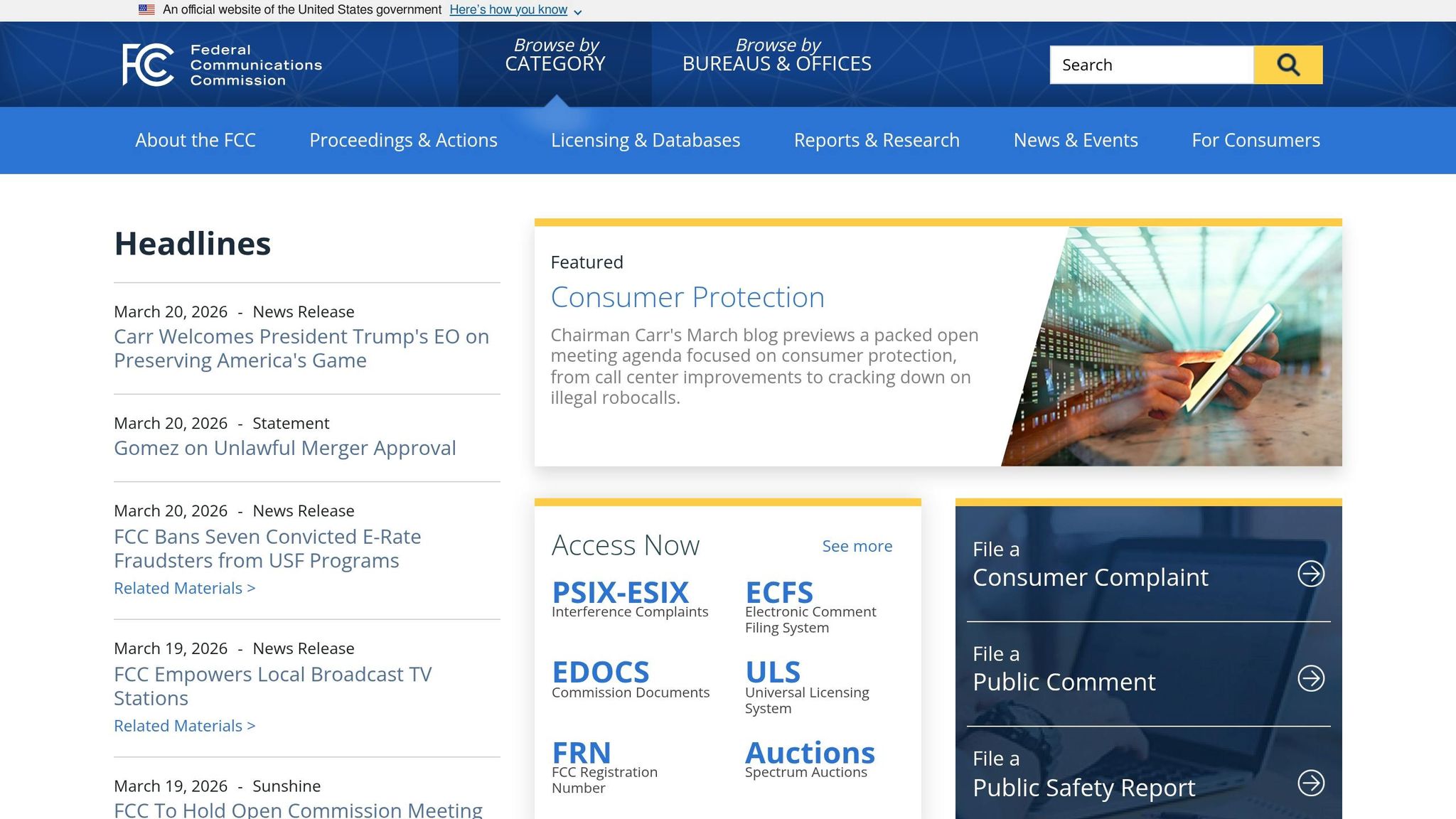
To report and stop unwanted calls or texts, consumers can visit consumercomplaints.fcc.gov and select the "unwanted calls/texts" option. Providing details like the calling number, displayed caller ID, date and time (including time zone), and whether the call was received on a landline or mobile device can strengthen a complaint. Additionally, spam texts can be forwarded to 7726 (SPAM) to notify mobile carriers. While the FCC doesn’t resolve individual complaints, it uses the collected data to identify patterns and build enforcement cases. This approach helps the FCC take targeted action against illegal activities.
"The Enforcement Bureau relies on information and complaints from consumers to help us identify illegal robocall and robotext campaigns that bombard Americans with unwanted messages every year." – Federal Communications Commission
Enforcement Actions and Outcomes
The FCC has levied penalties amounting to hundreds of millions of dollars against illegal robocallers. For instance, in March 2021, it issued its largest-ever fine of $225,000,000 to John C. Spiller, Jakob A. Mears, and their associated entities for making nearly 1 billion spoofed health insurance robocalls. In May 2018, Adrian Abramovich and Marketing Strategy Leaders were fined $120,000,000 for placing 96 million spoofed robocalls promoting vacation packages over a three-month period. More recently, in July 2022, the FCC issued a Notice of Apparent Liability for $116,156,250 to Thomas Dorsher and his companies for millions of illegal robocalls targeting toll-free numbers. The FCC can also require voice service providers to block non-compliant traffic, further curbing illegal activities.
4. State Attorney General Offices
Jurisdictional Focus
State Attorney General offices play a critical role in tackling telemarketing fraud at the state level. While federal agencies address nationwide violations, state AGs focus on enforcing laws tailored to their specific regions, like the Arizona Consumer Fraud Act or Texas’s do-not-call regulations. They also collaborate with the National Do Not Call Registry to monitor call patterns and take action against violators. Some states even maintain their own "No Call" lists to provide additional protection for residents.
Types of Telemarketing Violations Handled
State AG offices address a variety of violations that may not always fall under federal jurisdiction. This includes calls to state-specific do-not-call lists, robocalls made without prior written consent, and spoofing tactics. They also investigate misleading practices such as high-pressure sales pitches or fake "limited-time" offers. Telemarketers are required to disclose their identity and provide contact details within the first 60 seconds of a call, and state AGs ensure compliance with these rules. In states like Arizona, they also enforce consumer rights like the three-day cancellation period for telemarketing purchases and oversee sales by unregistered telemarketers.
Reporting Process and Ease of Filing Complaints
State AGs make it easy for consumers to report telemarketing violations. Complaints can typically be filed online, via hotlines, or through mail. To simplify the process, the National Association of Attorneys General offers a directory with links to each state’s complaint system. When filing, consumers should include details like the call’s date, time, caller ID, company name, and a brief description of the incident. Many states, such as Massachusetts, also provide multilingual resources to make the process more accessible.
Enforcement Actions and Outcomes
Using call data, State AGs identify illegal telemarketing operations and impose penalties for violations. For example, in Massachusetts, consumers can file private lawsuits to claim damages of up to $5,000 if they receive more than one unsolicited call from the same entity within a year. State AGs can also assist in canceling contracts with unregistered telemarketers or those that fail to provide required cancellation disclosures. Additionally, legitimate telemarketers must remove a number from their call lists within 31 days of its addition to the National Do Not Call Registry.
5. Consumer Financial Protection Bureau (CFPB)
Jurisdictional Focus
The CFPB is responsible for overseeing and enforcing federal regulations specifically related to consumer financial products. While the FTC and FCC handle broader telemarketing and robocall violations, the CFPB focuses on financial-related telemarketing, such as issues involving debt collection, mortgages, student loans, and credit cards. If a complaint falls outside its financial scope – like problems with phone, internet, or cable services or other annoying phone calls – the CFPB will forward it to the relevant federal or state agency and notify you. This targeted focus allows the CFPB to address financial telemarketing abuses more effectively.
Types of Telemarketing Violations Handled
Within its specialized scope, the CFPB tackles violations such as deceptive telemarketing practices and misleading offers related to financial products. Unlike the FCC, which oversees call technologies like robocalls and spoofing, or the FTC, which manages the National Do Not Call Registry, the CFPB hones in on financial fraud and abuse in telemarketing.
Reporting Process and Ease of Filing Complaints
Filing a complaint with the CFPB is straightforward. You can do it online in about 7–10 minutes or by phone in over 180 languages, which takes around 25–30 minutes. To streamline the process, gather relevant documents like account statements and communication logs beforehand – you can upload up to 50 pages of supporting materials. Once submitted, the CFPB forwards the complaint to the company, requiring a response within 15 days.
"Each week we send more than 100,000 complaints about financial products and services to companies for response." – Consumer Financial Protection Bureau
Enforcement Actions and Outcomes
The CFPB’s focused approach addresses gaps left by agencies that deal with broader telemarketing issues. While most cases are resolved quickly, more complex ones may take up to 60 days for a final response. The bureau also collaborates with federal and state agencies by sharing complaint data to support enforcement and market oversight. Additionally, it publishes anonymized complaint data in its public Consumer Complaint Database, which helps identify broader market trends. Complaint records are retained for 25 years, ensuring long-term accountability and transparency.
6. Better Business Bureau (BBB)
Jurisdictional Focus
While federal and state agencies enforce telemarketing laws, the Better Business Bureau (BBB) offers a different path for resolving disputes. The BBB operates as a private, nonprofit organization with a network of local and national offices across the U.S. and Canada. It serves as a neutral mediator, helping resolve conflicts between consumers and businesses, unlike federal agencies like the FTC or FCC.
Types of Telemarketing Violations Handled
The BBB addresses a variety of telemarketing-related complaints. These include scams like sweepstakes fraud, advance fee schemes, and work-from-home scams. It also handles "slamming", which is when a service provider is switched without consent. Other common issues include deceptive advertising – where businesses misrepresent their products or services – and aggressive sales tactics aimed at vulnerable groups, such as older adults. Additionally, the BBB deals with identity theft scams, phishing emails, and overpayment fraud.
Reporting Process and Ease of Filing Complaints
Filing a complaint with the BBB is free and must be done within 12 months of the incident. To submit a complaint, consumers need to provide the business’s name and report phone numbers or other contact details. While it’s encouraged to contact the business first, the BBB won’t accept complaints if the issue is already in litigation or if the complaint contains abusive language or threats.
Enforcement Actions and Outcomes
The BBB doesn’t enforce legal penalties but focuses on resolving disputes through customer service-oriented solutions. Typical outcomes include refunds, contract cancellations, or other resolutions agreed upon by both parties. While the BBB can’t arrest or prosecute individuals or impose fines, it does maintain a public profile for businesses. Complaints can impact a business’s BBB rating (graded from A+ to F), which serves as a warning to other consumers. Additionally, the BBB Scam Tracker allows users to report fraudulent telemarketing activities.
Report Unwanted Spam Phone Calls Do Not Call Database Registry
Agency Comparison Table
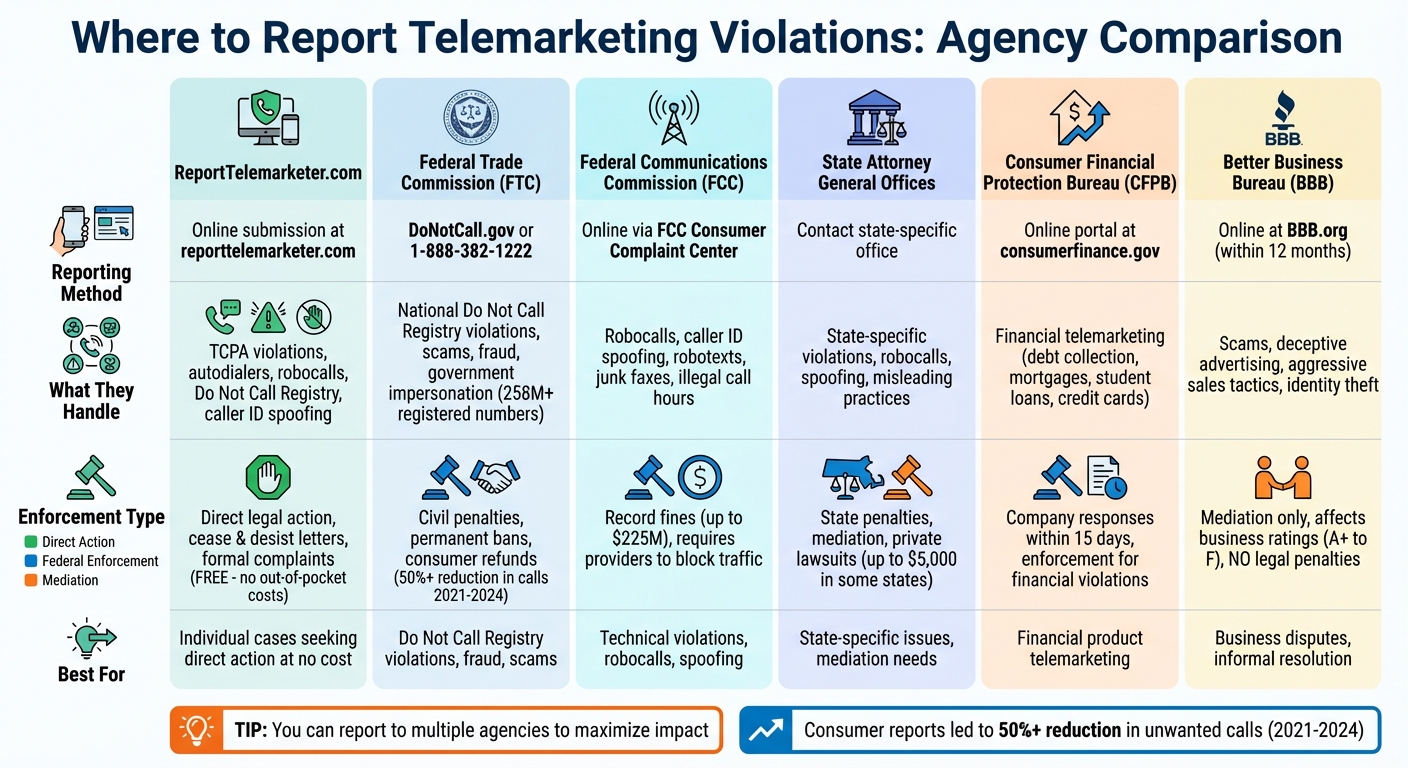
Telemarketing Violation Reporting Agencies Comparison Guide
Understanding the reporting requirements and enforcement methods of various agencies can help you choose the right one for your telemarketing complaints. The table below outlines the differences in reporting methods, required details, enforcement actions, and jurisdiction for six key agencies.
| Agency | Reporting Method | Required Information | Response Time & Enforcement | Jurisdiction |
|---|---|---|---|---|
| ReportTelemarketer.com | Online submission at reporttelemarketer.com | Caller ID, date/time of call, phone number, call details | Direct investigation and action; sends cease and desist letters or files formal complaints on behalf of consumers | Federal consumer protection laws (TCPA, TSR) |
| Federal Trade Commission (FTC) | DoNotCall.gov or 1-888-382-1222 | Phone number that received the call, caller ID number, callback number, date/time | Does not resolve individual cases but uses reports to pursue large-scale violations. The FTC has secured major civil penalties and restitution | National Do Not Call Registry violations and telemarketing fraud |
| Federal Communications Commission (FCC) | Online via FCC Consumer Complaint Center | Number dialed, caller ID name and number, date/time (including time zone), phone type | No individual resolution; data is used for policy-making and enforcement. Record fines have been issued, such as $225,000,000 in March 2021 | TCPA and Truth in Caller ID Act violations |
| State Attorney General Offices | Contact your state-specific office | Details of scam or fraudulent calls, including Do Not Call violations (after the 31‑day grace period) | Often provides direct mediation and individual dispute resolution; enforcement varies by state | State consumer protection laws |
| Consumer Financial Protection Bureau (CFPB) | Online complaint portal at consumerfinance.gov | Financial product or service details, company name, date/time of contact | Forwards complaints to companies for responses and monitors trends for enforcement | Telemarketing issues related to financial products and services |
| Better Business Bureau (BBB) | Online at BBB.org (complaints must be filed within 12 months) | Business name and contact details, incident description | No legal enforcement; focuses on mediation and dispute resolution, which may affect business ratings | Private mediation; no legal jurisdiction |
ReportTelemarketer.com stands out for its direct investigation and legal action on behalf of consumers, including handling legal processes at no cost (recovering attorney fees from violators when possible). Meanwhile, state attorney general offices often offer mediation services that federal agencies do not.
This comparison underscores each agency’s strengths, helping you decide the best course of action for your complaint.
Conclusion
If you’ve experienced telemarketing violations, report them to the agency that best matches your complaint. The FCC addresses technical issues like caller ID spoofing and illegal robocalls, while the FTC focuses on scams, fraud, and violations of the Do Not Call Registry. Additionally, your State Attorney General’s Office can provide localized enforcement and may even offer direct mediation.
Your complaints are a vital part of enforcement efforts. As the FCC explains:
"By filing a consumer complaint and telling your story, you contribute to federal enforcement and consumer protection efforts on a national scale and help us identify trends and track the issues that matter most".
Between 2021 and late 2024, consumer complaints helped cut unwanted telemarketing calls by over 50% thanks to ongoing enforcement efforts.
For those seeking direct legal action, ReportTelemarketer.com investigates violations and files formal complaints at no cost. While federal agencies use complaints to drive large-scale enforcement, this platform focuses on stopping the specific calls affecting you by learning how to block and report spam calls.
Choosing the right reporting channel – or even reporting to multiple agencies – can amplify your impact. Each complaint strengthens the broader fight against illegal telemarketing. Together, these agencies form a powerful network to deter these practices.
Consumer reports have led to enforcement actions worth hundreds of millions of dollars. Every single report contributes to the national effort to reduce illegal telemarketing.
FAQs
Which agency should I report my telemarketing complaint to?
If you’re dealing with unwanted telemarketing calls or texts, you can report them to the Federal Trade Commission (FTC). The FTC works to enforce consumer protection laws and takes action against these nuisances. Similarly, the Federal Communications Commission (FCC) handles complaints about robocalls and spam texts. Both agencies make it easy to file complaints through their online submission forms, ensuring a straightforward process for consumers.
What details should I collect before filing a complaint?
Before you file a telemarketing complaint, make sure you’ve gathered these important details:
- Caller’s phone number: This includes any suspicious or spoofed numbers.
- Date and time: Record exactly when the call or text occurred.
- Description of the call or message: Specify if it involved robocalls, spoofing, or unwanted texts.
- Behavior of the caller: Note if they ignored Do Not Call requests or used deceptive tactics.
- Content of the communication: If possible, jot down what was said or written in the call or message.
Having this information handy will strengthen your complaint and make it easier for authorities to investigate.
Can I report the same call or text to multiple agencies?
Yes, it’s possible to report the same call or text to multiple agencies. In fact, doing so is often encouraged because it boosts the chances of enforcement and ensures appropriate action is taken against violators.

