

If you’ve been bombarded by robocalls or spam texts, the TCPA (Telephone Consumer Protection Act) gives you two main ways to fight back: join a class action lawsuit or file an individual claim. Each option has its own pros and cons, depending on your goals, the number of violations, and how much control you want over the process. Here’s a quick breakdown:
- Class actions: Great for large-scale violations. They pool claims from many people, leading to massive settlements (average $6.6 million). But individual payouts are often small ($50–$500), and you have little say in the case.
- Individual lawsuits: Best for those who want control and higher payouts. Settlements often range from $2,500 to $15,000, and cases resolve faster. However, they require more effort, and finding a lawyer can be tricky since attorney fees aren’t covered.
Key takeaway: If you want a bigger personal payout or faster resolution, go solo. If you want to challenge a company on a larger scale, join a class action. Documenting every call or text is crucial for success in either approach.
Class Action Lawsuits for TCPA Violations
Class action lawsuits allow multiple consumers who have experienced similar illegal calls or texts to combine their claims into one case. Instead of hundreds or thousands of individuals filing separate lawsuits, a lead plaintiff represents everyone impacted by the same telemarketing campaign. This approach has become a popular way to handle TCPA violations.
The numbers tell the story. In the first quarter of 2025, 507 TCPA class actions were filed – an increase of 112% compared to the same period in 2024. By September 2025, the number of filings had nearly doubled the total from 2024, reaching 1,807 cases. This surge reflects a growing awareness among consumers and a strategic shift toward using class actions to address these violations.
How Class Actions Work
Before a class action can move forward, the court must certify the class. Judges evaluate four main criteria:
- Commonality: Did the defendant use the same system or script to contact everyone?
- Typicality: Does the lead plaintiff’s experience reflect what others went through?
- Adequacy: Will the lead plaintiff and their attorney fairly represent the group?
- Predominance: Do shared legal questions outweigh individual concerns?
TCPA cases often meet these conditions because companies typically rely on automated systems to contact large numbers of people in the same way. Once certified, the lead plaintiff represents the entire group, and all members are bound by the case’s outcome unless they opt out.
Benefits of Class Actions
One of the biggest advantages of class actions is the shared cost. Legal fees and other expenses are divided among all plaintiffs, making it affordable to pursue claims that might otherwise be too small to handle individually. Since the TCPA doesn’t provide attorney fees for individual cases, class actions are often the only viable way for lawyers to take on these cases.
Class actions also put significant financial pressure on defendants. Settlements in these cases average around $6.6 million, but some have reached staggering amounts. For example:
- Caribbean Cruise Line: $76 million
- Capital One: $75.5 million
- National Grid: $38.5 million
These large settlements send a clear message to companies about the consequences of violating the TCPA.
"TCPA cases are ten times more likely to be filed as class actions than other forms of consumer protection suits." – Eric J. Troutman, Troutman Amin, LLP
For defendants, the stakes are high. With no cap on total damages, a company responsible for 100,000 illegal calls could face potential exposure of $50 million to $150 million. This creates a strong incentive to settle rather than risk going to trial.
Drawbacks of Class Actions
Despite their benefits, class actions have some downsides. One major drawback is the reduced payout for individual claimants. While the TCPA allows for damages of $500 to $1,500 per violation, class members usually receive much less – often between $50 and $500 after the settlement is divided. For instance, in the Designer Brands (DSW) settlement in June 2025, eligible consumers received about $70 each from a $4.42 million settlement.
Additionally, class members give up control over the case. Decisions about settlement terms, trial strategy, and offers are made by the lead plaintiff and their attorney, leaving individual members without a say in the process.
Class actions also take time – lots of it. Just getting the class certified can take months or even years, and full resolution often spans several years. During this time, updates on the case may be limited. To make matters worse, only 3% to 15% of eligible class members typically submit valid claims for their share of the settlement, meaning many people never see any compensation at all.
sbb-itb-a8d93e1
Individual TCPA Lawsuits
While class actions make up about 80% of all TCPA filings, individual lawsuits offer a different path. Instead of joining a large group, you take control of your own case – deciding everything from settlement terms to whether to go to trial.
The process begins with gathering evidence. Save your call logs (including dates and times), take screenshots of text messages, preserve voicemails, and document when you revoked consent. You have four years from the date of each violation to file a claim. Many cases start with a demand letter, often seeking between $2,500 and $15,000 to settle before going to court. If that fails, you can file in small claims court (often without a lawyer) or in federal court with legal representation.
How Individual Lawsuits Work
Once you’ve collected your evidence, the next step is understanding the legal process. Many TCPA attorneys work on a contingency basis, meaning you don’t pay upfront – they only get paid if you win. This is helpful because the TCPA doesn’t require defendants to cover your attorney fees, even if you prevail. As a result, many lawyers prefer class actions, which often yield larger payouts. However, a strong case with solid evidence can make the contingency model work well for individual claims.
"Small claims court or a similar court would allow the consumer to appear before the court without an attorney."
– Senator Fritz Hollings, Original TCPA Sponsor
If you’ve clearly told a company to stop calling and they continue, those calls may count as "willful" violations. This increases the penalty from the standard $500 per violation to $1,500 each. A simple phrase like "stop calling" or texting "STOP" can turn every subsequent call into a costly mistake for the company.
Benefits of Individual Lawsuits
Individual lawsuits come with several advantages, especially financial ones. Settlements in these cases often range between $2,500 and $15,000, far exceeding the $50 to $500 payouts typically seen in class actions. Some cases have even resulted in massive payouts – like a 2015 case where a New Jersey woman won $229,500 against a cable provider. She had also secured a $571,000 verdict in 2013 against a finance company, though that was later resolved through a confidential settlement.
Another benefit? You’re in charge. You decide whether to accept a settlement, negotiate terms, or proceed to trial. Individual cases also tend to resolve faster than class actions, which can drag on for years. In contrast, individual claims may settle in just a few months.
Drawbacks of Individual Lawsuits
Despite the benefits, individual lawsuits have their challenges. Since the TCPA doesn’t allow for attorney fee shifting, some law firms are less inclined to take these cases. As Eric J. Troutman of Troutman Amin, LLP explains:
"The TCPA does not provide attorneys fees to a successful plaintiff. To be assured of a large recovery, therefore, Plaintiff’s lawyers are much more likely to pursue a class action as opposed to an individual suit."
Another hurdle is identifying the defendant. Telemarketers often use spoofed numbers or operate from overseas, making it tricky to figure out who to sue. Even when the company is identified, they might argue their equipment doesn’t qualify as an autodialer or claim you consented through fine print.
There’s also the issue of repeat filings. Between 31% and 41% of TCPA cases are filed by individuals with prior lawsuits. For instance, Kenneth Johansen, a plaintiff in around 60 TCPA cases, was accused of "deceptively" prolonging calls to increase his damages. Filing multiple claims can lead to more aggressive defenses from companies.
Lastly, individual lawsuits demand a significant time investment. Unlike class actions, where you simply wait for updates, individual cases require active involvement. You may need to participate in discovery, depositions, and possibly testify in court.
If you’re considering an individual lawsuit, platforms like ReportTelemarketer.com can help. They assist with documenting violations and connecting you to contingency-based attorneys, so you don’t have to navigate the process alone. The service also investigates reported telemarketers, helping you build a stronger case.
These factors highlight how individual lawsuits differ from class actions, both financially and procedurally, offering a unique path for those willing to invest the time and effort.
Class Actions vs. Individual Lawsuits: Direct Comparison
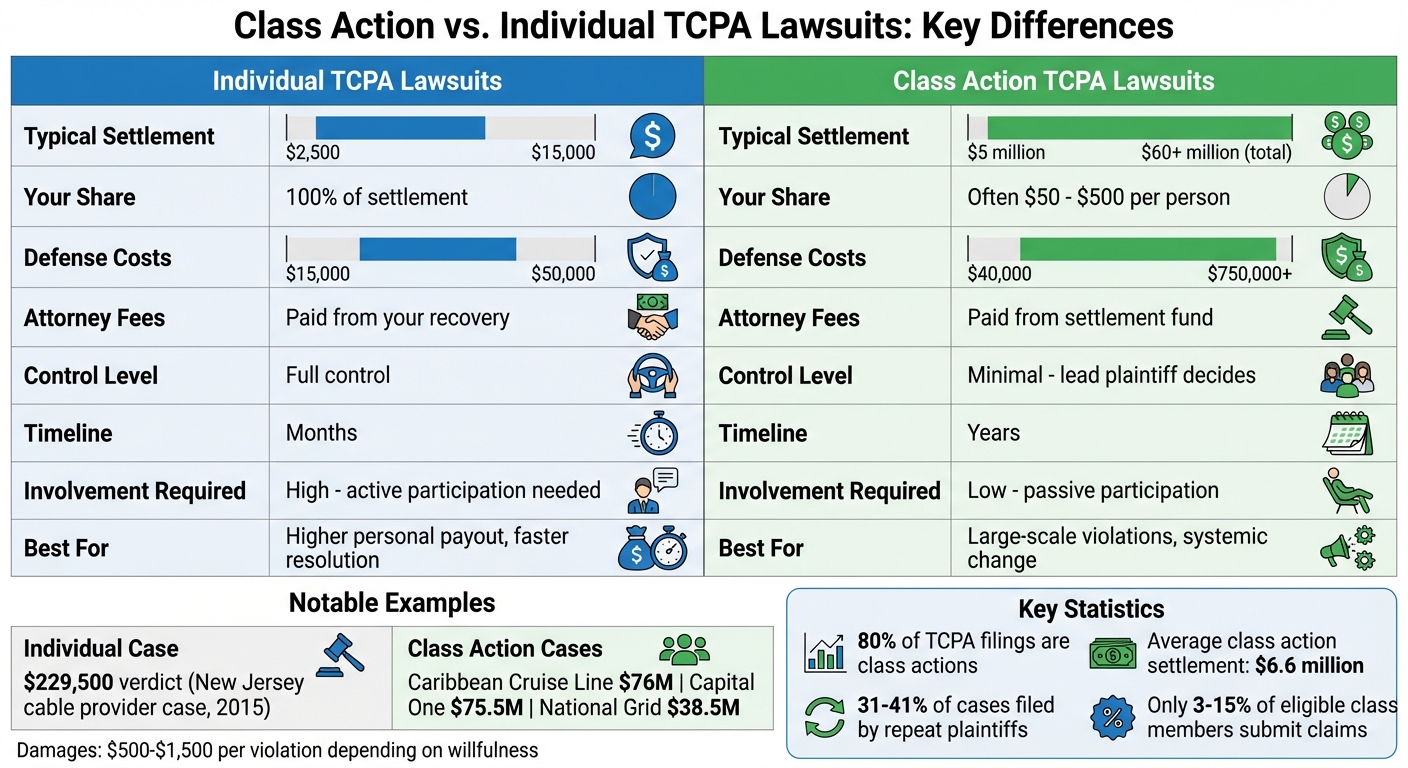
Class Action vs Individual TCPA Lawsuits Comparison Chart
Let’s break down how class actions and individual lawsuits differ when it comes to financial recovery, control, and resolution speed.
Financial Outcomes Compared
When it comes to money, the differences are striking. The average settlement for a TCPA class action is around $6.6 million. However, that large sum is split among numerous class members. On the other hand, individual plaintiffs typically see settlements between $2,500 and $15,000.
Take the Sheean v. Convergent Outsourcing, Inc. case as an example. The court approved a $3,710,000 settlement fund for the class, but the named plaintiff only received $4,450, while attorneys pocketed $1,250,000 in fees. Contrast that with a New Jersey plaintiff who scored a $229,500 verdict in an individual lawsuit. Clearly, individual cases can yield much higher payouts for a single person.
Here’s a quick comparison:
| Factor | Individual TCPA Claims | Class Action TCPA Lawsuits |
|---|---|---|
| Typical Settlement | $2,500 – $15,000 | $5 million – $60+ million |
| Your Share | 100% of settlement | Often $50 – $500 per person |
| Defense Costs | $15,000 – $50,000 | $40,000 – $750,000+ |
| Attorney Fees | Paid from your recovery | Paid from settlement fund |
For companies, the stakes are much higher in class actions. Recent examples include Keller Williams Realty paying $40 million, National Grid settling for $38.5 million, and Citibank paying $29.5 million.
Control and Involvement Compared
If you value control, an individual lawsuit might be the better choice. You’re in charge of every decision – whether it’s accepting a settlement, negotiating terms, or taking the case to trial. You can even represent yourself in small claims court, which aligns with the TCPA’s original intent.
Class actions, however, operate differently. The lead plaintiff and class counsel make the decisions, leaving most class members with little to no say in the process. Interestingly, data shows that 31% to 41% of TCPA cases are filed by repeat plaintiffs, suggesting some prefer the autonomy of individual litigation.
As Eric J. Troutman from Troutman Amin, LLP puts it:
"The TCPA does not provide attorneys fees to a successful plaintiff. To be assured of a large recovery, therefore, Plaintiff’s lawyers are much more likely to pursue a class action."
So, while individual plaintiffs are hands-on, class members typically play a passive role.
Timeline and Resolution Speed Compared
Time is another key factor to consider. Individual lawsuits usually wrap up in a matter of months, while class actions can drag on for years. The reason? Complexity. Individual cases focus on a single person’s call records and evidence, while class actions require gathering data on thousands – or even millions – of calls. Plus, the class certification process adds another layer of time and effort.
For example, even an early resolution in a class action can cost defendants $40,000 to $50,000 within six months. If the case goes to trial, those costs can skyrocket to $300,000 to $750,000 or more. Individual cases, on the other hand, often settle quickly through small claims or expedited federal processes.
The 2017 Dish Network verdict highlights the lengthy nature of class actions. That case involved over 50,000 calls to 18,000 consumers and ended with a $61 million verdict. Meanwhile, individual cases, if supported by strong evidence, can often be resolved in just a few months.
Whether you choose to pursue an individual lawsuit or join a class action, having well-documented evidence is critical. Tools like ReportTelemarketer.com can help you record violations and find attorneys who work on contingency. The right preparation can make all the difference in your case.
How to Choose Between Class Actions and Individual Lawsuits
When deciding between a class action lawsuit and an individual claim, the right choice often depends on your unique circumstances, resources, and objectives. Let’s break it down further.
Violation Severity and Number of Affected People
The severity of the violation and the number of people impacted play a big role in this decision. If you’ve received just one or two unwanted calls, joining a class action might be your best bet. However, if you’ve logged 10 or more calls from the same company, an individual lawsuit could result in a higher payout.
Here’s how the law works: under Section 227(c), a Do-Not-Call violation requires more than one call within a 12-month period. On the other hand, Section 227(b), which covers robocalls to cell phones, allows you to file a claim after just one call.
The scale of the issue matters too. For example, if a company made 100,000 illegal calls, each carrying a $500 penalty, the total liability could reach $50 million. Large-scale violations like this are often better suited for class actions. On the flip side, smaller, targeted issues – like a debt collector repeatedly calling the wrong number – might be better handled as individual cases.
If the violations were intentional, damages can triple from $500 to $1,500 per call. Cases involving deliberate misconduct often favor class actions due to the overall financial exposure. However, if you’ve been bombarded with calls, an individual lawsuit might result in a settlement far greater than the average payout for class members.
Legal Representation and Available Resources
The type of legal help you can access is another key factor. Unlike some consumer protection laws, the TCPA doesn’t offer attorney fees to successful plaintiffs, which has led to an increase in class actions. If you’re pursuing an individual case, you’ll need an attorney willing to work on a contingency basis or one you can afford to pay hourly. Keep in mind that defending an individual federal lawsuit can cost anywhere from $15,000 to $40,000, so your case needs to promise enough compensation to attract legal support.
Class actions, on the other hand, are typically initiated by attorneys who stand to earn a percentage of a large settlement fund. Joining a class action is usually as simple as filling out a claim form.
For smaller, straightforward cases, small claims court could be an option. According to Senator Fritz Hollings, who originally sponsored the TCPA, small claims court was designed to allow consumers to represent themselves without needing a lawyer. This route works well when you have clear evidence and want to keep costs low.
Don’t forget to check for arbitration clauses in your agreements. If you’ve signed a contract with a class action waiver, you may be required to pursue individual arbitration instead. In response, some law firms have developed “mass arbitration” strategies, filing hundreds or thousands of individual claims to pressure companies through filing fees.
Personal Goals and Risk Tolerance
Beyond the financials, your personal goals and comfort with legal involvement are crucial considerations. If you’re aiming for maximum personal compensation, an individual lawsuit might be the way to go. For example, in 2015, one plaintiff won a $229,500 verdict against a cable provider.
However, pursuing an individual case often requires more effort. You may need to participate in discovery, give depositions, or even testify in court. By contrast, class actions demand much less from participants – usually just the submission of a claim form once a settlement is reached.
If your goal is to stop a company’s large-scale telemarketing practices or push for systemic changes, a class action may have a stronger impact. Class actions can pose a major financial threat to companies, sometimes exceeding their total value. Recent settlements include National Grid’s $38.5 million payout and Citibank’s $29.5 million settlement in 2024.
Timing is another factor. Individual lawsuits can often settle quickly, sometimes within months using demand letters. Class actions, however, can drag on for years. While individual cases may offer higher payouts and quicker resolutions, they require more personal involvement and carry greater risks. Class actions, on the other hand, spread the risk across a group of plaintiffs. Interestingly, between 31% and 41% of TCPA cases are filed by “serial litigators” who are comfortable with the risks of pursuing individual claims.
Tools like ReportTelemarketer.com can help you document violations and connect with attorneys who work on a contingency basis. Keeping detailed records – like call logs, recordings, and dates – will strengthen your case no matter which route you choose.
Conclusion
This article broke down the key differences between class actions and individual lawsuits to help you decide on the best strategy for tackling TCPA violations. The right choice depends entirely on your situation. If you’re seeking a quicker resolution and a potentially larger personal payout, individual lawsuits might be the way to go. On the other hand, class actions are better suited for addressing widespread violations, leveraging the collective power of claimants to push for substantial settlements.
Your choice should reflect both the extent of the violations you’ve faced and your personal goals. Individual lawsuits often give you more control and resolve faster, while class actions can force companies to confront systemic issues, sometimes resulting in settlements that reach tens of millions of dollars. Both approaches have their strengths, and the decision ultimately comes down to what matters most to you.
One thing remains constant: meticulous documentation is key. Take action against those annoying robocalls and spam texts. With statutory damages applying to each violation, you hold significant legal power. Whether you decide to go it alone, join a class action, or even take the small claims court route, acting sends a strong message that telemarketing abuse won’t be ignored.
Keep detailed records – save call logs, screenshot spam texts, and document dates and times. If you’re unsure which path to take, resources like ReportTelemarketer.com can guide you. They connect you with attorneys who work on contingency, making it easier to enforce your rights. The TCPA is there to protect your privacy. Don’t hesitate to use it.
FAQs
How many robocalls or spam texts do I need to sue under the TCPA?
Under the TCPA, there’s no set minimum for how many robocalls or spam texts you need to receive before taking legal action. Any unsolicited automated call or text sent without proper consent could violate the law. For each violation, you could be entitled to $500 in damages – or up to $1,500 if the violation is found to be intentional. Even one unwanted call or text that breaks TCPA rules can be enough to file a lawsuit.
Should I opt out of a TCPA class action and file my own case?
Deciding whether to participate in or opt out of a TCPA class action lawsuit comes down to what matters most to you. Class actions allow a group to join forces, making the process simpler and less demanding for individuals. However, payouts are typically smaller per person, and you’ll have little say in how the case is handled.
On the other hand, pursuing an individual case gives you full control over decisions and the possibility of a larger settlement. That said, it often means investing more time, effort, and money into legal proceedings. Speaking with an attorney can help you weigh these options and choose what works best for your circumstances.
What evidence should I save to prove TCPA violations?
To establish TCPA violations, it’s crucial to gather evidence showing that automated calls or texts were sent without your consent. Keep detailed records like call logs, recordings, and documentation noting the date, time, and frequency of these communications. If the calls were made to a number listed on the National Do-Not-Call Registry, this information can be especially helpful. Additionally, save any correspondence where you requested the calls to stop – this can further support your case.

