
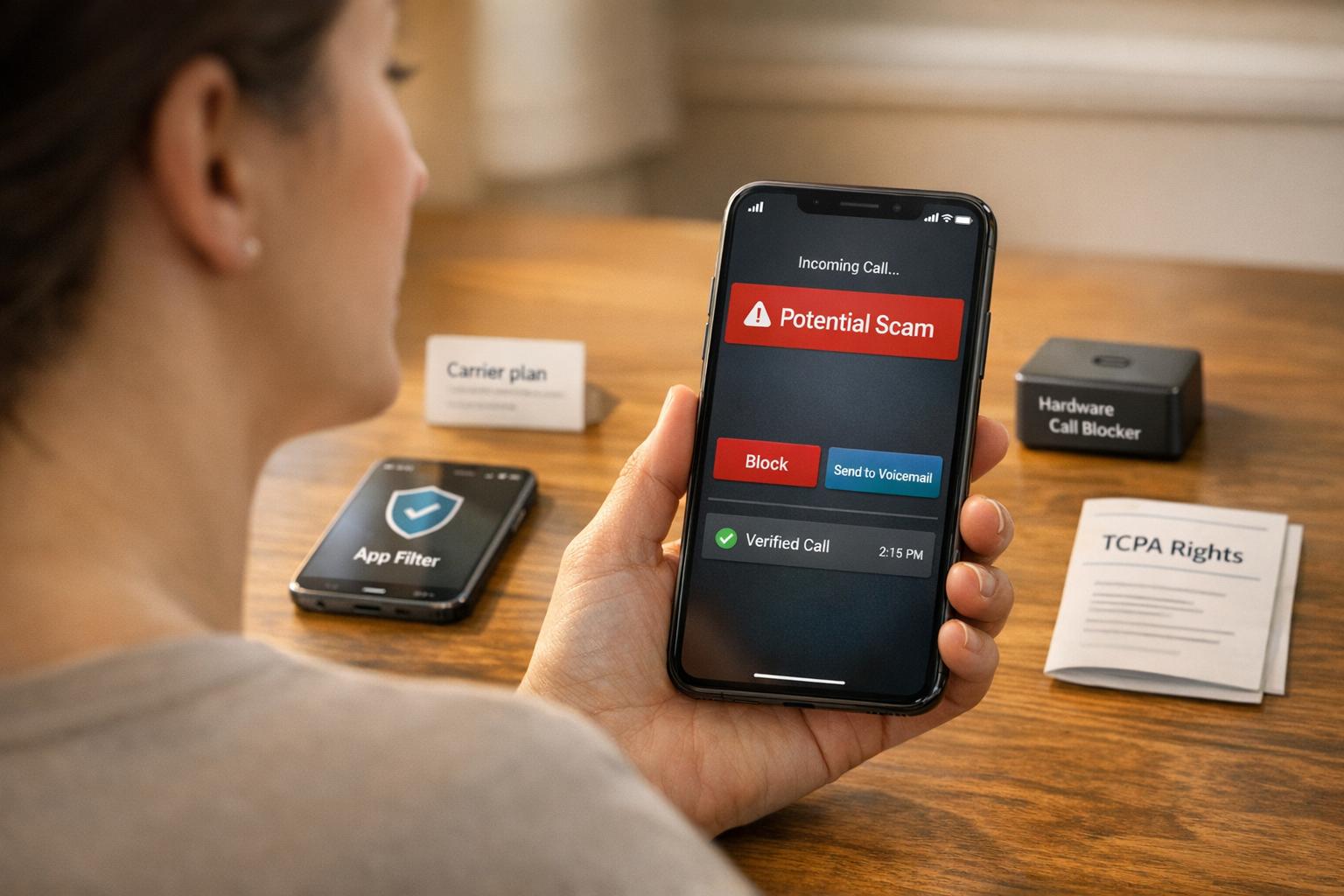
Unwanted calls remain a major issue in the U.S., despite advancements in blocking tools. In 2025, robocalls surged by 15.6%, reaching 29.6 billion, and the FTC received 2.6 million complaints. Scammers are exploiting AI and spoofing techniques, causing average losses of $3,690 per victim. While 68% of people avoid answering unknown calls, fewer than half of phone companies have fully implemented anti-robocall software.
Key Findings:
- STIR/SHAKEN Limitations: Only 44.9% of calls retain authentication data, and even verified calls can be spam.
- Consumer Complaints: False positives block essential calls, while scammers bypass tools using "neighbor spoofing."
- Best Tools: AT&T ActiveArmor leads among carriers, while YouMail tops third-party apps. Hardware blockers reduce scams by up to 95%.
- Challenges: Legal robocalls, number rotation, and caller ID spoofing hinder effectiveness.
For robust protection, combine carrier services, apps, and hardware devices. Platforms like ReportTelemarketer.com allow consumers to seek damages under the TCPA, offering a legal recourse against violators.
Recent Consumer Survey Results on Call-Blocking
National Satisfaction Rates with Call-Blocking Tools
Major voice service providers like Verizon, T-Mobile, and AT&T now offer call-blocking and filtering tools, but the results reveal mixed success. For instance, 85% of traffic between Tier-1 carriers was signed in 2025, with 93% achieving the top "A-level" attestation. In contrast, smaller carriers only managed 17.5% signed traffic.
This disparity creates vulnerabilities in smaller networks, allowing scammers to exploit outdated systems. Techniques like "SIM boxing" enable bad actors to originate fraudulent calls within trusted networks, even earning "A-level" attestation for illegal activity.
"Successful STIR/SHAKEN implementations and proactive investments in network modernization have propelled Tier-1 carriers to a strong position in the battle against unwanted robocalls." – Seth Walton, General Manager, TNS Communications Market
Despite advancements, the incomplete rollout of these technologies leaves gaps that scammers exploit. This disconnect between technological promises and actual performance explains why unwanted calls remain a persistent issue, frustrating consumers who often need to report unwanted phone calls when these tools fail.
Common Benefits and Problems Reported by Users
Consumer feedback highlights both the strengths and shortcomings of call-blocking tools. Features like whitelisting (restricting calls to saved contacts), AI call screening (requiring callers to identify themselves), and call labeling (marking numbers as "Spam" or "Scam Likely") are seen as particularly helpful. These tools empower users to make more informed decisions about answering calls.
However, the challenges are significant. False positives are a frequent complaint, with users reporting blocked calls from essential contacts like doctors, delivery drivers, and emergency services. Privacy concerns are another sticking point – many third-party apps collect sensitive data such as contact lists and IP addresses, often sharing this information with analytics firms without clear user consent. Meanwhile, scammers keep evolving tactics, using methods like "neighbor spoofing", which mimics the first six digits of a user’s phone number to bypass block lists.
The FTC aids in the fight against robocalls by publishing daily lists of Do Not Call and robocall complaints, helping analytics firms identify fraudulent numbers. Still, public concerns remain high. 77% of U.S. adults worry about AI voice impersonation being used to access sensitive accounts, and 80% believe imposter scams increased in 2025.
How Call-Blocking Technologies Perform
STIR/SHAKEN Protocol Performance
The STIR/SHAKEN protocol aims to ensure that callers are authorized to use the phone numbers displayed on your screen. It assigns one of three attestation levels – A, B, or C – based on how confident the carrier is in verifying the caller’s identity. A-level indicates full verification, B-level means partial verification, and C-level suggests the carrier only knows where the call entered the network.
But in practice, the system doesn’t always work as intended. By January 2026, only 44.9% of calls reached their destination with authentication data intact. Older, non-digital network segments often strip this verification information as calls are routed. Surprisingly, 87.7% of calls from frequent robocallers carried A-level attestation in the same period. This shows that even fully verified calls can be unwanted.
For mobile calls, about 89% successfully achieve A-level attestation. However, on non-mobile lines, nearly 19% of fully verified A-level calls were still flagged by recipients who report annoying phone calls as spam. Jonathan Nelson, Director of Product Management at Hiya, explains the issue:
"STIR/SHAKEN was meant to give us the confidence that the phone number being shown to us on our phone when it’s ringing is the phone number that’s making the call. It says nothing about the intent of the caller: why they are calling".
Essentially, STIR/SHAKEN can confirm who is calling but not their purpose. For consumers hoping for comprehensive protection from unwanted calls, this is a significant limitation – one that prompts further comparison of mobile apps and carrier services in blocking efficiency.
Mobile Apps vs. Carrier Services: Performance Comparison
Carrier-level services, such as AT&T ActiveArmor and Verizon Call Filter, operate directly at the network level. They use AI and fraud databases to block known robocalls before they even reach your phone. According to the FCC, these services reduced robocalls by about 60% in 2025. While these tools are often free or low-cost and update automatically, they provide limited personal control, and some spoofed calls still manage to get through.
On the other hand, mobile apps like RoboKiller and Nomorobo work at the device level. They rely on crowdsourced data and content analysis to identify spam. Standalone call-blocking devices for landlines go a step further, offering features like safe lists and one-touch blocking for specific numbers. Users can also report phone numbers to help improve these crowdsourced databases. These devices can cut scam and nuisance calls by up to 95%, though they require an upfront hardware purchase and manual setup.
The difference lies in their analytical methods. Carrier services focus on event-based analytics, tracking patterns like call frequency and duration. Mobile apps, however, often use content-based analytics, examining the actual audio or message to assess intent. Christian Montes, Executive Director of Sales at NobelBiz, highlights this distinction:
"People sometimes equate STIR/SHAKEN and call blocking and labeling as being the same thing, interchangeable, but they’re not. Call analytics take in a lot of different variables… The attestation level is just another piece of data".
For optimal protection, many people combine both approaches – using carrier services as a first line of defense and supplementing them with mobile apps or standalone devices to catch any unwanted calls that slip through.
Is the RoboKiller App Worth It? I Tested the Spam Call Blocking App..
sbb-itb-a8d93e1
Consumer Satisfaction Ratings by Platform
Call-Blocking Solutions Comparison: Apps vs Carrier Services vs Hardware Devices
Highest-Rated Apps and Devices
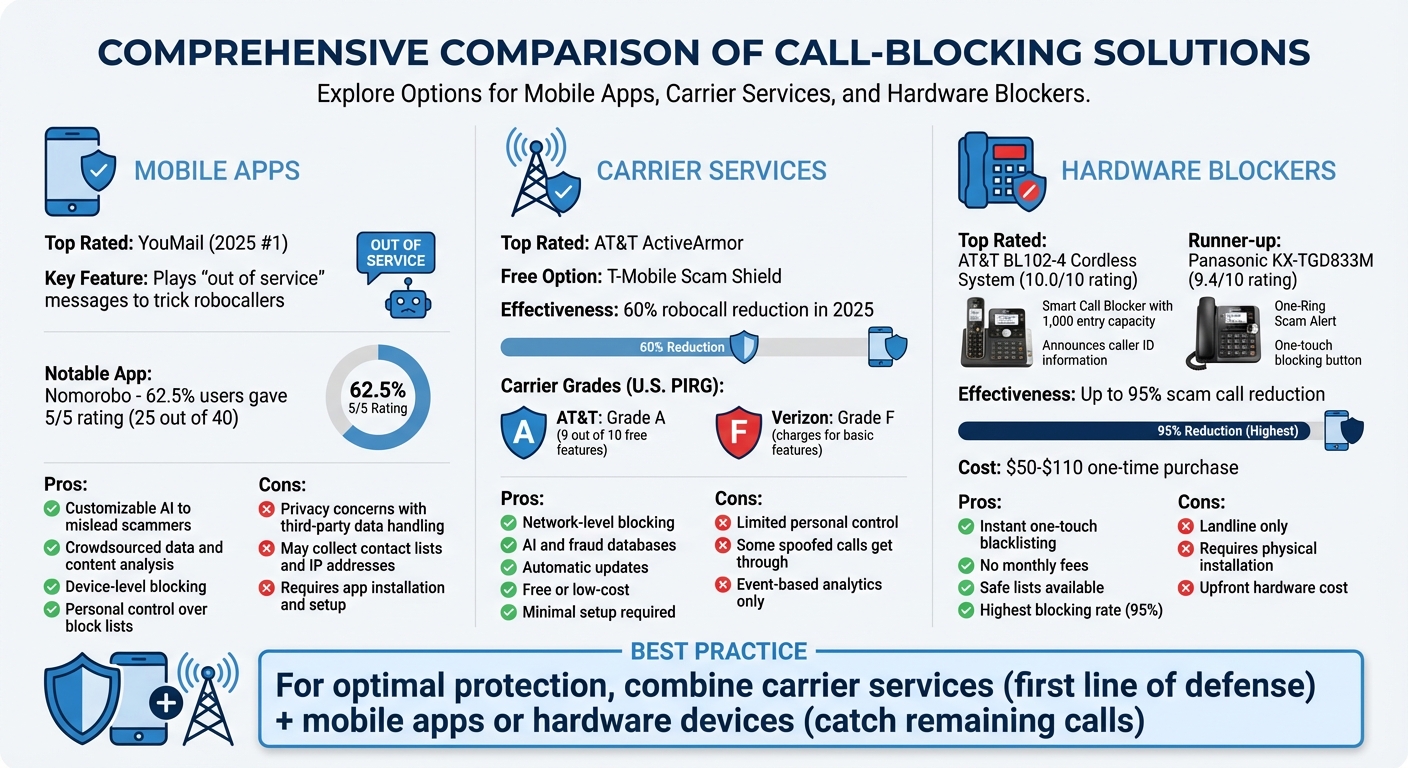
When it comes to consumer satisfaction, certain platforms stand out as clear leaders. Among third-party call-blocking apps, YouMail takes the top spot for 2025. Its standout feature? The ability to play "out of service" messages that effectively trick robocallers into removing your number from their lists. This highlights an interesting gap between technical features and what users actually find effective.
For carrier-based solutions, AT&T ActiveArmor emerges as the top performer, offering automatic fraud blocking and spam warnings. Meanwhile, for those seeking a free option, T-Mobile Scam Shield leads with its scam blocking and call screening services at no extra charge.
On the hardware side, devices also shine. The AT&T BL102-4 Cordless System earned a perfect 10.0/10 rating from BestReviews in March 2026, thanks to its Smart Call Blocker, which can store up to 1,000 entries and announces caller ID information. Close behind is the Panasonic KX-TGD833M, rated 9.4/10 for features like a "One-Ring Scam Alert" and a one-touch blocking button. For VoIP and landline users, Nomorobo remains a standout performer. According to Consumer Reports, 62.5% of users (25 out of 40) gave it a perfect 5/5 rating.
Interestingly, consumer advocacy groups are now grading carriers on their blocking tools. U.S. PIRG awarded AT&T an "A" for offering 9 out of 10 key free protection features. In contrast, Verizon received an "F" due to charging for basic features like personal block lists and category blocking.
Advantages and Disadvantages of Different Solutions
Each call-blocking option comes with its own set of pros and cons.
- Mobile Apps: Apps like YouMail and Robokiller use customizable AI to mislead scammers. While effective, they raise privacy concerns, as third-party developers may have fewer restrictions on how they handle sensitive call data.
- Carrier Services: These provide automated, network-level blocking that requires minimal setup. However, they often lack the personal control over block lists that apps offer.
- Hardware Blockers: Devices like the AT&T BL102-4 and Panasonic KX-TGD833M allow for instant, one-touch blacklisting. They can reduce scam calls by up to 95% and require no monthly fees after an initial purchase ranging from $50 to $110. The downside? They’re limited to landlines and require physical installation.
For the most thorough protection, many users report to stop spam calls by combining their carrier’s free network-level filters with either a third-party app or a hardware blocker. Even with this layered approach, some gaps persist, which will be explored further in the next section.
Limitations of Current Call-Blocking Technologies
Why Some Telemarketing Calls Still Get Through
Call-blocking tools have their limitations, and spammers are finding ways to exploit them. One of the biggest challenges is number rotation. Using VoIP services, spammers can cycle through thousands of phone numbers daily, making it nearly impossible for block lists to keep up.
Another hurdle is caller ID spoofing. Scammers manipulate the caller ID display to hide their identity or impersonate trusted organizations like banks or government agencies. A particularly sneaky tactic, neighbor spoofing, involves displaying numbers with your area code or prefix, making the call seem local and increasing the chances you’ll pick up.
Adding to the complexity, certain types of calls – like those from political campaigns, nonprofits, pollsters, and debt collectors – are legally allowed to bypass blocking tools. This means call-blocking apps often can’t filter these out without risking the interruption of legitimate communications.
Even the phone system itself is struggling. In 2025, the percentage of phone companies using federally mandated robocall-blocking technology actually dropped from 47% to 44%. Teresa Murray, Director of the Consumer Watchdog program at U.S. PIRG, summed it up:
"There is not enough enforcement by regulators and lawmakers, there are not enough consequences for bad actors".
The fallout? Spam robocalls in the U.S. jumped by 20% in just the first ten months of 2025.
On the flip side, false positives are causing headaches for legitimate businesses. Carrier algorithms often flag genuine calls as "spam" or "scam likely", leading 70% of consumers to miss important communications. The trust in phone calls has eroded so much that 74% of people now avoid answering unknown numbers altogether for fear of being scammed.
These challenges underscore the need for action beyond just technological solutions.
How ReportTelemarketer.com Fills the Gaps
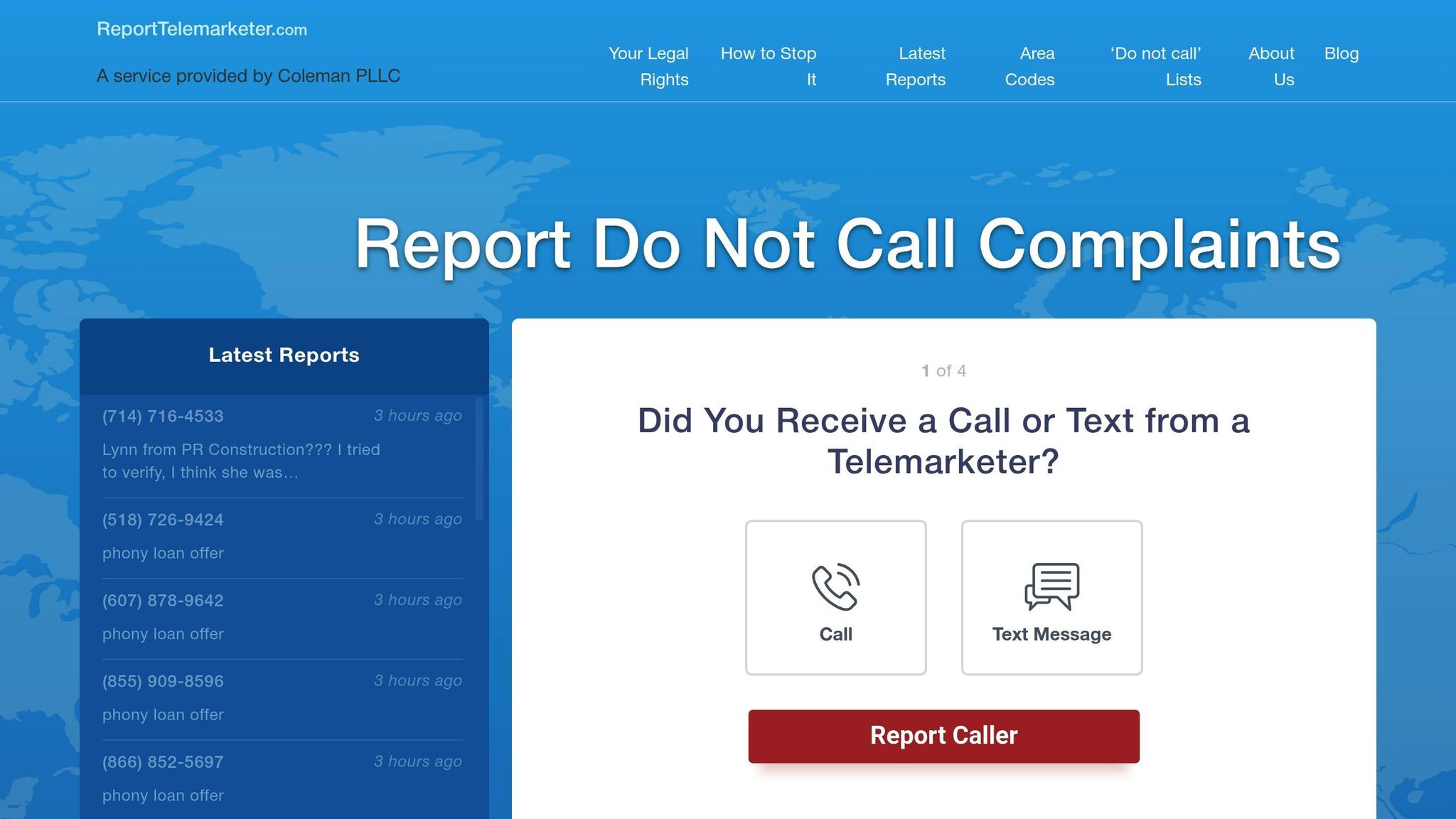
While blocking tools can silence the phone, they don’t address the root of the problem. That’s where ReportTelemarketer.com steps in. This platform empowers consumers to take action under the Telephone Consumer Protection Act (TCPA), which allows individuals to claim $500 per illegal call, or up to $1,500 for willful violations.
The service investigates violations, sends cease and desist letters or formal complaints, and helps users recover damages. Unlike the FCC, which doesn’t provide individual compensation for complaints, ReportTelemarketer.com helps consumers directly recover money from violators. It’s free to use, with attorney fees recovered from telemarketers when applicable.
Conclusion
While unwanted calls have decreased by 48% since 2021, challenges remain as scammers adapt their methods and complaints from consumers stay high. Despite progress, gaps in technology and evolving scam techniques, like caller ID spoofing and the use of AI, continue to outpace some defenses. As Sam Levine, Director of the FTC’s Bureau of Consumer Protection, stated:
"Illegal calls remain a scourge, but the FTC’s strategy to pursue upstream players and equip the agency to confront emerging threats is showing clear signs of success".
The best defense is a layered one. Consumers are encouraged to enable their carrier’s call-blocking tools, use standalone blocking devices for extra protection, and register their phone numbers with the National Do Not Call Registry at DoNotCall.gov. Reporting violations is equally important, as it helps analytics companies and service providers improve their blocking technologies.
For cases where technical measures fall short, platforms like ReportTelemarketer.com provide legal solutions. They investigate violations, send cease and desist letters, and assist consumers in recovering $500 per unauthorized call under the Telephone Consumer Protection Act.
Effective protection requires a combination of preventive measures, consistent reporting, and legal recourse.
FAQs
Why do “verified” STIR/SHAKEN calls still turn out to be spam?
Even with the STIR/SHAKEN framework in place, some "verified" calls can still turn out to be spam. Why? Because while this system helps authenticate caller identities and reduces spoofing, it doesn’t guarantee that every verified call is legitimate.
There are a few reasons for this. First, improper implementation can weaken its effectiveness. Second, scammers may exploit loopholes within the system to bypass its protections. Third, it struggles with international calls, which often fall outside its scope. Most importantly, STIR/SHAKEN primarily focuses on tackling spoofing. This means scam calls using legitimate numbers or other sneaky tactics can still slip through the cracks.
What’s the best setup to cut robocalls without blocking important calls?
The most effective approach mixes tools from your phone carrier with third-party options. Begin by activating your carrier’s anti-robocall services, which are designed to identify and flag scam calls. Next, enhance your defenses with apps or devices that let you fine-tune settings to block spam without interfering with important calls. To ensure you don’t miss legitimate contacts, maintain whitelists and stay informed about caller ID technologies like STIR/SHAKEN, which help verify the authenticity of incoming calls.
Can I get money back for illegal robocalls or texts under the TCPA?
Under the TCPA (Telephone Consumer Protection Act), you have the right to seek compensation for illegal robocalls or text messages. The law sets fines at $500 per violation, but that’s not all – some consumers have managed to secure six-figure judgments, exceeding $130,000, by combining TCPA claims with relevant state laws. These examples highlight how telemarketers violating consumer protection rules can face serious financial consequences.

