
The year 2025 saw a surge in cross-border telemarketing violations, with scammers exploiting U.S. telecom systems and advanced AI to target consumers. Key findings include:
- 2.6 million complaints were filed by individuals on Do Not Call lists.
- AI-driven scams became prevalent, with 25% of calls using AI-generated voices.
- Financial toll: Victims lost an average of $3,690 to scam calls.
- Legal actions: FTC lawsuits and state-level penalties increased, with some fines reaching up to $80,000 per violation.
- Enforcement efforts: Over 1,200 non-compliant telecom providers were removed from the Robocall Mitigation Database.
Despite stricter regulations and enforcement, scammers used tactics like voice cloning, rotating caller IDs, and bypassing financial safeguards to evade detection. Consumers are encouraged to document and report violations to platforms like ReportTelemarketer.com, which helps hold offenders accountable under the TCPA.
Cross-Border Telemarketing Violations: 2025 Key Statistics and Impact
Major Trends in Cross-Border Telemarketing Violations in 2025
Increase in Cross-Border Telemarketing Activities
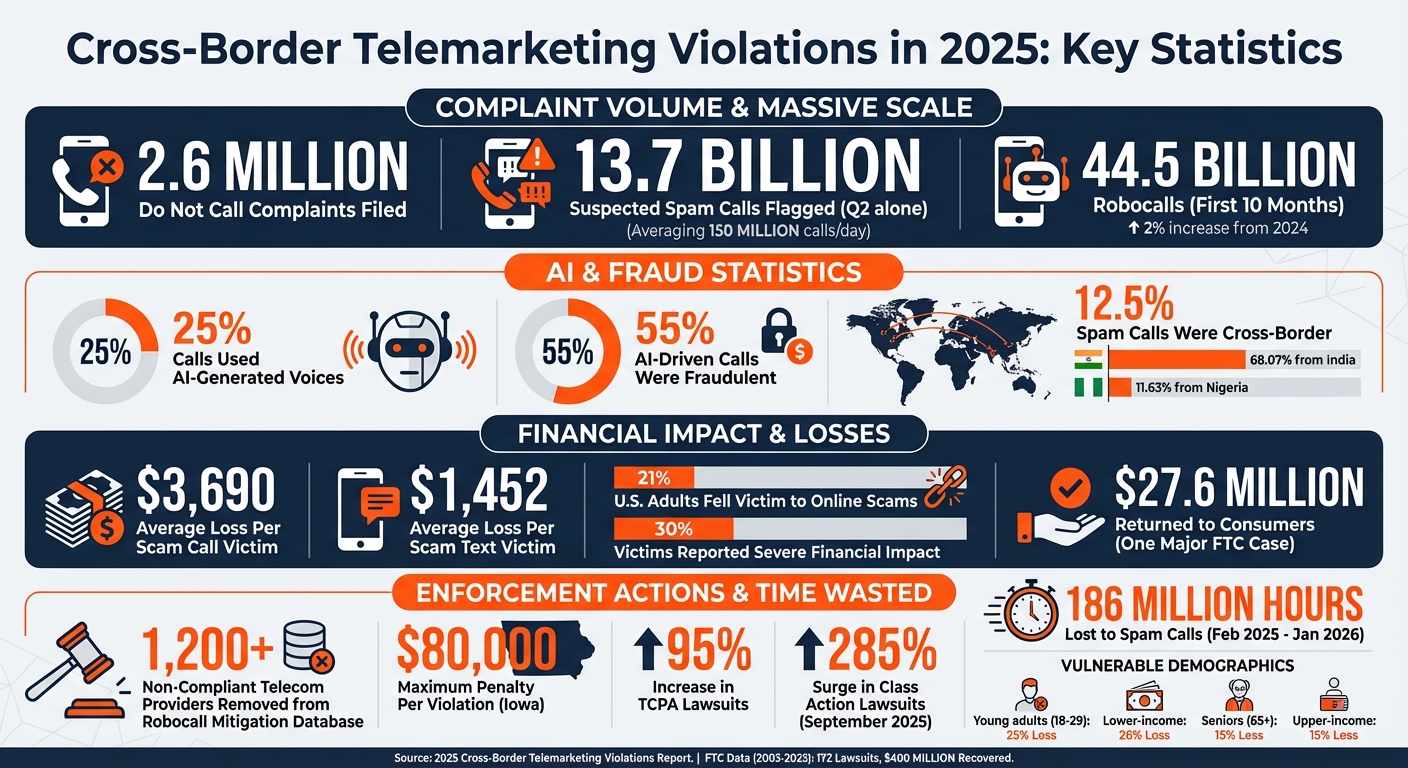
The scale of cross-border telemarketing violations hit staggering levels in 2025. During Q2 alone, a jaw-dropping 13.7 billion suspected spam calls were flagged globally – averaging 150 million calls per day. To put this in perspective, unwanted calls surged from 11.3 billion in Q4 2024 to 12.5 billion in just the first quarter of 2025.
International call centers exploited weaknesses in telecom systems to bombard American consumers. In a major crackdown, the FCC responded in August 2025 by removing over 1,200 voice service providers from the Robocall Mitigation Database (RMD) for failing to comply with anti-robocall regulations. These non-compliant carriers acted as gateways, allowing offshore telemarketers to sidestep U.S. protections. The growing number of violations highlighted how regulatory gaps between countries gave scammers the freedom to operate with little interference. This surge also led to the adoption of more advanced methods to evade detection.
Common Violation Methods
As call volumes soared, telemarketers became more sophisticated in their tactics. In early 2025, 25% of calls featured AI-generated audio, and 55% of those AI-driven calls were flagged as fraudulent. Stephanie Boulanger from Hiya noted:
"AI is making voice fraud worse, both in volume and in targeting".
Scammers employed a mix of strategies to stay under the radar. Many began with robocalls – often disguised as job offers – then quickly transitioned to encrypted messaging platforms like WhatsApp. This tactic not only escaped telecom monitoring but also became a dominant scam method, ranking as the top scam in Spain and the third most common in the UK during early 2025. To further evade detection, violators frequently rotated caller IDs and exploited vague "blanket consent" agreements, which allowed them to bypass call-blocking tools and financial safeguards.
Payment fraud also evolved. Scammers avoided traditional financial systems by using methods like remotely created payment orders, cash-to-cash transfers through services such as Western Union, and cash reload mechanisms. Some even took advantage of number portability, using mismatched area codes to bypass quiet-hour restrictions and call during prohibited times. These tactics showcased the lengths violators would go to in order to exploit regulatory loopholes and avoid accountability.
sbb-itb-a8d93e1
Enforcement Actions and Legal Developments in 2025
Federal Enforcement by the FTC
In 2025, federal regulators ramped up enforcement efforts, with the FTC taking aim at "consent farms" – websites that lure consumers with fake prizes or coupons to harvest personal data. These sites became a central focus because they supplied data for illegal telemarketing campaigns under the guise of false consumer consent. The FTC’s actions laid the groundwork for significant legal outcomes later in the year.
Two key areas of enforcement stood out: addressing false SSDI eligibility claims and shutting down unauthorized billing scams involving personal care products like CBD and Keto supplements.
Case Examples
In September 2025, the FTC reached a settlement with Citizens Disability, LLC, and its subsidiary, CD Media. The company faced a $1 million penalty for making over 109 million outbound calls, including 25.7 million calls that violated the National Do Not Call Registry. This case underscored the global reach of such deceptive practices. Christopher Mufarrige, Director of the FTC’s Bureau of Consumer Protection, explained:
"Consumers often wonder how telemarketers get their phone numbers, even if they’re on the Do Not Call Registry… The FTC will not tolerate such deceptive conduct".
Citizens Disability relied on consent farms to collect consumer data and falsely claimed they were responding to inquiries about SSDI benefits.
Later in December 2025, the FTC facilitated the return of $27.6 million to consumers defrauded by Legion Media LLC and related businesses, such as KP Commerce and Pinnacle Payments. The defendants promoted "free" CBD and Keto products but covertly enrolled customers in recurring billing plans, withdrawing funds without proper consent. The enforcement actions also led to asset recoveries valued at approximately $40 million.
State-Level Legal Changes
States complemented federal efforts by tightening their own regulations. Here’s a snapshot of the changes:
- Iowa: Increased civil penalties to $80,000 per violation.
- Maine: Required telemarketers to use the Reassigned Numbers Database to avoid contacting reassigned numbers.
- New York: Imposed fines of $5,000–$10,000 per violation for caller ID breaches and mandated free call mitigation technology.
- Missouri and Wisconsin: Introduced measures to combat spoofing, with Missouri allowing punitive damages up to $5,000 per false call identification.
These state-level updates reinforced the broader crackdown on deceptive practices, creating additional layers of accountability for telemarketers and fraudsters alike.
AI is supercharging scams and making fake calls sound real
Consumer Impact and Financial Losses
The aggressive rise in telemarketing scams and fraudulent activities has left a noticeable mark on consumers, both financially and emotionally.
Financial Loss Data
By 2025, cross-border telemarketing scams had taken a significant toll on Americans. On average, victims of scam calls lost $3,690, while those targeted through scam texts faced average losses of $1,452. These aren’t isolated incidents – 21% of U.S. adults reported falling victim to an online scam or attack by mid-2025. Among those who suffered financial losses, 30% admitted the impact on their finances was severe, describing it as affecting them "a great deal" or "a fair amount".
The sheer volume of unwanted contact was staggering. In just the first ten months of 2025, U.S. consumers were bombarded with 44.5 billion robocalls, marking a 2% rise compared to the same period in 2024. Moreover, between February 2025 and January 2026, Americans collectively lost 186 million hours dealing with spam calls.
Some groups were hit harder than others. Surprisingly, young adults aged 18–29 reported higher rates of financial losses (25%) compared to seniors aged 65 and older (15%). Lower-income households were also disproportionately affected, with 26% experiencing financial losses, compared to only 15% of upper-income households. Additionally, Black, Hispanic, and Asian adults faced higher rates of fraud and were more likely to report financial losses than White adults. These disparities highlight the uneven burden of telemarketing scams across different demographics.
Emotional and Privacy Impacts
The financial cost of these scams was just one part of the story. The emotional strain and privacy violations were equally damaging. The relentless flow of calls and texts – often during inconvenient hours like before 8 a.m. or after 9 p.m. – disrupted daily life and sleep patterns. Automated systems, oblivious to time zones, sent texts as early as 5:05 a.m. to Pacific Coast residents when initiated from the East Coast.
The emergence of AI-generated voices in robocalls further eroded consumer trust. These synthetic voices impersonated trusted figures and even created deepfakes, heightening feelings of insecurity. Many telemarketers relied on intimidation tactics, bombarding victims with repeated calls and aggressive language to coerce compliance. Cross-border spam calls – making up 12.5% of all spam calls in the U.S. – frequently originated from countries like India (68.07%) and Nigeria (11.63%), complicating enforcement efforts and exacerbating consumer vulnerability.
The emotional toll was undeniable. The strain reached such a point that new legal measures were introduced, allowing consumers to claim damages for "mental anguish." Reflecting the growing frustration, class action lawsuits tied to telemarketing violations surged by 285% in September 2025 alone. These figures illustrate how deeply these scams have affected not just wallets, but also peace of mind and trust.
The Role of Consumer Protection Services
How ReportTelemarketer.com Helps Consumers
As telemarketing violations surged in 2025, particularly across borders, consumers faced mounting challenges in seeking justice. The rise in violations led to a nearly 95% increase in TCPA lawsuits, with 15 states also implementing stricter "mini-TCPA" laws to address the issue. In this climate, ReportTelemarketer.com became a vital tool for those looking to navigate these complex legal waters.
The platform uses proprietary tools and extensive research to verify telemarketing violations and file formal do-not-call complaints under the TCPA and related laws. What makes it stand out is its ability to address all telemarketing calls targeting U.S. consumers, even those originating internationally, as governed by the Telemarketing Sales Rule.
"As a consumer protection firm, we use the telephone consumer protection laws to stop telemarketers from harassing consumers." – Stefan Coleman, lawyer and founder of ReportTelemarketer.com
One of the most appealing aspects of the service is that it’s completely free for users. Attorney fees are claimed directly from telemarketers when cases are resolved, and consumers can potentially recover up to $500 per call for violations of do-not-call regulations. This innovative approach has led to real, measurable results for consumers.
Consumer Success Stories
Since its inception, ReportTelemarketer.com has assisted more than 30,000 individuals in stopping unwanted telemarketing calls and texts. The platform emphasizes the importance of documenting call details, as thorough reports significantly increase the likelihood of identifying violators. This detailed documentation empowers the platform to take swift legal action, ensuring that telemarketers cease their activities and, where possible, compensating consumers for damages.
Conclusion
The numbers from 2025 tell a striking story: cross-border telemarketing violations hit new highs, yet enforcement efforts made some real headway. Federal and state regulators joined forces to tackle illegal robocalls, disrupting major operations and holding offenders accountable. One standout effort, Operation Robocall Roundup, involved 50 attorneys general issuing warning letters to 37 companies and successfully removing seven providers from U.S. networks. As Attorney General William Tong put it:
"Robocalls aren’t just annoying, they are a primary pathway for scammers to steal information and inflict serious financial harm. We are cracking down on the country’s worst scam enablers with the full weight of 50 attorneys general across the nation."
Despite these enforcement wins, the problem is far from solved. In 2025 alone, the FTC received over 2.6 million Do Not Call complaints. Overseas scammers continue to exploit VoIP technology and AI-generated voices, while the Supreme Court’s decision in McLaughlin v. McKesson added a new layer of complexity. By eliminating uniform FCC deference, the ruling created a fragmented legal landscape, making it harder for consumers to understand their rights and for businesses to ensure compliance.
If you’re receiving unwanted calls, filing a Do Not Call registry complaint can make a difference. The FTC uses these reports to identify patterns and target violators, sharing daily complaint data with analytics firms and voice service providers to enhance call-blocking tools. Since 2003, the agency has filed 173 lawsuits against 570 companies and 449 individuals, recovering nearly $400 million from violators.
To keep building on these efforts, document every unwanted call or text you receive – note the timestamp, caller ID, and content – and report it through ReportTelemarketer.com. This platform enforces federal TCPA rules and newer state laws that allow for treble damages and attorney’s fees. With TCPA lawsuits surging by nearly 95% in 2025, consumers now have more tools than ever to push back against these invasive practices.
FAQs
How can I tell if a call is using an AI-cloned voice?
Detecting AI-cloned voices isn’t always straightforward, but there are some telltale signs to watch for. Listen for unnatural pauses, shifts in tone that don’t quite match the flow of the conversation, or slight distortions in the audio. These voices often miss the mark on emotional depth and may struggle to respond naturally in context-specific situations.
If you receive a call that feels off – especially if it involves requests for sensitive details or pushes urgent offers – take a moment to verify the caller’s identity on your own. Staying alert and skeptical can help you steer clear of potential scams.
What details should I record to report an illegal robocall or text?
To report an illegal robocall or text, make sure you note down a few key details: the phone number that contacted you, the exact date and time of the call or message, the content of the message (if there was one), and any additional information, such as the caller’s name or organization. These details are crucial for helping authorities track patterns and take action against unlawful telemarketing practices.
Can I still take action if the telemarketer is calling from another country?
The Federal Trade Commission (FTC) takes action against overseas telemarketers and illegal robocalls. They encourage consumers to report any violations, as these reports play a key role in identifying and tackling cross-border telemarketing problems.

