
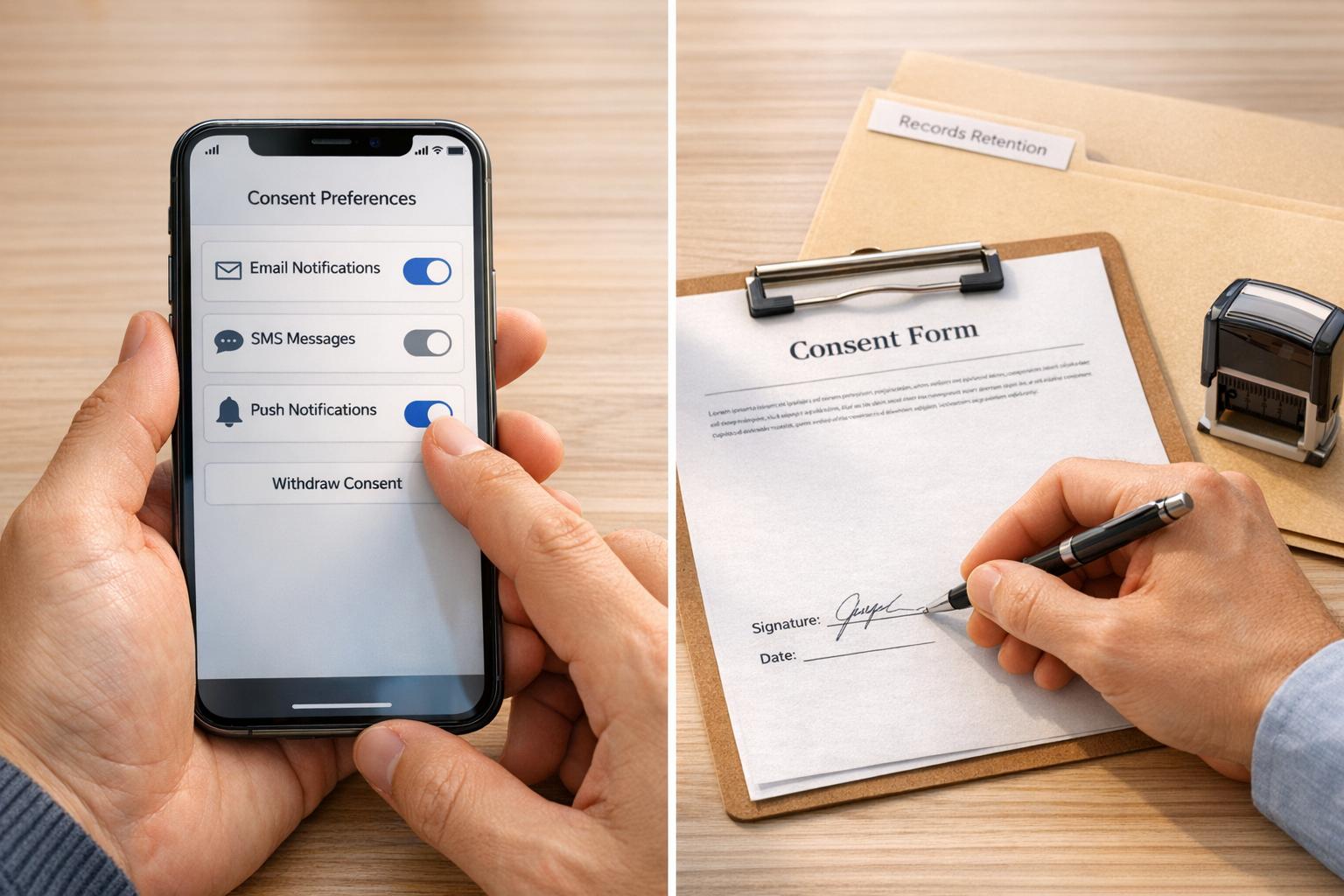
GDPR and TCPA both require businesses to obtain consent for marketing, but they differ in scope and focus. GDPR, which applies in the EU, prioritizes personal data protection and mandates clear, specific, and informed consent for data processing. TCPA, a U.S. regulation, governs telemarketing methods, emphasizing signed agreements for calls or texts made using automated systems.
Key Takeaways:
- GDPR: Requires active opt-in (e.g., unchecked boxes) for data use, with granular consent for each communication channel. Consent withdrawal must be easy and immediate.
- TCPA: Demands prior express written consent for telemarketing, with clear disclosures and a signed agreement. Consent revocation must be processed within 10 business days.
- Penalties: GDPR fines can reach €20 million or 4% of global revenue, while TCPA violations cost $500–$1,500 per call or text.
- Recordkeeping: GDPR requires indefinite retention during data processing, while TCPA mandates keeping records for at least 4 years.
Quick Comparison:
| Feature | GDPR | TCPA |
|---|---|---|
| Scope | Personal data processing | Telemarketing calls and texts |
| Consent Type | Clear affirmative action | Signed agreement |
| Revocation | Immediate | Within 10 business days |
| Penalties | Up to €20M or 4% revenue | $500–$1,500 per violation |
| Record Retention | Indefinite during processing | At least 4 years |
Understanding these differences is critical for compliance and avoiding costly penalties. Let’s dive deeper into how these rules apply to telemarketing practices.
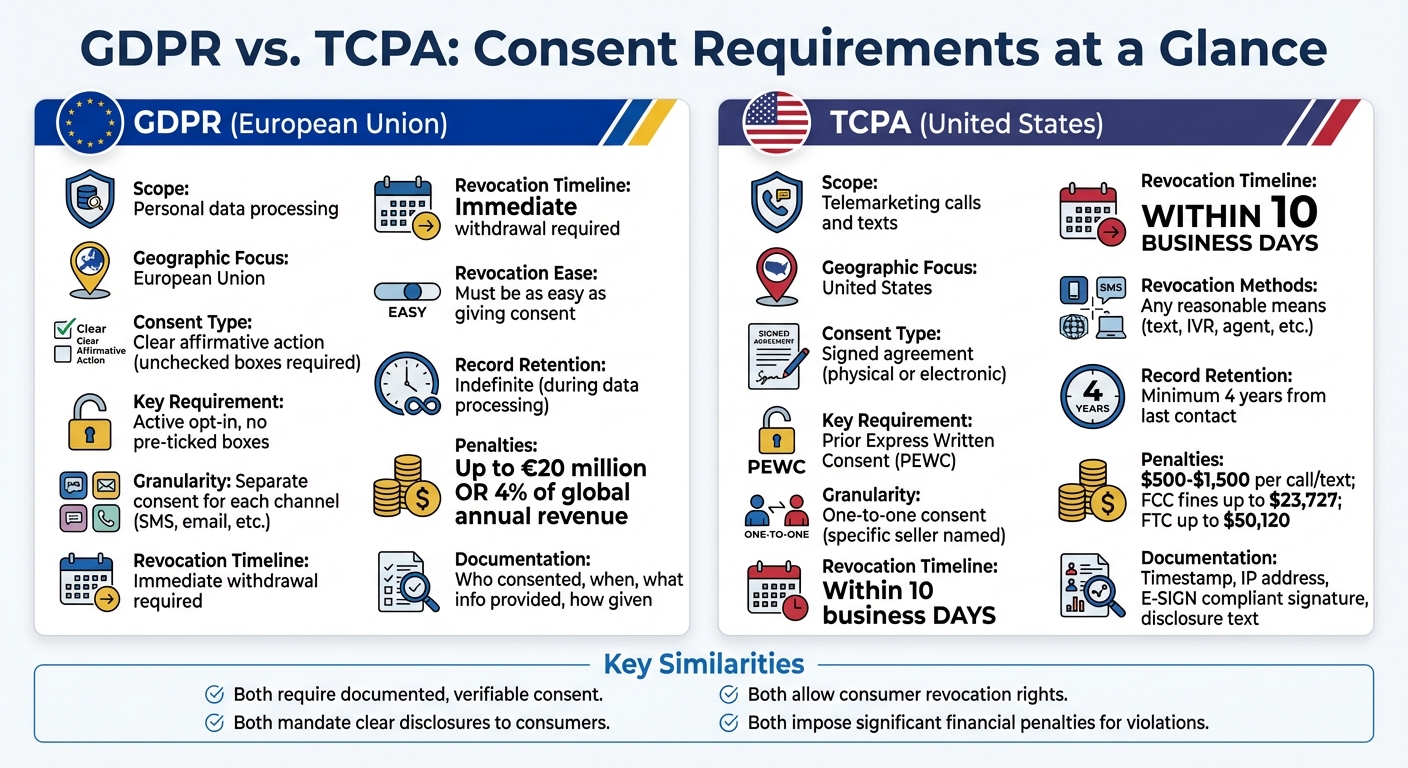
GDPR vs TCPA Consent Requirements Comparison Chart
Zendesk messaging opt-out compliance: what TCPA and GDPR actually require
sbb-itb-a8d93e1
GDPR Explicit Consent Requirements
Under GDPR, consent must come from clear, affirmative actions – not from silence, inactivity, or pre-checked boxes. Recital 32 of GDPR puts it plainly: "Consent should be given by a clear affirmative act establishing a freely given, specific, informed and unambiguous indication of the data subject’s agreement to the processing of personal data relating to him or her… Silence, pre-ticked boxes or inactivity should not therefore constitute consent."
This means that every opt-in checkbox on your web forms must start unchecked. If you’re asking users to subscribe to multiple communication channels, such as SMS alerts and email newsletters, each must have its own separate checkbox. Combining them into one opt-in violates GDPR’s requirement for granular consent. Article 7 further emphasizes that businesses must be able to prove consent for each individual’s data processing. These rules make active opt-in practices a cornerstone of GDPR compliance, especially in telemarketing.
Active Opt-In Requirements
GDPR requires consent mechanisms to involve clear, deliberate user actions. Pre-ticked boxes or passive agreements are not allowed. Instead, users must actively engage – whether by ticking an unchecked box, clicking a confirmation button, or verbally consenting during a recorded call.
As noted by Digital Applied, "SMS marketing almost always requires explicit consent under GDPR, not merely a soft opt-in or pre-checked box." This highlights the need for businesses to ensure that their consent processes are explicit and intentional.
Purpose Specification and Withdrawal Rights
GDPR also ensures that consumers know exactly what they are agreeing to before opting in. Your consent forms must clearly outline who will contact them (your business name), what types of messages they’ll receive (e.g., promotional offers, appointment reminders), and how frequently they can expect communication. Vague statements like "we may contact you occasionally" fall short of GDPR’s clarity standards.
Equally important is the ability to withdraw consent. GDPR Article 7(3) states: "It shall be as easy to withdraw as to give consent." If someone can opt in with a single click, they should be able to opt out just as effortlessly – such as replying "STOP" to a text message. Withdrawal requests must be processed immediately and synced across all marketing systems to avoid accidental non-compliance.
Documentation and Recordkeeping
To comply with GDPR’s accountability principle, businesses must keep detailed records proving valid consent. These records should include who consented, when they consented, what information was provided, and how consent was given. For online forms, this means logging details like the disclosure text, timestamp, IP address, and the consent URL.
Unlike the TCPA, which requires retaining records for four years, GDPR mandates that consent documentation be kept for as long as the data is being processed. To avoid losing key compliance evidence, export consent records from third-party SMS platforms to a secure internal system on a regular basis – monthly is a good practice. These timestamped records are essential if a regulator or consumer questions your compliance, especially since penalties can reach €20 million or 4% of global annual revenue.
TCPA Prior Express Written Consent Requirements
The TCPA relies on signed agreements to prove consent. Prior Express Written Consent (PEWC) is defined as "a signed, written agreement between the consumer and seller, which states that the consumer agrees to be contacted by this seller and includes the telephone number to which the calls may be placed". This signature can be either physical (ink on paper) or electronic, as long as it complies with the E-SIGN Act. Unlike GDPR’s opt-in model that focuses on unchecked boxes, the TCPA emphasizes electronic or physical signatures.
Signed or Electronic Agreements
The TCPA requires a verifiable signature to establish consent. This could be a physical signature or an electronic action, such as clicking "I Agree" on a web form or pressing a key during a phone call. These electronic signatures are legally binding under TCPA guidelines. To meet compliance, businesses must store detailed proof of these signature events, including timestamps, IP addresses, the consent URL, and a record of the disclosure. It’s essential to retain these records for at least four to five years from the date of the last contact.
Clear Disclosures and Non-Conditional Consent
Consent forms must meet four specific requirements under the TCPA:
- A statement that the consumer agrees to receive telemarketing calls or texts.
- A disclosure that messages may use an automatic telephone dialing system (ATDS) or prerecorded/artificial voice.
- Clear identification of the specific seller authorized to contact the consumer.
- A notice that consent is not a condition of purchasing any property, goods, or services.
These disclosures must be "clear and conspicuous", meaning they should be placed above the submit button with readable font sizes and adequate color contrast. Violations can result in damages of $500 per call or text, which may increase to $1,500 if the violation is deemed willful.
Revocation of Consent
The TCPA also ensures consumers have the right to withdraw consent at any time and through a reasonable method. This includes various options such as replying to a text, using an IVR system, submitting an online request, or even notifying an agent directly. As LeadGuard explains:
"Courts have held that consumers can revoke consent through any reasonable means, including telling an agent, pressing a button on an IVR, replying STOP to a text, or even posting on social media."
Importantly, businesses cannot require consumers to use a specific channel to opt out. Starting April 11, 2025, FCC rules mandate that revocation requests be honored within 10 business days. Failure to process these requests promptly can lead to FCC fines of up to $23,727 per violation or FTC penalties as high as $50,120 per incident.
GDPR vs. TCPA: Key Differences
Comparison Table of Consent Rules
While both GDPR and TCPA are designed to protect individuals from intrusive marketing practices, they take different approaches to consent. GDPR focuses on safeguarding the personal data of EU residents, while TCPA regulates telemarketing calls and texts in the U.S.. Here’s a quick breakdown of their core distinctions:
| Feature | GDPR Explicit Consent | TCPA Prior Express Written Consent |
|---|---|---|
| Primary Requirement | Requires clear affirmative action – no pre-ticked boxes | Signed agreement with specific disclosures |
| Marketing Scope | Covers all forms of digital marketing (email, SMS, web) | Focuses on autodialed/prerecorded calls and SMS |
| Third-Party Sharing | Must disclose controllers or third parties | Consent must name a specific seller (one-to-one) |
| Revocation Period | Must allow immediate withdrawal ("as easy as giving consent") | Allows up to 10 business days for revocation |
| Record Retention | Retain data indefinitely while processing | Requires keeping records for at least 4 years |
| Penalties | Fines up to €20 million or 4% of global revenue | $500–$1,500 per message/call |
These distinctions aren’t just theoretical – they directly influence compliance strategies. For example, a major 2025 TCPA update introduced a "one-to-one" consent rule. This requires consumers to give consent to a specific seller rather than a broad list of marketing partners. While this aligns with GDPR’s approach of naming specific data controllers, the TCPA rule applies only to telecommunications.
Impact on Telemarketing Compliance
These regulatory differences create unique challenges for telemarketers operating across borders. GDPR requires businesses to provide a simple, one-click option for withdrawing consent. On the other hand, the TCPA allows consent revocation through various methods – like verbal requests or voice response buttons – and gives businesses up to 10 business days to process the request.
The penalties for violations also vary significantly. GDPR imposes hefty fines of up to €20 million or 4% of global revenue, while TCPA violations result in fines ranging from $500 to $1,500 per call or text. Additionally, the FCC can impose fines of $23,727 per violation, and the FTC can issue penalties as high as $50,120 per incident.
Record-keeping requirements add another layer of complexity. Under the TCPA, businesses must store detailed consent records – such as timestamped screenshots, IP addresses, and E-SIGN compliant signatures – for a minimum of four years. In contrast, GDPR demands that records be retained indefinitely as long as the data is being processed. Without this documentation, defending against compliance claims becomes nearly impossible. For telemarketers, understanding and navigating these rules is essential to maintaining compliance with both GDPR and TCPA.
Compliance Recommendations for Telemarketers
Aligning GDPR and TCPA Standards
To stay compliant with both GDPR and TCPA, telemarketers need to adopt practices that meet the stricter requirements of each regulation. Start by implementing a one-to-one consent system. Following the FCC’s January 2025 rule, consumers must give explicit permission to a single, named seller. Bundling multiple brands into one consent form is no longer acceptable under TCPA guidelines.
Consent forms should have separate, unchecked boxes for each communication channel, such as SMS and email. Pre-checked boxes violate GDPR’s active opt-in rules and fail TCPA’s "clear and conspicuous" standard. Ensure that the disclosure language clearly states that communications are directly related to the content of the website. For instance, consent given on a car loan site cannot authorize calls about loan consolidation, as clarified by the FCC.
Before initiating any calls, verify consent records thoroughly. These records should include the IP address, timestamp, source URL, and the exact disclosure language shown to the consumer. Regularly cross-check your contact lists against the National DNC Registry – this must be done every 31 days to maintain safe harbor protection. Also, incorporate state-level DNC lists and internal suppression files into your process. Many telemarketers now use litigator scrubbing to flag numbers linked to frequent TCPA litigation before dialing.
Keep consent documentation for at least five years. While TCPA mandates a four-year retention period, GDPR requirements may necessitate longer storage. Capture timestamped screenshots of the consent form as it appeared to the consumer, and ensure electronic signatures comply with the E-SIGN Act by maintaining a tamper-proof audit trail. Additionally, independently validate every purchased lead to reduce liability risks.
By integrating these measures with active consumer monitoring, telemarketers can effectively address compliance gaps and reduce risks.
Using Consumer Protection Services
Platforms like ReportTelemarketer.com offer valuable tools for telemarketers by providing a feedback loop from consumers. When consumers report unwanted calls or texts, these platforms investigate potential violations and may issue cease-and-desist letters or formal complaints. Monitoring these reports can help telemarketers identify issues like outdated consent records, improper opt-out handling, or calls to numbers listed on the DNC Registry.
Using such services complements the technical and procedural safeguards outlined earlier. If your company’s number appears in consumer complaints, it’s a signal to immediately review your consent records. Verify agents’ documentation of opt-out requests and ensure that "STOP" commands are processed within 10 business days. Also, confirm that lead suppliers provide valid one-to-one consent records. Addressing these issues proactively can prevent costly legal or regulatory consequences. TCPA violations alone carry penalties ranging from $500 to $1,500 per call, while FCC fines can reach up to $23,727 per violation.
Conclusion
Both GDPR and TCPA emphasize documented consent, but they focus on different areas. TCPA regulates the methods of communication – like autodialers, prerecorded messages, and SMS – while GDPR governs all forms of personal data processing for EU residents. The FCC’s upcoming January 2025 one-to-one consent rule will bring TCPA practices closer to GDPR’s standards for specific and informed consent.
The financial risks of non-compliance are steep. TCPA violations can result in statutory damages ranging from $500 to $1,500 per message or call. For a campaign of 100,000 non-compliant calls, this could mean up to $150 million in damages. GDPR penalties, on the other hand, can reach as high as €20 million or 4% of a company’s global annual revenue. Beyond financial penalties, non-compliance risks carrier-level blocking, which could permanently disrupt a brand’s ability to use mobile communication channels.
For international telemarketers, adhering to the highest consent standards is essential. This includes using verified opt-in methods, clearly identifying the brand in consent disclosures, and maintaining records for at least five years. Opt-out requests should be processed immediately, rather than taking the full 10 business days allowed under TCPA, as GDPR requires that withdrawing consent be as straightforward as granting it.
The complexity of these regulations highlights the importance of staying ahead of compliance issues. As Andrew Folks, Attorney at Frankfurt Kurnit Klein & Selz, noted about the challenges posed by court volatility:
"For telemarketing compliance teams, adjustments cannot be made until a consensus emerges in the courts, which seems a near-impossibility given current volatility".
Given this uncertainty, proactive measures are critical. Tools like ReportTelemarketer.com can help by identifying consumer complaints early, exposing potential consent documentation gaps before they lead to regulatory action or lawsuits.
Ultimately, ensuring proper consent practices isn’t just about avoiding fines – it’s about fostering trust and maintaining sustainable operations in a tightly regulated environment.
FAQs
Do I need both GDPR and TCPA consent for SMS marketing?
For SMS marketing in the U.S., you don’t need to comply with both TCPA and GDPR unless your business handles data from EU citizens. The TCPA (Telephone Consumer Protection Act) requires explicit written consent from U.S. consumers, and you must document and retain this consent for at least four years. On the other hand, GDPR applies to EU citizens and also demands explicit consent. However, GDPR compliance isn’t necessary under U.S. law unless your marketing efforts involve EU residents. If your focus is solely on U.S. consumers, adhering to TCPA regulations is enough.
What counts as a valid “signature” for TCPA written consent online?
To meet TCPA requirements for a valid "signature" in online written consent, it’s essential to thoroughly document the entire consent process. This means keeping a record of:
- The exact disclosure text presented to the user.
- The full URL of the page where consent was given.
- The consumer’s IP address and user agent.
- The timestamp showing when the consent occurred.
The consent must also be clear, easy to notice, and able to be verified to align with TCPA standards.
How should I store consent records to defend against a complaint?
To handle complaints effectively, maintain comprehensive and verifiable consent records. These should include:
- A copy of the consent form or webpage, such as a timestamped screenshot.
- The exact disclosure language presented, along with the consumer’s signature or E-SIGN equivalent.
- Detailed information like the date, time (down to the second), IP address, and source URL of the consent.
- Supporting documentation, such as the consent method, evidence of DNC (Do Not Call) scrubbing, agent training records, and any opt-out requests.
Keeping these records ensures you have a solid legal foundation in case of disputes.

