
Getting robocalls or scam texts? Here’s where to report them:
- FCC: Handles technical violations like robocalls, spoofed caller IDs, and robotexts.
- FTC: Focuses on scams, fraud, and Do Not Call Registry violations.
Neither resolves individual complaints but uses them to track trends and take enforcement actions. If a call involves both technical and fraudulent issues, report to both agencies.
Quick Overview:
- FCC: Report at consumercomplaints.fcc.gov or call 1-888-225-5322.
- FTC: File at ReportFraud.ftc.gov or call 1-877-FTC-HELP.
Tip: Include details like date, time, caller ID, and whether your number is on the Do Not Call list for accurate processing.
How to File a Complaint with the Federal Communications Commission
If you are receiving illegal robocalls or spoofed numbers, you should report unwanted phone calls to the FCC to help them track and stop these callers.
sbb-itb-a8d93e1
FCC vs. FTC: Jurisdiction Differences
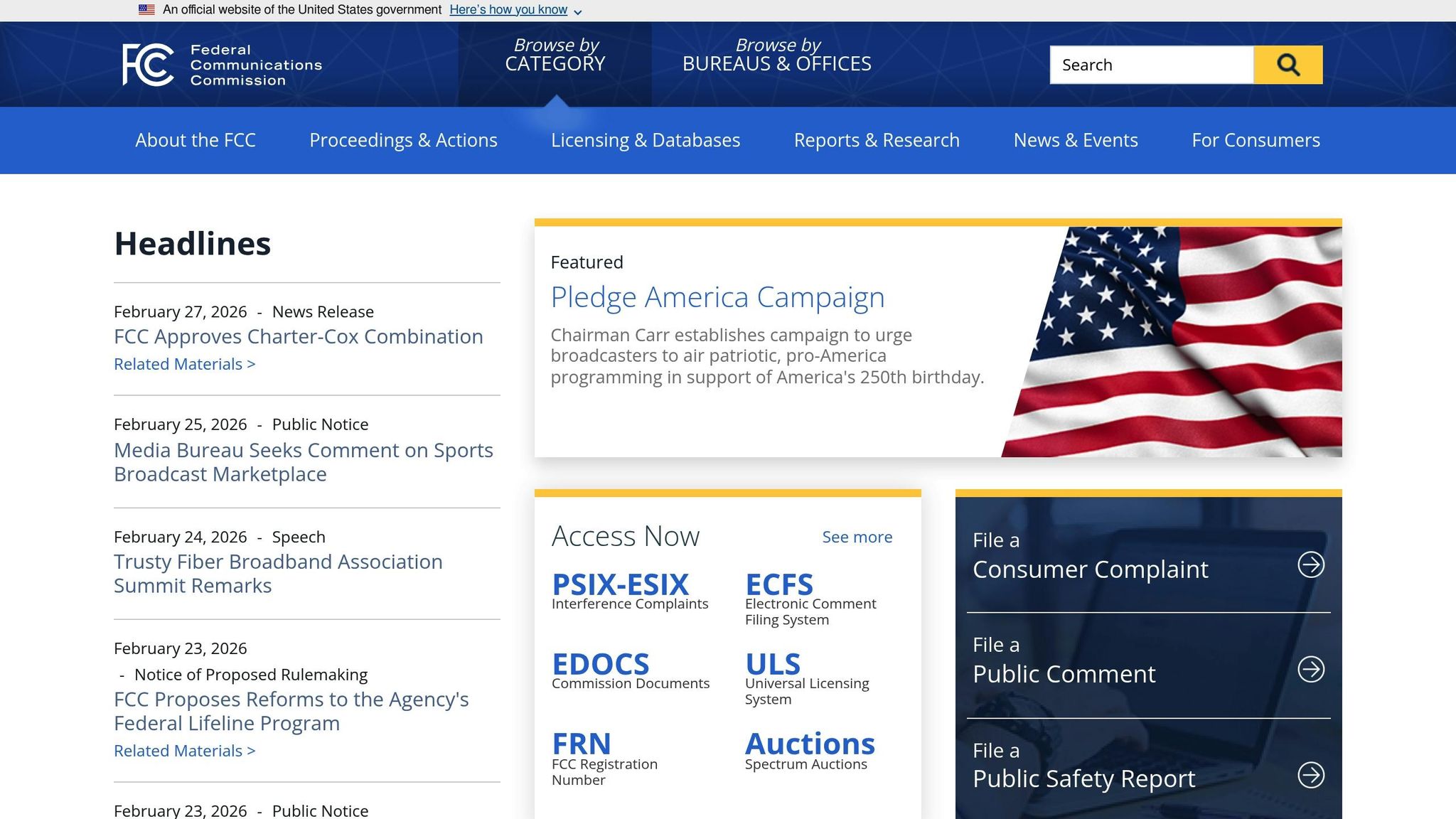
The FCC and FTC tackle telemarketing issues from different angles: the FCC focuses on how calls are made, while the FTC looks at who is calling and why. Each agency enforces specific laws and rules to address violations. Here’s a closer look at their roles:
FCC Jurisdiction
The FCC deals with the technical aspects of telemarketing violations. This includes:
- Calls made using autodialers, robocalls (prerecorded or AI-generated messages), and junk faxes. It also covers how to report unwanted text messages sent to mobile devices.
- Calls to cell phones, emergency lines, and healthcare facilities.
- Ensuring telemarketing robocalls to wireless numbers have prior express written consent.
The FCC also enforces the Truth in Caller ID Act, which prohibits falsifying caller ID information with the intent to defraud or harm. Violations can result in penalties of up to $10,000 per instance. For example, in March 2021, the FCC issued its largest-ever penalty: a $225 million forfeiture order against John C. Spiller, Jakob A. Mears, and Rising Eagle Capital Group LLC for making 1 billion spoofed robocalls promoting short-term health insurance plans.
FTC Jurisdiction
The FTC, on the other hand, focuses on consumer protection by addressing deceptive practices. It targets scams such as:
- Government or business impersonation.
- Fraudulent debt relief offers.
- Fake car warranty pitches.
- Medical or prescription-related scams.
The FTC also oversees the National Do Not Call Registry and enforces its rules. Companies violating these rules face civil penalties of up to $40,000 per violation. For instance, in December 2025, the FTC secured a $27.6 million settlement with Legion Media LLC, which provided refunds to over 1.2 million consumers affected by misleading negative-option marketing practices.
Shared Responsibilities
Both agencies work together to enforce Do Not Call Registry rules. If a telemarketing call involves both technical violations (like autodialing) and deceptive content (such as a scam pitch), it’s beneficial to file complaints with both agencies. This overlap ensures comprehensive enforcement when calls breach multiple rules.
How to File a Complaint with the FCC
Filing Process
The quickest way to file a complaint is online at consumercomplaints.fcc.gov. The FCC Consumer Complaint Center walks you through specific questions tailored to your issue, ensuring all the necessary details are included.
When filing online, choose "unwanted calls/texts" as your primary issue. This is the standard category for filing a robocall complaint. If the caller is using a spoofed or blocked number, select the sub-issue "my own number is being spoofed" to help with targeted enforcement.
Make sure to include:
- The date and time of the call (with time zone)
- Report the phone number from the Caller ID
- The number that received the call
- Whether it was a landline or wireless phone
- Whether the call was an advertisement
- If you gave permission to be contacted
- If you previously asked the company to stop calling
For international numbers that don’t fit standard formats, provide the full number in the "Additional Information" field.
If you prefer not to file online, you can also:
- Call 1-888-225-5322 (voice) or 1-888-835-5322 (TTY)
- Email fccinfo@fcc.gov
- Fax to 1-866-418-0232
- Mail your complaint to:
FCC, Consumer & Governmental Affairs Bureau
445 12th Street, SW
Washington, DC 20554
What Happens After Filing
Once your complaint is submitted, the FCC uses it, along with others, to identify potential regulatory violations. Keep in mind, the FCC does not resolve individual complaints or provide compensation. Instead, your report becomes part of a larger enforcement effort. According to the Federal Communications Commission:
"We do not resolve individual unwanted call or text complaints, but your complaint provides valuable information that we use to inform policy decisions and as the basis of potential enforcement actions against those violating our rules".
The FCC’s Enforcement Bureau reviews complaint patterns to uncover widespread violations and build cases against offenders. For example, in January 2021, the FCC issued a $9,918,000 forfeiture order against Scott Rhodes for malicious caller ID spoofing, based on consumer complaints.
How to File a Complaint with the FTC
Filing Process
The FTC focuses on addressing deceptive practices and fraud, unlike the FCC, which handles technical violations. To report telemarketing scams or fraud, head to ReportFraud.ftc.gov. For issues related to the National Do Not Call Registry that didn’t involve financial loss, use DoNotCall.gov instead.
When filing your complaint, select the category "Phone Calls, Text Messages, and Faxes" to ensure it’s routed properly. Be ready to provide key details, including:
- The date and time of the call
- Caller ID information
- The company name and any callback number
- Financial loss details (if applicable), such as the amount and payment method
- Whether your number is on the National Do Not Call Registry
- Any existing business relationship with the caller
If you prefer, you can file a complaint by phone. For general fraud, call 1-877-FTC-HELP (1-877-382-4357). To report Do Not Call Registry violations, dial 1-888-382-1222 (TTY: 1-866-290-4236). Keep in mind, to report a Do Not Call violation, your number must have been registered on the National Do Not Call Registry for at least 31 days.
What Happens After Filing
Once your complaint is submitted, the FTC starts a review process based on data analysis. It’s important to note that the FTC does not handle individual complaints or assist in recovering lost money. Instead, your report is added to the Consumer Sentinel Network, a secure database shared with over 2,800 law enforcement agencies worldwide.
The FTC uses this aggregated data to identify trends and prioritize larger investigations. These investigations can lead to impactful actions like court-ordered injunctions, freezing assets, and imposing civil penalties of up to $40,000 per violation on telemarketers who break the rules. While you won’t receive updates on your specific complaint, your input helps fuel broader efforts to combat fraudulent activities.
Choosing the Right Agency: FCC, FTC, or Both
Deciding which agency to contact depends on the nature of the issue. Whether it’s a technical violation, deceptive practice, or a mix of both, this guide helps you figure out where to direct your complaint.
When to Choose the FCC
Reach out to the FCC for technical violations. These include robocalls made to your cell phone without consent, robotexts, junk faxes, and caller ID spoofing. The FCC enforces laws like the Telephone Consumer Protection Act (TCPA) and the Truth in Caller ID Act, focusing on the how of the call – such as whether autodialers or spoofing tactics were used.
For spoofing violations, penalties can reach up to $10,000 per incident. The FCC has imposed hefty fines on illegal robocallers, including recent actions against large-scale spoofing operations.
If your concern is more about deceptive practices than technical violations, the FTC is the better choice.
When to Choose the FTC
The FTC is your go-to for fraud, scams, or violations of the Do Not Call Registry. If your number has been on the registry for at least 31 days and you’re still receiving unwanted sales calls, file a complaint with the FTC. They oversee the registry and enforce the Telemarketing Sales Rule, targeting businesses that use deceptive practices.
You should also report calls pretending to be from government agencies like the IRS or Social Security Administration, especially if they ask for money or personal details. The FTC can impose civil penalties of up to $40,000 per violation on telemarketers who break these rules.
When to File with Both Agencies
Some complaints involve both technical and deceptive elements. For instance, if illegal robocalls also include fraudulent messages, filing with both agencies is recommended. The FCC supports this approach:
"If you have a complaint about telephone fraud or telemarketers who have disregarded the Do Not Call list, we also encourage you to file a complaint with the FTC".
In May 2020, the FCC and FTC collaborated to issue cease-and-desist letters to three voice service providers for transmitting COVID-19 scam robocalls. Filing with both agencies can strengthen the case against persistent offenders.
ReportTelemarketer.com can simplify the process for you. They investigate your complaint, determine the right agency to contact, and handle formal complaints or cease-and-desist letters at no cost. Attorney fees are recovered from telemarketers when applicable.
FCC vs. FTC: Complaint Handling Comparison
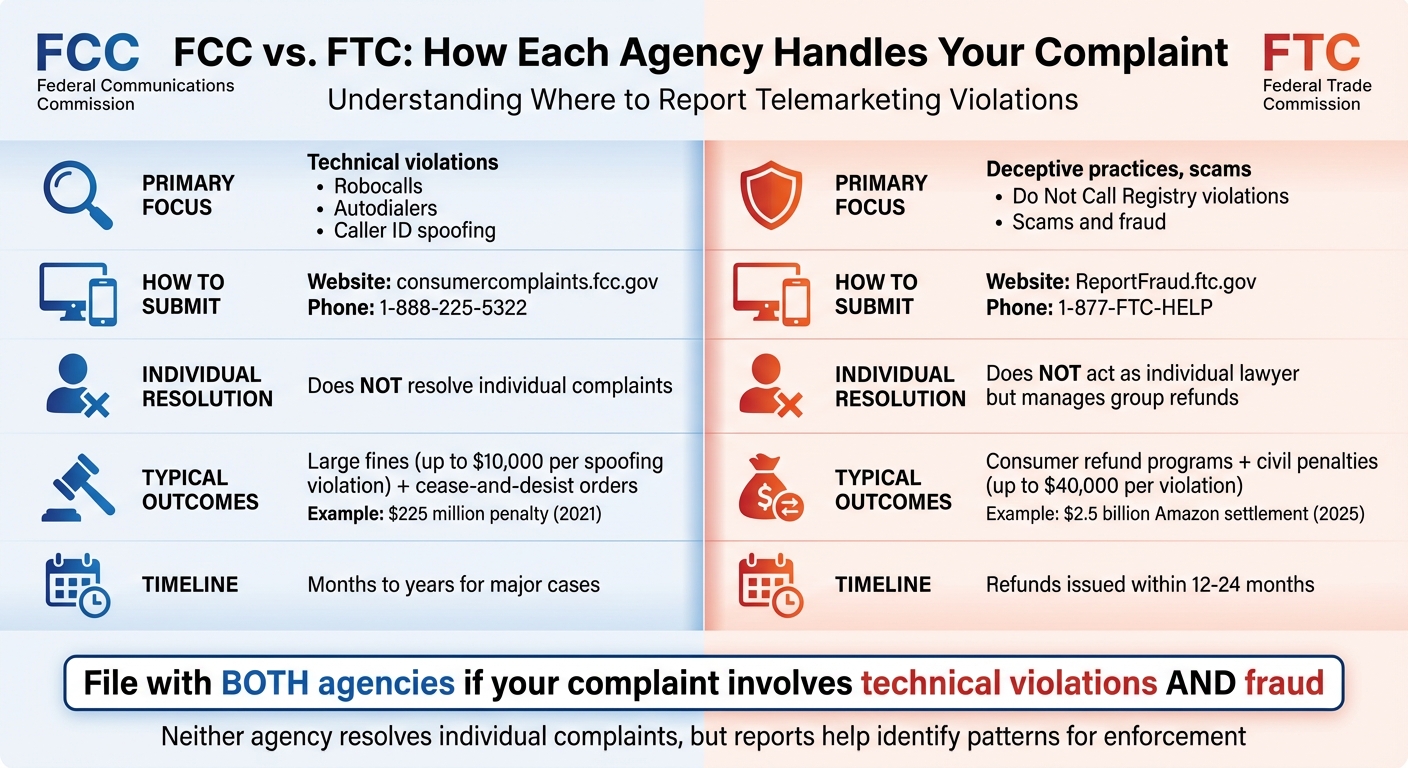
FCC vs FTC Complaint Process Comparison Chart
When it comes to handling complaints, the FCC (Federal Communications Commission) and FTC (Federal Trade Commission) share some similarities but differ significantly in their focus and outcomes. Both agencies use complaints to identify trends and build enforcement cases, though they don’t resolve individual issues. Instead, your complaint becomes part of a larger dataset that helps uncover patterns of violations.
The FCC primarily targets technical violations, such as robocalls, autodialers, and caller ID spoofing. For example, in March 2021, the FCC imposed a staggering $225 million penalty on John C. Spiller and Jakob A. Mears for making roughly 1 billion spoofed robocalls promoting short-term health insurance. Similarly, in September 2018, Philip Roesel’s company, Best Insurance Contracts, was fined $82.1 million for illegal caller ID spoofing.
On the other hand, the FTC focuses on deceptive practices and fraud prevention, often resulting in consumer refunds. In September 2025, the FTC secured a $2.5 billion settlement from Amazon for misleading subscription practices. Another example is December 2025, when Legion Media LLC paid $27.6 million, benefiting over 1.2 million consumers. While these settlements take time, they often lead to direct financial relief for affected individuals.
Comparison Table
| Aspect | FCC | FTC |
|---|---|---|
| Primary Focus | Technical violations (e.g., robocalls, spoofing) | Deceptive practices, scams, Do Not Call Registry violations |
| Submission Methods | Online portal (fcc.gov/complaints), phone | Online portal (reportfraud.ftc.gov), phone |
| Individual Resolution | Does not resolve individual complaints | Does not act as an individual lawyer but manages group refunds |
| Typical Outcome | Large fines (up to $10,000 per spoofing violation) and cease-and-desist orders | Consumer refund programs and civil penalties (up to $40,000 per violation) |
| Enforcement Timeline | Can take months to years for major cases | Refunds issued within 12–24 months |
For those who find the process overwhelming, ReportTelemarketer.com simplifies things by investigating your complaint, identifying the appropriate agency, and filing formal complaints – all at no cost to you. They recover attorney fees from violators when possible, ensuring you aren’t left with any out-of-pocket expenses.
This breakdown highlights the different enforcement strategies of the FCC and FTC, helping you decide the best way to approach your complaint.
Conclusion
The FCC handles technical issues like robocalls and caller ID spoofing, while the FTC focuses on fraudulent activities and violations of the Do Not Call Registry. Neither agency resolves individual complaints directly, but your reports help shape broader enforcement efforts. As the FCC explains, these complaints are used to guide large-scale actions rather than address specific cases. Knowing which agency to approach – or whether to file with both – ensures your complaint is properly documented.
ReportTelemarketer.com takes a more hands-on approach. They investigate your case, send cease-and-desist letters or formal complaints, and even recover attorney fees from violators – all without charging you. While federal agencies focus on identifying patterns and enforcing systemic solutions, this service zeroes in on your individual case by identifying violations and taking direct legal action to stop the calls.
Understanding the roles of these agencies helps you determine the best course of action for your situation. For immediate, personalized action, ReportTelemarketer.com can handle the investigation and legal process for you. Pairing this with registering on the National Do Not Call Registry at donotcall.gov and filing complaints with the relevant federal agencies ensures you’re doing everything possible to combat illegal telemarketing.
FAQs
Should I report a robocall to the FCC, the FTC, or both?
If you’re dealing with robocalls or unwanted telemarketing calls, it’s a good idea to report them to both the FCC and FTC. Here’s why: the FCC tackles illegal robocall operations, while the FTC zeroes in on telemarketing scams. By reporting to both, you help bolster enforcement efforts on multiple fronts.
You can also use platforms like ReportTelemarketer.com, which assist in investigating and addressing violations. These tools work to identify offenders and take appropriate action. Filing complaints across all these channels increases the chances of effectively combating unwanted calls.
What details should I collect before filing a complaint?
Before submitting a complaint to the FCC or FTC, make sure you’ve collected all the essential details. This includes the date and time of the call or message, the phone number involved, the name of the caller or company (if available), and the specific content of the call or message.
If you’re filing with the FCC, also note whether your number was spoofed or blocked. For FTC complaints, be sure to include any evidence of fraud or misleading practices. Having these details ready will make your complaint more effective.
Will filing a complaint stop the calls or get me my money back?
Filing a complaint with the FCC or FTC can play a role in helping authorities address telemarketer violations. However, it’s important to understand that this process won’t necessarily stop the calls right away or guarantee you’ll get back any lost money. These agencies focus on tackling issues at a broader, systemic level. To make your report effective, provide accurate and detailed information, but keep in mind that filing a complaint is not a quick fix or a direct path to refunds.

