
The Federal Trade Commission (FTC) actively enforces rules to reduce unwanted telemarketing calls through the National Do Not Call Registry. Here’s what you need to know:
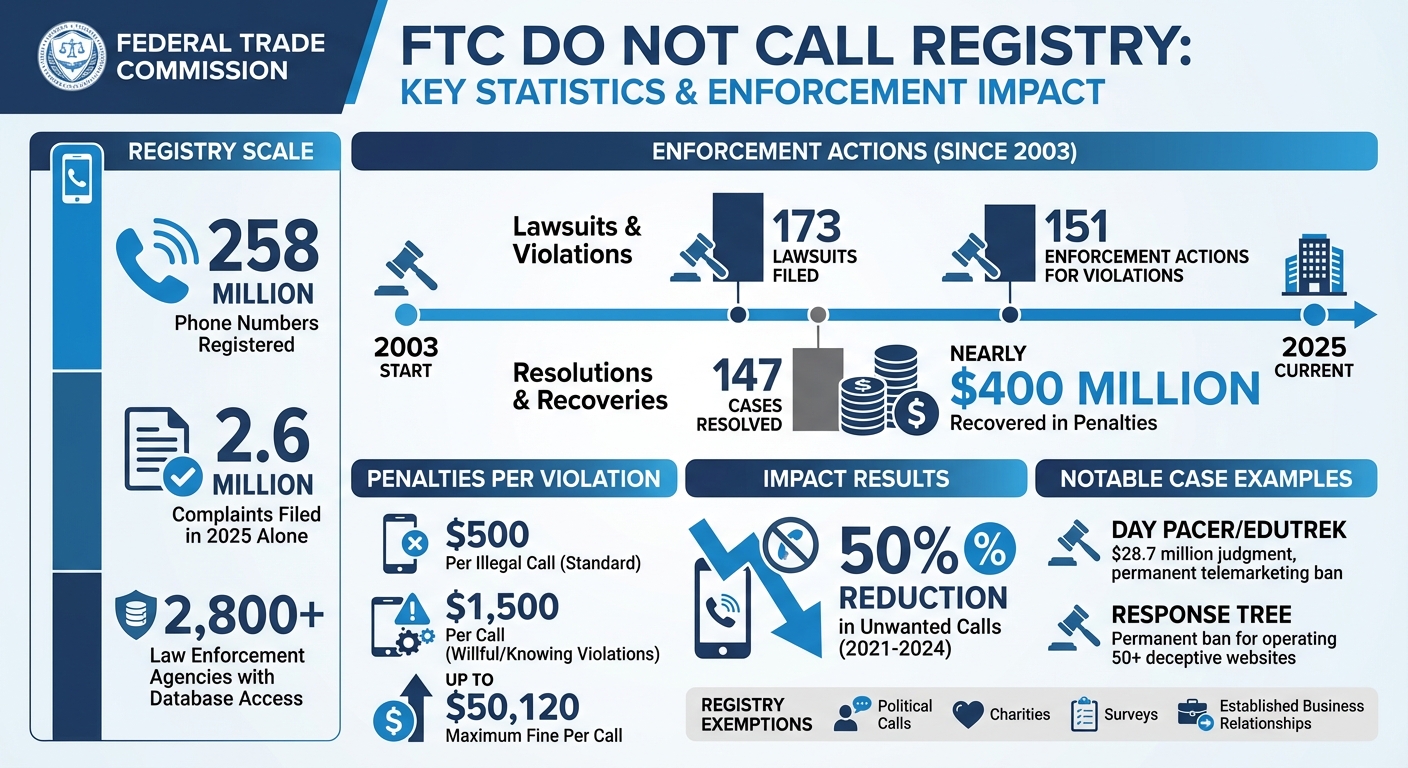
- Registry Basics: Over 258 million phone numbers are registered, and telemarketers must avoid calling these numbers for sales purposes. Registration is free and permanent unless the number is disconnected.
- Consumer Role: You can report violations at DoNotCall.gov or by calling 1-888-382-1222. In 2025 alone, over 2.6 million complaints were filed.
- Enforcement Actions: Since 2003, the FTC has filed 173 lawsuits, penalized violators with fines up to $50,120 per call, and recovered nearly $400 million.
- Exemptions: Political calls, charitable solicitations, and informational calls are not covered by the rules. Businesses can also call consumers with an established relationship unless told otherwise.
- Key Results: Between 2021 and 2024, unwanted calls dropped by over 50%, thanks to enforcement actions and collaborations with telecom providers.
FTC Do Not Call Registry Enforcement Statistics and Impact 2003-2025
What Is the National Do Not Call Registry

The National Do Not Call Registry is a free service provided by the government that helps people reduce unwanted telemarketing calls. By registering, you make it illegal for most telemarketers to contact you for sales purposes.
What the Registry Does
This registry acts as a compliance tool for telemarketers, rather than a call-blocking mechanism. It provides a list of phone numbers that legitimate telemarketing companies must avoid contacting. As the FTC explains:
"The National Do Not Call Registry is designed to stop unwanted sales calls from real companies that follow the law".
When you sign up with your home or cell phone number, telemarketers are required to check the registry every 31 days and remove your number from their call lists. Registration is free, lasts indefinitely, and applies to both live calls and robocalls. If you receive a sales call more than 31 days after registering, the caller is breaking federal law and you should report the Do Not Call Registry violation.
However, the registry doesn’t cover everything. Scammers often ignore the law, and certain types of calls – like political campaigns, charities, debt collection, or informational calls without a sales pitch – are exempt from these rules.
This system operates within a legal framework, which is explained below.
FTC’s Legal Authority
The FTC enforces the Do Not Call rules under several federal laws. The Telemarketing and Consumer Fraud and Abuse Prevention Act laid the groundwork for the Telemarketing Sales Rule (TSR), while the Do-Not-Call Implementation Act (15 U.S.C. § 6151) specifically authorized the creation and enforcement of the registry.
As stated in the law:
"The Federal Trade Commission is authorized under section 6102(a)(2)(A) of this title to implement and enforce a national do-not-call registry".
The Do-Not-Call Improvement Act of 2007 added more protections by making registrations permanent unless the phone number is disconnected or the consumer requests removal.
With these laws, the FTC has strong powers to investigate and enforce compliance. This includes issuing subpoenas, charging up to $14,850 annually for access to the full database, and penalizing violators with fines of up to $50,120 per illegal call. The FTC also collaborates with the Federal Communications Commission to align telemarketing rules across federal agencies.
These legal tools allow the FTC to monitor compliance and take action against those who violate the rules.
sbb-itb-a8d93e1
How the FTC Finds Violations
The Federal Trade Commission (FTC) uses a combination of consumer reports and automated monitoring to identify telemarketers who violate Do Not Call rules. These methods are essential for enforcing compliance and initiating penalties or legal actions.
How Consumers Report Violations
Consumer complaints play a critical role in helping the FTC detect violations. In fiscal year 2025, over 2.6 million complaints about unwanted calls were filed with the agency. If you need to report a violation, you can do so online at DoNotCall.gov or by calling 1-888-382-1222. Be sure to include key details like the caller ID, date, time, and whether it was a robocall or a live call.
Once collected, this complaint data is shared through the Consumer Sentinel Network, a secure database that more than 2,800 federal, state, and local law enforcement agencies can access. While consumer complaints are invaluable, the FTC also depends on automated systems to strengthen its enforcement efforts.
FTC Monitoring Systems
The FTC takes additional steps to track and curb violations through its monitoring systems. Each day, the agency shares complaint data with telecommunications providers and call-blocking companies. It also keeps a close eye on registry access logs to identify telemarketers who are actively checking the Do Not Call list.
To investigate potential violators, the FTC uses tools like Civil Investigative Demands and subpoenas to gather documents and testimony. The agency also monitors Voice over Internet Protocol (VoIP) providers and auto-dialing platforms that facilitate illegal robocalls. By analyzing complaint data through interactive dashboards, the FTC can identify trends in fraudulent activity. In 2025, the most commonly reported violations included debt reduction scams, medical-related inquiries, and government impersonation schemes.
Penalties for Violating Do Not Call Rules
The FTC doesn’t just rely on advanced detection methods – it backs them up with hefty penalties. These penalties are designed to hit violators where it hurts: their wallets. Telemarketers who ignore Do Not Call rules face both civil fines and restitution to compensate consumers impacted by their actions.
How Fines Are Calculated
Violations come with a price. Each illegal call carries a statutory penalty of $500, which can jump to $1,500 for willful or knowing violations. For companies making thousands – or even millions – of illegal calls, the fines can quickly add up to staggering amounts.
"The TCPA allows a person who has received more than one call in 12 months in violation of the Do Not Call Registry provisions to recover up $500 in statutory damages per call (or up to $1,500 in statutory damages per call if the defendant acted willfully or knowingly)."
- Kronenberger Rosenfeld, LLP
But the consequences don’t stop at monetary fines. Offenders may face permanent bans from telemarketing, asset freezes to ensure funds for consumer compensation, and even personal liability for corporate officers who knowingly engage in these violations. Courts can also issue injunctions to shut down illegal operations immediately and enforce ongoing compliance measures.
Real Enforcement Cases
The FTC has pursued 151 enforcement actions for Do Not Call violations, with 147 cases already resolved. One notable case occurred in January 2024, when a federal court ruled against Day Pacer, LLC, EduTrek, LLC, and their owners. They were held jointly responsible for a $28.7 million judgment after making millions of illegal calls and aiding others in placing around 40 million more. The court also permanently barred them from telemarketing.
Another example involves Response Tree, LLC and its president, who were permanently banned from telemarketing activities. They had operated over 50 deceptive websites that collected consumer information for illegal robocalls. These cases highlight the FTC’s commitment to enforcing the rules and protecting consumers from abusive practices.
Exemptions and Enforcement Limits
The FTC’s enforcement powers are limited to calls within its jurisdiction, which means some unwanted calls persist even if you’re on the Registry.
Which Calls Are Exempt
Certain types of calls fall outside the FTC’s regulatory scope. For instance, political calls are exempt because the FTC lacks authority over political speech or campaign-related calls. Likewise, nonprofit and charity calls are generally not regulated, though third-party telemarketers working for charities must still follow Registry rules. These exemptions are tied to legal restrictions on the FTC’s authority.
Survey and research calls are also exempt because they aren’t selling anything. The FTC focuses on "telemarketing sales calls", so informational calls – like flight updates or appointment reminders – don’t count as violations.
The Established Business Relationship (EBR) exemption allows companies to contact consumers they’ve recently done business with. This includes up to 18 months after a purchase or 90 days after an inquiry, unless the consumer opts out. However, even with an EBR, businesses must honor direct requests to stop calling.
Additionally, companies can invoke Safe Harbor if they demonstrate strong compliance practices, such as employee training and maintaining internal suppression lists. This protection only applies to accidental violations, not deliberate misconduct.
These exemptions are rooted in legal limits that define the FTC’s jurisdiction.
Reasons for Exemptions
The exemptions are based on statutory restrictions on what the FTC can regulate. For example, First Amendment protections prevent the agency from restricting political calls, and nonprofit exemptions reflect Congress’s decision to limit the FTC’s reach.
The EBR exemption acknowledges that businesses should be able to follow up with consumers who have voluntarily interacted with them. However, this privilege has strict time limits – 18 months for transactions and 90 days for inquiries – to prevent indefinite use of past relationships.
"Because of the limits to FTC’s authority, the Registry does not apply to political calls or calls from non-profits and charities."
- Federal Trade Commission
Since the FTC’s authority has boundaries, other agencies step in to fill the gaps. The Federal Communications Commission (FCC) enforces the Telephone Consumer Protection Act (TCPA), and state laws often impose stricter rules than federal regulations. This layered system provides additional consumer protections, even where the FTC’s jurisdiction ends.
How to Report Violations
Reporting violations plays a crucial role in strengthening the FTC’s ability to enforce laws and safeguard consumers from illegal telemarketing practices. By filing a report, you help the FTC track and take action against repeat offenders nationwide.
Filing a Complaint with the FTC
To make your report count, head to DoNotCall.gov and provide the following details:
- The phone number that received the call
- The caller ID information (even if spoofed)
- Any callback number mentioned during the call
- The exact date and time of the call
- Whether it was a robocall or a live call
- The subject of the call (e.g., debt reduction, government impersonation, medical inquiries, etc.)
If you’ve experienced a financial loss or have specific details about a scam, use ReportFraud.ftc.gov instead. The FTC shares reported phone numbers daily to assist carriers and analytics companies in improving call-blocking technologies. These reports also feed into the FTC’s extensive complaint database.
A quick tip: Never press any opt-out buttons during robocalls. Doing so confirms your number is active, which can lead to even more calls. Hang up immediately and file a report instead.
For those seeking legal support, there’s another option outlined below.
Using ReportTelemarketer.com
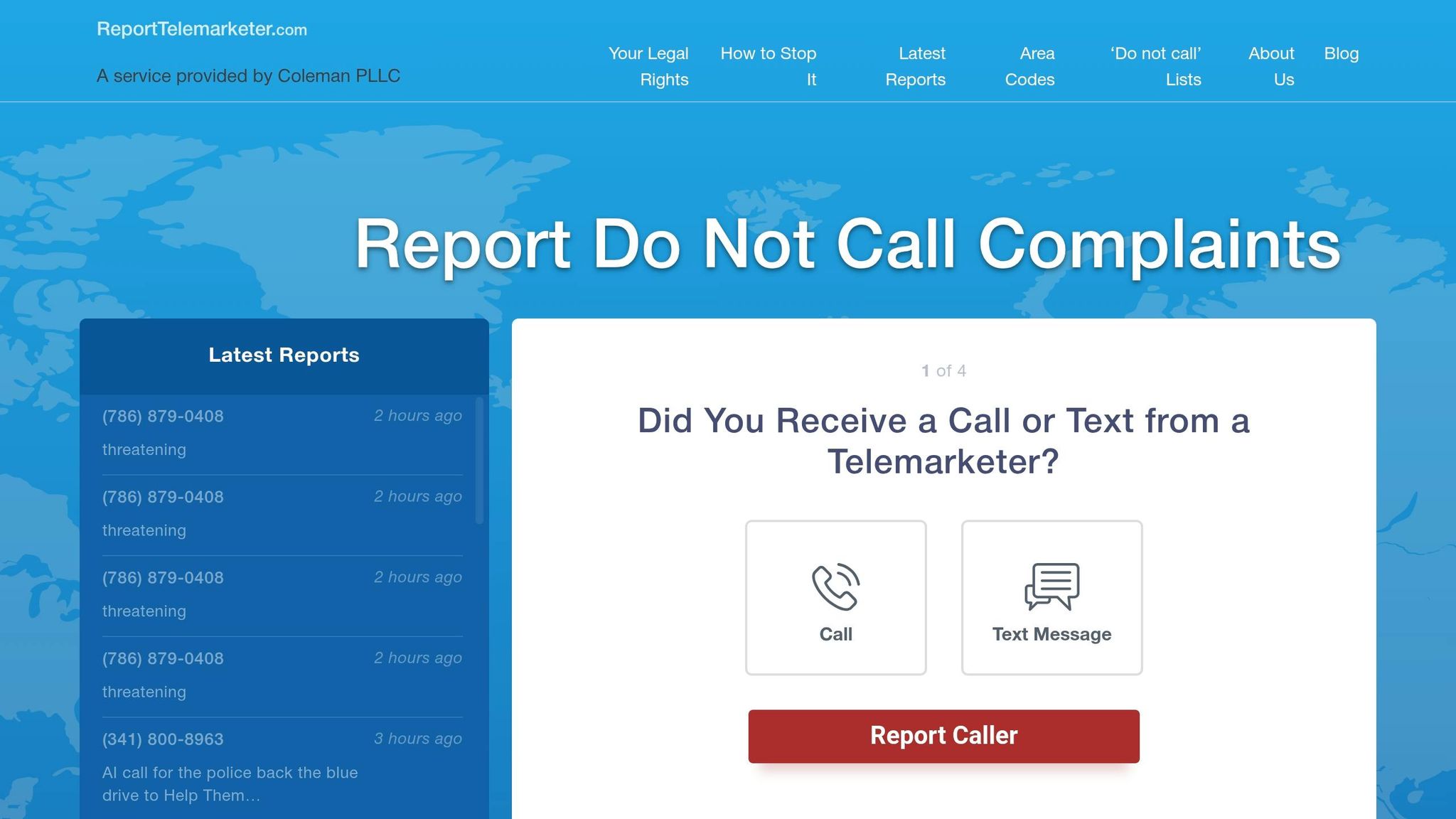
ReportTelemarketer.com offers a legal follow-up service designed to investigate telemarketers, identify violations, and take direct action. This can include filing cease-and-desist letters or formal complaints. The service is completely free for consumers, as attorney fees are recovered from the telemarketers when applicable.
Conclusion
Since 2003, the FTC has made strides in reducing unwanted calls, recovering nearly $400 million and cutting related complaints by half. This progress highlights how federal efforts and consumer involvement work together to protect privacy.
Your reports play a key role in this process. The FTC relies on consumer complaints to identify trends, coordinate enforcement actions, and share data with call-blocking technology providers. These efforts demonstrate how impactful your participation truly is.
Getting involved is straightforward. You can register your number at DoNotCall.gov, report violations as they happen, and use call-blocking tools to minimize interruptions. As Samuel Levine, Director of the FTC’s Bureau of Consumer Protection, emphasized:
"Today, government agencies at all levels are united in fighting the scourge of illegal telemarketing. We are taking action against those who trick people into phony consent to receive these calls and those who make it easy and cheap to place these calls."
If you’re dealing with persistent offenders, ReportTelemarketer.com offers a free service to investigate violations and file cease-and-desist letters or formal complaints on your behalf. The best part? The platform recovers attorney fees directly from the telemarketers, so there are no out-of-pocket costs for you.
Every action you take strengthens the fight against illegal telemarketing. By reporting violations, you help law enforcement track patterns, improve call-blocking tools, and hold offenders accountable. Your participation ensures continued progress in protecting consumer privacy.
FAQs
Why am I still getting calls after registering?
The National Do Not Call Registry helps reduce unwanted sales calls, but it doesn’t block everything. For instance, it doesn’t stop calls from scammers or illegal telemarketers. Plus, legitimate telemarketers may take up to 31 days to update their lists after you register. While the registry is a useful tool, it’s not a complete solution for avoiding all types of calls.
What proof do I need to report a Do Not Call violation?
To report a Do Not Call violation, you’ll need to gather evidence showing that a telemarketer contacted you despite your number being listed on the National Do Not Call Registry. Make sure to note the date and time of the call, the phone number that appeared on your caller ID, and, if possible, provide any recordings of the call. These details are crucial for a proper investigation.
Can I sue a telemarketer for illegal calls?
Yes, it’s possible to take legal action against a telemarketer for illegal calls. If they violate the Do Not Call rules, the Federal Trade Commission (FTC) can step in with enforcement actions, which may include financial penalties. On top of that, individuals affected by these violations have the right to seek legal remedies under relevant laws.

