
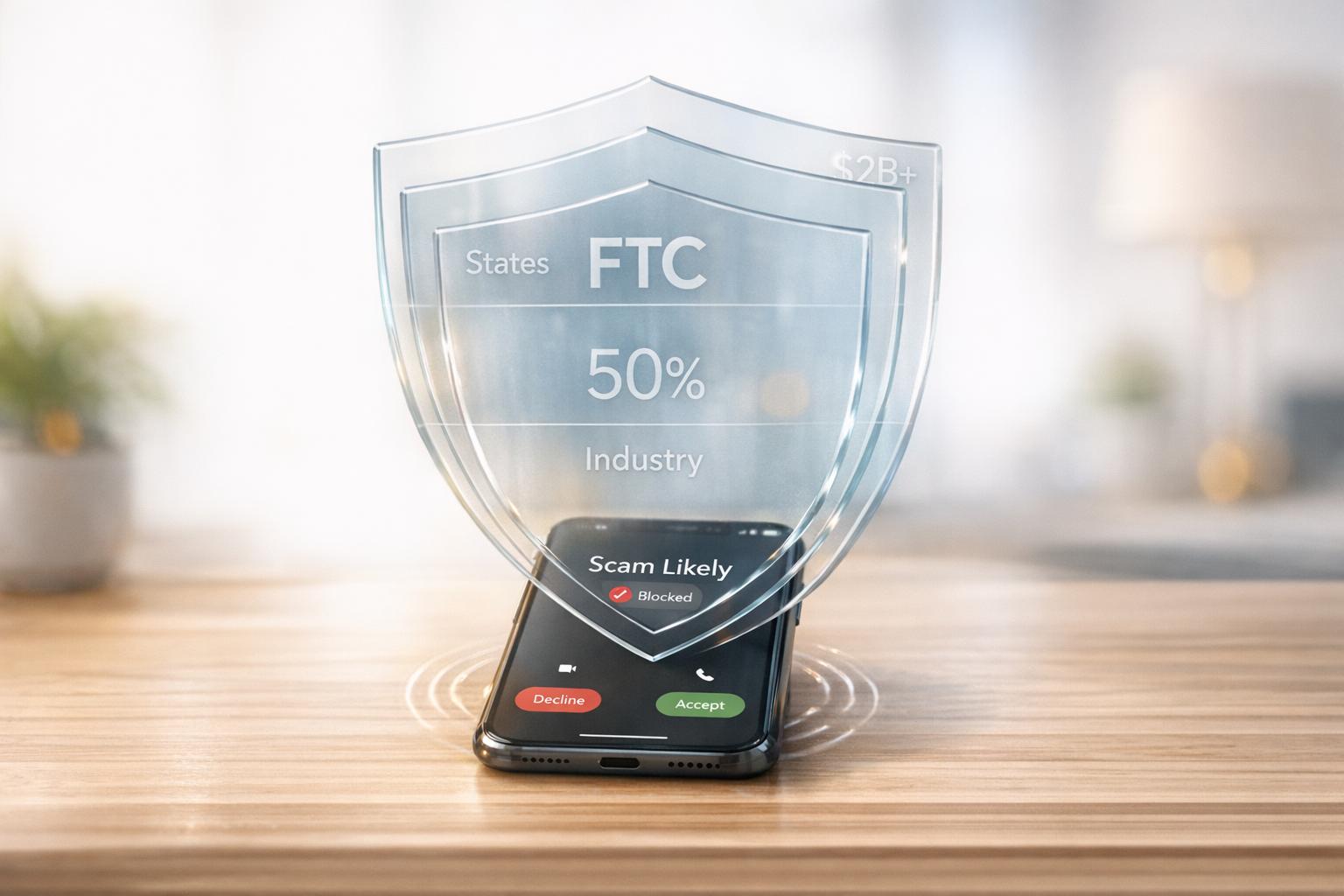
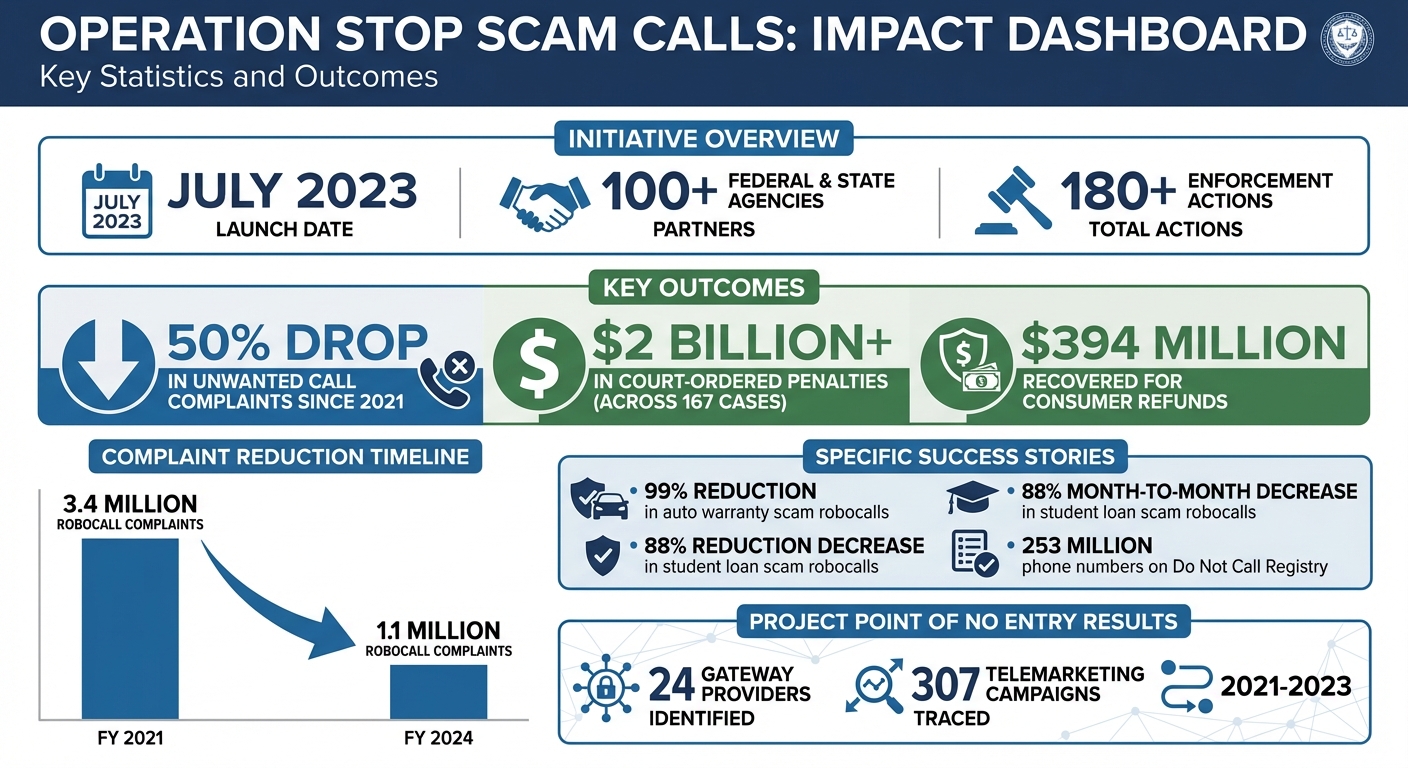
Since July 2023, the FTC, alongside over 100 federal and state partners, has been cracking down on illegal robocalls through Operation Stop Scam Calls. This initiative targets the entire ecosystem behind scam calls, from telemarketers to VoIP providers, and has led to over 180 enforcement actions. Key outcomes include:
- 50% drop in unwanted call complaints since 2021.
- Over $2 billion in penalties issued across 167 cases.
- $394 million recovered for consumer refunds.
The effort combines legal actions, consumer education, and advanced call-blocking measures. Agencies like the FCC and DOJ also play critical roles by blocking scam calls at the network level and pursuing criminal cases.
What You Can Do:
- Report scam calls at ReportTelemarketer.com.
- Register your number on the Do Not Call Registry.
- Use call-blocking tools to protect your phone.
Illegal robocalls are declining, but staying vigilant and reporting suspicious calls remains vital. Together, these actions are making a real difference.
Operation Stop Scam Calls: Key Statistics and Impact Results 2021-2024
Key Partnerships in the Initiative
Operation Stop Scam Calls thrives on partnerships that span federal, state, and industry sectors. These collaborations are designed to address every part of the illegal telemarketing chain – from the scammers making the calls to the technology providers enabling them. By targeting all angles, the initiative ensures no stone is left unturned in tackling the problem.
Collaboration with the Federal Communications Commission (FCC)
The FTC and FCC work together to combat scam calls using a two-pronged strategy. The FTC focuses on legal action against companies making illegal calls, while the FCC uses its authority to block robocall traffic directly at the network level. This coordinated effort has led to impressive results, including a 99% drop in auto warranty scam robocalls and an 88% month-to-month decrease in student loan scam robocalls.
To strengthen these efforts, the FCC mandated that all IP-based voice service providers implement STIR/SHAKEN caller ID authentication by June 2023. Additionally, a renewed Memorandum of Understanding between the FTC and FCC supports their joint work in the Anti-Robocall Litigation Task Force, with the FCC focusing on stopping illegal calls at the network level. Knowing how to stop spam calls is essential for consumer protection. As Loyaan Egal, FCC Enforcement Bureau Chief, put it:
"The FCC is committed to using every tool at its disposal to crack down on illegal robocalls and protect the U.S. communications network."
Partnership with the U.S. Department of Justice (DOJ)
The DOJ plays a critical role by filing federal complaints and pursuing both civil and criminal charges to support FTC enforcement. In July 2023, the DOJ took action on FTC complaints against companies like Fluent, LLC, which operated "consent farms" to deceptively collect and sell over 620 million telemarketing leads. This resulted in a $2.5 million civil penalty. Another case targeted Yodel Technologies, LLC and its owner Robert Pulsipher for making over 1.4 billion soundboard robocalls, leading to a $1 million penalty and a permanent ban.
The DOJ has also gone after VoIP providers facilitating illegal calls. For example, Miami-based Hello Hello Miami (HHM) was accused of enabling 37.8 million illegal robocalls from foreign telemarketers impersonating Amazon.com. Another case targeted XCast Labs, Inc., which allegedly ignored government warnings and funneled hundreds of millions of illegal calls. Combined, these legal actions have resulted in more than $2 billion in penalties.
The FTC also works closely with USTelecom’s Industry Traceback Group (ITG), which helps trace illegal robocalls and identify "gateway" providers. Through "Project Point of No Entry", the ITG identified 24 service providers responsible for routing illegal calls for roughly 307 telemarketing campaigns between 2021 and 2023.
Involvement of State Attorneys General
State attorneys general bring local expertise and enforcement power to the initiative. Their efforts complement federal actions, often through multistate lawsuits that deliver substantial financial penalties and permanent injunctions against offenders. For example, in March 2023, the Texas Office of the Attorney General dismantled a major robocall operation, securing judgments totaling over $244 million against two individuals.
In another case, Texas led a multistate coalition in May 2023 to file a lawsuit against Michael D. Lansky, LLC (doing business as Avid Telecom), its owner Michael Lansky, and Vice President Stacey S. Reeves. The suit alleged that the defendants facilitated billions of robocalls, including hundreds of millions targeting Texas numbers. Illinois Attorney General Kwame Raoul highlighted the importance of such partnerships, stating:
"Unsolicited robocalls violate consumers’ privacy and unnecessarily cost them time and money. Companies responsible for these illegal, annoying calls must be held accountable."
sbb-itb-a8d93e1
Federal and State Agency Contributions
Operation Stop Scam Calls has orchestrated over 180 enforcement actions and initiatives to combat illegal telemarketing activities. This collaboration leverages the distinct strengths of federal and state agencies, combining resources and expertise to address various aspects of the telemarketing problem. These efforts are further strengthened by targeted initiatives from specialized groups and direct enforcement actions led by the FTC.
Industry Traceback Group and Law Enforcement
A key player in this fight is USTelecom’s Industry Traceback Group (ITG), which works closely with law enforcement to trace the origins of illegal robocalls. By providing detailed tracing data, the ITG helps pinpoint the entry points for foreign calls, enabling agencies to block these calls at their source. Consumers can also take proactive steps to block and report spam calls directly.
State law enforcement agencies complement federal efforts by contributing localized expertise and resources, enhancing the overall enforcement strategy and expanding the range of actions taken against illegal telemarketing operations.
Additional Enforcement Actions by the FTC
While tracing efforts focus on blocking call origins, the FTC takes additional steps through targeted legal actions. For instance, in July 2023, the FTC settled charges against Viceroy Media Solutions, LLC (operating as quick-jobs.com) and its owners, Sunil Kanda and Quynh Tran. Accused of facilitating millions of illegal robocalls via deceptive lead generation, the settlement imposed a $913,636 civil penalty (partially suspended) and prohibited the defendants from assisting companies in placing robocalls.
Another case in July 2023 involved Solar Xchange LLC and its owner, Mark Getts. They were charged with making tens of millions of unlawful telemarketing calls on behalf of Vision Solar LLC, often falsely claiming affiliations with government or utility entities. The settlement included a partially suspended $13.8 million civil penalty.
To date, the FTC has pursued 167 cases against illegal robocallers and Do Not Call violators. Courts have ordered over $2 billion in penalties, with the FTC successfully collecting more than $394 million to provide refunds to affected consumers.
Key Outcomes of Operation Stop Scam Calls
Reduction in Scam Calls and Penalties Levied
Unwanted call reports have seen a dramatic decline – over 50% since 2021. In Fiscal Year 2024, the FTC logged 1.1 million robocall complaints, a significant drop from the 3.4 million complaints filed in FY 2021. This steady decrease in complaints has continued for three consecutive years.
On the enforcement side, courts have issued heavy financial penalties. Across 167 cases, defendants in FTC robocall lawsuits have been ordered to pay over $2 billion. Out of these judgments, the FTC has recovered more than $394 million, with a significant portion refunded directly to affected consumers.
"Illegal calls remain a scourge, but the FTC’s strategy to pursue upstream players and equip the agency to confront emerging threats is showing clear signs of success." – Sam Levine, Director of the FTC’s Bureau of Consumer Protection
These enforcement achievements mark a crucial step in protecting consumers from fraudulent schemes.
Improved Consumer Protection
The reduction in scam calls has gone hand-in-hand with stronger consumer protections. Alongside the drop in call volume, measures to safeguard consumers have been bolstered. For instance, the National Do Not Call Registry now boasts over 253 million actively registered phone numbers. Additionally, the FTC has updated its regulations, introducing a rule that bans impersonation of government entities or businesses and expanding the Telemarketing Sales Rule to shield businesses from illegal telemarketing practices.
The initiative has adopted a more comprehensive approach, targeting the entire telemarketing ecosystem. Through "Project Point of No Entry", authorities identified 24 gateway providers responsible for routing illegal robocalls across roughly 307 telemarketing campaigns. By cutting off these upstream players – such as VoIP providers and lead generators – the effort has disrupted the critical infrastructure scammers rely on to reach U.S. consumers.
How Consumers Can Help Fight Scam Calls
Using ReportTelemarketer.com
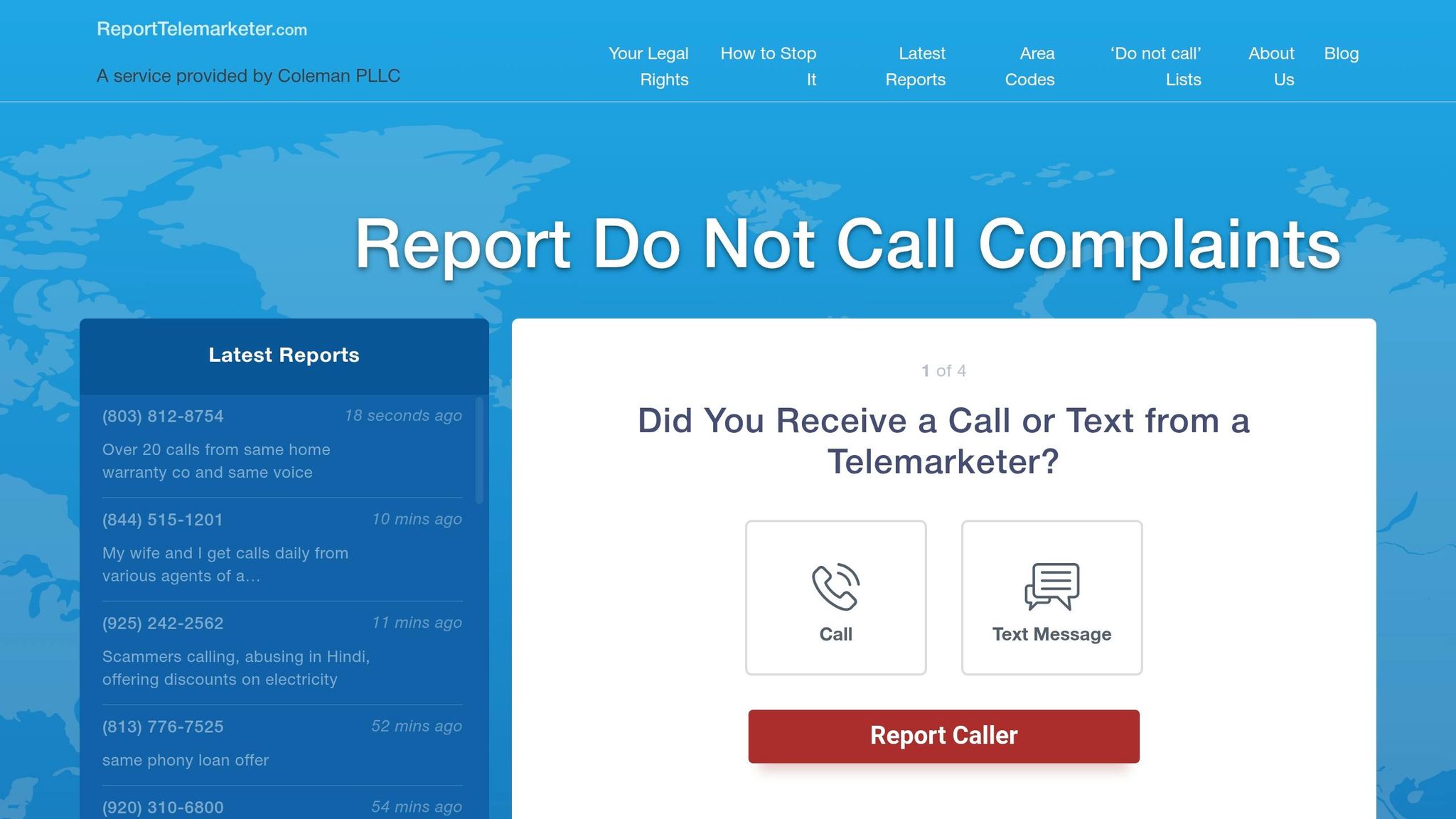
Consumer reports play a key role in helping authorities track down illegal robocallers. Your input makes a difference in combating these nuisances. Ohio Attorney General Dave Yost emphasized this by saying:
"Our secret weapon is consumers – whom we urge to continue reporting illicit robocalls, so we can sever these unwanted illegal robocallers’ connection once and for all".
ReportTelemarketer.com provides a free service designed to track illegal calls, spot consumer protection violations, and send cease-and-desist letters – all without charging you. The costs are covered by recovering fees from telemarketers.
When reporting a scam call, be as detailed as possible. Include the number that received the call, the caller ID number displayed, any callback number provided, and the exact date and time of the call. Even if you suspect the number is spoofed, report it. The FTC uses these reports to identify trends, trace illegal callers, and publicly share reported numbers every business day.
Beyond reporting, there are steps you can take to safeguard your phone.
Tips for Protecting Yourself from Scam Calls
If you hear a recorded message or encounter a suspicious sales pitch, hang up right away. Avoid pressing any numbers, as this can confirm your number and lead to more unwanted calls. Keep in mind that robocalls selling products or services are illegal unless you’ve given written consent for the company to contact you.
To reduce unwanted calls, register your number at DoNotCall.gov or call 1-888-382-1222. Additionally, use call-blocking features to filter out unknown numbers, as scammers often manipulate caller IDs to appear legitimate .
Conclusion
Operation Stop Scam Calls showcases the strength of coordinated enforcement. With support from over 100 law enforcement partners – including attorneys general from all 50 states – this initiative has taken over 180 enforcement actions and secured more than $2 billion in court-ordered penalties. The FTC alone has recovered more than $394 million to refund consumers. These partnerships tackle every stage of the scam call process, from shady "consent farms" selling fake leads to gateway VoIP providers enabling illegal robocalls. As FTC Chair Lina M. Khan emphasized:
"This scourge does not respect borders, and our recommitment to this MOU underscores the importance of international communication and cooperation to combat this problem".
This collective effort not only disrupts scammers but also empowers you to play a role in stopping these schemes. Reporting suspicious calls is essential to tracing and dismantling these operations. Platforms like ReportTelemarketer.com make it simple to report violations for free, sparking investigations and cease-and-desist actions funded by telemarketer fees.
The results speak for themselves: complaints about unwanted calls have decreased by more than 50% since 2021. While scammers continue to adapt, staying alert and reporting every suspicious call is key. By doing so, you’re not just protecting yourself – you’re helping shield millions of Americans from these persistent threats. As federal, state, and industry partners evolve their strategies, your vigilance and reporting remain critical to this ongoing fight.
FAQs
How does Operation Stop Scam Calls actually stop robocalls?
Operation Stop Scam Calls takes aim at the growing problem of robocalls by bringing together federal and state agencies in a united enforcement effort. The focus? Cracking down on the key players behind these illegal calls – telemarketers, lead generators, and VoIP providers that enable scammers to operate.
The initiative uses a multi-pronged approach, including shutting down operations linked to illegal robocalls, disrupting the technology scammers rely on, and taking legal action against those responsible. Beyond enforcement, it also emphasizes educating consumers about their rights and how to protect themselves.
By dismantling the systems that fuel these scams and equipping individuals with knowledge, this operation works to significantly cut down robocalls and shield people from falling victim to these schemes.
What is STIR/SHAKEN, and why does it matter for caller ID spoofing?
STIR/SHAKEN is a framework designed to authenticate caller ID information, ensuring that the caller’s identity is legitimate. This system is crucial in the fight against caller ID spoofing – a tactic frequently used in scam calls and robocalls. By verifying the accuracy of the caller’s details, STIR/SHAKEN helps safeguard consumers from fraudulent and deceptive calls.
What details should I include when I report a scam call to ReportTelemarketer.com?
When submitting a scam call report to ReportTelemarketer.com, make sure to include these important details to aid the investigation:
- Phone number the call originated from.
- Date and time when the call occurred.
- Description of the scam, such as suspicious messages, threats, or unusual requests.
The more detailed your report, the easier it is to identify offenders and work toward stopping these unwanted calls.

