
If your business uses telemarketing or promotional texts, understanding TCPA (Telephone Consumer Protection Act) and FTSA (Florida Telephone Solicitation Act) is essential to avoid hefty fines.
Here’s what you need to know:
- TCPA (Federal, 1991): Requires written consent for telemarketing calls/texts and narrowly defines autodialers as systems using random or sequential number generation.
- FTSA (Florida, updated 2021/2023): Stricter rules for contacting Florida residents, including broader autodialer definitions, a 3-call/text daily cap, and shorter permissible call hours (8:00 a.m.–8:00 p.m.).
Violations under both laws cost $500–$1,500 per infraction, but FTSA lawsuits are rising due to added provisions like attorney fee recovery and a private right of action. Businesses must also honor opt-out requests within 15 days under FTSA.
Quick Comparison
| Feature | TCPA (Federal) | FTSA (Florida) |
|---|---|---|
| Autodialer Definition | Narrow – random/sequential number use | Broad – automated selection & dialing |
| Daily Call Limit | None | 3 calls/texts per 24 hours |
| Permissible Hours | 8:00 a.m.–9:00 p.m. | 8:00 a.m.–8:00 p.m. |
| Opt-Out Grace Period | Immediate | 15 days for texts |
| Penalties | $500–$1,500 per violation | $500–$1,500; attorney fees recoverable |
To comply, businesses must secure written consent, respect Florida’s stricter rules, and maintain accurate records. Ignoring these laws could lead to six- or seven-figure penalties.
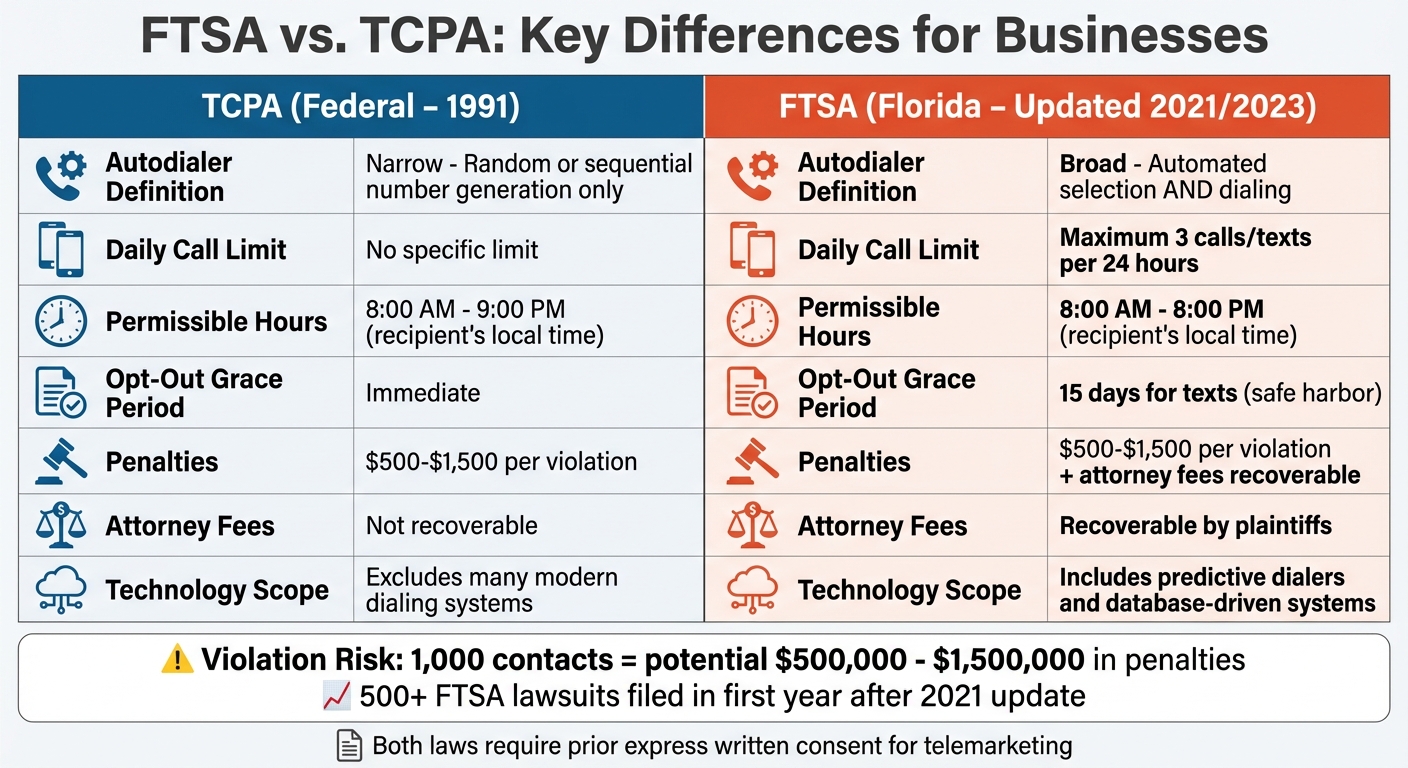
FTSA vs TCPA Compliance Requirements Comparison Chart
Window to the Law: Updated Guidance for TCPA Compliance
sbb-itb-a8d93e1
Main Differences Between FTSA and TCPA
Both the FTSA and TCPA aim to regulate telemarketing practices, but they differ significantly in how they approach automated calling systems, frequency limits, and consent requirements. These differences can make compliance tricky, especially for businesses targeting Florida consumers or operating across multiple states.
How Each Law Defines Autodialers
The TCPA defines an Automatic Telephone Dialing System (ATDS) narrowly. It applies only to equipment capable of storing or producing numbers using a random or sequential number generator. Florida’s Telephone Solicitation Act (FTSA), however, casts a wider net by regulating any "automated system" that handles both the selection and dialing of phone numbers. A 2023 amendment tightened this definition by requiring that both functions – selection and dialing – be automated, replacing the word "or" with "and."
This broader definition means that systems compliant with the TCPA, such as predictive dialers or database-driven technologies, might still violate the FTSA.
David O. Klein, Managing Partner at Klein Moynihan Turco, explains: "The FTSA’s ‘automated system’ was not the equivalent of the TCPA’s ‘autodialer.’ As expected, the definition and alleged use of an automated system is now heavily litigated."
In Turizo v. Subway (2023), the Southern District of Florida confirmed that the FTSA’s definition of an "automated system" extends beyond the TCPA’s narrower scope.
| Feature | TCPA (Federal) | FTSA (Florida) |
|---|---|---|
| Autodialer Definition | Requires random or sequential number generation | Covers automated systems for selection and dialing |
| Technology Scope | Narrower – excludes many modern dialing systems | Broader – includes predictive dialers and database-driven systems |
| Rebuttable Presumption | – | Calls to Florida area codes are presumed to reach Florida residents |
Call Frequency Limits and Time Restrictions
Florida imposes stricter limits on how often businesses can contact consumers. Under the FTSA, companies can make no more than three calls or texts to the same person about the same subject within a 24-hour period. This cap applies regardless of whether different numbers are used.
The TCPA, on the other hand, does not set a specific daily limit. excessive calls might still lead to legal trouble, requiring consumers to report to stop spam calls under harassment claims, but there’s no hard rule about frequency.
| Feature | FTSA (Florida) | TCPA (Federal) |
|---|---|---|
| Daily Call Limit | Maximum of 3 calls/texts per 24 hours | No specific daily call limit |
| Permissible Hours | 8:00 a.m. – 8:00 p.m. | 8:00 a.m. – 9:00 p.m. |
| Time Zone Basis | Recipient’s local time (Eastern or Central) | Recipient’s local time |
According to ALFA International: "The FTSA time of day restrictions are slightly shorter than under the TCPA. The TCPA allows telemarketer calls between 8:00 a.m. and 9:00 p.m. for the recipient’s local time. The FTSA cuts back an hour, allowing calls from 8:00 a.m. to 8:00 p.m."
Florida’s multiple time zones add another layer of complexity. Businesses need to ensure their dialing systems align with the recipient’s local time, whether Eastern or Central.
Consent Requirements and Coverage
Consent rules differ significantly between the two laws, creating additional challenges for businesses. Both the FTSA and TCPA require prior express written consent for telemarketing, but the FTSA applies this rule more broadly. Florida mandates consent for all unsolicited telephonic sales calls made using automated systems to its residents.
Unlike the TCPA, the FTSA also extends its consent requirements to promotional texts. Even if a technology doesn’t meet the TCPA’s ATDS definition, businesses must still secure written permission before sending texts to Florida area codes. A 2023 amendment clarified that a valid signature under the FTSA could include digital acts, like checking a box on a web form, as long as it authorizes both the selection and dialing of numbers.
Joshua H. Threadcraft, Partner at Burr & Forman LLP, notes: "Substitution of the word ‘and’ for ‘or’ [in the 2023 amendment] provides greater clarity regarding the technology subject to the FTSA, and limits arguable application of the Act."
The FTSA also offers a 15-day safe harbor for text messages. If a consumer replies "STOP", businesses have 15 days to cease contact before a lawsuit can be filed. By contrast, the TCPA generally requires businesses to stop immediately.
Penalties and Enforcement
Both the FTSA and TCPA impose a fixed penalty of $500 per violation, but that amount can triple to $1,500 for willful violations. When violations are intentional or knowing, the penalties escalate significantly, potentially reaching six or seven figures for large-scale infractions. These escalating fines highlight the distinct enforcement nuances that set the FTSA apart from the TCPA.
One major difference lies in attorney’s fees. Unlike the TCPA, the FTSA allows prevailing plaintiffs to recover attorney’s fees, which has led to a surge in lawsuits in Florida. Within the first year following the FTSA’s 2021 update, over 500 consumer complaints were filed. Features like higher damage multipliers, fee recovery, and safe harbor provisions increase the stakes for businesses that fail to comply.
The FTSA also introduces a unique safe harbor provision for text messages. Consumers must first reply "STOP" to opt out before pursuing legal action, giving businesses a 15-day window to address the issue. This provision played a pivotal role in the December 2023 case, Holton v. eXp Realty, LLC, where a class action was dismissed because the plaintiff failed to use the "STOP" option.
"The amended FTSA’s application to a class is wholly prospective and the amended FTSA applies only to a class certified after May 25, 2023", the court ruled in Holton v. eXp Realty, LLC.
Another key development came with the 2023 amendments, which narrowed the FTSA’s definition of an autodialer. The updated language now requires a system to perform both "selection and dialing" of numbers, rather than just one or the other. This change, applied retroactively to uncertified class actions filed on or after May 25, 2023, has already helped businesses successfully dismiss claims that might have advanced under the original, broader definition.
How Businesses Can Comply with Both Laws
Navigating the requirements of the TCPA and FTSA calls for a well-thought-out approach that tackles consent, timing, data management, and opt-out procedures head-on.
Start by securing prior express written consent for any marketing or promotional messages. Thanks to the 2023 FTSA amendments, this consent can be obtained digitally – like checking a box on a web form or sending an affirmative reply. However, the responsibility lies squarely on the seller to prove that the disclosure was clear, easy to understand, and that the consent was unmistakable .
Once consent is in place, adjust your operations to comply with strict call timing and frequency rules. Calls can only be made between 8:00 a.m. and 8:00 p.m. in the recipient’s local time zone, and sales calls are capped at three per 24-hour period, as mandated by the FTSA . Florida’s split between Eastern and Central time zones means businesses need to fine-tune their outreach schedules accordingly .
Keep your Do Not Call registries updated every 30 days . Automating compliance can help here – use tools that update consent statuses and cross-check numbers against the Reassigned Number Database to avoid contacting numbers that have been reassigned . Additionally, any business telemarketing to Florida residents must obtain a license from the Florida Department of Agriculture and Consumer Services. Staying on top of data maintenance ensures your compliance efforts remain solid and supports effective opt-out processes.
When it comes to opt-out mechanisms, simplicity and speed are key. Make the process straightforward by offering options like replying "STOP" or "QUIT", and act on these requests within 10 business days. While the FTSA provides a 15-day safe harbor for text messages, processing opt-outs immediately helps reduce the risk of legal challenges . After receiving an opt-out, businesses may send one final, non-promotional message to confirm the request’s scope .
Record-keeping and vendor oversight are equally important. Maintain detailed logs of consent and opt-out requests, noting timestamps and the exact language used. These records can be invaluable if compliance is ever questioned in court . Also, businesses are accountable for messages sent by their CRM platforms or marketing agencies, so it’s crucial to review contracts and ensure proper consent documentation is in place . Finally, every communication must clearly include the business’s name and a valid contact number. Concealing or "spoofing" caller ID information is strictly forbidden .
Conclusion
The FTSA and TCPA both aim to protect consumers, but their rules differ significantly, creating unique compliance hurdles. Florida’s FTSA is particularly strict, banning calls after 8:00 p.m., capping outreach to three attempts per day, and defining automated dialing systems more broadly than the TCPA does. This means that simply adhering to federal standards won’t necessarily protect businesses from state-level violations, especially when targeting Florida area codes.
The stakes are high. With statutory damages ranging from $500 to $1,500 per violation, a single campaign involving 1,000 Florida residents could lead to penalties in the six- or seven-figure range. The FTSA’s private right of action has also fueled a surge in lawsuits – over 500 complaints were filed within a year of its 2021 expansion. While measures like the 15-day grace period for honoring "STOP" requests offer some relief, they require quick action to avoid further liability.
These challenges reflect a growing trend of stricter state-level regulations. The emergence of laws similar to the FTSA in states like Washington and Oklahoma adds to the complexity, creating a web of rules businesses must navigate. As Bradley Insights points out:
"The FTSA triggered a host of lawsuits and caused numerous challenges due to its ambiguity".
This underscores the urgent need for proactive measures.
To stay compliant, businesses should prioritize strategies like maintaining robust consent records, enabling instant opt-outs, and carefully managing time zones. Beyond reducing penalties, these practices build trust with consumers – a critical asset in today’s regulatory climate.
If you’ve been on the receiving end of telemarketing calls or texts that might breach the FTSA or TCPA, platforms like ReportTelemarketer.com can assist. They investigate violations, send cease-and-desist letters, and take action to stop illegal communications.
FAQs
Does the FTSA apply if my business isn’t based in Florida?
The Florida Telephone Solicitation Act (FTSA) generally applies to calls and texts directed at consumers located within Florida. If your business operates outside of Florida and targets businesses or individuals in other states, the FTSA typically does not come into play.
Do my texts count as “automated” under the FTSA even without an autodialer?
Under the FTSA, your text messages might be classified as "automated" if they involve technology that can select and dial phone numbers – even if there’s no autodialer in use. The law defines an “automated system” broadly, covering any technology used for selecting and dialing numbers.
What records should I keep to prove written consent and opt-outs?
Businesses need to keep well-organized records of written or electronic consent. This can include signed agreements, electronic signatures, or affirmative responses from individuals. It’s also important to maintain date-stamped records of opt-out requests or any requests to stop communication. These records play a key role in proving compliance with both the FTSA and TCPA regulations.

