
If you’re tired of telemarketing calls in Michigan, here’s how to take action:
- Register Your Number: Add your phone number to the National Do Not Call Registry at donotcall.gov or call 1-888-382-1222. This blocks sales calls within 31 days.
- Spot Violations: Illegal telemarketing includes calls outside 9 a.m.–9 p.m., robocalls without consent, spoofed caller IDs, and payment requests via wire transfers or gift cards.
- File a Complaint: Report violations to the Michigan Attorney General online at michigan.gov/consumerprotection or by mail. Include details like the caller’s number and call logs.
- Notify Federal Agencies: Submit reports to the FTC (reportfraud.ftc.gov) and FCC (consumercomplaints.fcc.gov).
- Seek Legal Help: Use free services like ReportTelemarketer.com to stop calls and potentially recover $500 per violation.
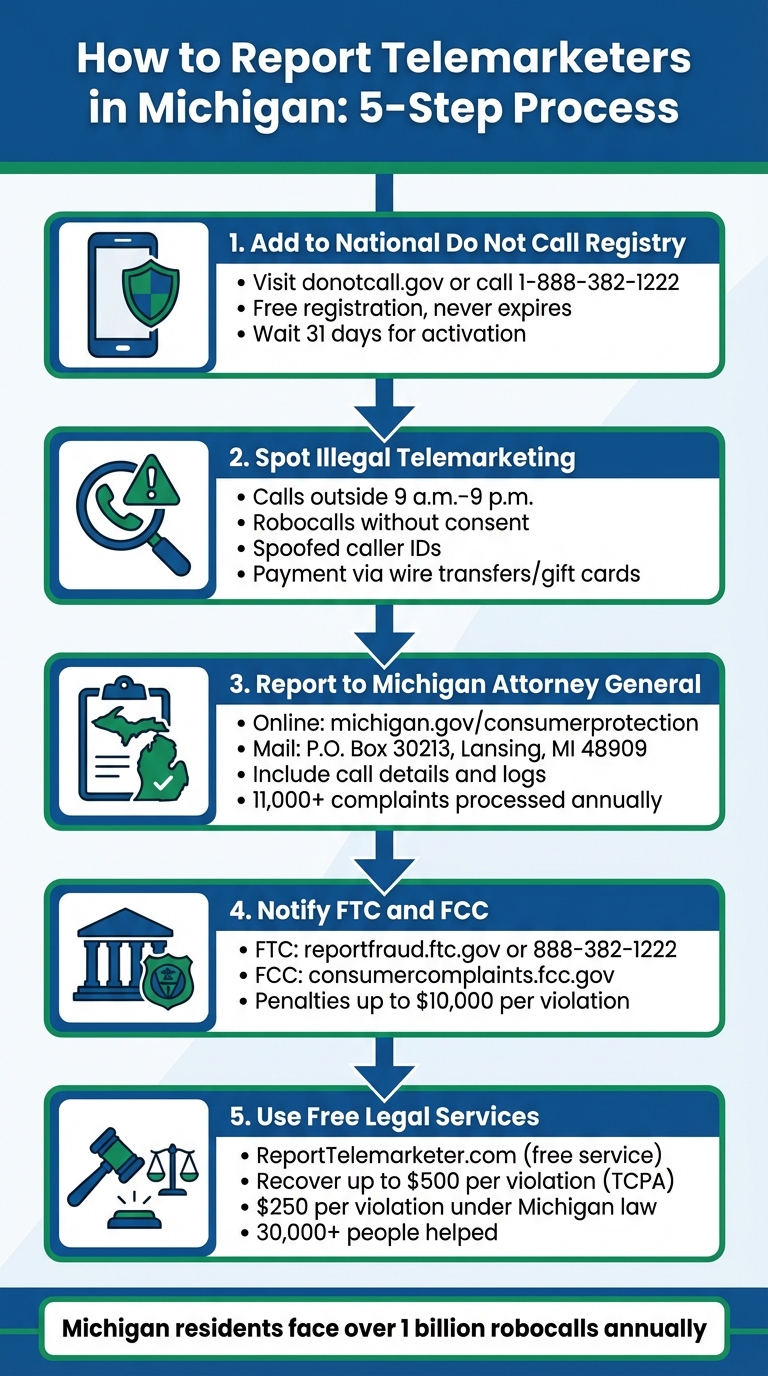
5-Step Process to Report Telemarketers in Michigan
Report Unwanted Spam Phone Calls Do Not Call Database Registry
sbb-itb-a8d93e1
Step 1: Add Your Number to the National Do Not Call Registry

If you’re in Michigan and want to stop telemarketing calls, registering your phone number with the National Do Not Call Registry is the way to go. Michigan uses the Federal Trade Commission‘s registry as its official state list, so you only need to register once for both state and federal protection. It’s completely free, and your registration never expires.
How to Register
You can register your number either online or by phone. Here’s how:
- Online: Visit donotcall.gov. You can register up to three numbers at a time. Make sure to confirm your registration by clicking the verification link sent to your email within 72 hours.
- By Phone: Call 1-888-382-1222 directly from the number you want to register.
- TTY (for hearing impaired): Use 1-866-290-4236 to register.
| Method | Contact Info | Requirements |
|---|---|---|
| Online | donotcall.gov | Active email; verify within 72 hours |
| Phone | 1-888-382-1222 | Call from the number you want to register |
| TTY | 1-866-290-4236 | For hearing-impaired registration |
Activation Timeline: 31 Days
Once you register, your number is added to the list the very next day. However, telemarketers have up to 31 days to stop calling you. This delay happens because companies update their call lists periodically, not in real-time. After this period, any sales calls from companies you don’t have a business relationship with are considered violations and can be reported.
"If you received an unwanted call after your number was on the National Registry for 31 days, report it to the FTC." – Federal Trade Commission
Keep in mind, the registry doesn’t block all calls. Charities, political groups, debt collectors, and businesses you’ve interacted with in the past 18 months are still allowed to contact you. For companies that ignore the rules, the consequences are steep – they can be fined up to $50,120 for each illegal call.
After 31 days have passed, you’ll be ready to monitor and report any telemarketing violations in Michigan.
Step 2: Identify Telemarketing Violations in Michigan
Once the 31-day activation period passes, it’s important to understand what counts as a telemarketing violation. Michigan law, through the Michigan Telemarketing Act and related statutes, protects consumers from aggressive or deceptive sales tactics. These regulations clearly define what constitutes illegal telemarketing behavior.
Michigan Telemarketing Act and SB 351 Violations
Under Michigan law, telemarketers cannot call between 9:00 p.m. and 9:00 a.m. Telemarketers are also required to introduce themselves at the beginning of the call, providing both their name and the full name of the business they represent. Refusing to supply a working phone number where a live person can be reached is considered a violation.
Robocalls – calls with prerecorded messages – are illegal unless you’ve given prior consent. Additionally, telemarketers are prohibited from blocking or tampering with your caller ID.
Other violations include charging your credit card without explicit authorization, demanding payment upfront without your verifiable consent, or requesting payment through questionable methods like cash-to-cash money transfers (e.g., Western Union), cash reload card PINs, or remotely created checks.
"Persons who suffer loss as a result of a violation of the law may bring a private lawsuit to recover actual damages or $250.00, whichever is greater, and reasonable attorney fees." – Michigan Attorney General
Some deceptive telemarketing practices are classified as misdemeanors, punishable by up to six months in jail or a $500 fine.
Warning Signs of Illegal Practices
Recognizing the warning signs can help you quickly spot illegal telemarketing behavior. One common scam tactic is "neighbor spoofing", where scammers manipulate their phone number to appear local on your caller ID. If you get a call from a local area code that isn’t in your contacts, proceed cautiously.
Other red flags include telemarketers who refuse to disclose their business name or callback number, or who become hostile when questioned. If this happens, it’s best to hang up immediately.
Be wary of requests for payment via wire transfers or gift cards. Legitimate businesses don’t use these payment methods without proper authorization.
Here’s a quick table summarizing common violations and their warning signs:
| Violation Type | Warning Sign |
|---|---|
| Timing | Calls made between 9:00 p.m. and 9:00 a.m. |
| Identification | Caller fails to provide their name, business name, or a callback number |
| Payment Method | Requests for unauthorized payments like wire transfers or gift cards |
| Technology | Use of robocalls without prior consent |
| Caller ID | Blocking, tampering with, or spoofing caller ID |
Additionally, telemarketers must not mislead you about prices, refund policies, or product details. If an offer seems suspiciously good or the caller avoids answering your questions, it’s likely a scam.
Spotting these violations is a crucial step before filing a complaint with the Michigan Attorney General’s office.
Step 3: File a Complaint with the Michigan Attorney General
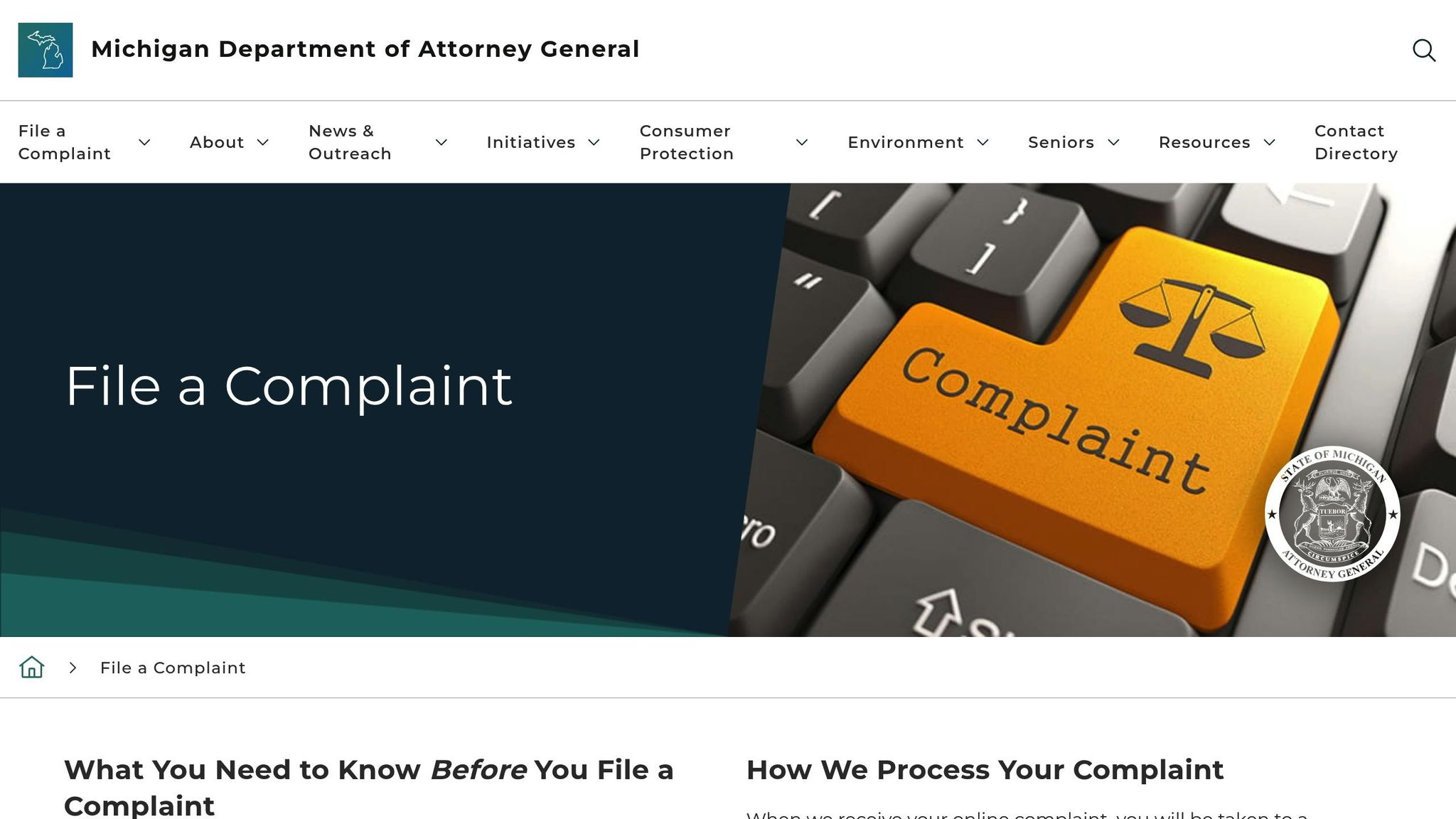
If you’ve identified a violation, the next step is to file a complaint with the Attorney General’s (AG) Consumer Protection Team. This office serves as an informal mediator between consumers and businesses, with telemarketing complaints being one of their most common areas of focus. Attorney General Dana Nessel has urged residents to take action to stop the calls:
"I encourage anyone who believes they have been a victim of fraud or deceptive business practices to reach out and file a complaint".
File Your Complaint Online
You can file your complaint online at michigan.gov/consumerprotection or mi.gov/agcomplaints. Before doing so, confirm that your issue falls under the AG’s jurisdiction by using the online Complaint Directory. If your complaint involves automated calls, use the specific "Report Illegal Robocalls" form, which is part of Michigan’s efforts to combat illegal robocalls.
When completing the form, provide details such as the telemarketer’s business name, phone number, and a thorough description of the incident. Be sure to attach any supporting documents, like call logs or voicemails, to strengthen your case. Avoid including sensitive information like Social Security or credit card numbers. If providing such information is necessary, send your complaint by mail to:
P.O. Box 30213, Lansing, MI 48909
.
After submitting your complaint, a confirmation screen will display an Attorney General file number. Save this number – it’s important for any follow-up. The Consumer Protection Team will forward a copy of your complaint to the business, requesting a response. If the business fails to reply within 30 days, the AG’s office will follow up. In cases where the business refuses to cooperate, you may need to explore other legal options, such as Small Claims Court.
Processing Time and Privacy
Due to the high volume of complaints, processing may take several weeks. Keep in mind that your complaint becomes a public record under the Freedom of Information Act (FOIA). This means it may be shared with the business you’re reporting, other government agencies, or individuals who request it. However, rest assured that the AG’s office does not sell, rent, or lease your personal information to third parties.
If you have questions about your complaint, you can contact the Consumer Protection Team at 877-765-8388 (toll-free) or 517-335-7599. By filing your complaint, you not only address your own issue but also contribute to broader efforts to enforce laws against illegal telemarketing practices.
Step 4: Report to Federal Agencies
After notifying state authorities, take your efforts a step further by reporting the issue to federal agencies. These reports play a key role in identifying patterns of misconduct and building cases against offenders. As the Federal Trade Commission (FTC) states:
"Your reports can help us detect patterns of wrongdoing, and lead to investigations and prosecutions".
By filing with federal agencies, you contribute to broader enforcement efforts aimed at curbing illegal telemarketing and related practices. These agencies often detect trends that might go unnoticed by state-level authorities.
File a Complaint with the FTC
If you’ve experienced a violation of the Do Not Call Registry, report it directly to the FTC. You can do this online at reportfraud.ftc.gov or by calling 888-382-1222 toll-free. However, make sure your number has been on the registry for at least 31 days before filing a complaint.
When submitting your report, provide specific details, including:
- The date and time of the call
- The phone number displayed on your caller ID
- Whether the call involved a live person or a recorded message
Keep in mind that certain organizations, such as political campaigns, charities, and survey companies, are exempt from Do Not Call regulations.
File a Complaint with the FCC
You can also report unwanted calls to the Federal Communications Commission (FCC) at consumercomplaints.fcc.gov. The FCC has made tackling unwanted calls a top consumer protection priority, and filing a complaint online is both free and straightforward.
When completing the form, select "phone" as the category and "unwanted calls" as the issue. Be sure to include:
- The phone number that contacted you
- Caller ID information
- The exact date and time of the call, including your time zone
If your own number is being spoofed – meaning it’s falsely displayed as the caller ID for others – select the option indicating "my own number is being spoofed". Violators can face penalties of up to $10,000 per infraction.
Step 5: Use ReportTelemarketer.com for Free Legal Help
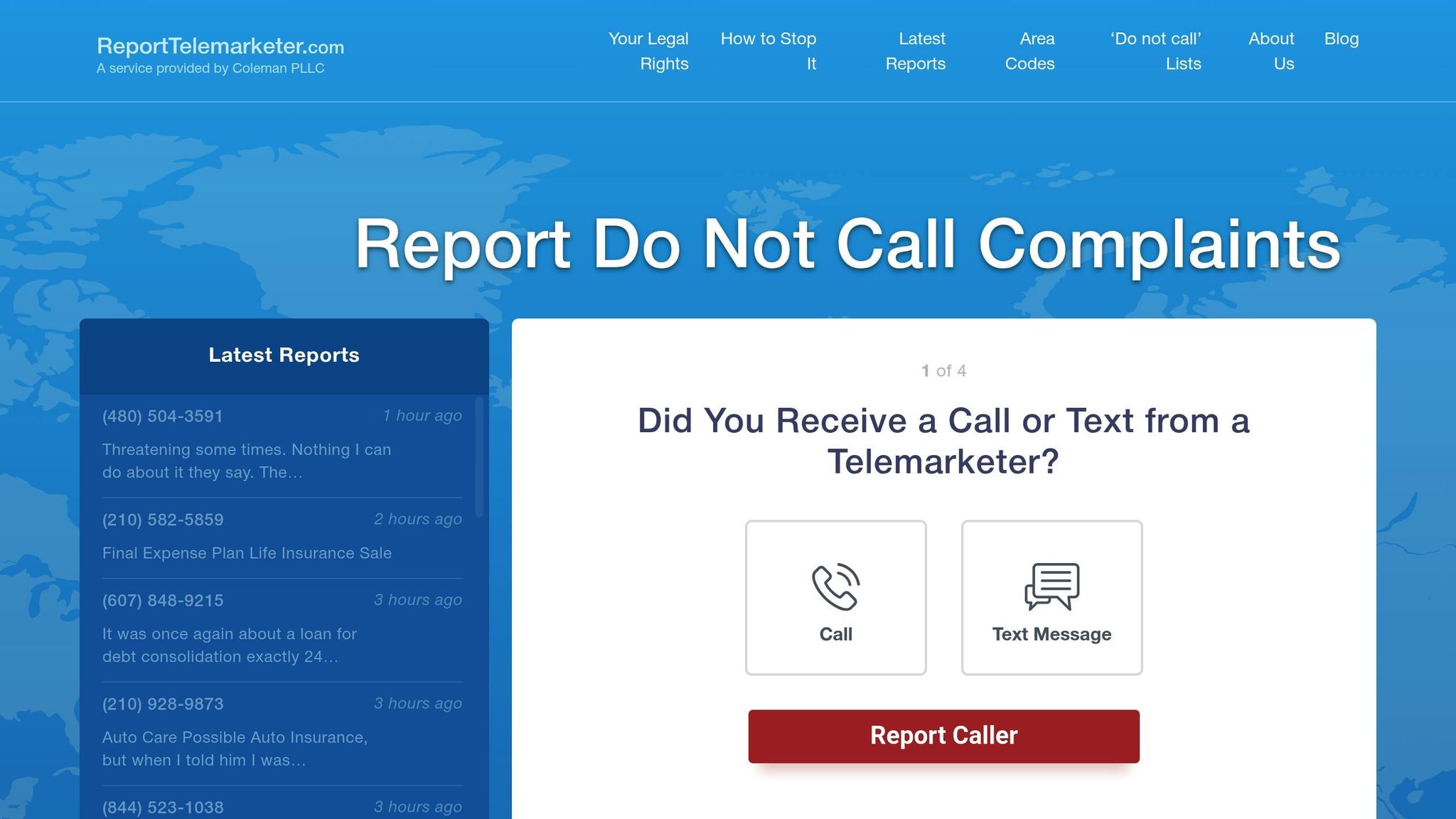
If you’re dealing with relentless telemarketing calls despite filing complaints with state and federal agencies, ReportTelemarketer.com offers a free legal option to help you fight back. Created by Stefan Coleman, this service has already assisted more than 30,000 people in stopping unwanted calls. The best part? It’s completely free for consumers, as the platform handles the legal work on your behalf. This service not only helps enforce your rights but also complements the traditional reporting methods.
How ReportTelemarketer.com Works
The process is simple. Start by filling out an online form detailing the unwanted calls or texts you’ve received. From there, a team of researchers uses specialized tools to uncover the identity of the telemarketer, even when Caller ID Spoofing is involved. Once the telemarketer is identified, the service takes action by sending cease-and-desist letters or filing formal complaints under the TCPA (Telephone Consumer Protection Act) and Michigan consumer protection laws.
Stefan Coleman explains the service’s approach:
"As a consumer protection law firm, we offer our services at no out of pocket cost to you, the consumer. After we stop the telemarketer from calling you, we claim our attorney’s fees from the telemarketer".
This thorough process not only stops the calls but can also lead to legal compensation.
Benefits of Using ReportTelemarketer.com
The service is entirely free for consumers, with attorney fees collected from the telemarketers themselves. Beyond stopping the harassment, you could receive $500 per call under federal TCPA rules. Michigan law also allows consumers to recover either actual damages or $250.00 per violation, along with reasonable attorney fees. Additionally, the platform prioritizes your privacy, ensuring your personal information is protected throughout the process. By working alongside official complaint channels, this service strengthens the fight against telemarketing abuse in Michigan.
Conclusion
This guide has outlined the key steps to address illegal telemarketing in Michigan. With unwanted telemarketing calls often violating the law, taking action not only protects you but also supports the broader Michigan community. The Michigan Department of Attorney General processes over 11,000 consumer complaints annually, and every report you submit adds valuable data to the state’s "Crackdown on Illegal Robocalls Initiative". Considering Michigan residents face more than 1 billion robocalls each year, your efforts help authorities identify trends and hold violators accountable under state and federal laws.
To report these calls, start by registering your number on the National Do Not Call Registry, wait the required 31 days, and then file complaints with the Michigan Attorney General, the FTC, and the FCC. Be sure to document key details, such as the date, time, and caller information, and keep copies of your records, as they may become public.
Your reports also play a role in preventing serious fraud and theft. Detailed call data aids enforcement agencies in their efforts. As the Attorney General’s office states, "The data collected will help us in the fight against illegal robocalls". By participating, you contribute to safeguarding not just yourself but the entire community.
Whether you file through official channels or use platforms like ReportTelemarketer.com, taking action ensures your legal rights are upheld. Michigan law allows you to seek actual damages or $250 per violation, along with attorney fees. Every complaint strengthens enforcement efforts and helps shut down illegal telemarketing operations. By following these steps, you’re actively contributing to a safer and more secure environment for all Michigan residents.
FAQs
What details should I write down before reporting a telemarketing call?
To report a telemarketing call, make sure to jot down a few important details: the date and time of the call, the phone number shown on your caller ID, and the name of the company or person (if provided). Also, mention whether it was a live call or a robocall. If you answered, include a brief summary of the message or conversation. These details are crucial for authorities and platforms like ReportTelemarketer.com to investigate potential violations properly.
Can I report calls from charities, political groups, or debt collectors?
Charities, political groups, and debt collectors are not automatically off the hook when it comes to complaints. If you’re receiving unwanted calls from these entities, you can take action. Reports can be filed with the Michigan Attorney General’s Office, the Federal Trade Commission (FTC), or the Federal Communications Commission (FCC).
Can I get money back for illegal robocalls or spam texts in Michigan?
In Michigan, you can’t directly claim money for illegal robocalls or spam texts. However, you can take action by filing complaints with the Michigan Attorney General’s Office or the FTC. While this won’t result in immediate compensation, your reports play a crucial role in cracking down on these violations. They help hold telemarketers accountable and contribute to efforts to reduce unwanted calls and messages.

