
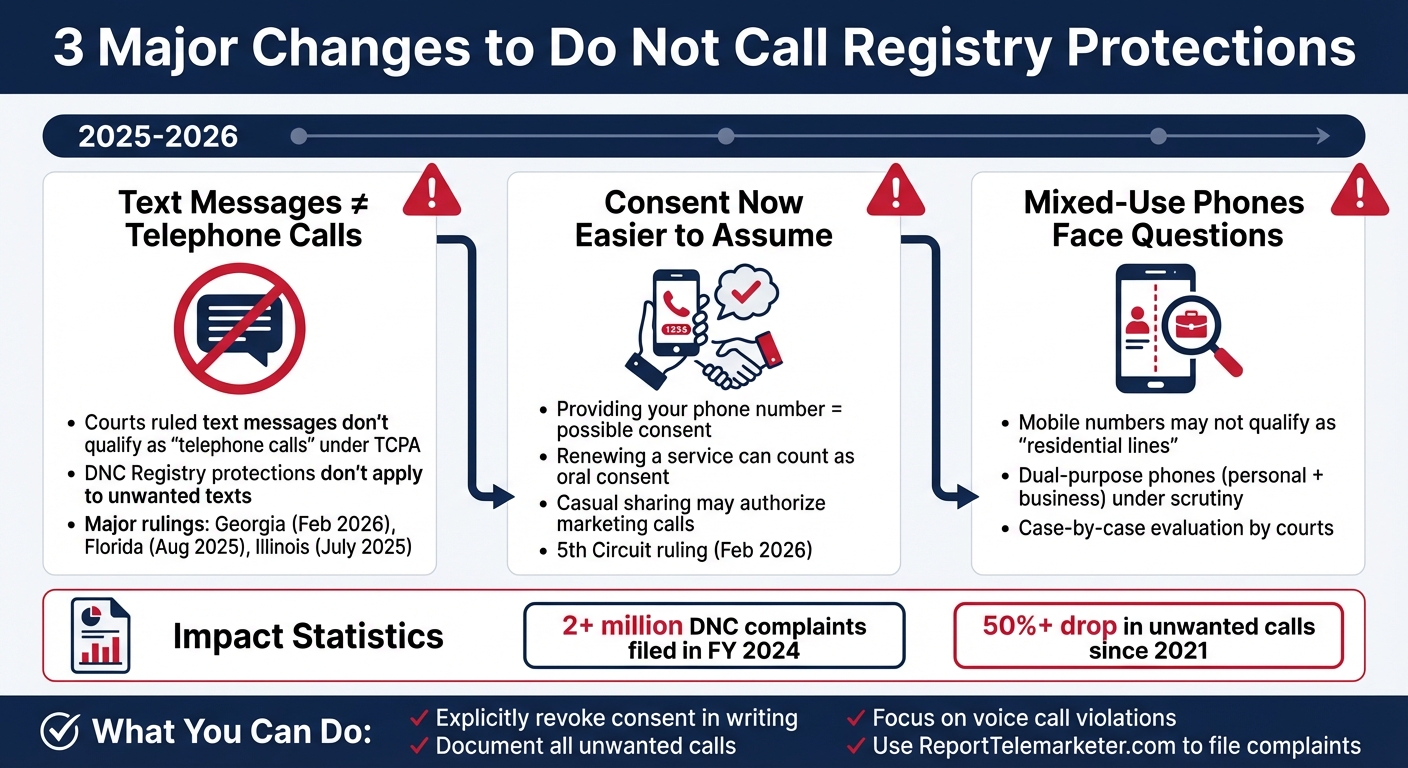
Recent court rulings have narrowed the protections of the National Do Not Call (DNC) Registry, leaving consumers with fewer options to combat unwanted telemarketing. Here’s what you need to know:
- Text messages are not “telephone calls” under the law: Courts, including rulings in Georgia and Florida, have determined that text messages don’t fall under the TCPA’s DNC provisions.
- Consent rules have been broadened: Providing your phone number, even casually or during a transaction, can now be interpreted as agreeing to receive marketing calls or texts.
- Mobile phones used for mixed purposes face scrutiny: Courts may question whether your mobile number qualifies as a “residential line” under DNC rules.
These changes highlight the importance of explicitly revoking consent and documenting unwanted calls. Services like ReportTelemarketer.com can help you take action by investigating violations and filing complaints. Stay informed to protect your privacy and understand your rights under the evolving legal landscape.
How Recent Court Rulings Changed Do Not Call Registry Protections
Major Court Decisions on DNC Registry Exceptions
Northern District of Georgia: Text Messages Not Covered as Telephone Calls
In February 2026, Judge Thomas W. Thrash delivered a key ruling in Radvansky v. 1-800-Flowers.com, clarifying that text messages sent to numbers listed on the National Do Not Call (DNC) Registry do not violate the TCPA’s Do Not Call provisions. The court’s decision hinged on a straightforward reading of the law. Judge Thrash pointed out that when Congress updated the TCPA in 2019, it specifically included the term "text message" in certain sections but left Section 227(c) unchanged. He further emphasized that, in everyday American English, a "telephone call" and a "text message" are distinct forms of communication. This ruling dismissed the plaintiff’s claims, reinforcing the idea that texts fall outside these provisions. It also reflects a broader judicial trend of interpreting telephonic communications more narrowly.
Northern District of Florida: Davis v. CVS Pharmacy, Inc.
In August 2025, Judge Allen Winsor ruled on Davis v. CVS Pharmacy, Inc., a case involving unwanted marketing texts. The court dismissed the plaintiff’s class action, stating that the statutory language of the TCPA clearly separates "telephone calls" from text messages. Judge Winsor offered a straightforward explanation:
"Certainly, no ordinary person would think of a text message as a ‘telephone call.’ This conclusion – supported by the ordinary public meaning at the time of the provision’s enactment – is enough to end this case."
- Judge Winsor, Northern District of Florida
The ruling also highlighted that district courts are not obligated to follow the FCC’s 2003 guidance, which had previously categorized texts as calls. Later that year, in October 2025, the Middle District of Florida reached a similar conclusion in Sayed v. Naturopathica Holistic Health (Case No. 8:25-cv-00847-SDM-CPT), further reinforcing this interpretation. Together, these decisions are shaping a clearer boundary for what qualifies as a "telephone call" under the TCPA.
Central District of Illinois: Jones v. Blackstone and Dish Network Cases
In July 2025, the Central District of Illinois added to this growing body of case law with its ruling in Jones et al v. Blackstone. The court determined that Section 227(c) of the TCPA does not apply to text messages, reasoning that the technology for text messaging did not exist when the law was enacted in 1991. The court concluded that "telephone call" refers solely to voice communications.
This decision marks a departure from earlier enforcement actions, such as those against Dish Network, which faced substantial fines for voice call violations. The Jones ruling underscores that DNC protections under Section 227(c) are primarily designed for voice calls, whether on landlines or cell phones, and do not extend to text-based communications.
sbb-itb-a8d93e1
Higher Court Decisions Affecting DNC Enforcement
Higher courts have played a pivotal role in redefining FCC authority and consent rules, significantly impacting how the Telephone Consumer Protection Act (TCPA) is enforced.
Supreme Court Ruling on FCC Authority
In a landmark decision on June 20, 2025, the U.S. Supreme Court ruled 6-3 in McLaughlin Chiropractic Associates, Inc. v. McKesson Corporation that district courts are not obligated to follow FCC interpretations of the TCPA. Justice Kavanaugh, writing for the majority, stated:
"the Hobbs Act does not preclude district courts from independently assessing whether an agency’s interpretation of the relevant statute is correct."
This ruling effectively ended years of deference to FCC orders, giving courts the freedom to interpret the TCPA using standard statutory methods. The decision builds on the 2024 case Loper Bright Enters. v. Raimondo and is expected to trigger a wave of legal challenges to existing FCC orders. These developments could reshape consumer rights and enforcement mechanisms under the TCPA.
Eleventh Circuit on Consent Rules
On January 24, 2025, the Eleventh Circuit Court of Appeals ruled in Insurance Marketing Coalition Limited v. Federal Communications Commission that the FCC had overstepped its statutory authority by mandating "one-to-one consent" for robocalls. The court also struck down the FCC’s rule requiring telemarketing calls to be "logically and topically related" to the website where consent was obtained. The judges underscored:
"A textual policy cannot overcome clear text."
and further clarified:
"agencies have only those powers given to them by Congress."
This decision allows consumers to grant consent to multiple entities through a single interaction. It also raises questions about the FCC’s 2012 written consent requirement, as the TCPA itself only specifies "prior express consent" without requiring it to be in writing. These rulings could pave the way for further challenges to FCC regulations, potentially altering the landscape of telemarketing consent.
How These Rulings Affect Consumers
Patterns in Court Rulings: Text Messages, Consent, and Phone Types
Recent court decisions have reshaped how consumers can address unwanted telemarketing, introducing three key changes that limit legal options.
First, courts now separate text messages from phone calls when considering Do Not Call (DNC) claims. This means that if you receive unsolicited texts – even with your number listed on the National Do Not Call Registry – you might not have grounds for a DNC complaint. This distinction shifts the boundaries of what counts as a violation.
Second, the scope of consent has expanded. In February 2026, the Fifth Circuit ruled that simply providing your phone number or renewing a service can be interpreted as oral consent for future telemarketing calls. This broad interpretation means that sharing your number, even casually, might be seen as agreeing to receive marketing communications.
Third, courts are now scrutinizing whether a phone qualifies as a "residential subscriber" line, especially for dual-purpose mobile phones used for both personal and business activities. This case-by-case approach adds complexity for consumers who rely on their mobile devices for mixed-use purposes.
How to Report Violations with ReportTelemarketer.com
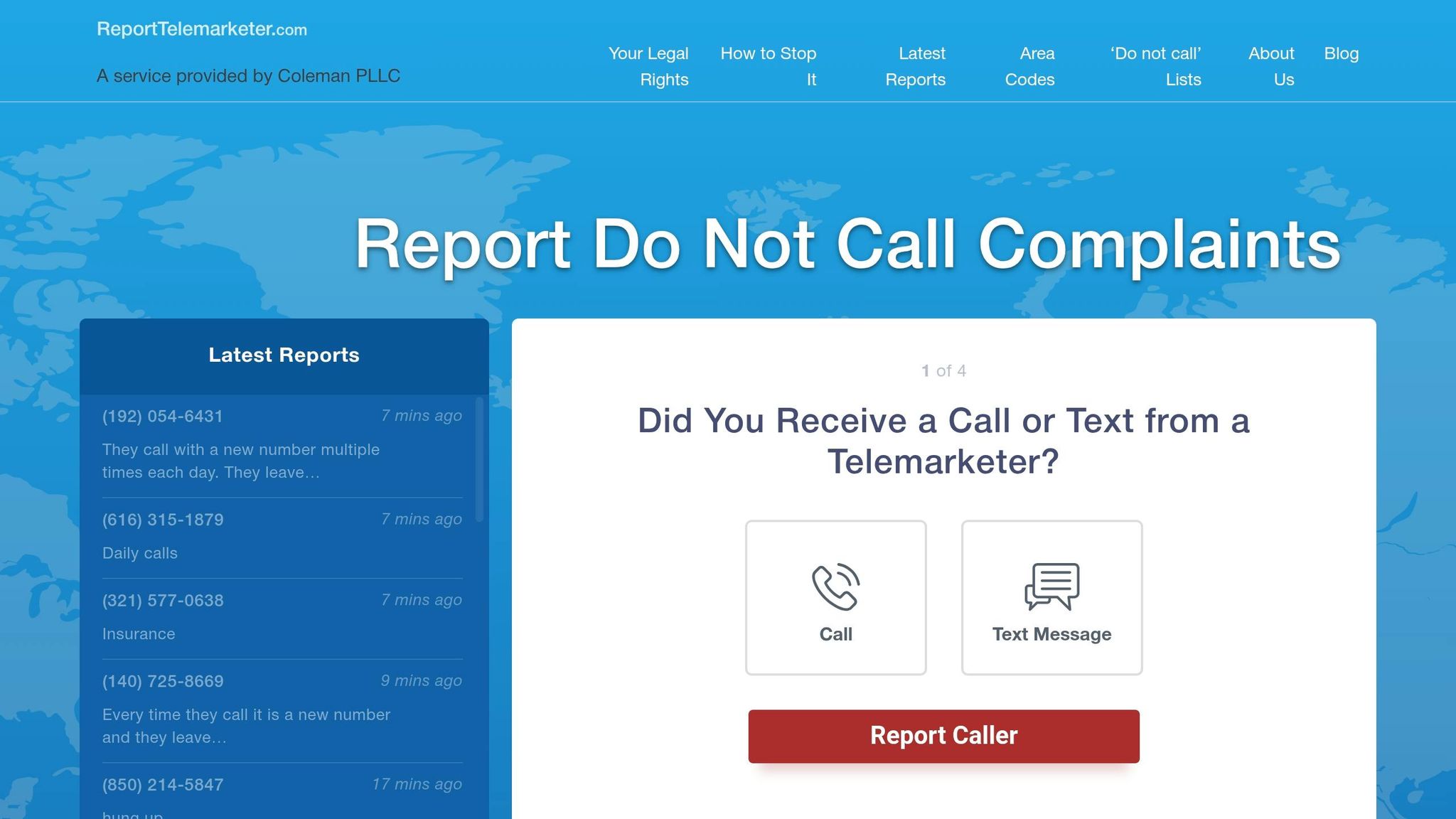
These legal shifts highlight the need for vigilance when dealing with telemarketing violations. In fiscal year 2024, the FTC received over 2 million Do Not Call complaints, and reports of unwanted telemarketing calls have dropped by more than 50% since 2021. This shows that enforcement efforts are having an impact.
To navigate this evolving legal environment, detailed records and timely reporting are crucial. ReportTelemarketer.com offers a free service designed to help consumers take action. The platform allows you to report unwanted calls and texts, investigates telemarketers using specialized tools, and takes steps like sending cease-and-desist letters or filing formal complaints on your behalf.
When reporting violations, focus on documenting voice calls specifically. Also, make sure to explicitly revoke consent by directly telling companies not to call you, as courts often interpret providing a phone number as implied permission for future contact.
Conclusion: Understanding Your Rights Under DNC Rules
These court rulings are reshaping how consumers can protect themselves from unwanted calls. Recent decisions have clarified some key exceptions to the Do Not Call (DNC) rules. For instance, courts have determined that text messages may not be classified as "telephone calls" under the TCPA, that oral consent can sometimes be enough to allow telemarketing calls, and that providing your phone number during a transaction might be seen as giving consent for future marketing communications.
Because sharing your number could imply consent, it’s important to explicitly tell companies not to contact you and to keep a record of such requests. Be cautious about where and how you share your phone number – sometimes, simply continuing to use a service without objecting could be interpreted as permission for future calls. Even with these complexities, the National Do Not Call Registry remains a key tool for protecting your privacy.
If you experience DNC violations, make sure to document important details about the calls you receive. Platforms like ReportTelemarketer.com provide free resources to help you report violations, investigate telemarketers, and even send cease-and-desist letters or file formal complaints. Staying informed about these rulings gives you the tools to take control of unwanted calls.
FAQs
Are marketing texts still illegal if my number is on the Do Not Call Registry?
Marketing texts aren’t automatically prohibited just because your number is on the Do Not Call Registry. Recent court decisions have clarified that text messages don’t fall under the same category as calls when it comes to the TCPA Do Not Call rules. Enforcement efforts mainly focus on violations involving telemarketing calls rather than text messages.
How do I revoke consent after I’ve shared my phone number with a business?
If you’ve given your phone number to a business but no longer want them to contact you, let them know directly and ask them to stop calling. Additionally, you can register your number with the National Do Not Call Registry to reduce telemarketing calls in the future. If the calls continue after you’ve revoked consent or registered your number, you can report the issue to the Federal Trade Commission (FTC), which oversees and enforces the Do Not Call rules. Remember, safeguarding your privacy is a right you have under the law.
Do Do Not Call rules apply to my cell phone if I use it for both personal and work?
A North Carolina judge determined that cell phones are not covered under Do Not Call protections. However, a federal court in the Fourth Circuit expanded TCPA (Telephone Consumer Protection Act) protections to include wireless numbers, such as cell phones, for telemarketing calls. So, while the specific protections for your cell phone can vary, it may still be safeguarded in certain situations.

