

Sick of spam texts? The Telephone Consumer Protection Act (TCPA) can help you fight back. This law, expanded in 2013 to include text messages, allows you to take legal action against companies that send unwanted texts without your consent. Violators face fines of $500 to $1,500 per text, depending on the severity of the violation.
Here’s what you need to know:
- Companies must have prior written consent before texting you.
- They must honor opt-out requests like replying "STOP."
- Messages are restricted to 8 a.m. to 9 p.m.
Success stories include Dan Graham, who recovered $75,000 by suing spammers, and major settlements like Lifetime Fitness ($15M) and Steve Madden ($10M). Tools like ReportTelemarketer.com make it easy to report violations and recover damages, often at no upfront cost.
Want to stop spam texts and reclaim your privacy? Keep records of violations and take action under the TCPA.
Make Them Pay YOU…. $500–$1500 Per Call Under the TCPA
sbb-itb-a8d93e1
Major TCPA Legal Cases
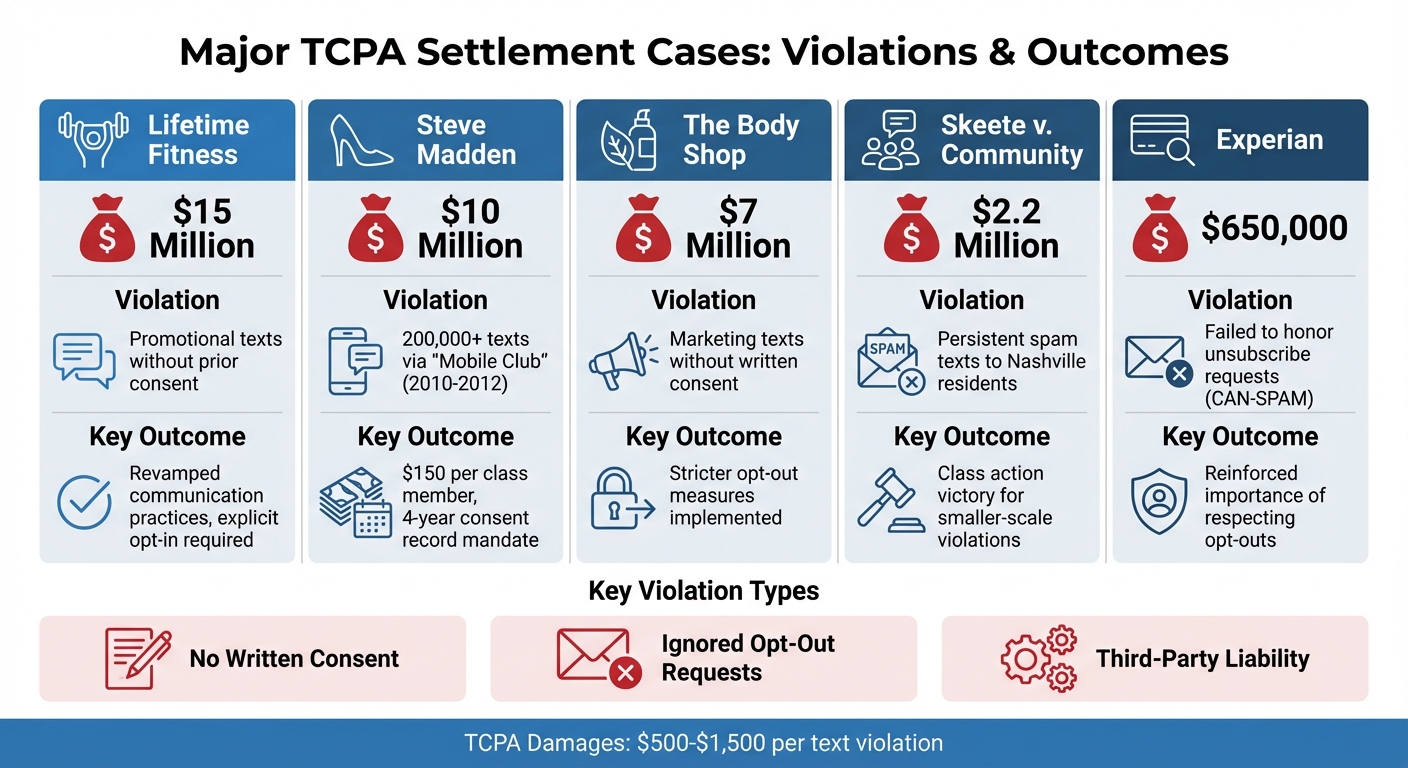
Major TCPA Settlement Cases and Violation Types
The Telephone Consumer Protection Act (TCPA) gives consumers a powerful tool to push back against unwanted promotional texts. Violators often face massive settlements, sometimes reaching millions of dollars. These legal battles not only compensate affected individuals but also force companies to rethink how they handle consumer communication. Here are some notable cases that showcase the impact of TCPA enforcement.
Lifetime Fitness: $15 Million Settlement

Lifetime Fitness found itself in hot water after sending promotional text messages to members without obtaining their prior consent. The company ended up settling a class action lawsuit for $15 million. Beyond the payout, Lifetime Fitness had to revamp its communication practices to ensure that future messages would only be sent to consumers who explicitly opted in.
Steve Madden: $10 Million Settlement

Between 2010 and 2012, Steve Madden sent promotional texts to more than 200,000 consumers as part of its "Mobile Club", using short codes 91919 and 623336. Despite working with a third-party marketing firm, the company was held responsible for failing to secure proper consent. In 2013, the U.S. District Court for the Central District of California approved a settlement of up to $10 million. This case underscored the financial dangers of non-compliance, with potential liabilities estimated to exceed $100 million – far more than Steve Madden’s net income for 2011. As part of the settlement, the company committed to obtaining written consent from consumers and keeping records for at least four years.
The Body Shop: $7 Million Settlement
The Body Shop faced legal action for sending marketing texts to customers without obtaining written consent. The beauty retailer agreed to a $7 million settlement and implemented stricter opt-out measures. Moving forward, the company committed to ensuring that customers explicitly agree to receive promotional messages before any texts are sent.
Skeete v. Community Spam Texts: $2.2 Million Settlement
In Nashville, residents banded together to file a class action lawsuit against persistent spam texters. The case resulted in a $2.2 million settlement, proving that even smaller-scale violations of the TCPA can come with hefty consequences.
Experian CAN-SPAM Violation: $650,000 Penalty
Experian, a major credit reporting agency, ran afoul of the CAN-SPAM Act by failing to honor unsubscribe requests from consumers. The company faced a lawsuit and ultimately paid $650,000 to settle the case. This serves as a reminder that respecting opt-out requests isn’t just good practice – it’s the law.
How ReportTelemarketer.com Helps Consumers
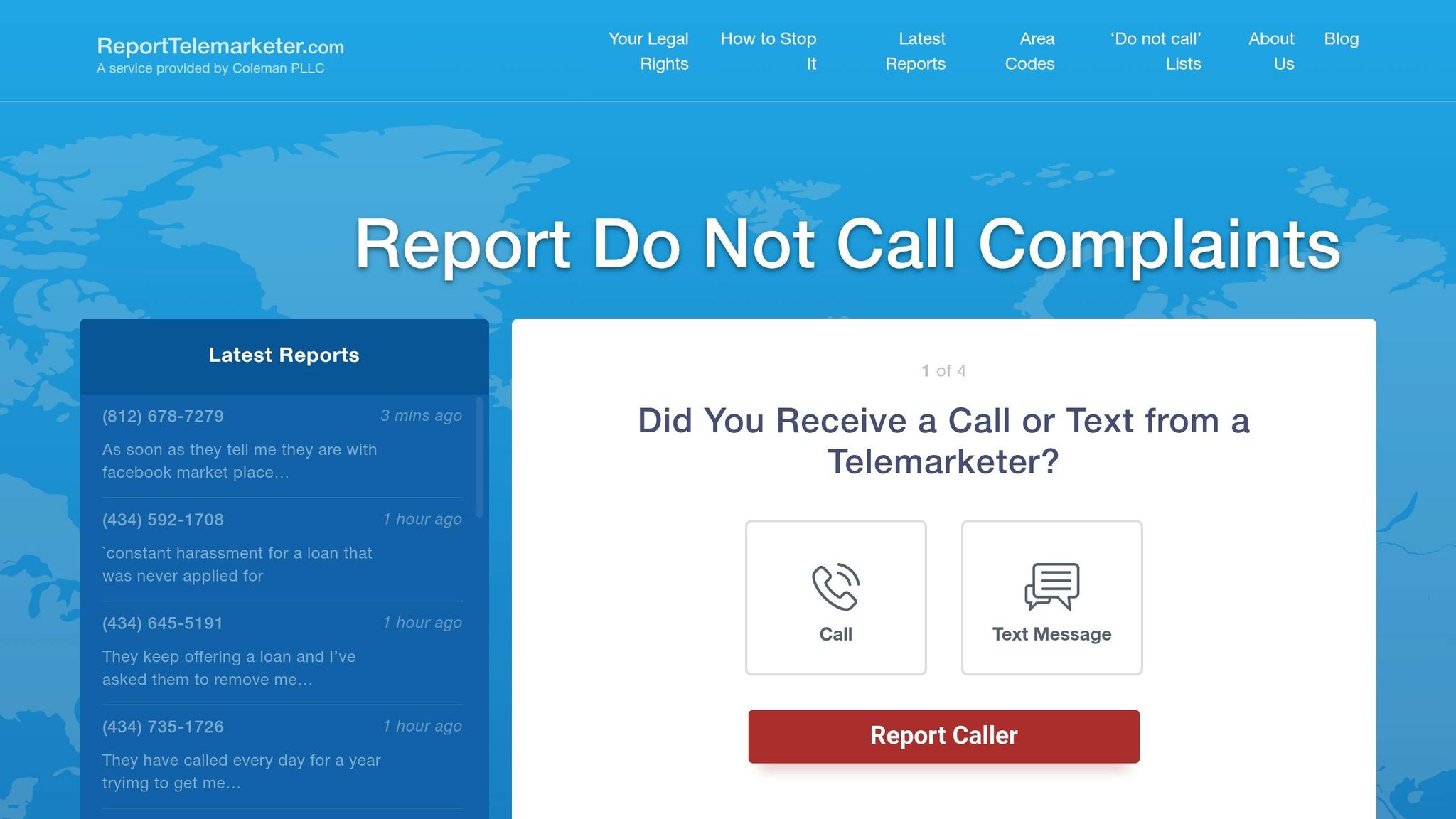
ReportTelemarketer.com builds on the momentum of landmark TCPA cases, giving consumers a powerful tool to combat spam texts.
Free Reporting Process
ReportTelemarketer.com makes it simple for anyone to take action against spam texts – completely free of charge. You don’t need to be a legal expert or have a big budget to participate. Just report the spam text, and the platform takes it from there. There are no hidden fees, and the process is designed to be hassle-free.
Legal Team and Investigation Tools
After you file a report, the platform’s legal team gets to work immediately. Using advanced investigation tools, they dig into the details to uncover possible violations of the TCPA and other consumer protection laws. Spammers often try to obscure their tracks by using fake numbers or relying on third-party marketing firms, but the team’s tools and expertise help trace the entities behind the spam.
The attorneys focus on collecting evidence, documenting violations, and determining whether companies failed to obtain proper consent or ignored opt-out requests. If violations are confirmed, they take action – whether that’s sending cease and desist letters or filing formal complaints – to stop the harassment. This thorough investigative process not only holds violators accountable but also reinforces the fight for consumer privacy.
Privacy Protection and Damage Recovery
Your personal information is kept secure throughout the entire process. ReportTelemarketer.com prioritizes privacy while pursuing legal action against violators. Additionally, you may have the opportunity to recover damages without any upfront costs. The service operates on a contingency basis, meaning attorney fees are taken directly from the telemarketers if damages are awarded. Under the TCPA, violators can be required to pay statutory damages, which may even be tripled if the court determines their actions were willful. This means that companies – and sometimes their owners or employees – can face personal liability for their spam campaigns.
What These Cases Teach Us
Looking at these cases, one thing becomes clear: getting proper consent and following compliance guidelines are essential for protecting consumers. These settlements highlight patterns of rights violations and demonstrate how legal action can curb unwanted text messages.
Common Factors in Winning Cases
Lack of Written Consent
One of the most common violations involves sending marketing texts without "prior express written consent." Since October 16, 2013, the FCC has required companies to obtain documented consent for autodialed texts. Simply providing a phone number is not enough. For instance, Lifetime Fitness claimed they had prior consent, but this argument was rejected, leading to a settlement worth millions of dollars.
Ignoring Opt-Out Requests
When companies continue sending texts after receiving a "STOP" message, it constitutes a willful violation. This can triple the statutory damages from $500 to $1,500 per text. As consumer debt expert Steve Rhode puts it: "’You gave us your number’ is not a lifetime pass".
Third-Party Liability
Outsourcing messaging doesn’t shield companies from responsibility. For example, Steve Madden’s use of MoGreet to send over 200,000 texts resulted in a strict mandate to keep detailed consent records moving forward.
These violations don’t just result in hefty financial penalties – they also push companies to adopt better practices.
How Legal Action Strengthens Consumer Rights
Beyond compensating victims, these settlements lead to long-term changes in how companies operate. Take the Steve Madden case: the potential legal liabilities exceeded $100 million, which was more than the company’s entire net income in 2011. This case also underscored the importance of written, signed consent for advertising texts, as noted by Eric Shinabarger of Winston & Strawn: "This case is a reminder that companies should be getting written, signed consent before sending autodialed advertising text messages to address TCPA consent requirements".
The damages structure under the TCPA – $500 per negligent violation and $1,500 per willful violation – gives consumers significant leverage, even without proving financial harm. Each unsolicited text is treated as an independent violation. These legal outcomes empower individuals and emphasize the importance of staying vigilant against spam texts.
Settlement Comparison Table
Here’s a quick look at how these cases played out, highlighting the types of violations, settlement amounts, and key outcomes:
| Case | Violation Type | Settlement Amount | Key Outcome |
|---|---|---|---|
| Life Time Fitness | Unsolicited automated texts | $10–$15 million | Cash awards or memberships; clarified consent rules |
| Steve Madden | Unsolicited "Mobile Club" ads | $10 million | $150 per class member; 4-year consent record mandate |
| Powerhouse Gym | Unsolicited marketing texts | $600,000 | Consumers received up to $30 per text |
Conclusion
The legal victories highlighted earlier show how the TCPA gives consumers the power to take back control of their privacy. From the $15 million settlement with Lifetime Fitness to Dan Graham’s $75,000 recovery in Texas, these cases prove that taking legal action can make a real difference. Companies that ignore opt-out requests or send automated marketing texts without proper consent now face steep financial penalties.
Under the TCPA, you can claim $500 for each illegal text message, or up to $1,500 if the violation was intentional. Each unwanted message counts as a separate violation, making it possible to hold repeat offenders accountable.
Platforms like ReportTelemarketer.com make it easier than ever to protect your privacy. They offer free case reviews, help you properly document violations, and connect you with legal experts who specialize in TCPA cases. By gathering evidence – such as screenshots with sender details and timestamps – they investigate violators and seek statutory damages on your behalf, all without any upfront costs.
Don’t let spam texts invade your personal space. Keep a record of every unwanted message and report each violation. When consumers take action together, it sends a clear message: privacy matters more than profit.
Your phone is your space – take charge of it.
FAQs
What counts as “prior written consent” for marketing texts?
"Prior written consent" refers to explicit, written permission a recipient provides before receiving marketing texts. This is a legal requirement under regulations like the TCPA (Telephone Consumer Protection Act) to safeguard consumer privacy. It usually involves the recipient clearly agreeing to receive promotional messages, ensuring transparency and compliance.
What evidence should I save to prove a TCPA spam-text violation?
To establish a TCPA spam-text violation, it’s crucial to gather evidence that shows the message was unsolicited and sent without your consent. Here’s what to keep:
- The text message(s): Save the entire message, including the date and time it was received.
- Sender’s contact details: Record the sender’s phone number or any identifying information.
Take screenshots or preserve the messages in their original format. This documentation is key to proving the message was sent without prior express consent, as required by the TCPA.
Can I still sue if the texts come from different numbers or a third-party marketer?
Yes, taking legal action is an option, even when spam texts come from various numbers or third-party marketers. There have been successful cases where individuals sued companies employing such tactics to send spam messages. These lawsuits have played a key role in safeguarding privacy and ensuring that offenders face consequences.

