
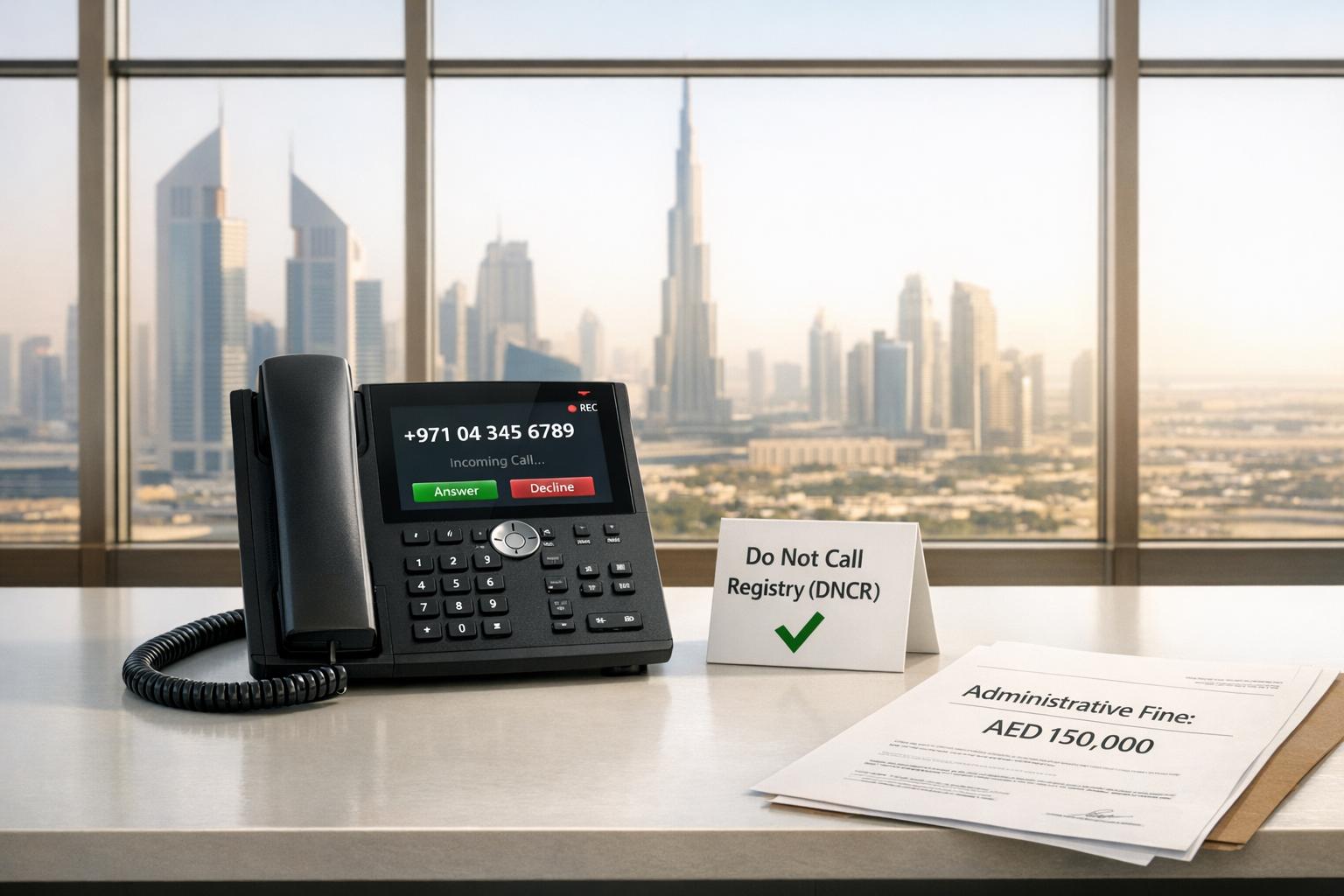
The UAE has implemented strict telemarketing rules to protect consumer privacy and reduce intrusive calls. Businesses and individuals must comply with regulations introduced on August 27, 2024, or face hefty fines and operational consequences. Key points include:
- Fines: Starting at AED 75,000 ($20,400) for companies operating without authorization, escalating to AED 150,000 ($40,800) for repeat violations.
- Do Not Call Registry (DNCR): Contacting registered numbers incurs fines from AED 50,000 ($13,600) to AED 150,000 ($40,800).
- Restricted Hours: Calls allowed only between 9:00 AM and 6:00 PM; violations result in fines up to AED 50,000 ($13,600).
- Personal Numbers Prohibited: Individuals using personal numbers for telemarketing face fines starting at AED 5,000 ($1,360).
Compliance is mandatory for all UAE-licensed companies, including those in free zones. Businesses must register with the DNCR, use licensed local numbers, and adhere to strict call and record-keeping rules. Violations can lead to license suspension or revocation. Consumers can report violations via platforms like ReportTelemarketer.com or by SMS to 1012.
Penalties Under the Updated UAE Telemarketing Laws
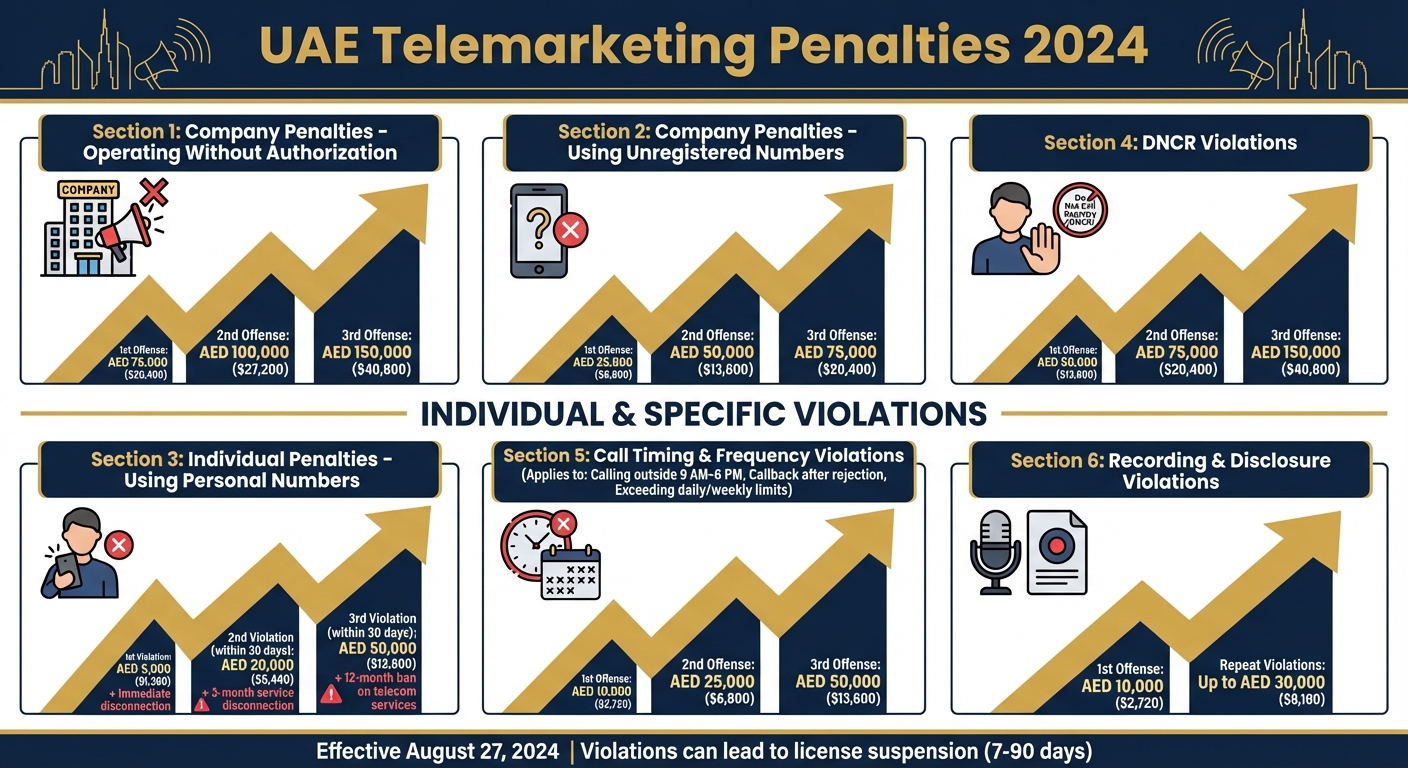
UAE Telemarketing Fines and Penalties 2024 – Complete Breakdown
The updated telemarketing laws in the UAE introduce strict penalties to safeguard consumer privacy. Both companies and individuals face significant consequences, with corporate fines reaching up to AED 150,000 (around $40,800) for repeated or serious violations.
Fines for Operating Without Authorization
Before engaging in telemarketing, companies are required to secure approval from the Competent Authority, which oversees licensing for their specific economic activities. Failure to obtain this authorization results in escalating penalties:
Company Penalties:
- Operating without proper authorization leads to fines of AED 75,000 ($20,400) for the first offense, AED 100,000 ($27,200) for the second, and AED 150,000 ($40,800) for subsequent violations.
- Using unregistered phone numbers incurs a fine of AED 25,000 ($6,800) for the first offense, increasing to AED 50,000 ($13,600) and AED 75,000 ($20,400) for repeat violations.
Individual Penalties:
- Individuals using personal numbers for telemarketing face a AED 5,000 ($1,360) fine, along with immediate disconnection of their phone numbers until the fine is cleared. This enforcement helps report unwanted phone calls and reduce illegal solicitation.
- A second violation within 30 days results in a AED 20,000 ($5,440) fine and a three-month service disconnection.
- A third violation within the same period results in a AED 50,000 ($13,600) fine and a 12-month ban on obtaining telecommunications services in the UAE.
"The competent authority may… not follow the gradation in penalties… and imposes the most severe administrative penalty in case the violating company commits the same violation that was the subject of a previous administrative penalty within six months from the date of imposing the administrative penalty." – Cabinet Resolution No. 57 of 2024
These penalties are part of a broader set of measures aimed at curbing unauthorized telemarketing practices. Additional fines apply to calls targeting numbers listed on the DNCR, and consumers can report National Do Not Call List violations to authorities.
Penalties for Contacting DNCR-Listed Numbers
Calling individuals whose numbers are registered on the Do Not Call Registry (DNCR) is strictly forbidden. The penalties for such violations are steep, starting at AED 50,000 ($13,600) for the first offense, increasing to AED 75,000 ($20,400) for the second, and reaching AED 150,000 ($40,800) for the third.
Fines for Violations of Call Timing Rules
Telemarketing calls are only allowed between 9:00 AM and 6:00 PM. Violating these timing rules results in escalating fines, as does making excessive callback attempts. The penalties are as follows: AED 10,000 ($2,720) for the first offense, AED 25,000 ($6,800) for the second, and AED 50,000 ($13,600) for the third.
Additionally, companies must adhere to strict callback rules. If a consumer declines a product or service during the first call, the telemarketer is prohibited from calling again on the same day. For calls that go unanswered or are prematurely ended, telemarketers can attempt only one follow-up call per day and no more than two in a week. Exceeding these limits incurs the same fines as timing violations.
| Violation Type | 1st Offense | 2nd Offense | 3rd Offense |
|---|---|---|---|
| Calling outside 9:00 AM – 6:00 PM | AED 10,000 | AED 25,000 | AED 50,000 |
| Calling back after consumer rejection | AED 10,000 | AED 25,000 | AED 50,000 |
| Exceeding daily/weekly call frequency | AED 10,000 | AED 25,000 | AED 50,000 |
These penalties underscore the importance of strict compliance with the outlined telemarketing regulations to avoid hefty fines and operational disruptions.
sbb-itb-a8d93e1
Compliance Requirements for Businesses and Telemarketers
To steer clear of the hefty penalties mentioned earlier, businesses must adhere to specific compliance measures. The updated regulations, effective August 27, 2024, emphasize obtaining proper authorization, reviewing contact lists, and ensuring transparent practices for telemarketing activities.
Obtaining Required Approvals
Before making any marketing calls, businesses need authorization from the relevant Competent Authority, which varies by sector. For example, the Central Bank oversees financial and insurance services, while the Securities and Commodities Authority handles trading activities. Only UAE-licensed companies, including those in free zones, are eligible to conduct telemarketing. Additionally, a company’s commercial license must explicitly state telemarketing as a permitted activity before seeking regulatory approval.
All outbound calls must originate from local phone numbers registered under the company’s commercial license. Using personal phone numbers for marketing is strictly prohibited. Violators face an initial fine of AED 5,000 ($1,360) and immediate disconnection. Furthermore, businesses are required to provide employees with training on professional conduct and DNCR (Do Not Call Registry) procedures. Failure to document this training could result in fines of up to AED 50,000 ($13,600).
An essential step in compliance is ensuring that consumer contact lists respect DNCR guidelines.
Respecting DNCR Listings
Businesses must cross-check their contact lists with the unified national Do Not Call Registry (DNCR). Introduced in September 2022, the DNCR allows consumers to opt out of receiving unsolicited marketing calls. This is a critical step for consumers looking to stop spam calls effectively. Before launching any campaign, companies must verify their lists against the DNCR, which is managed by the TDRA (Telecommunications and Digital Government Regulatory Authority). Non-compliance with DNCR regulations can lead to severe penalties.
"The initiative empowers individuals to opt out of receiving marketing calls from specific sectors or all sectors."
– Mohammed Al Ramsi, Deputy Director-General for the Telecommunications Sector, TDRA
Additionally, businesses must ensure transparency by displaying their company name and number using the ‘Kashif’ caller ID feature.
Call Recording and Disclosure Practices
All marketing calls must be recorded, and consumers must be informed at the start of the call that recording is in progress. A suggested opening script is:
"This call is being recorded for quality and compliance purposes. I am calling from [Company Name] regarding [Purpose]. Do you wish to continue this call?"
Using automated dialing systems can help ensure consistent disclosures and proper record-keeping, which are key to meeting regulatory standards. Companies are required to maintain detailed records of all marketing calls using the specified format and retain these records for the mandated period. Failure to record calls or notify consumers can result in fines ranging from AED 10,000 ($2,720) for first offenses to AED 30,000 ($8,160) for repeat violations.
How ReportTelemarketer.com Can Help Consumers
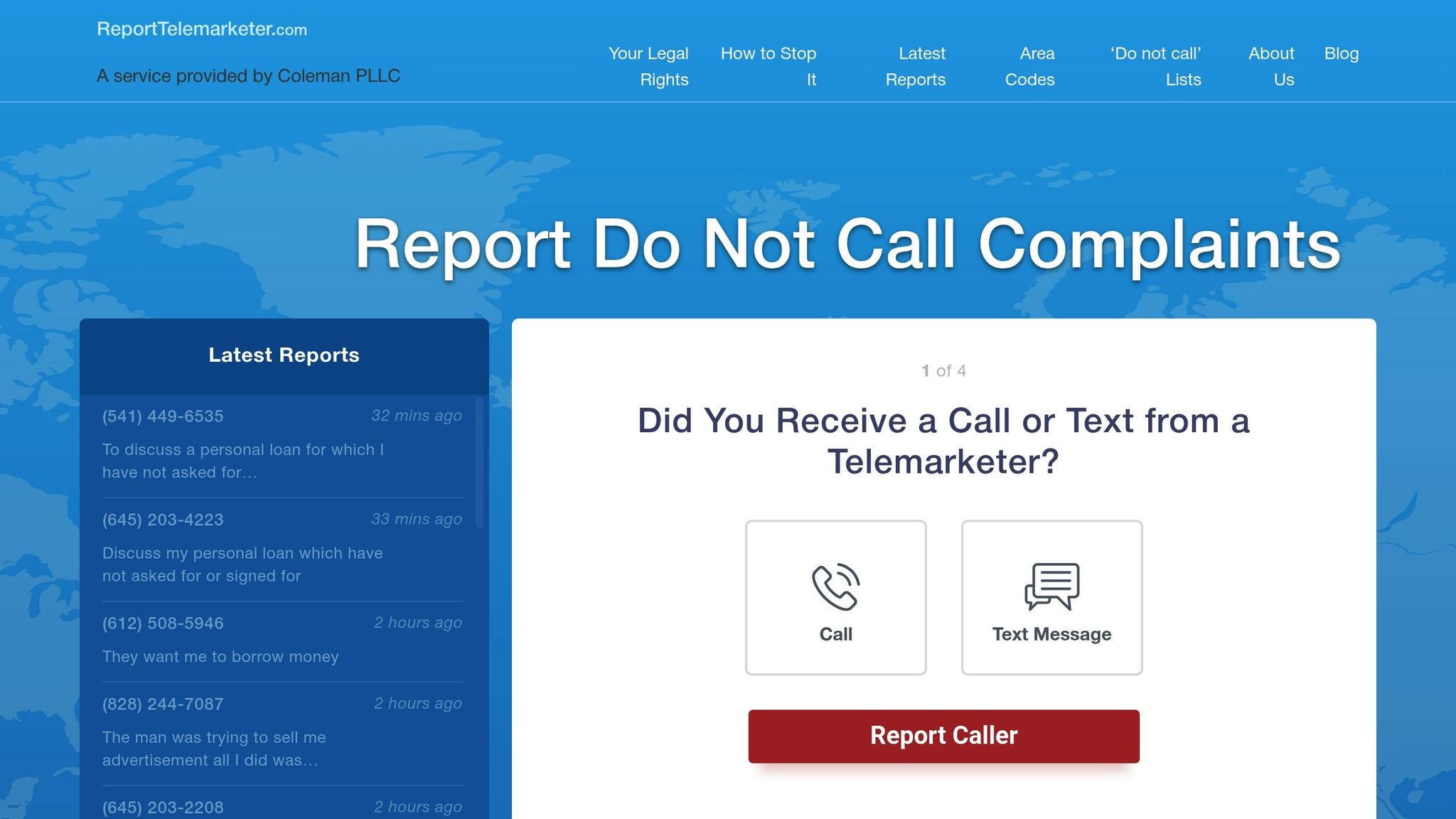
Unwanted calls aren’t just annoying – they often violate regulations. That’s where ReportTelemarketer.com steps in, offering a free service to help consumers report and combat rule-breaking telemarketers. So far, the platform has helped over 30,000 users take action against these unwanted intrusions.
Reporting Violations
To report a violation, consumers need to provide details about the call, along with evidence like call logs or text messages. Using advanced tools, the platform investigates the telemarketer behind the call and evaluates whether it broke any rules. Violations may include contacting numbers listed on the Do Not Call Registry, calling outside the allowed hours (9:00 AM to 6:00 PM), or using unregistered personal numbers instead of official business lines.
"By reporting on our site, we will try to identify the telemarketer calling you and then determine whether they had the consent to call you." – ReportTelemarketer.com
Keeping detailed records is crucial. If you’ve told a telemarketer to stop calling and they continue, those calls are considered illegal. Once a breach is confirmed, the platform takes steps to provide legal and consumer support.
Legal Actions and Consumer Support
After verifying a violation, ReportTelemarketer.com helps users pursue legal action. They assist with drafting cease and desist letters or filing formal complaints, all at no cost to the consumer. Importantly, any legal claim is only filed with your explicit consent, ensuring full transparency throughout the process.
Because the service is free, there’s no financial risk to you. When legal action is successful, attorney fees are recovered from the telemarketers themselves. This approach ensures that violators are held accountable under the UAE’s strict telemarketing laws.
Conclusion
The UAE’s updated telemarketing regulations, active since August 27, 2024, bring stricter measures to protect consumer privacy while holding businesses accountable. Repeat violations now carry hefty penalties for both companies and individuals.
For businesses, compliance is non-negotiable. Failing to follow these rules can lead to severe consequences, including commercial license suspension or operational shutdowns lasting between 7 and 90 days. Key violations, like operating without prior approval, contacting numbers listed on the Do Not Call Registry (DNCR), or making calls outside the approved hours of 9:00 AM to 6:00 PM, can result in significant financial losses and damage to reputation.
On the consumer side, the regulations provide better tools for privacy protection and complaint reporting. Features like the DNCR and the "Kashif" caller ID system ensure greater transparency by clearly identifying the source of incoming calls. If violations occur, consumers can easily report them via SMS to 1012 or report unwanted text messages or through platforms like ReportTelemarketer.com, holding telemarketers accountable.
"The initiative empowers individuals to opt out of receiving marketing calls from specific sectors or all sectors".
This balanced approach discourages non-compliance while prioritizing consumer rights. For businesses and consumers, understanding these regulations is key to fostering a respectful and compliant telemarketing environment in the UAE.
FAQs
How do I register my number on the DNCR?
To stop receiving unwanted calls in the UAE, you can register your number on the Do Not Call Registry (DNCR) for free. Here’s how:
- Etisalat: Send an SMS with "DNCR" to 1012.
- Du: Send "Block" to 1012.
- Virgin Mobile: Open the Virgin Mobile app, go to Settings, and select Manage third party voice calls.
To confirm your registration:
- For Etisalat, send "Check IDNCR" to 1012.
- For Du, send "Check" to 1012.
What qualifies as a “telemarketing” call under these rules?
A "telemarketing" call is any call made by a business or individual aimed at marketing, advertising, or promoting products or services. This definition also extends to marketing efforts via SMS or social media messages. Such activities must comply with updated telemarketing rules, which include specific penalties for non-compliance.
What proof should I keep when reporting illegal calls?
When you report illegal telemarketing calls, it’s crucial to keep thorough evidence. This might include call recordings, screenshots of the caller ID, and records of the date and time the calls occurred. These details are essential for verifying your report and highlighting violations of telemarketing laws. Make sure your documentation is clear, accurate, and well-organized to strengthen your case.

