
New York is cracking down on illegal telemarketing with stricter laws, higher fines, and federal partnerships. Here’s what you need to know:
- Increased Penalties: Violations of the Do Not Call (DNC) registry now face fines up to $20,000 per infraction, nearly double the previous $11,000 cap.
- Key Law: N.Y. General Business Law § 399-z regulates telemarketing practices, including call time restrictions and mandatory disclosures.
- Federal Collaboration: New York works with the FTC and a multistate task force to combat large-scale robocall operations and hold voice service providers accountable.
- Highlighted Cases:
- Rocket Mortgage: Facing a $15M class-action lawsuit for ignoring consumer opt-out requests.
- Avid Telecom: Accused of facilitating 24.5 billion robocalls, including 7.5 billion to numbers on the DNC registry.
- New Measures: Voice service providers must register with the FCC’s Robocall Mitigation Database and comply with traceback requests.
New York’s approach focuses on tougher enforcement, targeting infrastructure supporting illegal calls, and empowering consumers to report do not call violations.
New law increases fine for unwanted sales calls in NY
sbb-itb-a8d93e1
1. Diamond Phone Card Inc. Settlement
In 2012, Diamond Phone Card Inc. found itself at the center of a breach of contract case. This dispute wasn’t about telemarketing violations but rather unpaid prepaid phone cards.
Key Violations
Diamond Phone Card Inc. failed to meet its financial obligations to Titan Communications, Inc. Specifically, the company missed the 14-day deadline to settle payments for prepaid phone cards.
Penalties Imposed
The Supreme Court of Queens County ruled against Diamond Phone Card Inc., ordering them to pay $295,095.04 in principal damages. This decision was later upheld by the Appellate Division in April 2012.
Enforcement Agency
This case was handled within New York’s civil court system after Titan Communications, Inc. filed a lawsuit.
While this wasn’t a telemarketing-related case, it highlights how other types of business practices can also lead to legal action and financial penalties.
2. Rocket Mortgage Do Not Call Violations
Rocket Mortgage has come under scrutiny for repeatedly violating federal Do Not Call (DNC) rules by disregarding consumer opt-out requests. This case highlights how even large corporations are subject to New York’s stringent regulatory standards.
Key Violations
In November 2025, Hillary Wissart filed a federal class-action lawsuit against Rocket Mortgage after the company ignored her opt-out request. Despite sending a "Stop" text message to halt further communications, she continued receiving calls and texts over the next 12 months. These violations included contacting individuals who were not existing customers and had no prior business relationship with the company.
This case raises important legal questions about the scope of opt-out requests. Eric J. Troutman, Partner at Troutman Amin, LLP, commented:
"The case is interesting because it will test whether: i) SMS messages are subject to the TCPA’s DNC rules; and ii) whether a request that SMS ‘stop’ also requires calls to cease".
Rocket Mortgage’s repeated breaches have led to mounting legal and financial challenges.
Penalties Imposed
The Wissart v. Rocket Mortgage case involves over 10,000 claimants and could result in damages totaling $15,000,000. Under the Telephone Consumer Protection Act (TCPA), each violation carries a penalty of $500, which can increase to $1,500 for willful misconduct. In New York, penalties for DNC violations can reach as high as $11,000 per incident.
Enforcement Agency
These violations fall under the TCPA, a federal law enforced by the Federal Communications Commission (FCC). Unlike government-led actions, this is a private class-action lawsuit. Eric J. Troutman noted:
"Rocket Mortgage is no stranger to TCPA litigation. They have been sued repeatedly for unwanted solicitations and alleged robocalls".
Consumers affected by similar violations can report incidents through ReportTelemarketer.com, a free platform dedicated to addressing unwanted calls and texts.
3. New York Nuisance Call Act Enforcement
The New York Nuisance Call Act focuses on regulating live telemarketing calls, aiming to close existing loopholes. Its updated framework introduces stricter rules and heftier penalties for violations.
Key Violations
Under the act, live telemarketers must now ask recipients if they want to be added to the company’s internal "do not call" list. They are also required to obtain express written consent before sharing or selling consumer data. Section 399-z of the act outlines specific rules, including restrictions on call times and mandatory oral disclosures during calls.
Voice service providers play a critical role, too. They must register with the FCC’s Robocall Mitigation Database and submit detailed plans to curb illegal robocalls. Additionally, they are required to cooperate with government traceback requests to track the origins of illegal call traffic.
These measures set the stage for the increased penalties outlined below.
Penalties Imposed
New York has ramped up financial penalties for violators, raising the maximum fine from $11,000 to $20,000 per violation as of September 2023.
Since these fines apply to each individual violation, companies engaging in widespread illegal calling practices could face enormous financial consequences.
This aggressive approach supports the state’s broader enforcement efforts.
Enforcement Agency
New York’s state agencies are now at the forefront of enforcement, working alongside federal partners. The New York Attorney General‘s Office leads these efforts, collaborating with the bipartisan Anti-Robocall Litigation Task Force, which includes attorneys general from 50 states. The New York Department of State‘s Division of Consumer Protection also investigates complaints and pursues administrative actions.
For example, in May 2023, Attorney General Letitia James, along with a coalition of 51 attorneys general, filed a lawsuit against Avid Telecom, its owner Michael Lansky, and VP Stacey S. Reeves. The lawsuit claimed the company facilitated 24.5 billion calls between December 2018 and January 2023. Alarmingly, over 90% of these calls lasted less than 15 seconds, a hallmark of robocalling. Avid Telecom allegedly made more than 7.5 billion calls to numbers listed on the National Do Not Call Registry and transmitted 8.4 million calls that falsely appeared to come from government or law enforcement agencies. Despite receiving 329 notifications from the Industry Traceback Group about illegal activity, the company continued these practices.
In August 2025, the multistate task force sent warnings to 37 voice service providers, including Alpha Stream, Dial Vista Corp., and Zenitel, demanding they stop routing fraudulent robocalls. Investigations revealed these companies had ignored FCC traceback requests and failed to register with the Robocall Mitigation Database. Attorney General James emphasized the public’s frustration, stating:
"New Yorkers are sick and tired of robocalls from scammers who are trying to steal their money or private personal information."
Unlike the TCPA, the Nuisance Call Act does not allow individual consumers to file lawsuits. Instead, enforcement is handled by state authorities. However, consumers can report violations through platforms like ReportTelemarketer.com, which investigates complaints and works to stop unwanted calls at no cost to users.
Case Comparison: Strengths and Weaknesses
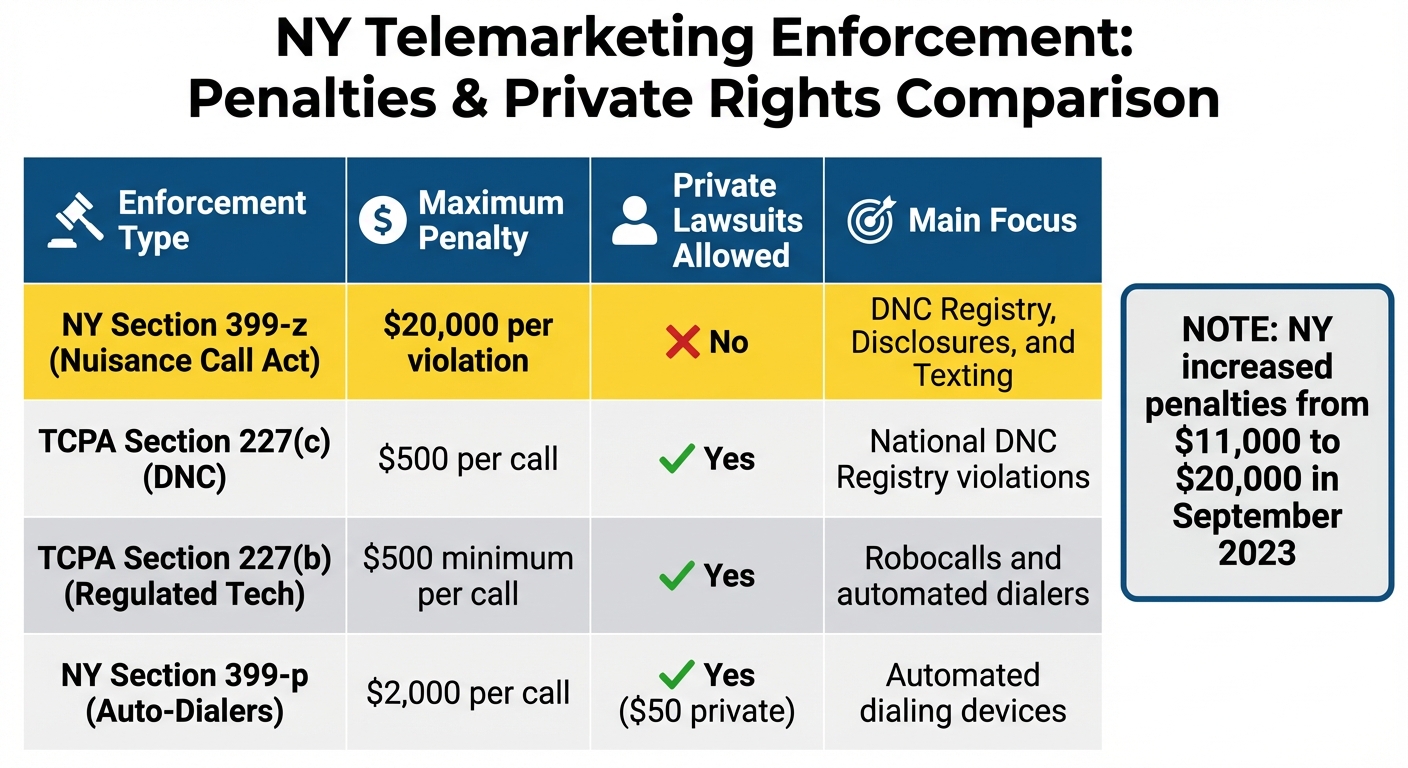
NY Telemarketing Enforcement Framework Comparison: Penalties and Private Lawsuit Rights
Each enforcement method brings its own set of advantages and challenges. For instance, the settlement with Diamond Phone Card Inc. highlighted the speed and efficiency of negotiated agreements, which can deliver immediate relief to consumers without the delays of prolonged litigation. On the other hand, Rocket Mortgage faced penalties under the federal TCPA’s Do Not Call provisions, which cap fines at $500 per call under Section 227(c). In comparison, New York’s Nuisance Call Act significantly raises the stakes, with fines now reaching up to $20,000 per violation, an increase from the previous $11,000. This shift reflects a broader move from addressing individual claims to implementing measures aimed at deterring violations on a structural level.
New York’s approach prioritizes targeting voice service providers directly, sidestepping the need to pursue individual violators. This strategy has shown promise, such as when 37 providers received warning letters for failing to comply with FCC traceback requirements. However, a notable drawback of the Nuisance Call Act is the absence of a private right of action, meaning consumers cannot bring individual lawsuits under Section 399-z, unlike the TCPA.
Here’s a comparison of key enforcement frameworks:
| Enforcement Type | Maximum Penalty | Private Lawsuits | Main Focus |
|---|---|---|---|
| NY Section 399-z (Nuisance Call Act) | $20,000 per violation | No | DNC Registry, Disclosures, and Texting |
| TCPA Section 227(c) (DNC) | $500 per call | Yes | National DNC Registry violations |
| TCPA Section 227(b) (Regulated Tech) | $500 minimum per call | Yes | Robocalls and automated dialers |
| NY Section 399-p (Auto-Dialers) | $2,000 per call | Yes ($50 private) | Automated dialing devices |
The federal TCPA empowers individuals to directly pursue violators, resulting in thousands of enforcement actions every year. In contrast, New York’s regulatory framework consolidates enforcement power within the Attorney General’s office, which has extensive authority to demand business records immediately upon suspicion of wrongdoing. For consumers, platforms like ReportTelemarketer.com offer an accessible way to report violations and stop spam calls. These platforms investigate complaints and take action without charging users.
New York’s layered approach addresses gaps in telemarketing regulations by combining financial penalties with enhanced oversight. For example, the state extended Do Not Call protections to cover live telemarketing calls, closing what regulators referred to as a "license to annoy". Additionally, by requiring voice service providers to register in the FCC’s Robocall Mitigation Database, the state has introduced multiple levels of enforcement. Together, these measures reflect New York’s commitment to holding the industry accountable while safeguarding consumer interests.
Conclusion
New York has taken significant steps to tighten its grip on telemarketing violations, adopting stricter penalties and pushing for greater accountability. For instance, the state has raised the maximum fines for violations from $11,000 to $20,000, signaling a firm commitment to closing gaps that telemarketers have exploited in the past.
The cases discussed illustrate both the progress and the challenges in enforcement. The Rocket Mortgage case, for example, highlights persistent non-compliance with Do-Not-Call rules, emphasizing the need for strong state oversight. Tools like the ability to demand immediate access to business records are crucial in holding violators accountable. These developments show how higher fines and centralized oversight are reshaping the enforcement landscape.
Consumer involvement remains a cornerstone of these efforts. New York Secretary of State Walter T. Mosley emphasized the importance of public participation:
"Every consumer should take the time to put their phone number on the Do Not Call Registry and report any instance of an unwanted telemarketing call so we can track down bad actors and take legal action against them".
To support these efforts, platforms like ReportTelemarketer.com serve as valuable resources. They allow consumers to report spam calls, investigate telemarketers, and take action through cease-and-desist letters or formal complaints. This not only helps individuals stop illegal calls but also strengthens broader enforcement efforts.
FAQs
When does New York’s $20,000-per-call fine apply?
Telemarketers in New York face a $20,000 fine per call if they break the state’s telemarketing laws. These violations include ignoring rules about when calls can be made or failing to meet disclosure requirements. These regulations, detailed in Section 399-z, are designed to shield consumers from illegal or unwelcome telemarketing practices.
Can I sue a telemarketer under NY’s Nuisance Call Act?
Under New York’s Nuisance Call Act, you might have the right to sue a telemarketer. This law, detailed in N.Y. General Business Law Section 399-Z, is designed to shield consumers from intrusive telemarketing calls and sets clear rules that telemarketers are required to follow.
What proof should I save for a DNC or “Stop” violation?
To ensure compliance and address potential issues effectively, keep records of the consumer’s explicit request or consent to contact. This can include things like written confirmations, email exchanges, or detailed communication logs. These documents are crucial for proving whether a DNC (Do Not Call) or “Stop” violation has occurred.

