
The Telephone Consumer Protection Act (TCPA), enacted in 1991, was designed to protect consumers from intrusive telemarketing practices like robocalls and unsolicited faxes. Over the years, the TCPA has evolved to address new challenges posed by advancing technology, such as AI-generated robocalls, and has introduced stricter rules to safeguard consumer privacy.
Key Highlights:
- 1991: TCPA established, banning autodialed/prerecorded calls without consent and empowering consumers to sue violators for $500–$1,500 per violation.
- 2003: Launch of the National Do Not Call Registry, reducing telemarketing calls significantly.
- 2012: Supreme Court ruling in Mims v. Arrow Financial Services affirmed federal and state court jurisdiction for TCPA lawsuits. The FCC also required express written consent for telemarketing calls.
- 2021: Supreme Court decision in Facebook v. Duguid narrowed the definition of autodialers, reducing liability for many businesses.
- 2019–2026 Updates: Introduction of the TRACED Act, AI voice rules, and stricter opt-out compliance timelines. Penalties for violations increased, with recent settlements reaching millions of dollars.
Consumer Tools:
- Do Not Call Registry: Register to block telemarketing calls.
- ReportTelemarketer.com: Free service to report violations and pursue compensation.
The TCPA continues to adapt to modern challenges, ensuring consumers have tools to combat telemarketing abuse and protect their privacy.
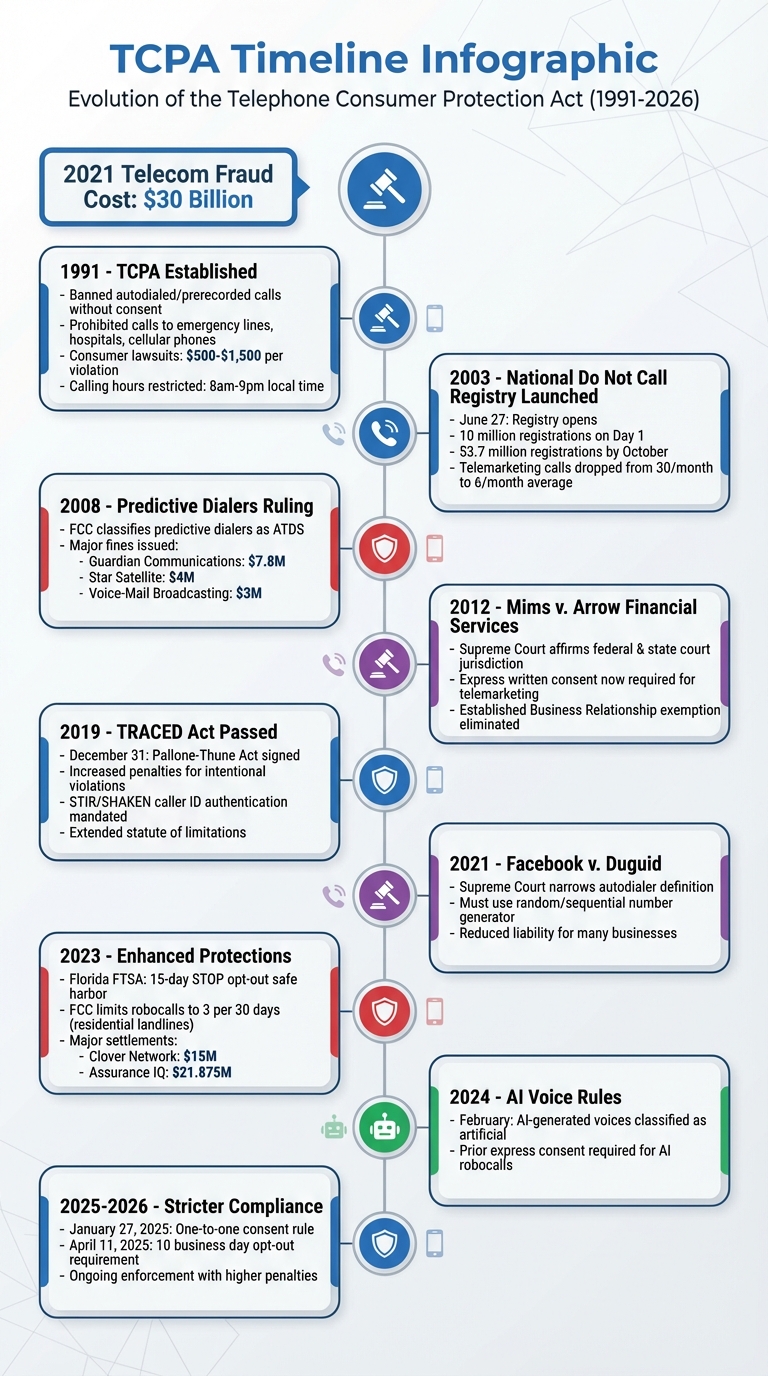
TCPA Evolution Timeline: Major Milestones from 1991 to 2026
1991: The TCPA Is Created
Consumer Complaints Lead to Legislative Action
By the late 1980s, telemarketing had become a growing issue. New technologies allowed telemarketers to make automated calls at staggering rates – up to 1,000 calls per hour – and send tens of thousands of unsolicited faxes every week.
While individual states tried to address these concerns with their own rules, their efforts fell short when telemarketers operated across state borders. Frustrated by intrusive practices, consumers filed complaints, prompting Congress to take action. After reviewing 10 different legislative proposals, Congress opted for a federal approach. Legal experts Daniel Heidtke, Jessica Stewart, and Spencer Weber Waller explained:
"The TCPA was born out of abusive telemarketing practices, made more intrusive by advances in technology".
These frustrations laid the groundwork for the specific TCPA regulations that followed.
Original TCPA Provisions
The TCPA introduced clear limits to curb telemarketing abuses. It banned the use of artificial or prerecorded voice messages to residential phone lines without prior consent. It also prohibited autodialed calls to emergency lines, hospital rooms, doctors’ offices, and cellular phones. Telemarketers faced additional restrictions, including a ban on calling residences before 8:00 a.m. or after 9:00 p.m. (local time). They were also required to identify themselves by providing their company name and contact details.
To further protect consumers, the law required companies to maintain internal do-not-call lists and honor consumer requests for five years. The TCPA also addressed one of the most frequent complaints from businesses by banning unsolicited fax advertisements. On top of these restrictions, the law gave consumers the power to take legal action against violators, allowing them to sue for $500 per violation – or up to $1,500 for willful violations.
sbb-itb-a8d93e1
2002-2003: The National Do Not Call Registry
From Company Lists to a National Registry
Back in 1991, the TCPA allowed for a national database to curb telemarketing calls, but the FCC initially opted for a less centralized approach in 1992. They required companies to maintain their own opt-out lists, which placed the burden on consumers to individually request removal from each telemarketer’s list – a process that was both time-consuming and frustrating for many [12, 14, 17].
As telemarketing calls continued to flood American homes, states began taking matters into their own hands. By the end of 2002, 27 states had created their own do-not-call registries to address the issue. However, this patchwork of state-level efforts underscored the need for a streamlined, nationwide solution. This led to the passage of the Do-Not-Call Implementation Act in March 2003. The legislation gave the FTC the authority to create a centralized national registry [10, 12].
The 2003 Report and Order
In response to the growing demand for a unified system, the National Do Not Call Registry officially launched on June 27, 2003. The response was overwhelming – over 10 million phone numbers were registered on the very first day. By October 24, 2003, the number of registrations had skyrocketed to 53.7 million. FCC Chairman Michael K. Powell described the initiative, saying:
Government is at its best when it empowers individuals to make their own choices. Consumers wanted more control over their telephones – and we are giving it to them.
The registry simplified the opt-out process by providing a single platform for consumers to register their numbers. Telemarketers, on the other hand, were required to check their call lists against the database every three months [10, 11]. This initiative also extended protections to areas outside the FTC’s jurisdiction, including banks, insurance companies, and telecommunications providers, ensuring a consistent national standard for all callers.
Additional rules were introduced to address common consumer complaints. For example, "dead air" calls – where no one is on the line – were limited to 3%, and telemarketers were required to transmit Caller ID information [11, 16]. Violations of these rules came with hefty fines of up to $11,000 per call.
While registration was free for consumers, telemarketers incurred costs. They paid $25 per area code (with the first five codes free) or a maximum annual fee of $7,375 for nationwide access. The impact was immediate: a survey revealed that registered consumers experienced a sharp drop in telemarketing calls, from an average of 30 per month to just 6.
2008-2012: FCC Rulings and Court Decisions
2008 FCC Ruling on Predictive Dialers
In 2008, the FCC clarified its stance on predictive dialers, ruling that these devices qualify as ATDS under the TCPA. Industry groups had argued that predictive dialers should only be considered autodialers if they randomly or sequentially generated numbers. However, the FCC determined that the defining feature was their ability to dial numbers automatically. This ruling meant telemarketers and debt collectors could no longer use predictive dialers to contact wireless numbers without prior express consent. For example, providing a cell number on a credit application was deemed sufficient consent to be contacted about the associated debt.
This decision was followed by significant enforcement actions, including fines against Guardian Communications Inc. ($7.8 million in November 2007), Star Satellite Inc. ($4 million in June 2008), and Voice-Mail Broadcasting Corp. ($3 million for abandoned calls). These actions reinforced the FCC’s position and set the stage for further judicial interpretations.
2012 Mims v. Arrow Financial Services
In January 2012, the Supreme Court issued a landmark decision in Mims v. Arrow Financial Services, LLC, reshaping the jurisdiction for TCPA lawsuits. Marcus D. Mims had sued Arrow Financial Services over repeated autodialed calls to his cell phone for debt collection. After the Eleventh Circuit dismissed the case due to jurisdictional issues, the Supreme Court reversed that ruling. Justice Ruth Bader Ginsburg, writing for the unanimous court, stated:
"We find no convincing reason to read into the TCPA’s permissive grant of jurisdiction to state courts any barrier to the U. S. district courts’ exercise of the general federal-question jurisdiction they have possessed since 1875."
This decision affirmed that both federal and state courts share jurisdiction over private TCPA lawsuits, overturning earlier interpretations that limited such claims to state courts . This ruling, alongside the FCC’s regulatory actions, strengthened the TCPA’s enforcement framework.
2012 Express Written Consent Requirement
Later in 2012, the FCC introduced additional safeguards for consumers, requiring prior express written consent for autodialed or prerecorded calls to both wireless and residential lines . Consumers must now provide signed consent, which can be collected electronically. The rule also eliminated the Established Business Relationship (EBR) exemption, which had previously allowed prerecorded calls to residential lines without consent if a prior purchase had been made. Consent forms must clearly state that consumers are authorizing telemarketing calls and that agreeing to such calls is not a condition for making a purchase.
Violations of these rules can lead to penalties ranging from $500 to $1,500 per unsolicited call or text. To ensure compliance, companies are advised to keep consent records for at least four years . These updates further solidified the TCPA’s regulatory and judicial reach, setting the stage for future landmark decisions on consent and jurisdiction.
What is TCPA & Why Does It Matter?
2012-2020: Autodialer Definitions and Court Cases
From 2012 to 2020, the TCPA faced challenges in keeping up with rapidly changing telecommunication technologies. During this time, courts and regulators grappled with defining what exactly constituted an automatic telephone dialing system (ATDS), leading to significant legal uncertainty and inconsistent enforcement across jurisdictions.
Facebook v. Duguid (2021)
Throughout this period, federal courts were deeply divided over the ATDS definition. Some courts, including the 9th, 2nd, and 6th Circuits, adopted a broader interpretation, ruling that any equipment capable of storing and automatically dialing phone numbers could qualify as an ATDS. On the other hand, other circuits argued that only devices using a random or sequential number generator met the criteria. This split left businesses in a bind, as the rules varied depending on the jurisdiction.
In 2021, the Supreme Court stepped in to settle the matter with its decision in Facebook v. Duguid. The Court adopted a narrower definition, ruling that devices must use a random or sequential number generator to qualify as autodialers under the TCPA. This decision excluded many systems that merely store numbers and dial them automatically, significantly altering the enforcement landscape. The FCC also weighed in during this period to clarify the technical capabilities of autodialers.
FCC Orders on Reassigned Numbers and Exemptions
In 2015, the FCC added another layer of complexity by ruling that an autodialer’s "capacity" extended to its potential functionalities. In other words, a device didn’t need to immediately use random or sequential dialing – it only needed to be capable of being modified to do so. This interpretation, combined with conflicting court rulings, created a regulatory maze for businesses to navigate. The Supreme Court’s eventual ruling in Facebook v. Duguid helped bring clarity, but the years leading up to it were marked by significant uncertainty and evolving enforcement standards.
These legal and regulatory shifts during 2012-2020 played a key role in shaping how the TCPA was enforced in the face of advancing technology.
2019-2026: Recent Changes and Enforcement Trends
Between 2019 and 2026, regulators have taken major steps to address evolving technologies and consumer complaints. These updates have increased penalties, clarified consent rules, and introduced safeguards against emerging threats like AI-generated robocalls.
2019 TRACED Act
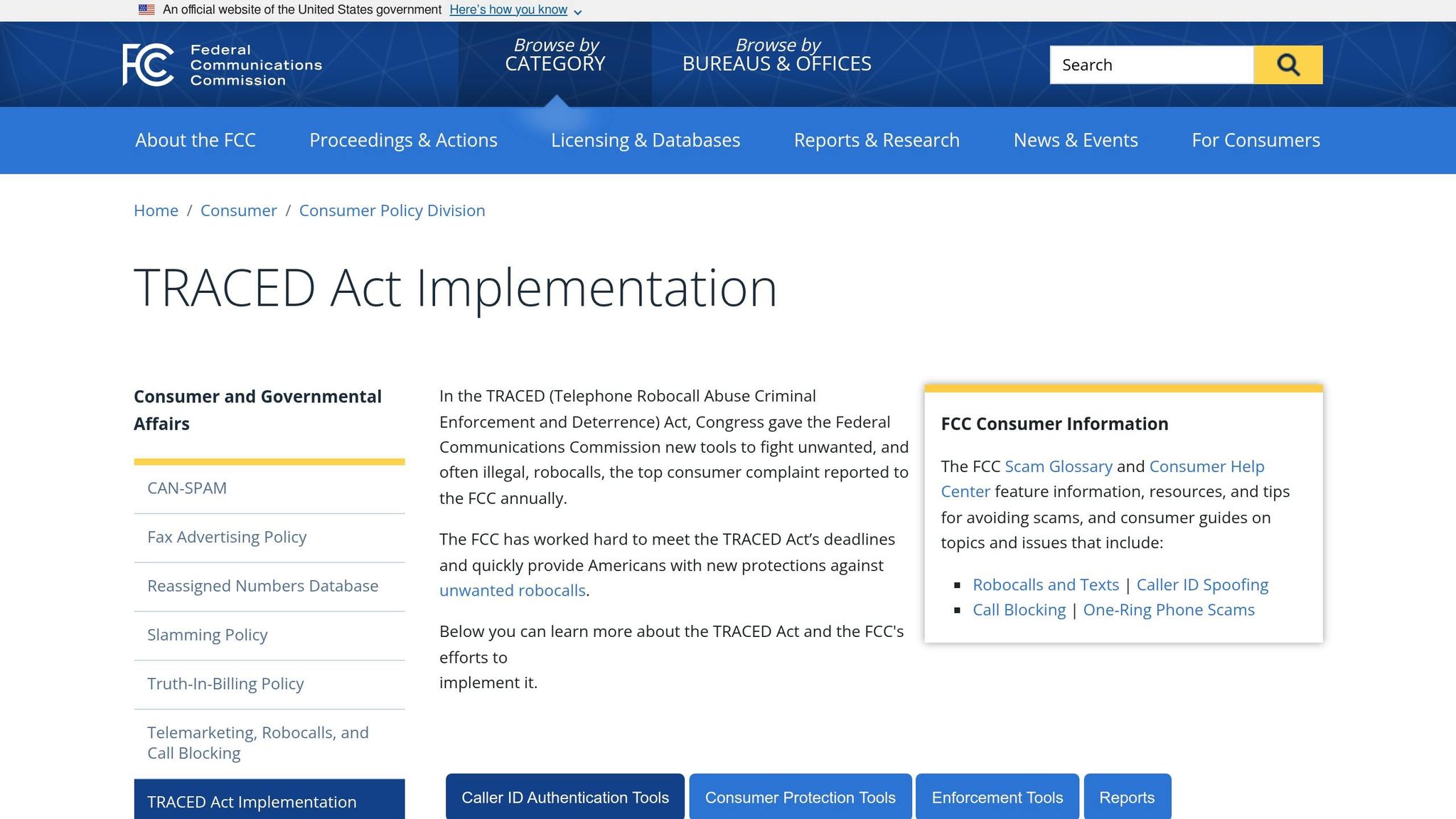
On December 31, 2019, Congress passed the Telephone Robocall Abuse Criminal Enforcement and Deterrence (TRACED) Act, also known as the Pallone-Thune Act. This marked one of the most impactful updates to the TCPA in decades. The TRACED Act introduced tougher financial penalties for intentional violations and extended the statute of limitations, giving the FCC more time to act against illegal robocallers. A key feature of the law was the mandatory rollout of STIR/SHAKEN, a caller ID authentication technology designed to combat spoofing. This system helps consumers distinguish legitimate calls from fraudulent ones. These federal changes also paved the way for further innovations at the state level, including Florida’s 2023 FTSA updates.
2023 FTSA Updates and STOP Opt-Out
In 2023, Florida revised its Telephone Solicitation Act (FTSA), introducing new compliance rules that have influenced telemarketing practices across the country. One significant change was narrowing the definition of an "automated system" to apply only to technology that both selects and dials numbers, replacing the earlier "selection or dialing" phrasing. Another key update was the establishment of a 15-day "safe harbor" for text messages. Under this rule, telemarketers must stop sending texts within 15 days of receiving a "STOP" request. Consumers can only take legal action if texts continue beyond this period.
At the federal level, the FCC implemented additional rules on July 20, 2023. These rules limit informational robocalls to residential landlines to three calls per 30-day period unless prior consent is given. They also require prerecorded calls to residential lines to include an automated, interactive opt-out option. Recent high-profile settlements include Clover Network LLC agreeing to pay up to $15,000,000 for unauthorized texts and Assurance IQ settling for up to $21,875,000 over misuse of an automatic dialing system. These developments highlight a growing trend toward stricter consumer protections.
Future Enforcement Through 2026
Building on these reforms, regulators are preparing for even tougher compliance measures through 2026. In February 2024, the FCC classified AI-generated voices used in robocalls as "artificial or prerecorded voices" under the TCPA, requiring prior express consent for their use. Additionally, new FCC rules effective April 11, 2025, will require businesses to honor consumer opt-out requests within 10 business days, a significant reduction from earlier timelines. These changes signal a clear direction: as telemarketers adopt advanced technologies, regulators are responding with shorter compliance windows and stricter rules, setting the stage for even stronger consumer protections through 2026.
How ReportTelemarketer.com Helps Enforce the TCPA
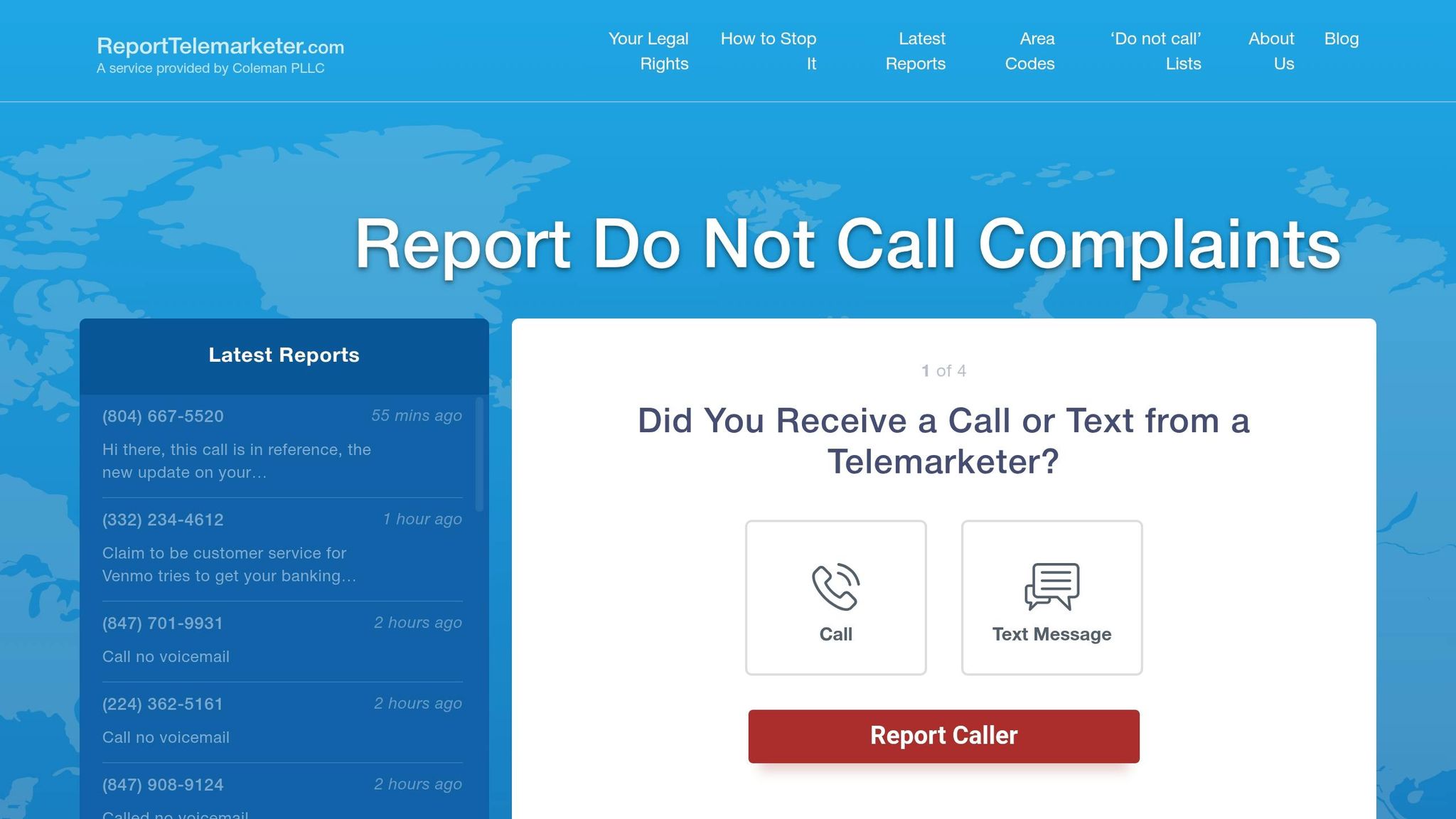
With stricter TCPA regulations in place through 2026, consumers now have more ways to push back against illegal robocalls and texts. ReportTelemarketer.com is a free service designed to help individuals report these violations. It connects users with a specialized legal team that investigates complaints and pursues compensation on their behalf. This streamlined approach aligns with ongoing efforts to curb unwanted telemarketing.
Through the platform, users can report unwanted calls and texts, including those made using autodialers, artificial voices, or prerecorded messages sent without prior consent. After a report is submitted, the legal team reviews the details to determine if the telemarketer has violated TCPA regulations, such as ignoring the Do Not Call registry or failing to respect opt-out requests. When violations are confirmed, the team takes action, which may include sending cease-and-desist letters or filing formal complaints to stop the harassment.
One standout feature of this service is its focus on helping consumers quickly pursue TCPA claims. Under the TCPA, individuals can sue violators in state or federal courts for statutory damages. These damages typically range from $500 per violation to $1,500 for willful violations, such as ignoring a stop request. Importantly, ReportTelemarketer.com operates at no cost to users – attorney fees are collected directly from telemarketers when applicable, so consumers face no out-of-pocket expenses.
In addition to halting unwanted calls, the service also seeks legal injunctions to force telemarketers into compliance and assists users in recovering statutory damages. These efforts not only hold violators accountable but also reinforce the protections established by the TCPA, ensuring individuals can exercise their rights under the law.
Conclusion
Since its introduction in 1991, the TCPA has evolved to safeguard consumer privacy against the ever-changing landscape of telemarketing technology. Key Supreme Court cases like Mims v. Arrow Financial Services (2012) and Facebook v. Duguid (2021) have shaped how the law is enforced, while tools like the National Do Not Call Registry have given consumers a straightforward way to limit unwanted calls.
Recent updates to the law tackle new digital challenges. For example, the one-to-one consent rule, coming into effect on January 27, 2025, addresses loopholes in lead generation practices. Additionally, the FCC’s decision to require prior express written consent for AI-generated voices highlights the law’s adaptability to threats like deepfake robocalls. These changes are essential, especially when considering that telecommunications fraud cost Americans $30 billion in 2021.
Consumers now have stronger tools to fight back against telemarketing abuse. They can revoke consent at any time, register their numbers on the Do Not Call Registry, and even claim damages ranging from $500 to $1,500 per violation – penalties designed to keep telemarketers in check. As legal experts Daniel Heidtke, Jessica Stewart, and Spencer Weber Waller from Loyola University Chicago School of Law have observed:
The TCPA was born out of abusive telemarketing practices, made more intrusive by advances in technology.
The TCPA empowers individuals to take legal action against violators, creating financial consequences that encourage compliance. Whether dealing with relentless robocalls, spam texts, or AI-driven scams, the TCPA offers practical tools to hold telemarketers accountable and protect consumer privacy.
FAQs
Do I have a TCPA claim if I never gave consent?
You might have a TCPA claim if you never agreed to receive certain calls. Under the law, prior express consent is typically required for autodialed or prerecorded calls made to cell phones. That said, some situations – and updates from the FCC, such as the one-to-one consent rule – could influence whether you’re eligible. To know for sure, you’ll need to carefully examine the specifics of your case.
What counts as an autodialer after Facebook v. Duguid?
Under the Facebook v. Duguid ruling, for a device to be considered an autodialer under the TCPA, it must have the ability to use a random or sequential number generator to either store or produce phone numbers. Devices that solely store and automatically dial pre-existing numbers, without incorporating such a generator, are not classified as autodialers.
How do I prove a robocall or text violated the TCPA?
To show that a robocall or text violated the TCPA, you need solid evidence proving it was sent without your clear, prior consent. Here’s what can help build your case:
- Call logs, recordings, or screenshots: Keep records of the unwanted calls or messages.
- Proof of no consent: Show that you never gave written permission for these communications.
- Caller identification information: Document details about the caller, especially if spoofing tactics were used.
If the call or text involved an auto-dialer or a prerecorded message, it strengthens your claim even further.

