
The Telephone Consumer Protection Act (TCPA) imposes strict penalties on telemarketers who violate its rules, with fines starting at $500 per violation and reaching $1,500 for willful misconduct. Courts have clarified how damages are calculated in several cases, addressing concerns over excessive awards and the evidence required for higher penalties.
Key takeaways:
- Base Penalty: $500 per violation, rising to $1,500 for willful violations.
- Massive Awards Reduced: Courts can lower total damages if they are deemed excessively large, as seen in cases like Wakefield v. ViSalus and Golan v. FreeEats.com.
- Evidence for Treble Damages: Plaintiffs must prove intentional misconduct to secure higher penalties, as highlighted in Carr v. Credit Acceptance Corp..
- Do Not Call violations: Judges have more flexibility in adjusting damages compared to other TCPA violations.
For consumers, keeping detailed records of violations is crucial. For telemarketers, compliance is critical to avoid steep financial consequences.
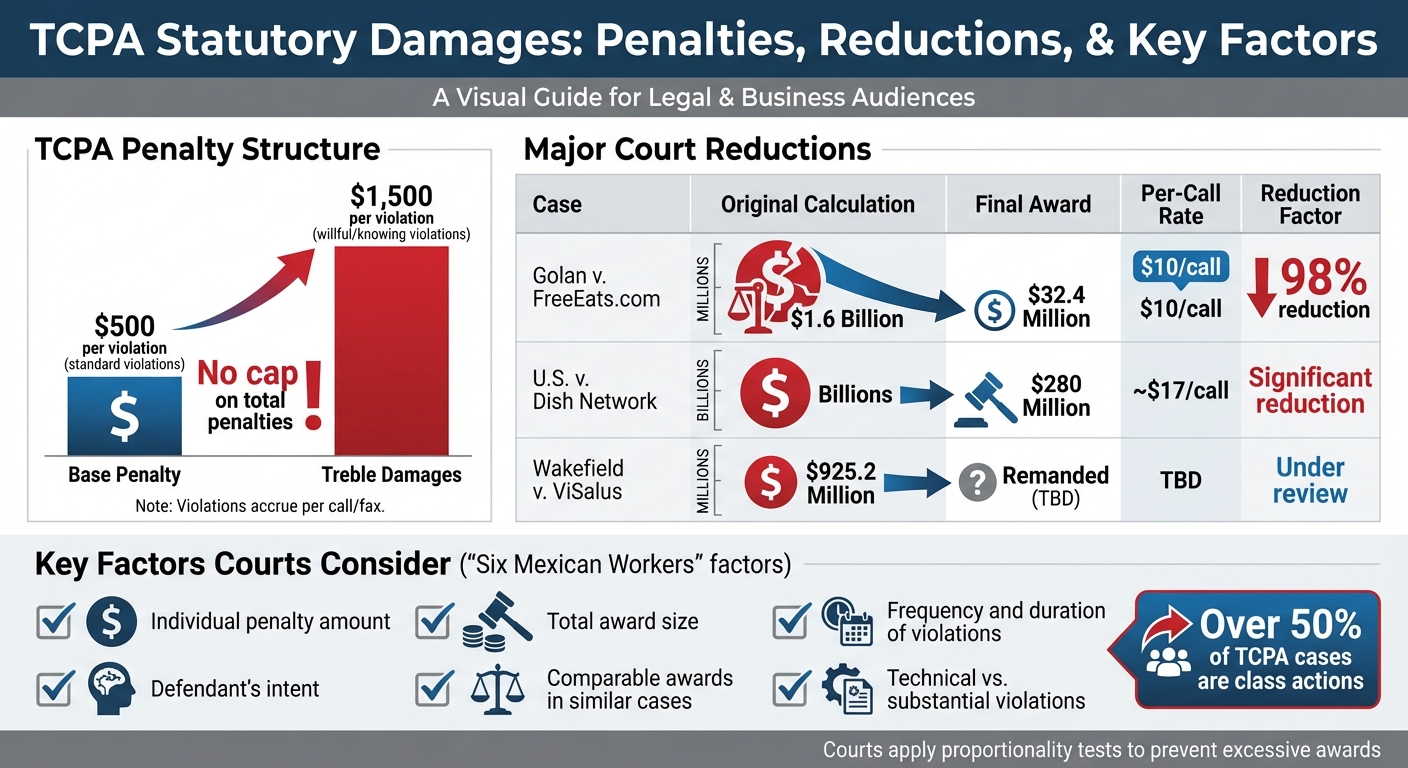
TCPA Statutory Damages: Penalty Structure and Major Court Reductions
TCPA Compliance and Litigation Update
sbb-itb-a8d93e1
Major Court Decisions on TCPA Statutory Damages
Three pivotal court cases have reshaped how damages under the TCPA are calculated and limited. These decisions address the constitutional boundaries of large awards, the distinction between different TCPA provisions, and the evidence required to justify enhanced penalties.
Wakefield v. ViSalus, Inc.: Limits on Massive Class Action Awards
In October 2022, the Ninth Circuit Court of Appeals overturned a staggering $925,220,000 judgment against ViSalus, Inc., a multi-level marketing company. The case revolved around 1,850,440 automated "WinBack" campaign calls made between 2012 and 2015, each carrying a $500 penalty. While the individual penalties were upheld, the near $1 billion total raised serious constitutional concerns.
The court ruled that the aggregate award must be reviewed under the Due Process Clause of the Fifth Amendment. Using the standard from St. Louis, I.M. & S. Ry. Co. v. Williams, the court asked whether the total damages were "so severe and oppressive as to be wholly disproportionate to the offense and obviously unreasonable". The decision highlighted how modern technology enables automated calls that can quickly lead to enormous damages.
To assess whether such aggregate awards cross constitutional limits, courts now apply the "Six Mexican Workers" factors. These include considerations like the individual penalty amount, the total award size, the frequency and duration of violations, the defendant’s intent, comparable awards in similar cases, and whether the violations were technical or substantial. For instance, the Eighth Circuit previously reduced a $1.6 billion TCPA award to $32 million in Golan v. FreeEats.com, Inc.. This framework provides a clear path for defendants to contest excessive class action damages.
Watson v. Manhattan Luxury Autos., Inc.: Flexibility in Do Not Call Violation Damages
The TCPA imposes strict penalties, but courts approach damages differently depending on the type of violation. Section 227(b), which addresses autodialers and prerecorded messages, mandates a minimum $500 penalty per call. In contrast, Section 227(c), dealing with Do Not Call list violations, allows judges more discretion to adjust damages based on the specific harm and circumstances.
This distinction means that while some violations result in rigid penalties, others leave room for courts to tailor awards to the situation.
Carr v. Credit Acceptance Corp.: Evidence Requirements for Treble Damages
Under the TCPA, treble damages of $1,500 per call are only awarded when plaintiffs prove the defendant "willfully and knowingly" violated the law. In Carr v. Credit Acceptance Corp., the court rejected claims for treble damages because the plaintiff failed to show sufficient evidence of willful conduct. As a result, the award was limited to the standard $500 per violation.
This decision emphasized that proving willfulness requires more than demonstrating a technical violation. Plaintiffs must present clear evidence of the defendant’s intent or knowledge of the illegality of their actions. Without such proof, courts typically stick to the minimum statutory penalty. This case sets a higher bar for plaintiffs seeking enhanced damages under the TCPA.
Patterns in TCPA Damages Calculations
Courts have established clear approaches for calculating damages under the TCPA, particularly in cases involving automated dialing systems. The statute sets a baseline penalty of $500 per violation, which increases to $1,500 for willful violations, with no upper limit on total penalties. This lack of a cap can lead to staggering awards, often reaching billions of dollars when modern dialing technology is involved.
To address this, courts use proportionality tests rather than strict arithmetic when determining damages in large class actions. For instance, the Ninth Circuit employs a seven-factor framework that allows judges to reduce the per-violation rate significantly – from the statutory $500 to amounts as low as $10 or $17 – when total awards would otherwise be excessively high. These factors help courts balance fairness and deterrence, tailoring penalties based on the nature and severity of the violations.
A key consideration in these calculations is the distinction between technical and substantive violations. Minor infractions, such as small consent errors, are treated differently from serious privacy breaches. Courts often reduce awards for technical violations to avoid penalties that could be seen as overly punitive.
Here’s a closer look at how courts have adjusted awards in notable cases:
| Case Name | Original Statutory Calculation | Final/Reduced Award | Effective Per-Violation Rate | Key Factor for Reduction |
|---|---|---|---|---|
| Golan v. FreeEats.com | $1.6 Billion | $32.4 Million | $10 | Short duration; "plausible belief" of consent |
| U.S. v. Dish Network | Billions | $280 Million | ~$17 | Culpability; history of prior conduct; ability to pay |
| Wakefield v. ViSalus | $925.2 Million | Remanded | TBD | Aggregated award was "shockingly large" |
The TCPA’s strict liability framework means plaintiffs don’t need to prove intent to secure the base $500 penalty. However, to obtain treble damages (up to $1,500 per violation), they must provide clear evidence of willful or knowing misconduct. This creates a two-tiered system: basic violations trigger automatic penalties, while enhanced damages require a higher standard of proof. Increasingly, courts are scrutinizing both individual penalties and overall awards to ensure they act as effective deterrents without crossing into unconstitutional territory.
What TCPA Damages Mean for Consumers and Telemarketers
The Telephone Consumer Protection Act (TCPA) has a damages framework that places hefty financial burdens on telemarketers while giving consumers the power to push back against unwanted calls. Under the law, consumers can directly sue telemarketers without needing to show actual financial harm. Telemarketers operate under strict liability, meaning they must prove they obtained clear, explicit consent before making contact. If a telemarketer’s actions are found to be willful or intentional, courts can increase the penalty to $1,500 per call.
Take the 2019 case Krakauer v. Dish Network, for example. The Fourth Circuit upheld a $61 million judgment against Dish Network after a third-party marketer made calls to individuals on the Do Not Call registry. This case highlights how large-scale outreach combined with lapses in compliance can lead to massive penalties. As ActiveProspect puts it:
even minor oversights in compliance protocols can result in hundreds or thousands of violations.
For consumers, maintaining detailed records is crucial. Documenting violations – like saving timestamps, screenshots, or recordings – can significantly strengthen your case. Adding your number to the National Do Not Call Registry also creates a solid foundation for identifying violations. Importantly, you can revoke consent at any time, through oral or written notice, and telemarketers cannot impose specific methods for doing so.
Platforms like ReportTelemarketer.com (https://reporttelemarketer.com) make this process easier by offering free assistance. They investigate reported telemarketing practices, identify potential TCPA violations, and take action to stop further calls – all without upfront costs. Since the TCPA doesn’t allow consumers to recover attorney fees, these free services help level the playing field, ensuring violators are held accountable.
On the flip side, telemarketers face immense pressure to comply. Over half of federal TCPA cases are class actions, and courts are increasingly willing to impose severe penalties for systematic violations. The cost of non-compliance can far exceed the investment needed for proper consent management and monitoring systems. For telemarketers, the stakes couldn’t be higher.
Key Takeaways
The TCPA operates as a strict liability law, meaning telemarketers can face penalties even without intentional wrongdoing. Courts usually impose a baseline fine of $500 per violation, which can increase to $1,500 if the violation is found to be willful or intentional. However, when class action awards become excessively large, judges have shown a willingness to reduce them. A notable example is the Golan v. FreeEats.com case, where the Eighth Circuit slashed a $1.6 billion jury award down to $32.4 million – equating to about $10 per call. The court justified this reduction by stating:
$1.6 billion is so severe and oppressive as to be wholly disproportioned to the offense and obviously unreasonable.
For consumers: Consumers hold the right to revoke consent through reasonable means, and courts recognize unwanted calls as sufficient grounds to sue, even without proving additional harm. Keeping detailed records – like timestamps, call content, and proof of consent withdrawal – can significantly strengthen a legal case.
For telemarketers: Liability is expanding, especially for third-party violations. Even free webinars can qualify as unsolicited communications if they tie back to commercial purposes. This highlights the broad reach of TCPA compliance requirements.
Reporting violations is essential. TCPA penalties empower consumers to hold companies accountable. Tools like ReportTelemarketer.com offer free resources, such as investigating claims, sending cease and desist letters, and pursuing formal actions.
Both consumers and telemarketers need to take TCPA compliance seriously. Consumers should document every breach, while telemarketers must prioritize robust consent management to avoid the steep financial consequences of non-compliance.
FAQs
What counts as a separate TCPA “violation” for damages?
Each unauthorized call or text under the TCPA is treated as an individual violation. The law typically sets statutory damages at $500 per call or message, but if there are multiple infractions, the penalties can add up, leading to significantly higher total damages.
When can a court reduce a huge TCPA class action award?
A court has the authority to lower a substantial TCPA class action award if the damages are found to be excessively harsh and infringe upon the defendant’s due process rights. A notable instance of this occurred in the Ninth Circuit case Wakefield v. ViSalus, Inc., where a $925 million award was sent back for reassessment due to constitutional concerns.
What proof is needed to get $1,500 per call (treble damages)?
To claim $1,500 per call in damages under the TCPA, you need to demonstrate that the defendant acted knowingly or willfully in violating the law. Courts have the authority to raise damages from $500 to $1,500 per violation if intentional misconduct is established. To succeed, you’ll need solid documentation that clearly shows the defendant’s actions and intent.

