
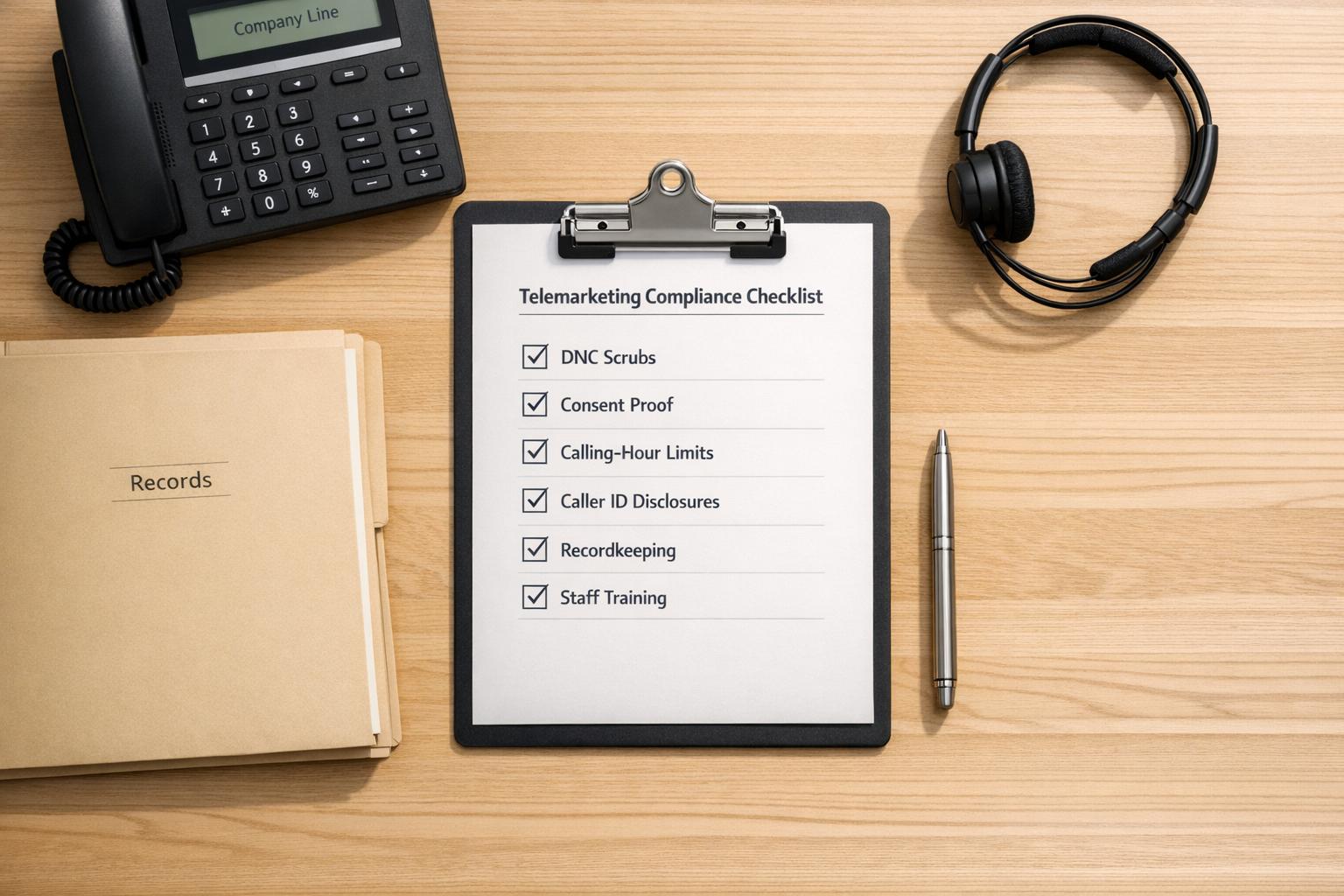
Telemarketing compliance training is critical for avoiding massive fines and legal troubles. One non-compliant campaign can cost millions in penalties. This guide breaks down the essentials of a compliance training program to help businesses meet legal standards and protect their operations. Key areas include:
- Do Not Call (DNC) List Compliance: Regularly scrub call lists and honor opt-outs within 10 business days.
- Consent Verification: Ensure explicit, documented consent for calls, with detailed records stored for 4–5 years.
- Time-of-Day Restrictions: Follow federal and state-specific calling hours, which vary by location.
- Caller ID and Disclosures: Display accurate caller information and provide required disclosures at the start of every call.
- Recordkeeping: Maintain detailed logs of DNC compliance, consent, and training for at least 5 years.
Training methods like interactive online modules, role-playing, and regular assessments ensure employees understand and follow these rules. Proper documentation and monitoring systems are also essential to stay audit-ready and prevent violations. With the right program in place, businesses can reduce risks and build trust with consumers.
Important 2025 Compliance Changes…
sbb-itb-a8d93e1
Training Curriculum Checklist
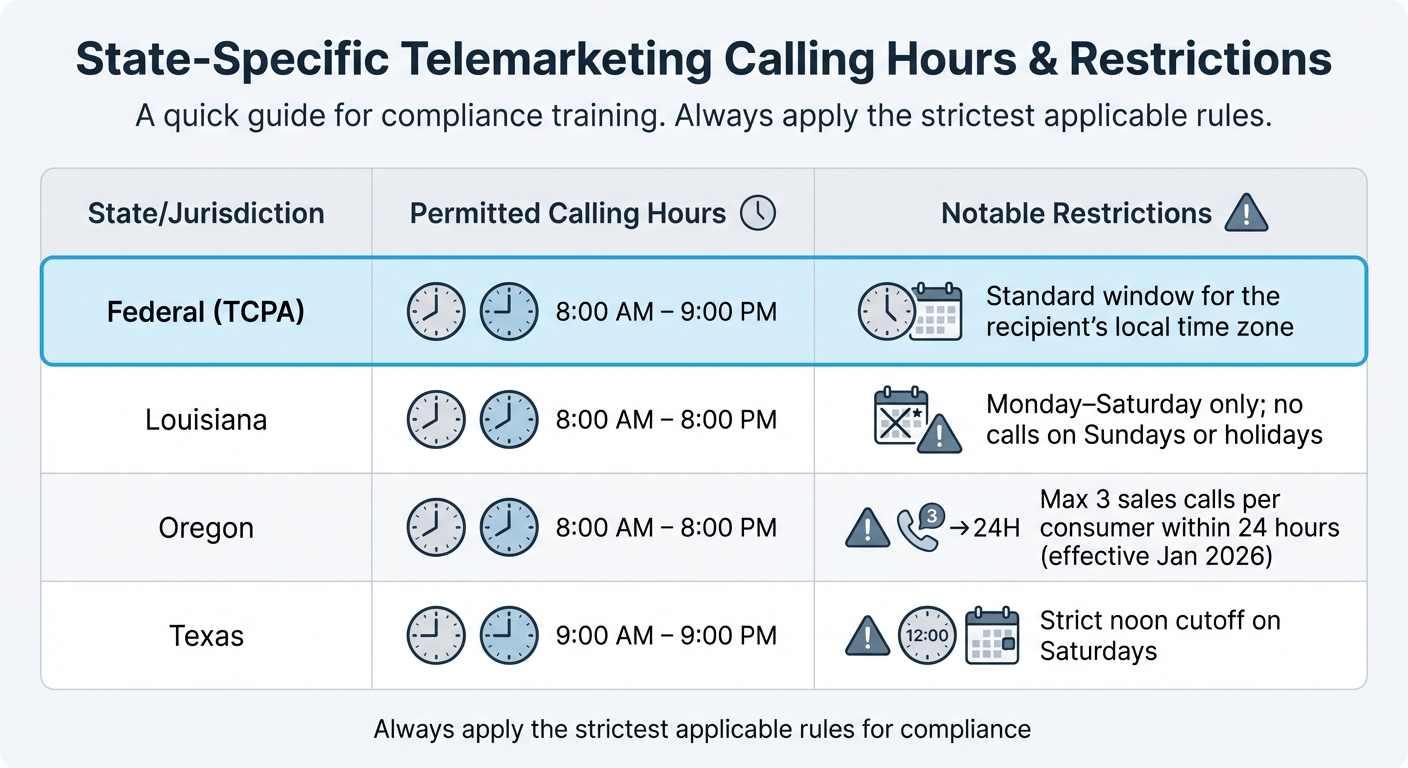
State-Specific Telemarketing Calling Hours and Restrictions Comparison
This checklist focuses on five key compliance areas, ensuring alignment with both state and international regulations for multinational operations.
Do Not Call (DNC) List Compliance
Regularly scrub contact lists against the National DNC Registry, at least every 31 days. Maintain a company-specific DNC list and promptly add consumers who opt out – within 10 business days starting April 2025. Training should also highlight state-specific requirements, as states like Florida, Texas, and Pennsylvania have their own registries.
Your program should cover Established Business Relationship (EBR) exemptions, which allow outreach within 18 months of a transaction or three months of an inquiry. To keep up with changing standards, adopt real-time API scrubbing tools.
Federal violations under the Telemarketing Sales Rule can result in penalties of up to $43,792 per call. Ensure your training also emphasizes the importance of strong consent verification practices.
Consent Verification Requirements
Staff must be trained on the FCC’s "one-to-one consent" rule, effective April 11, 2026. Blanket consent for "marketing partners" will no longer suffice – consumers must explicitly agree to be contacted by your company.
Consent records should clearly name your company, be current, and remain active. Never rely solely on lead suppliers for valid consent. Instead, audit the records, including timestamped screenshots of what the consumer saw when they provided consent.
Key documentation should include:
- Timestamp (to the second)
- Consumer’s IP address
- Source URL
- Exact disclosure language shown to the consumer
These records should be stored for 4 to 5 years to comply with the TCPA statute of limitations. Violations can result in damages of $500 per call, or $1,500 for willful breaches.
This foundation ties into broader compliance areas, such as calling time restrictions.
Time-of-Day Calling Restrictions
Federal law limits telemarketing calls to 8:00 AM–9:00 PM in the recipient’s local time zone. However, some states enforce stricter rules. For instance, Louisiana allows calls only between 8:00 AM and 8:00 PM Monday through Saturday, with no calls on Sundays or holidays. Oregon, starting January 2026, will permit up to three sales calls per consumer within a 24-hour period.
Dialing systems should be configured to calculate time zones based on the consumer’s current location and apply the strictest applicable rules.
| State | Permitted Calling Hours | Notable Restrictions |
|---|---|---|
| Federal (TCPA) | 8:00 AM – 9:00 PM | Standard window for the recipient’s local time zone |
| Louisiana | 8:00 AM – 8:00 PM | Monday–Saturday only; no calls on Sundays or holidays |
| Oregon | 8:00 AM – 8:00 PM | Max 3 sales calls per consumer within 24 hours (effective Jan 2026) |
| Texas | 9:00 AM – 9:00 PM | Strict noon cutoff on Saturdays |
These timing rules should integrate seamlessly with disclosure and recordkeeping protocols.
Caller ID and Disclosure Rules
Telemarketers must display accurate caller ID information, including a valid, callable number and the correct company name. Avoid practices like using random or rotating numbers to bypass call blocking or displaying misleading identifiers.
"The Truth in Caller ID Act and related regulations create legal exposure for using random or rotating caller ID numbers to avoid call blocking, displaying misleading company names, or failing to answer return calls to your displayed number." – LeadCompliant
Agents must use scripts that include mandatory disclosures at the start of each call:
- Identify the seller
- State that the call is for sales purposes
- Describe the goods or services being offered
In states requiring two-party consent, such as California, Florida, and Pennsylvania, agents must also disclose that the call is being recorded at the beginning of the conversation.
Recordkeeping Standards
Proper recordkeeping is essential for defending against legal or regulatory challenges. Training should stress the importance of retaining:
- DNC scrub logs
- Consent records (including timestamps and IP addresses)
- Training attendance logs
These should be kept for at least five years, in compliance with the E-SIGN Act. Technology should be implemented to automatically process "STOP" responses from text replies or IVR inputs, ensuring internal DNC lists are updated accurately and reducing manual errors. Additionally, save timestamped screenshots or archived versions of consent forms as they appeared to consumers, ensuring the disclosures were clear and easy to understand.
Training Delivery Methods
Delivering compliance training effectively is key to ensuring your team understands and applies the required regulations. The method you choose can make all the difference in how well employees retain the material and implement it in their daily tasks. A well-executed training strategy helps reduce risks and ensures compliance goals are met.
Interactive Online Training Modules
Online training platforms with interactive features – like animations, videos, and branching scenarios – make compliance training more engaging and practical. For example, instead of simply reading about Do Not Call (DNC) requirements, employees can participate in simulations that mirror real-life situations, requiring them to make quick compliance decisions.
Adding gamification elements, such as challenges and rewards, keeps the learning process engaging and reinforces complex rules. Short microlearning modules, typically lasting 2 to 5 minutes, fit seamlessly into a busy workday. These bite-sized lessons are ideal for refreshing knowledge on topics like consent verification or time-of-day restrictions.
Mobile-friendly platforms also allow employees to access training on any device, ensuring continuous learning as telemarketing regulations evolve.
"eLearning modules with their innovative use of learning strategies and visually appealing format make compliance training more engaging for learners and more likely to be applied in practice." – Paul McElvaney, eLearning Industry
To complement these digital tools, hands-on exercises can further bridge the gap between theory and practice.
Role-Playing and Practical Exercises
Role-playing offers a hands-on way for employees to tackle real-world compliance challenges. These exercises simulate challenging situations, such as handling objections or responding to compliance-related questions. A structured approach works best: outline the compliance issue, provide a scenario, assign roles (e.g., agent, customer, observer), act out the scenario, and conclude with a group debrief to address any mistakes.
Rapid-response drills, where agents must quickly reply to objections like "I’m on the DNC list" or "Where did you get my number?" within 5 seconds, help develop the quick decision-making skills needed on the job.
A "crawl-walk-run" progression is particularly effective. Start with basic scripts, then move to more complex scenarios that require multitasking across tools like CRM and dialing systems. These exercises not only improve compliance but also reduce the impact of poor customer service and help consumers stop spam calls, which costs businesses roughly $75 billion annually.
"Medals are given out at the championship, but you earn them in practice." – Adam Clark, Director of Sales, REPAY
In-Person vs. Online Training Comparison
The choice between in-person and online training depends on your organization’s needs, including budget, team size, and geographic spread. Each method has its strengths:
| Feature | In-Person / Manual Training | Online / Automated Training |
|---|---|---|
| Cost | Higher, with potential for manual errors and fines | More cost-effective, with automated error reduction |
| Scalability | Limited; challenging for large teams or high call volumes | Highly scalable; API-based systems handle thousands of calls in milliseconds |
| Engagement | Excellent for role-playing and immediate feedback | Highly engaging with interactive multimedia and AI-driven modules |
| Compliance Tracking | Relies on manual logs, which can be inconsistent | Automated tracking ensures comprehensive audit trails |
For larger organizations managing high call volumes, online systems are ideal. They can integrate with APIs to perform compliance checks almost instantly and automatically log training events for audits. However, in-person training still plays a critical role in scenarios requiring personalized feedback and dynamic role-playing exercises.
Assessment and Certification
After delivering the curriculum, it’s crucial to assess and certify employees to ensure they meet all compliance standards. Testing plays a key role in evaluating the success of your compliance training. Pre-training assessments help pinpoint knowledge gaps before training begins. On the other hand, post-training tests confirm that employees grasp essential regulations like TCPA rules, DNC procedures, and opt-out requirements.
The U.S. Department of Justice emphasizes that a compliance program must be well-designed, properly implemented, and effective. To meet these criteria, assessments should include realistic scenarios, such as processing "stop calling" requests or presenting required disclosures at the start of a call.
Pre- and Post-Training Assessments
To measure progress effectively, use consistent benchmarks for both pre- and post-training tests. Design these questions to mirror real-life compliance challenges, such as identifying which states (California, Florida, and Illinois) require all-party consent for call recording. Keep a centralized log of all assessment results, and retain these records for at least five years to account for the 4-year statute of limitations with an added buffer.
Failing to comply can be costly. FCC and FTC fines can exceed $23,727 and $50,120 per violation, respectively, while TCPA damages can range from $500 to $1,500 per call. Passing these assessments leads to formal certification and ongoing compliance tracking.
Certification and Compliance Tracking
Once employees successfully complete their assessments, issue formal certifications and store them securely in a centralized system, such as a document management platform or CRM compliance module. These records should include historical policy versions to illustrate what was taught at any given time. Automating this process can ensure your records are complete and audit-ready.
"Proper documentation is both a regulatory requirement and your strongest defense against TCPA claims." – LeadCompliant
Certifications should be updated quarterly to reflect changes in FCC orders, state laws, or court rulings. Assign a compliance officer to oversee regulatory updates and maintain the certification database. This detailed recordkeeping is essential for building a safe harbor defense, demonstrating that your company has implemented effective measures to prevent violations.
Monitoring and Proficiency Checks
Certification is just the beginning. Ongoing monitoring ensures employees continue to meet compliance standards. Conduct monthly quality assurance reviews of recorded calls to verify agents are following proper procedures, such as delivering required disclosures, managing Do Not Call requests, and adhering to calling hour restrictions. Compliance dashboards can track key metrics like opt-out rates, complaint trends, and unusual calling behaviors.
To keep knowledge fresh, require employees to sign annual TCPA compliance certification forms acknowledging their understanding of company policies. Between certifications, use AI-powered speech analytics to spot potential compliance risks, such as deviations from approved scripts or unauthorized disclosures, which can guide future training. Additionally, update assessment materials at least annually or whenever regulations change.
| Monitoring Activity | Recommended Frequency | Purpose |
|---|---|---|
| Call Recording Quality Reviews | Weekly/Monthly | Ensure proper disclosures and DNC compliance |
| Complaint Trend Analysis | Monthly | Identify systemic issues or specific agent gaps |
| Agent Training & Testing | At Hire & Quarterly | Maintain and refresh compliance knowledge |
| Employee Certification | Annually | Formal acknowledgment of compliance responsibilities |
| Comprehensive Program Audit | Quarterly/Annually | Assess overall program efficacy and policy updates |
Documentation and Audit Readiness
Keeping thorough documentation isn’t just about staying organized – it’s a critical safeguard against regulatory and legal challenges. As LeadCompliant emphasizes, "Documentation is not just a best practice; it is a legal necessity". When it comes to proving consent and compliance, the responsibility often lies with the caller. That’s why maintaining accurate, complete, and easily accessible records is essential. A solid documentation framework, supported by detailed training logs, signed acknowledgments, and program updates, ensures you’re always prepared for audits.
Employee Training Logs
Every training session should be meticulously recorded, including the date, topics covered, attendees, and assessment results. These records need to be stored securely in a tamper-proof system with strict access controls to maintain their integrity for audits. Automation can simplify this process – using CRM compliance tools or document management systems with version control can help reduce human error. It’s recommended to retain these records for five years after an employee leaves the company, aligning with the four-year TCPA limitation plus an added buffer. Assigning dedicated staff for periodic audits ensures the records remain up-to-date and reliable.
Acknowledgment of Compliance Policies
Every employee should sign an acknowledgment confirming their commitment to TCPA compliance. To reinforce this, consider using an annual TCPA Compliance Certification Form. This document can serve as a reminder of key responsibilities, such as adhering to TCPA guidelines, handling consent revocations, and managing opt-outs properly. These signed acknowledgments should be stored alongside training logs and retained for five years. During regulatory reviews, they act as crucial evidence of your team’s compliance awareness and commitment.
Program Update Records
In addition to training logs and acknowledgments, a "Regulatory Update Tracking Log" is essential for documenting changes to your compliance program. Updates might stem from new FCC rulings, court decisions, or changes in state laws. Employ strict version control for all compliance policies and training materials, keeping every historical version permanently. This approach allows you to demonstrate what procedures were in place during any specific period within the statutory limitation.
If a violation is identified or an audit uncovers an issue, document the entire find-and-fix process. This includes noting the findings, conducting root cause analyses, implementing corrective actions, and verifying the results. Such detailed documentation of proactive compliance efforts can significantly mitigate penalties. As LeadCompliant points out, "Companies that demonstrate good faith compliance efforts receive better outcomes than those that show indifference".
| Document Type | Minimum Retention Period | Rationale |
|---|---|---|
| Training Records | 5 years after employment ends | Evidence of compliance program |
| Compliance Policies | Permanently (all versions) | Historical compliance demonstration |
| Consent Records | 5 years from last contact | Statute of limitations plus buffer |
| Call Detail Records | 5 years | Litigation defense evidence |
| DNC Scrubbing Records | 5 years | Safe harbor defense documentation |
Integration with Reporting and Enforcement Tools
Automated consumer reporting systems have made it easier and faster to detect compliance issues. As the LeadCompliant Team explains, "The practical takeaway is that compliance failures are more likely to be caught now than at any time in the past. Between automated complaint systems, call-tracing technology… the odds of operating non-compliantly without consequence are shrinking rapidly". Instead of seeing these tools as obstacles, train your team to work with them. This mindset can turn potential challenges into opportunities for improvement. A key focus should be teaching agents how to recognize situations that might lead to consumer complaints.
Training on Identifying Reportable Violations
Building on earlier training about DNC (Do Not Call) rules and consent requirements, employees also need to know how to handle consumer complaints effectively. One critical area is learning to identify behaviors or actions that could trigger complaints, such as those reported on platforms like ReportTelemarketer.com. Common violations include:
- Calling numbers listed on the National DNC Registry.
- Failing to provide mandatory disclosures at the start of a call.
- Contacting consumers outside the legally allowed hours of 8:00 AM to 9:00 PM local time.
Training modules should emphasize these high-risk areas, helping agents understand when a call might cross the line into non-compliance. For instance, agents must verify that any consent from lead suppliers is valid and meets legal standards. This includes ensuring that the consent forms include all necessary disclosures and explicitly name the seller.
Simulating Complaint Handling Processes
Role-playing exercises are a practical way to prepare agents for handling consumer complaints. These simulations should cover five key stages: Acknowledgment, Understanding, Investigation, Resolution, and Follow-up. During these sessions, agents should practice logging opt-out requests immediately, as federal law requires honoring such requests within 10 business days. Regular practice builds familiarity with de-escalation techniques and proper documentation procedures.
Additionally, when a consumer contacts your company after filing a complaint through platforms like ReportTelemarketer.com, your team should already be equipped to investigate, resolve, and document the issue efficiently.
Using Consumer Reports for Compliance Improvement
Once your team is skilled in complaint handling, leverage consumer feedback to strengthen your compliance efforts. Set up a weekly review process to analyze consumer complaints and data from reporting platforms. This review helps identify recurring issues, whether they stem from lead quality, agent performance, or system errors.
For example, if complaints show repeated calls outside the permitted time frame, it might signal a need for additional training or a system adjustment. Tracking patterns by agent, time, lead source, and violation type can pinpoint specific problem areas. Proactively addressing these gaps can prevent escalation to enforcement actions by the FCC or FTC, which impose steep penalties – up to $23,727 per violation by the FCC and $50,120 per violation by the FTC.
Conclusion
Creating an effective telemarketing compliance training program means committing to continuous education. This includes mastering consent verification, scrubbing against DNC lists every 31 days, adhering to time-of-day restrictions (8:00 AM to 9:00 PM local time), ensuring mandatory disclosures, and maintaining detailed records. As FlyFone highlights:
"Compliance is not a checkbox exercise. It requires continuous monitoring, policy updates, and enforcement as regulations evolve and your operations scale".
The stakes are high. In 2024, TCPA violations cost U.S. call centers over $589 million in settlements, proving that non-compliance carries a hefty price tag. These measures aren’t just best practices – they’re essential to building a strong compliance framework.
Detailed documentation is a non-negotiable element of this framework. Retain records of consent – such as IP addresses, timestamps, and form screenshots – along with call logs and training attendance for at least five years to meet the statute of limitations. As LeadCompliant aptly states:
"Documentation is the backbone of any defensible compliance program".
Without timestamped proof of consent or evidence of training, your organization risks being found non-compliant in court. This documentation supports the ongoing training and evaluation efforts discussed earlier.
Additionally, telemarketers must navigate state-specific regulations. For example, 13 states, including California, Florida, and Washington, require two-party consent for call recording. When calling across state lines, it’s best to follow the strictest standard. This often means disclosing call recording at the start of every call, even in states with one-party consent laws. By adhering to these rigorous standards, your program aligns with the highest levels of compliance.
Technology can also play a key role in simplifying compliance. Automated tools for DNC scrubbing, real-time consent verification, and monitoring dashboards can help prevent issues before they result in costly penalties – such as FCC fines of up to $23,727 per violation or FTC fines of up to $50,120 per violation. Platforms like ReportTelemarketer.com provide consumer feedback to identify and address potential problems early. Training your team to use these tools effectively can foster a culture where compliance strengthens your operations and becomes a competitive edge.
FAQs
What should we keep to prove consent if we get sued?
To protect yourself in case of a lawsuit, it’s essential to keep detailed records of the consent process. This means documenting:
- The exact wording used when obtaining consent
- The method used to collect consent (e.g., online form, phone call)
- Timestamps showing when consent was given
- Any disclosures or terms provided at the time
These records should clearly show that you’ve followed TCPA requirements. Having everything well-organized can make all the difference when defending against legal claims.
How do we handle calls across states with different rules?
To handle calls across states with different regulations, it’s important to set up a solid compliance program. This should involve:
- Monitoring state-specific rules: Stay updated on the telemarketing laws and requirements unique to each state.
- Maintaining accurate records: Keep detailed logs of consent and opt-out requests to ensure you’re honoring customer preferences.
- Following registration and scrubbing requirements: Comply with each state’s guidelines for registering and scrubbing call lists.
Make sure to schedule regular updates and audits of your practices to stay aligned with multi-state telemarketing laws.
What tools help automate DNC, opt-outs, and audit logs?
Automation tools play a key role in managing compliance with telemarketing regulations. These systems handle tasks like maintaining internal Do Not Call (DNC) lists, cross-checking numbers against the National DNC Registry, and tracking consent events.
Industry providers such as LeadGuard and Telnyx often feature these tools in their compliance resources, emphasizing their importance in adhering to telemarketing rules. These tools not only streamline processes but also help businesses stay on top of regulatory requirements effectively.

