
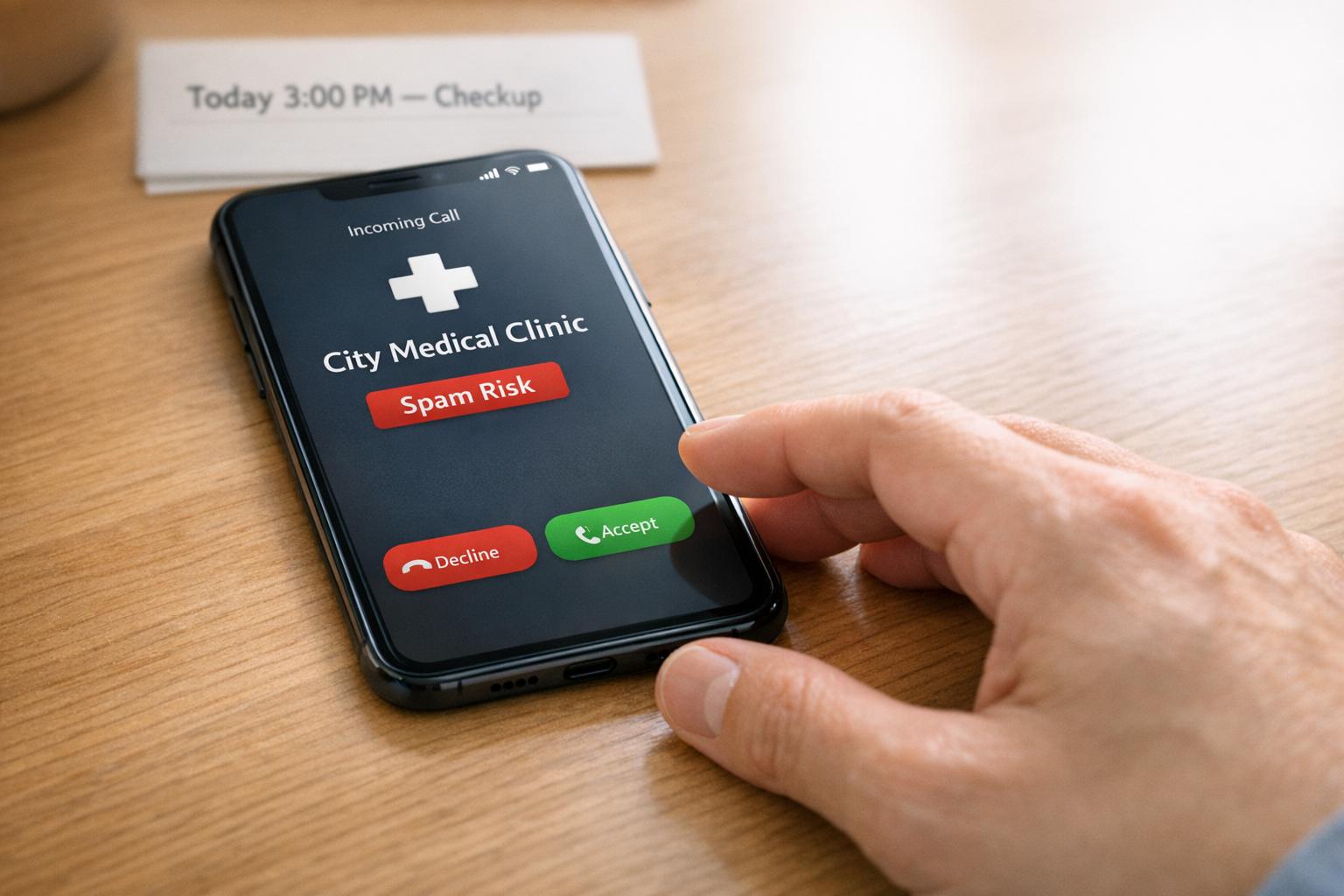
Spam detection algorithms often mislabel legitimate calls, disrupting critical communications. Businesses, healthcare providers, and schools often face challenges when their calls are flagged as "Potential Spam" or "Scam Likely." Here’s why this happens and what can be done to fix it:
- Suspicious Patterns: Algorithms flag high call volumes or short call durations, even when these reflect normal business activity.
- User Reports: Crowdsourced spam reports often lack verification, leading to errors.
- Number History & Spoofing: Past misuse or spoofing of numbers causes mislabeling.
- Short Calls & Dead Air: Brief calls or initial silence mimic robocall behavior.
- Weak Authentication: Calls without proper verification are penalized.
Key Fixes:
- Use STIR/SHAKEN protocols to verify caller identity.
- Gradually increase call volumes to build trust.
- Register numbers with carriers and monitor and stop spam calls.
- Train teams to avoid behaviors that trigger spam filters.
- Implement branded caller ID to improve answer rates.
These steps can reduce false positives and ensure important calls are delivered.
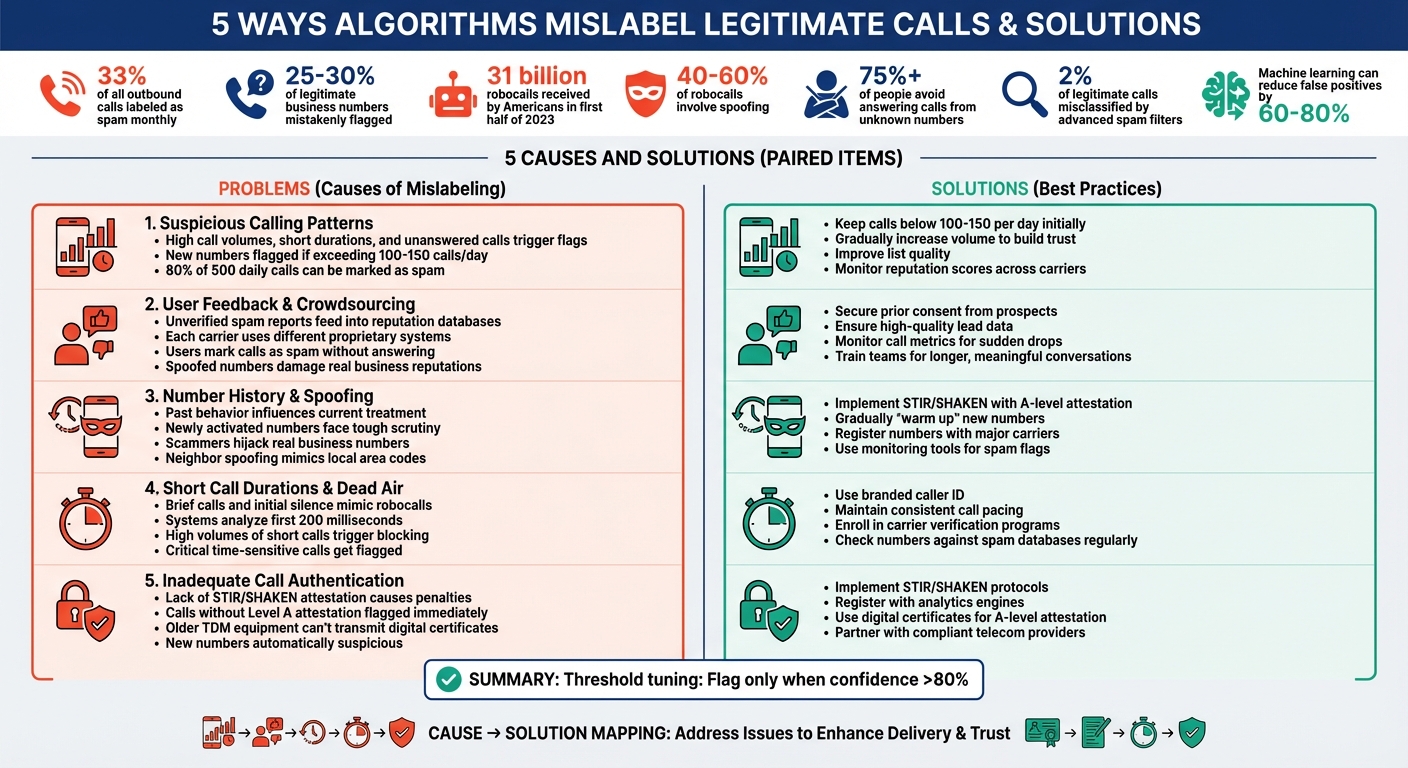
5 Causes of Legitimate Call Mislabeling and Solutions
1. Suspicious Calling Patterns
Algorithmic Detection Flaws
Carrier algorithms are designed to identify suspicious calling behaviors, such as high call volumes, short call durations, or a large number of unanswered calls. Unfortunately, these patterns can also reflect the legitimate activities of many businesses. Every month, 33% of all outbound calls are labeled as spam, and 25–30% of legitimate business numbers are mistakenly flagged by these systems.
Major U.S. carriers like AT&T, Verizon, and T-Mobile rely on AI-driven tools like Hiya and TNS/Call Guardian to evaluate call reputation in real time. However, reputation scores can differ across networks and are highly sensitive to activity. For example, even new or previously spoofed numbers might get flagged if they exceed 100–150 outbound calls per day. What’s more, these scores can shift within minutes, making the system unpredictable.
Impact on Legitimate Communication
When numbers are flagged, it can severely disrupt communication efforts. For example, if 80% of 500 daily calls are marked as spam, critical messages may never reach their recipients. This can have serious consequences: appointment reminders from healthcare providers, school alerts, or essential follow-ups from businesses might be blocked. Sales teams, in particular, face challenges as they often go through phone numbers rapidly, unintentionally mimicking behaviors associated with scammers.
Potential for Mitigation or Resolution
To reduce the risk of being flagged, businesses can take proactive steps:
- Keep daily outbound calls per number below 100–150 and gradually increase volume to build trust.
- Improve list quality by avoiding invalid or disconnected numbers.
- Encourage longer call durations by refining scripts and providing better training.
- Monitor reputation scores regularly across carriers.
- "Warm up" new numbers with low-volume, high-engagement calls to establish credibility .
These strategies can help businesses navigate the challenges of algorithmic detection, but the issue remains complex, as further explored in the next section on user feedback and crowdsourcing.
sbb-itb-a8d93e1
2. User Feedback and Crowdsourcing
Algorithmic Detection Flaws
When you report a call as spam through your carrier’s app or third-party blocking tools like RoboKiller, Nomorobo, or TrueSpam, those reports feed directly into reputation databases used by major networks like AT&T, Verizon, and T-Mobile. These systems rely on algorithms to process the data, but they often treat all reports the same – without verifying the legitimacy of the complaints.
The problem? These algorithms struggle to separate truly harmful scam calls from those that are merely unwanted. Many users mark calls as spam without even answering them, leading to mislabels. To make matters worse, each carrier uses its own proprietary system, so a number cleared on one network might still be flagged as spam on another. This inconsistency only adds to the confusion caused by the misidentification of suspicious calling patterns.
Impact on Legitimate Communication
Legitimate businesses often bear the brunt of these flaws. Scammers frequently spoof real business numbers, and when recipients report those calls, the genuine business number ends up with a tarnished reputation – even though the business itself had no part in the scam. In just the first half of 2023, Americans received 31 billion robocalls, with spoofing accounting for 40–60% of them. This heavy reliance on user reports has inadvertently led to innocent numbers being flagged.
Potential for Mitigation or Resolution
Businesses can take proactive steps to address these misclassifications and protect their numbers. For starters, securing prior consent from prospects can significantly reduce complaints. Ensuring high-quality lead data also helps calls reach individuals who are more likely to be receptive, rather than annoyed.
Keep an eye on call metrics – if you notice a sudden drop, it could mean your number has been flagged. In such cases, switching to fresh numbers while giving flagged ones time to recover can help. Training your sales team to focus on longer, meaningful conversations can also reduce negative signals from user feedback. These strategies align with broader efforts to address algorithmic false positives, which are explored further in later sections.
3. Number History and Spoofing
Algorithmic Detection Flaws
Spam detection systems rely heavily on a number’s dialing history rather than its current intent. This means that a number’s past behavior can heavily influence how it’s treated today. David Krasinski, VP of Trust and Identity Solutions at TransUnion, puts it plainly:
"Spam tags get applied to numbers based on the dialing behavior of that individual number".
Newly activated numbers face even tougher scrutiny. Carriers often flag numbers without an established history, especially if they’re used for high-volume outbound calls right after being activated. This reliance on historical data creates a bias that becomes even more problematic when spoofing tactics are involved.
Spoofing, which involves scammers disguising their calls to appear as though they’re coming from a trusted or local number, further complicates the issue. This overlap between historical bias and spoofing muddies the waters, making it harder to distinguish between legitimate and scam calls.
Impact on Legitimate Communication
Spoofing doesn’t just harm consumers – it also disrupts legitimate businesses. Scammers might hijack real business numbers or use "neighbor spoofing", where they mimic local area codes to increase the chances of someone answering. As a result, even genuine business numbers can end up being mislabeled as spam.
To address spoofing, the STIR/SHAKEN framework was introduced. This system uses cryptographic signatures to verify caller identities. However, spam detection algorithms still rely on imperfect criteria like call frequency or whether the number is saved in the recipient’s contacts. This means even legitimate businesses, such as sales teams making high-volume calls, can be misclassified as robocallers.
Potential for Mitigation or Resolution
To tackle these challenges, businesses can work with telecom providers that offer "A-level" attestation under the STIR/SHAKEN protocol. Angela Garfinkel, Director at Quality Voice & Data, explains:
"By signing their calls with an attestation level, businesses can receive a higher trust rating, which will enable their legitimate calls to go through".
This top-tier verification ensures both the caller’s identity and their authorization to use a specific number.
For new numbers, building a positive reputation is key. Instead of jumping straight into high-volume dialing, businesses should gradually "warm up" numbers by maintaining consistent and moderate call activity. Additionally, registering numbers with major carriers and third-party analytics providers, reporting unwanted calls to clear legitimate data, as well as using tools to monitor spam flags, can improve call deliverability and reduce the risk of misclassification.
Why You’re Getting So Many Spam Calls
4. Short Call Durations and Dead Air
Short call durations and initial silence often add another layer of complexity to accurate spam call classification.
Algorithmic Detection Flaws
Spam detection systems frequently flag brief call durations and initial silence as suspicious. This is because these behaviors mimic those of automated dialers, which often disconnect as soon as they encounter voicemail. RealCall highlights this issue:
"Short call setup time & high abandon rate suggests auto‑dialers that drop when voicemail answers".
AI-based voice analysis tools can sometimes make the problem worse. These systems analyze the first 200 milliseconds of a call, looking for automation indicators like "zero turn-taking latency." Essentially, if there’s no natural pause between the call being answered and the caller speaking, the system may classify it as a scripted robocall. Even a slight delay or an unusually quick response can lead to misclassification.
Impact on Legitimate Communication
This misclassification can disrupt critical, time-sensitive communications. Picture a delivery driver calling to say, "I’m outside", or a pharmacy confirming a prescription pickup – these brief but important calls can easily be flagged as spam. When carriers detect high volumes of short-duration calls, they may impose temporary blocking or throttling on the originating number. These practices are often governed by strict regulations like the Telephone Consumer Protection Act.
The effects are especially concerning given consumer behavior: more than 75% of people avoid answering calls from unknown numbers. On top of that, advanced spam filters misclassify about 2% of legitimate calls. Industries like healthcare and finance, where timely communication is crucial, often bear the brunt of these false positives.
Potential for Mitigation or Resolution
A branded caller ID can significantly reduce the chances of a call being mistaken for spam. Displaying the company’s name on the recipient’s screen builds trust and increases the likelihood of the call being answered. Major carriers like AT&T, T-Mobile, and Verizon offer verification programs that help businesses bypass aggressive spam filters.
Consistency in call pacing is another effective strategy. Sudden spikes in outbound calls can trigger carrier-level throttling, so maintaining steady call patterns is key. Additionally, businesses should regularly check their phone numbers against spam databases to identify and resolve labeling issues before they start affecting answer rates. These proactive measures can help ensure that legitimate calls reach their intended recipients.
5. Inadequate Call Authentication
Inadequate call authentication adds another layer of complexity to the challenges of spam detection, making it harder to ensure the reliability of these systems.
Algorithmic Detection Flaws
Call authentication systems lean heavily on STIR/SHAKEN attestation levels to assess the trustworthiness of incoming calls. These levels serve as a major trust signal for algorithms, with calls lacking "Level A" (Full Attestation) often receiving immediate reputation penalties from carrier systems. While STIR/SHAKEN is helpful for verifying numbers, its inconsistent implementation across outdated networks leaves critical gaps in authentication. Beyond this, detection algorithms often rely on non-identity factors like call frequency, whether the number is saved in contacts, and the caller’s name – rather than focusing solely on verified authentication.
Angela Garfinkel, Director at Quality Voice & Data, sheds light on the problem:
"The primary challenge of call blocking and labeling is that legitimate calls often get mislabeled as spam or robocalls. This happens because call blocking and labeling algorithms use various criteria to determine the authenticity of a call… these criteria are not foolproof".
The issue worsens when calls pass through intermediate providers or older TDM (Time Division Multiplexing) equipment incapable of transmitting digital certificates. Without cryptographic verification, algorithms struggle to differentiate between legitimate businesses and scammers who spoof those businesses’ numbers, such as real estate agents cold calling without authorization.
Impact on Legitimate Communication
When authentication systems fail, genuine calls often get flagged as "Potential Spam" or "Scam Likely." This mislabeling can severely disrupt communication. Dhara Mehta, Product Manager at Twilio, highlights the frustration this causes:
"The phone rings, and the called party doesn’t answer because they see ‘Potential Spam’ calling instead of your phone number on their cell phone. This has frustrated many legitimate callers".
New phone numbers face even greater challenges. With no prior communication history, they are automatically flagged as suspicious by spam filters.
Potential for Mitigation or Resolution
Businesses can take proactive steps to improve call authentication. Implementing STIR/SHAKEN protocols through telecom providers and leveraging tools like Twilio’s Voice Integrity to register numbers with analytics engines can help secure an "A-level" attestation. Experts agree that signing calls with digital certificates enhances a number’s trust rating, making it less likely to be flagged incorrectly. Strengthening these authentication measures is essential for reducing false positives and ensuring legitimate calls reach their intended recipients.
How to Reduce False Positives
Cutting down on false positives requires a multi-faceted approach: implementing STIR/SHAKEN, refining behavioral analysis, and fine-tuning algorithm thresholds. The first step is adopting STIR/SHAKEN protocols, which authenticate calls and ensure businesses collaborate with telecom providers to register their numbers with major carriers’ analytic systems.
Once authentication is in place, analyzing calling behaviors can further improve accuracy. Modern systems establish behavioral baselines to flag only significant deviations. For instance, a healthcare provider consistently making appointment reminder calls at 9:00 AM every weekday shouldn’t be flagged for predictable calling patterns. Machine learning also plays a big role here, reducing false positives by up to 60% and potentially reaching 80% as models adapt to real-life scenarios.
Another critical step is threshold tuning. Instead of flagging every call with minor suspicious traits, systems should only label calls as spam when the confidence level exceeds 80%. Adding an "uncertain" category can also help, allowing algorithms to gather more context before making a final decision. This approach improved one model’s precision from 0.70 to 0.85.
Consumer feedback is equally important. Platforms like ReportTelemarketer.com provide a way for users to report violations. They investigate telemarketers, identify breaches of consumer protection laws, and take action through cease-and-desist letters or formal complaints. This feedback loop helps refine spam databases, ensuring legitimate callers can connect with their intended recipients. Best of all, this service is free, with attorney fees recovered directly from violators when necessary.
| False Positive Cause | Solution |
|---|---|
| Caller ID Spoofing | Use STIR/SHAKEN cryptographic signatures to verify call origins |
| Suspicious Calling Patterns | Apply behavioral analysis to establish normal activity baselines |
| Outdated Reputation Lists | Enable real-time data enrichment and refresh lists automatically |
| Overly Sensitive Algorithms | Tune thresholds to require >80% certainty before flagging calls |
| Lack of Identity Verification | Register numbers with carrier analytics engines |
Conclusion
Spam-blocking algorithms play a critical role in shielding consumers from the overwhelming number of robocalls inundating U.S. phone networks. But when these systems mistakenly flag legitimate calls as spam, they create obstacles for businesses trying to reach their customers and for individuals missing crucial communications from healthcare providers, financial institutions, or service companies.
The key to addressing these misclassifications lies in implementing strong verification measures. As Angela Garfinkel from Quality Voice & Data highlights:
"This is especially important in today’s digital business environment, where communication is vital to building trust and loyalty".
By properly verifying their numbers and maintaining the correct attestation levels, businesses can minimize false positives and contribute to a safer, more reliable phone network.
Additionally, businesses should register their phone numbers, and consumers are encouraged to report violations through platforms like ReportTelemarketer.com. This reporting system not only investigates telemarketing practices but also helps refine spam databases, improving accuracy and ensuring that legitimate calls reach their recipients.
The telecommunications industry is also moving toward advancements like cryptographic verification and branded calling. These technologies aim to provide clarity and trust, so when your doctor calls to confirm an appointment or your bank reaches out to verify a transaction, you can confidently answer rather than dismiss the call as spam.
With better algorithms and verification processes, we can reduce missed connections, enhance customer service, and create a phone network that effectively protects consumers while ensuring legitimate calls get through. This underscores the importance of continuously refining these systems to strike the right balance.
FAQs
How can I tell if my business number is labeled as spam?
If your business number is labeled with tags like "Scam Likely", it could hurt your ability to connect with customers. This usually happens due to problems like number spoofing or complaints from consumers. However, even legitimate calls might get flagged by mistake. It’s important to monitor for these labels so you can quickly address any errors and maintain trust with your audience.
What’s the fastest way to get “Scam Likely” removed from a legitimate number?
The fastest way to get rid of a ‘Scam Likely’ label on a legitimate phone number is to report the mistake through the appropriate channels. This usually means reaching out to your phone carrier or notifying the relevant authorities. Be sure to follow their instructions carefully to resolve the issue as quickly as possible.
Does STIR/SHAKEN “A-level” attestation guarantee my calls won’t be blocked?
A STIR/SHAKEN “A-level” attestation doesn’t mean your calls are completely safe from being blocked or labeled as spam. That said, higher attestation levels typically help establish more trust, which can lower the likelihood of your calls being flagged.

