
Florida’s telemarketing laws have changed significantly, especially with updates to the Florida Telephone Solicitation Act (FTSA) and key court rulings. Here’s what you need to know:
- FTSA Basics: Telemarketers must follow strict rules, including obtaining written consent for automated messages and adhering to a "STOP" opt-out mechanism.
- 2023 Amendments (HB 761): Narrowed the definition of autodialers, introduced a 15-day safe harbor for opt-outs, and capped damages at $500 per action.
- Court Rulings: Recent cases clarified that plaintiffs must prove actual harm, follow opt-out procedures, and comply with updated rules. Retroactive application of amendments has also shaped ongoing litigation.
- Impact: Businesses now face clearer compliance requirements, while consumers must document violations carefully to stop spam text messages and pursue claims.
These changes aim to balance consumer protection with reducing frivolous lawsuits and helping consumers stop spam calls. Below, we explore the updates, court decisions, and their implications for telemarketers and consumers.
HB 761 Amendments and Changes to FTSA
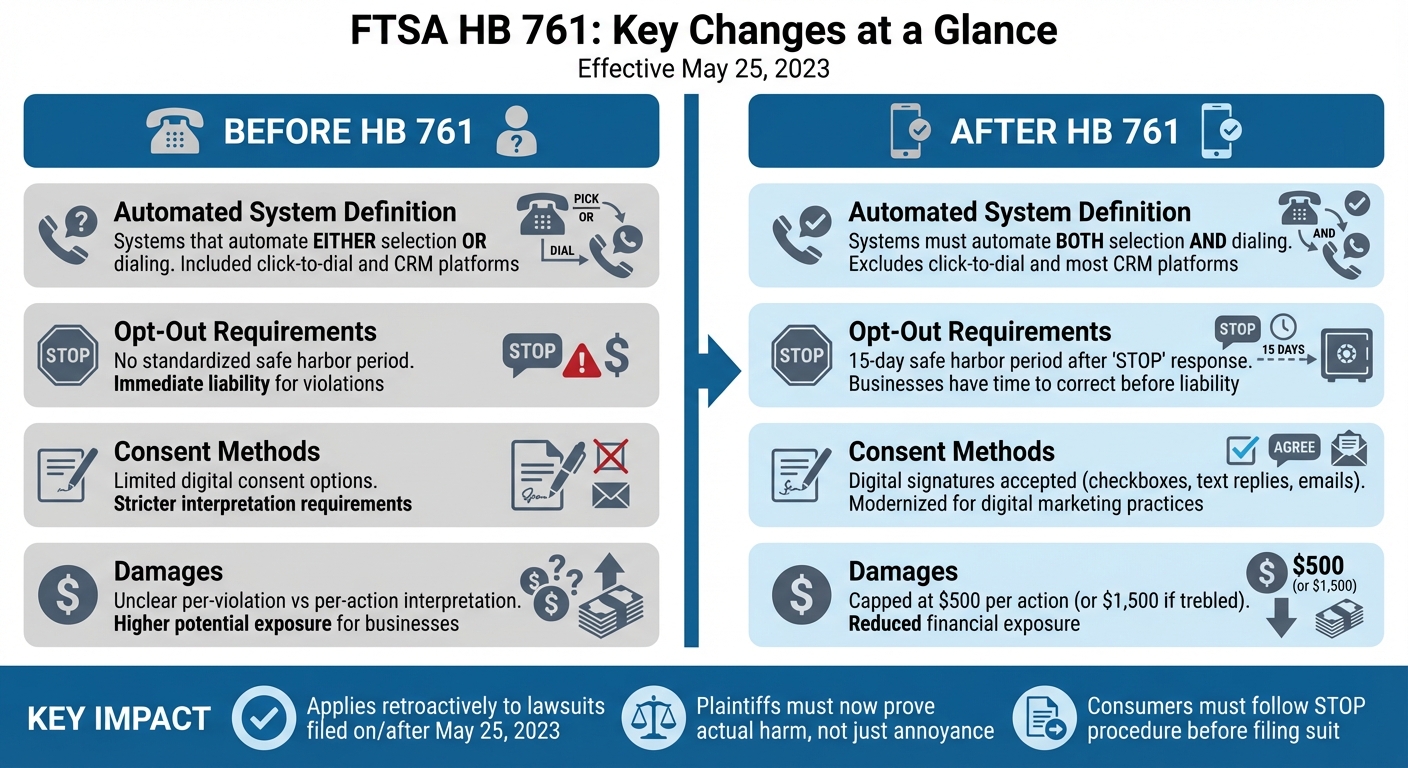
FTSA HB 761 Amendments: Before vs After May 2023 Changes
What HB 761 Changed
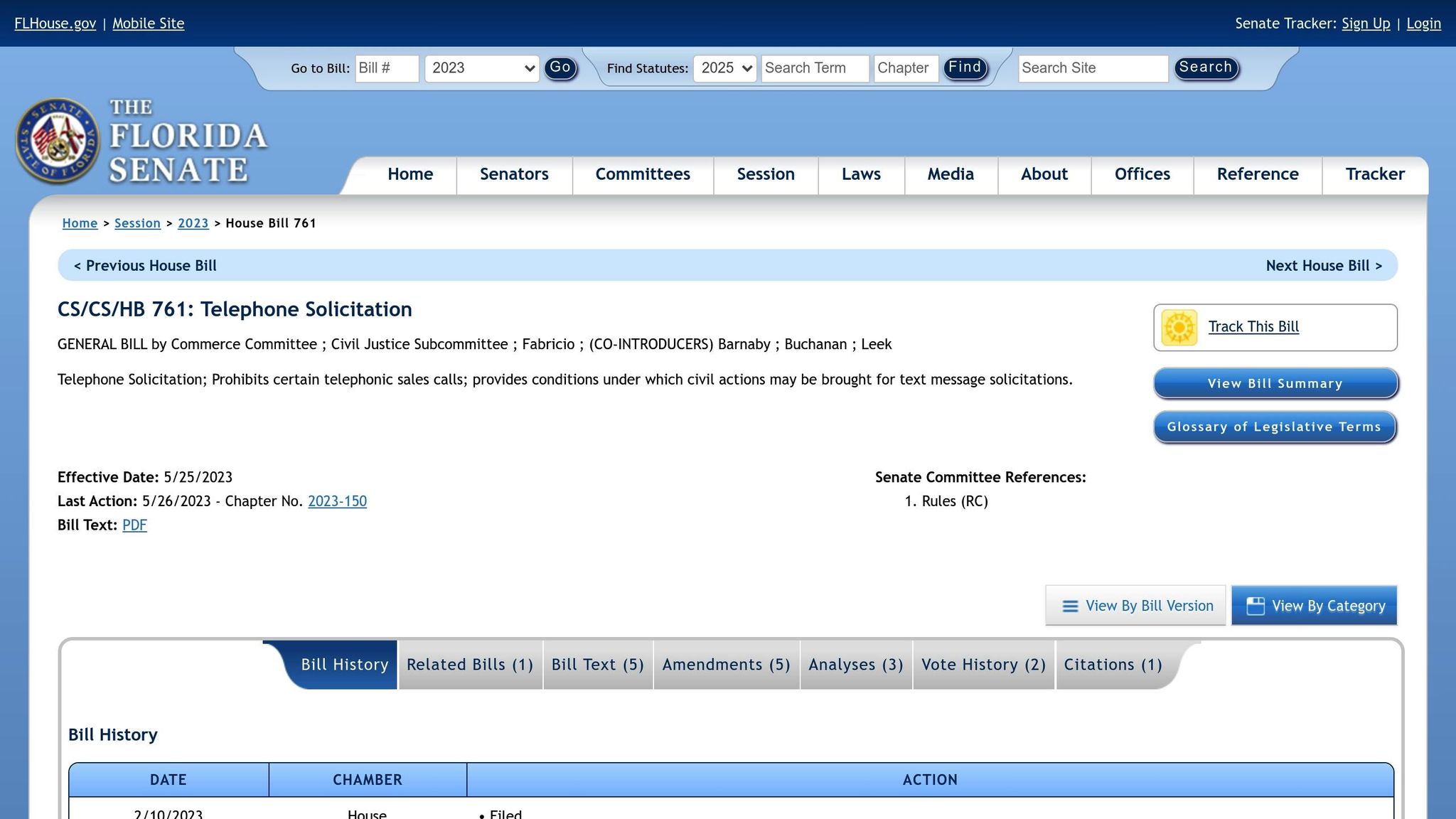
House Bill 761 was introduced to address the rising number of lawsuits under the Florida Telephone Solicitation Act (FTSA) by targeting frivolous claims while maintaining consumer protections. Effective May 25, 2023, the bill brought several key changes that impact how Florida’s telemarketing laws are enforced and interpreted in court.
One of the most impactful changes was the updated definition of an automated system. Before this amendment, the FTSA applied to systems that automated either the selection or dialing of phone numbers. HB 761 narrowed this scope to include only systems that automate both selection and dialing. This shift means commonly used tools like click-to-dial systems and Customer Relationship Management (CRM) platforms are no longer included under the law’s restrictions.
Another important update was the introduction of a 15-day safe harbor period for text message solicitations. Now, consumers must respond with "STOP" to the sender’s number before they can file a lawsuit. Businesses are then given 15 days to stop sending messages, providing them with an opportunity to correct any issues before facing legal action.
The law also expanded the definition of "signature" for obtaining consent. It now includes digital actions like checking a box on a website or replying affirmatively to a text or email. Additionally, the law clarified that it applies only to unsolicited calls, ensuring businesses can contact customers who have requested communication or have an established relationship with them.
These amendments apply retroactively to lawsuits filed on or after May 25, 2023, including any uncertified class actions. This retroactive application has already influenced ongoing litigation and will continue to shape future cases. These changes also lay the groundwork for more transparent opt-out practices, which are discussed further below.
Clarifying Consent and Opt-Out Rules
HB 761 introduced a standardized opt-out mechanism for text messages by requiring consumers to reply "STOP" to unsolicited messages. This gives businesses a 15-day grace period to halt communications before they face liability.
In December 2023, the U.S. District Court for the Middle District of Florida issued a significant ruling in Holton v. eXp Realty, LLC. The court determined that the plaintiff’s failure to reply "STOP" to marketing texts disqualified the class claims under the new safe harbor provision.
These updates also provide businesses with greater clarity when using digital consent methods, such as web form checkboxes. By aligning the law with modern communication practices, HB 761 balances the need for consumer protections with the realities of digital marketing.
sbb-itb-a8d93e1
Major FTSA Court Rulings
Consent and Disclosure Requirements
Florida courts have made notable changes to the interpretation of FTSA consent and disclosure rules. In January 2024, the Florida 11th Judicial Circuit Court‘s decision in Soto Leigue v. Everglades College Inc. established that plaintiffs must prove actual damages – a measurable and tangible loss – rather than simply citing annoyance or frustration. The ruling also clarified that statutory damages are capped at $500 per action (or $1,500 if trebled), rather than per individual violation. This significantly limits the financial exposure for businesses, regardless of how many texts were sent under a single action.
"A plaintiff in a class action seeking statutory damages under the FTSA must demonstrate actual damages. Merely claiming ‘liquidated actual damages’ or ‘actual liquidated damages’… is insufficient."
- Florida 11th Judicial Circuit Court
Another pivotal ruling came in December 2023 when the U.S. District Court for the Middle District of Florida addressed retroactivity in Holton v. eXp Realty. The court ruled that the 2023 FTSA amendments apply retroactively to any class action not certified before May 25, 2023. In this case, the plaintiff’s failure to allege that they replied "STOP" to marketing texts rendered the class claims invalid. This precedent was reinforced in June 2024 with Germain v. Mario’s Air Conditioning and Heating, Inc., further solidifying the retroactive application of the amendments.
Autodialer and Text Message Cases
Recent cases have continued to refine the FTSA’s definitions and defenses, particularly in light of the legislative updates introduced by HB 761. Courts have narrowed the interpretation of an "automated system" under the FTSA. Early rulings, such as Turizo v. Subway Franchisee Advertising Fund Trust Ltd. in 2022, allowed for broader definitions. However, more recent decisions, influenced by the 2023 amendments, now limit liability to systems that both select and dial numbers automatically. This shift excludes manual click-to-dial systems and many CRM platforms from falling under FTSA restrictions.
The "STOP" safe harbor provision has also become a critical factor in FTSA litigation. For example, in November 2024, the U.S. District Court for the Middle District of Florida dismissed a claim in Adams v. Safelite Group because the plaintiff failed to allege they responded with "STOP" to an unsolicited text. Under current standards, plaintiffs must show they sent "STOP", waited the required 15-day period, and still received messages before filing a lawsuit.
Additionally, the Third District Court of Appeal provided further clarity in Eldridge v. Pet Supermarket Inc. by ruling that a procedural violation of the FTSA alone is insufficient for standing. Plaintiffs must demonstrate "concrete harm" that would be considered "highly offensive to a reasonable person", thereby aligning Florida state court requirements with federal Article III standing standards.
How Court Rulings Affect Telemarketers and Consumers
Compliance Guidelines for Telemarketers
Recent changes to Florida’s telemarketing laws, along with court rulings, have brought more clarity to compliance rules for telemarketers. A key update requires businesses to honor "STOP" requests within 15 days to avoid liability, even under the safe harbor provision.
The definition of autodialers has also been refined. Systems that need manual intervention, like "click-to-dial" technology, are no longer classified as automated under the FTSA. The law now applies exclusively to systems that can both select and dial numbers without human input.
Consent protocols have been updated as well. Telemarketers can now collect valid consent through website checkboxes or affirmative replies to text messages or emails. Additionally, every message must include an option for recipients to respond or provide an alternative contact method, such as a toll-free number (e.g., "Call 1-800-XXX-XXXX with questions").
Maintaining detailed records is now more important than ever. Companies should document consent, the timing of opt-outs, and any follow-up communications. These logs are critical for defending against lawsuits, especially given that statutory damages are capped at $500 per violation.
These compliance measures are closely tied to new enforcement practices, which are outlined below.
Consumer Reporting and Enforcement Tools
For consumers, recent rulings have underscored the importance of following proper procedures before taking legal action. According to these rulings, consumers must reply "STOP" to unwanted messages and wait 15 days before filing a lawsuit. To proceed with a claim, plaintiffs must show they sent the "STOP" message, waited the required period, and continued to receive messages afterward.
Moreover, courts now require proof of actual harm rather than just inconvenience. This was reinforced in the January 2024 Leigue v. Everglades College decision.
To help consumers manage telemarketer violations, services like ReportTelemarketer.com offer tools to investigate and stop unwanted calls or texts. The platform assists with filing cease-and-desist letters or formal complaints, ensuring users meet all procedural steps – like sending a "STOP" message and observing the 15-day waiting period – before pursuing legal action. Since the service is free, with attorney fees recovered from violators when applicable, consumers can enforce their FTSA rights without financial concerns.
For stronger claims, consumers should document the timing of their "STOP" messages, save screenshots of any texts received after the safe harbor period, and provide evidence of tangible harm. It’s also worth noting that the FTSA assumes any call made to a Florida area code is directed at a Florida resident, regardless of the caller’s location.
Comparison of Major FTSA Cases
Florida courts are now divided on how to enforce the FTSA, with federal and state courts taking different approaches. Federal courts, particularly in the Middle District of Florida, have consistently applied the May 2023 amendments retroactively to uncertified class actions. For example, in cases like Holton v. eXp Realty (December 2023) and Germain v. Mario’s Air Conditioning and Heating, Inc. (June 2024), the courts dismissed class claims, citing failure to meet the safe harbor provision requirements.
In contrast, state courts have taken a different stance. Decisions in Smith v. Rocky Brands and Fiallo v. El Car Wash show that Florida circuit courts have refused to apply the pre-suit notice requirements retroactively, arguing that such application would violate due process. This divergence adds complexity to FTSA enforcement and influences how cases are filed, making precise legal compliance even more critical.
A significant development arose in Soto Leigue v. Everglades College Inc. (January 2024), where a Florida Circuit Court ruled that statutory damages under the FTSA are capped at $500 per action, not per violation. The court explained:
"The Florida Legislature, however, did not use that same language [‘per violation’] in the FTSA… Accordingly, the Court grants judgment… that Plaintiff is entitled to recover a single statutory penalty."
This decision has drastically reduced potential damages for plaintiffs, reshaping how attorneys assess case values. Additionally, courts have raised the bar for standing. The Eleventh Circuit in Drazen v. Pinto maintained that receiving a single unwanted text suffices for standing, but Florida’s Third District Court of Appeal in Pet Supermarket v. Eldridge required a higher degree of intrusion or "outrageousness". Soto Leigue went even further, mandating that plaintiffs demonstrate actual, measurable damages, beyond mere annoyance or inconvenience, to sustain a class action.
Another key case, Adams v. Safelite Group (November 2024), saw the Middle District of Florida dismiss claims outright due to noncompliance with procedural requirements. These differing rulings are shaping litigation strategies and highlighting the necessity of strict adherence to legal standards for both telemarketers and consumers.
Conclusion
Florida’s changing FTSA law presents new hurdles for telemarketers while increasing protections for consumers. The May 2023 amendments and subsequent court decisions have reshaped the FTSA, introducing retroactive enforcement, a "STOP" safe harbor, a $500 damages cap per action, and a requirement for proof of actual harm .
Telemarketers must now adapt by keeping records of opt-out requests and aligning their practices with the revised, narrower definition of autodialers. This updated definition, which requires systems to both "select and dial" numbers, provides some relief for businesses using manual dialing methods. As Daniel Blynn, Partner at Steptoe LLP, explained:
"An FTSA plaintiff may recover, on his or her best day in court, a single award of statutory damages under the FTSA ($500 up to $1,500)".
On the consumer side, the process to protect their rights has become more structured. Consumers must reply "STOP" to unsolicited messages and carefully document any violations to build a strong case. Navigating these steps is crucial, especially given the increasingly intricate judicial environment.
Platforms like ReportTelemarketer.com are stepping in to assist consumers with these challenges. They offer free tools to document violations, send cease-and-desist letters, and file formal complaints when telemarketers ignore opt-out requests. With courts now requiring proof of actual harm and strict compliance with procedural rules, having expert help can make all the difference in enforcing consumer rights under the FTSA.
The differing interpretations of the FTSA at federal and state levels add another layer of complexity, making it even more critical to follow legal standards precisely.
FAQs
Does my texting platform count as an “autodialer” under the updated FTSA?
Your texting platform probably doesn’t meet the definition of an “autodialer” under the updated FTSA if it cannot store or generate phone numbers using a random or sequential number generator. Recent changes to the law have tightened this definition, aiming to narrow what qualifies as an autodialer.
What proof do I need to show ‘actual harm’ in an FTSA case?
To establish ‘actual harm’ in an FTSA case, you need to show clear, measurable damages – like financial losses or other tangible impacts. Simply citing general grievances, such as annoyance or frustration, won’t satisfy the requirement for proving actual damages.
How does the 15-day “STOP” safe harbor impact when I can sue?
The 15-day “STOP” safe harbor provision introduces a notice-and-cure period, giving defendants 15 days to remove plaintiffs from their texting lists. This offers businesses a chance to resolve the issue and potentially sidestep lawsuits under the amended FTSA. Plaintiffs are only permitted to sue if the problem remains unresolved after this period.

