
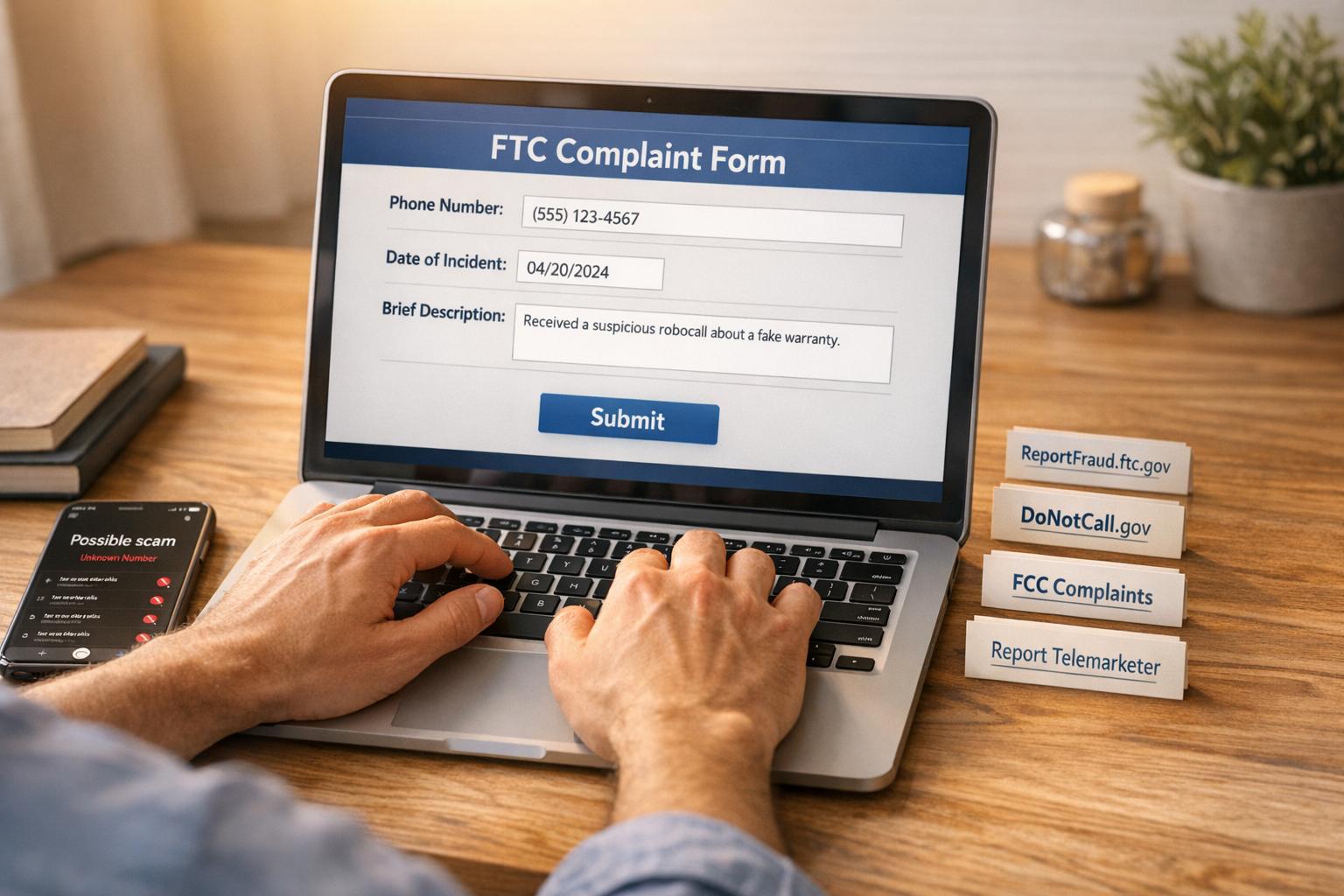
If you’re tired of unwanted calls or texts, filing a complaint with the FTC is one of the most effective ways to take action. Reports help the FTC crack down on illegal telemarketing and scams, leading to investigations, penalties, and improved call-blocking technologies. Here’s what you need to know:
- Where to File Complaints:
- Use ReportFraud.ftc.gov for scams involving financial loss.
- Visit DoNotCall.gov for unwanted calls or texts if your number is on the National Do Not Call Registry.
- Details to Provide:
- Phone number that received the call.
- Caller ID or callback number (even if spoofed).
- Date, time, and type of call (live or robocall).
- Additional Resources:
- The Do Not Call Registry helps block legitimate telemarketers but doesn’t stop scammers.
- Services like ReportTelemarketer.com offer free legal support to stop harassment and may help you recover up to $500 per violation.
- For technology-related violations like spoofing, file a complaint with the FCC at fcc.gov/complaints.
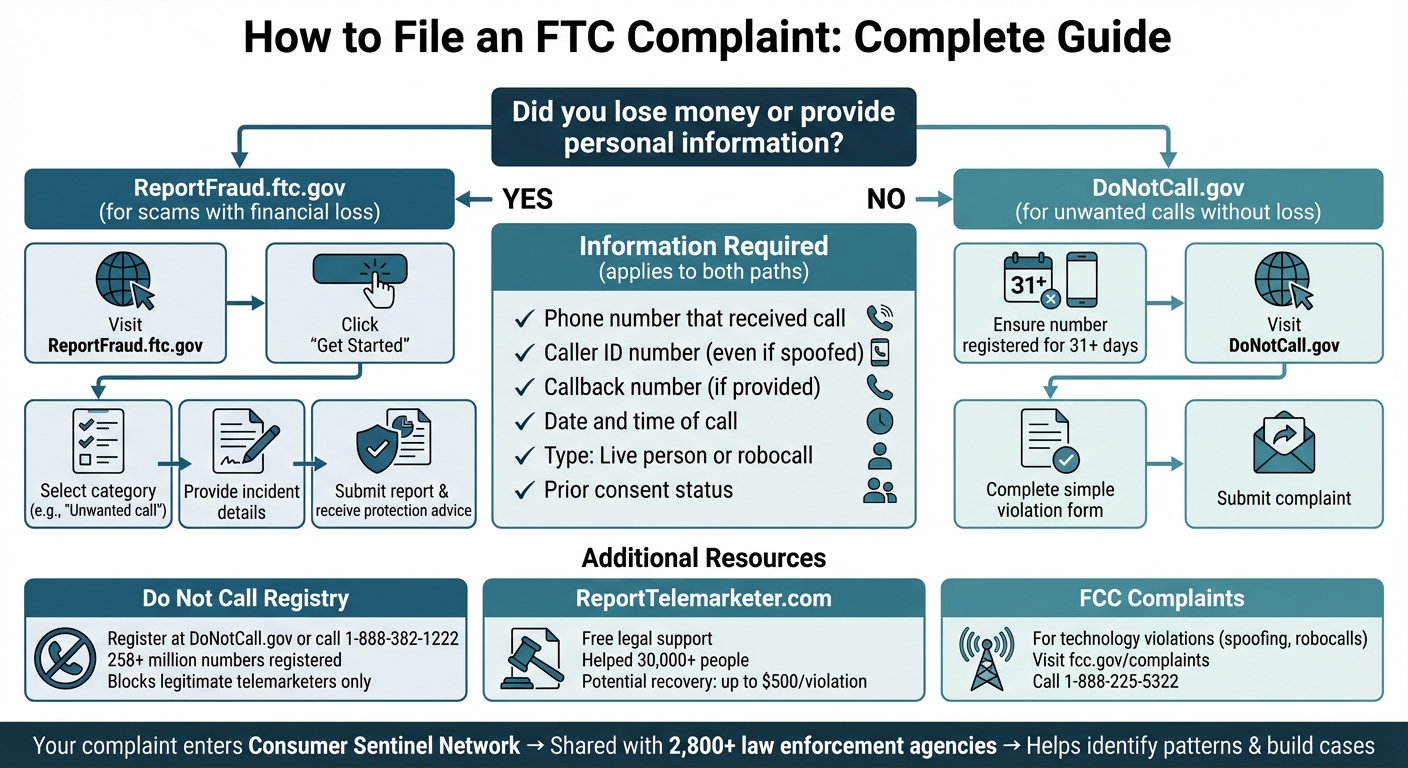
How to File FTC Complaints: Step-by-Step Guide with Portal Selection
How to File a Complaint with the Federal Trade Commission
Filing a report is a critical step, but you should also take proactive measures to stop unwanted calls immediately.
sbb-itb-a8d93e1
FTC Official Complaint Portal at ftc.gov/complaint
The Federal Trade Commission (FTC) provides two online portals for reporting issues: DoNotCall.gov for unwanted calls without financial loss, and ReportFraud.ftc.gov for scams involving monetary loss or additional details. When you file a report through either portal, it becomes part of a shared database used by law enforcement agencies to investigate and take action against illegal activities.
It’s important to note that neither portal resolves individual cases. Instead, your report contributes to a broader effort to identify patterns and build cases against offenders. As the FTC puts it:
"Your reports can help us detect patterns of wrongdoing, and lead to investigations and prosecutions".
Here’s a guide to using the FTC complaint portal effectively.
How to Use the FTC Complaint Portal
To report a scam or fraud, visit ReportFraud.ftc.gov, click on "Get Started", select the appropriate category (like "Unwanted call"), and provide the requested details about the incident. Follow the prompts to complete your report. Once submitted, the site offers advice on protecting yourself from further harm.
For complaints about unwanted calls that don’t involve financial loss, head to DoNotCall.gov. This portal provides a quick and simple form for reporting violations of the National Do Not Call Registry.
Information Required for Your Complaint
Before filing a report, gather the following details:
- The phone number that received the call.
- The number displayed on your caller ID (even if it seems spoofed).
- Any callback number provided in the message.
- The date and time of the call.
You’ll also need to specify whether the call was from a live person or a robocall, and whether you had previously given the company written consent to contact you.
Even if you suspect the caller ID is spoofed, it’s still important to report the displayed number. The FTC clarifies:
"Technology has made it easy for scammers to fake or ‘spoof’ caller ID information, so the number you’re reporting might not be the caller’s real number. But sometimes, the FTC and other law enforcement agencies can still trace the call based on the information you give".
To make this process easier, consider keeping a notepad by your phone to jot down details immediately. Caller ID information can disappear from logs quickly, so capturing it right away is crucial.
Do Not Call Registry Complaint System at donotcall.gov

The National Do Not Call Registry offers a free way to reduce unwanted sales calls by shielding personal phone numbers. As of January 6, 2026, over 258 million telephone numbers have been added to the registry. While this service blocks legitimate telemarketers, it doesn’t stop calls from scammers, political campaigns, charities, or debt collectors.
Registering Your Phone Number
Before filing a complaint, make sure your phone number is registered. You can sign up any home or cell phone number at DoNotCall.gov or by calling 1-888-382-1222 from the number you wish to protect. If you register online, remember to click the confirmation link sent via email within 72 hours to complete the process.
Once registered, your number stays protected indefinitely unless it’s disconnected, reassigned, or you request its removal. Keep in mind that business phone lines and fax numbers aren’t eligible for this service – it’s strictly for personal use.
Filing a Complaint Through the Registry
After your number has been on the registry for 31 days, you can report unwanted phone calls. Businesses are required to update their call lists within that 31-day period, so complaints filed earlier won’t be valid.
To file a complaint, visit DoNotCall.gov or call 1-888-382-1222. You’ll need to provide key details like the number that received the call, the caller ID (even if it was spoofed), any callback number, the date and time of the call, and whether it was a live call or a robocall. Your complaint is added to the FTC’s Consumer Sentinel database, a tool accessed by over 2,800 law enforcement agencies to track violations and build cases against offenders.
For example, in September 2025, Citizens Disability, LLC and its subsidiary faced a $1 million penalty for making millions of illegal calls to registered numbers, falsely claiming ties to Social Security Disability Insurance. Complaints like yours help hold companies accountable and protect others from similar violations.
If your complaint involves financial scams, report them at ReportFraud.ftc.gov. If you need to report annoying phone calls that don’t fit the standard scam profile, there are specific steps to take. Up next, we’ll look at other resources available for handling telemarketing complaints.
ReportTelemarketer.com Free Reporting Platform
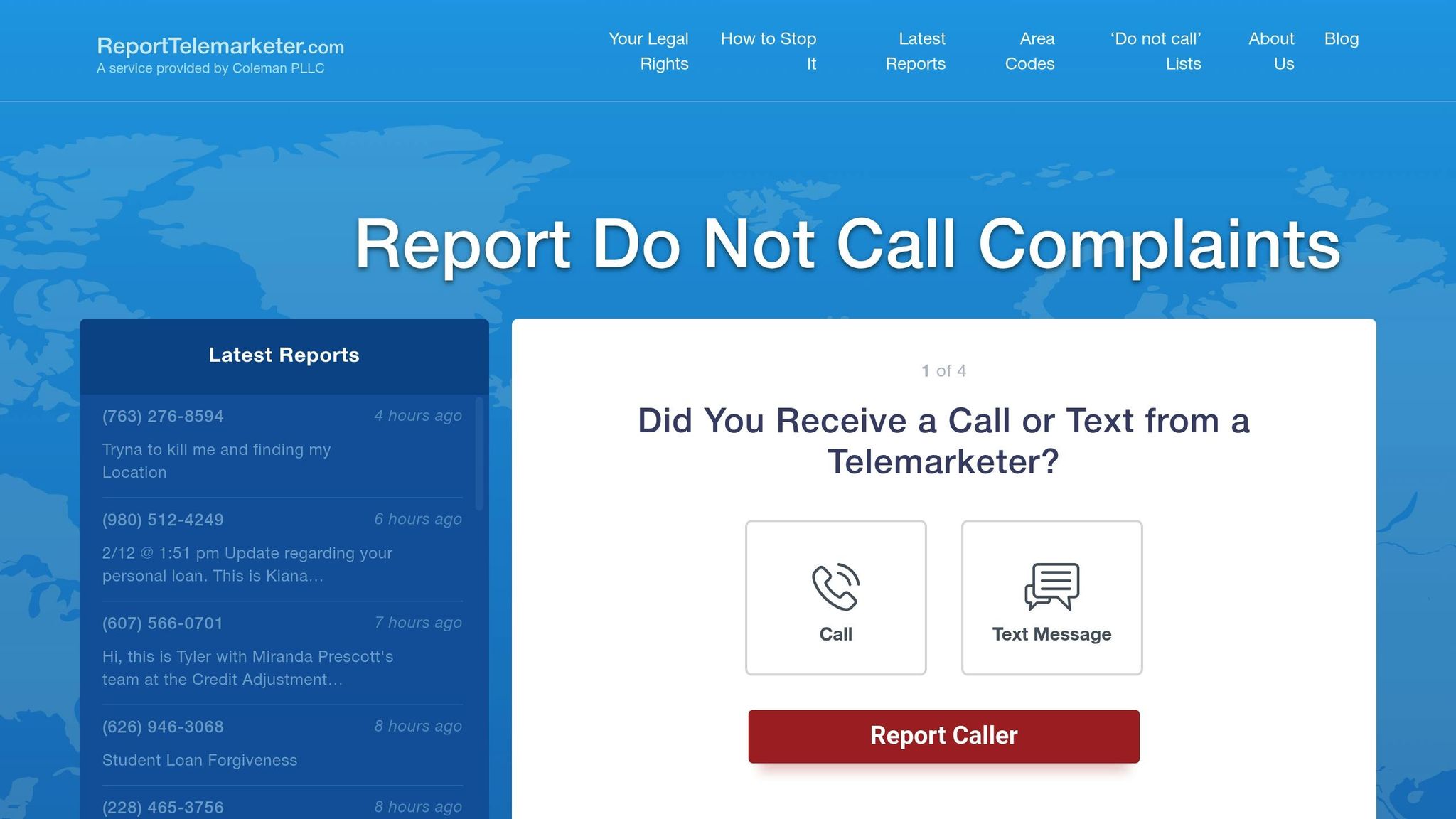
ReportTelemarketer.com is a service designed to protect consumers from unwanted telemarketing calls and texts. So far, it has helped over 30,000 people put a stop to telemarketing harassment. The platform takes care of everything – from investigating the issue to pursuing legal action – all without charging you a dime. Here’s a closer look at how it works.
How ReportTelemarketer.com Works
The process kicks off when you report an unwanted call or text message. Using advanced tools, the platform’s experts trace telemarketers, even if they’ve used spoofed caller IDs. Once the source is identified, their legal team steps in to send a cease and desist letter or file a formal complaint to end the harassment.
Stefan Coleman, the lawyer behind ReportTelemarketer.com, emphasizes the service’s affordability:
"Our services do not cost you anything out of pocket and we do all of the work for you."
Once the calls stop, the platform recovers legal fees directly from the telemarketer, ensuring you receive help without any financial burden.
Benefits of Using ReportTelemarketer.com
Beyond stopping intrusive calls, you could qualify to receive up to $500 per violation under consumer protection laws. The platform’s legal team has a strong track record with telemarketing cases, leveraging laws like the Telephone Consumer Protection Act (TCPA) to protect your rights.
Your personal information stays secure throughout the process. Additionally, telemarketers reported through the platform are publicly listed to warn other consumers. Whether you’re dealing with unwanted calls or texts, ReportTelemarketer.com offers a thorough solution for telemarketing harassment. As they put it:
"After we stop the telemarketer from calling you, we claim our attorney’s fees from the telemarketer."
FCC Consumer Complaint Center for Related Issues
While the FTC addresses many telemarketing complaints, the Federal Communications Commission (FCC) focuses on specific technology-related violations. Filing a complaint with the FCC can bolster your efforts against persistent telemarketers.
Understanding FCC’s Role in Telemarketing Complaints
The FCC enforces the Telephone Consumer Protection Act (TCPA), targeting how telemarketers contact individuals. This includes dealing with robocalls made through autodialers or prerecorded messages, robotexts, and illegal caller ID spoofing under the Truth in Caller ID Act. While the FTC prioritizes deceptive sales practices, the FCC tackles the technical side of telemarketing violations.
The FCC has taken strong action against violators. For instance, in March 2021, the commission issued a $225 million penalty against John C. Spiller and Rising Eagle Capital Group for making around one billion spoofed robocalls falsely advertising health insurance from companies like Aetna and UnitedHealth Group. Similarly, Scott Rhodes faced a $9.9 million fine for using spoofed caller IDs to send harmful robocalls targeting specific communities.
The rules are stricter for wireless numbers compared to landlines. Most autodialed or prerecorded calls to wireless phones require prior express consent, while restrictions for landlines mainly apply to advertising calls. Additionally, the FCC has clarified that calls using AI-generated voices fall under the "artificial" category in the TCPA, making them illegal without prior consent.
It’s important to note that the FCC does not resolve individual complaints or provide compensation. As stated by the commission:
"We do not resolve individual unwanted call or text complaints, but your complaint provides valuable information that we use to inform policy decisions and as the basis of potential enforcement actions".
If you’re ready to proceed, here’s how to stop spam calls by filing your complaint.
Filing a Complaint with the FCC
The quickest way to file a complaint is online at fcc.gov/complaints or consumercomplaints.fcc.gov. Alternatively, you can call 1-888-CALL-FCC (1-888-225-5322) or mail a detailed letter to:
Federal Communications Commission
Consumer and Governmental Affairs Bureau
45 L Street NE
Washington, DC 20554
When filing online, select "Phone" > "Unwanted calls/texts." Provide details such as the phone number that received the call, the caller ID name and number displayed, the exact date and time (including your time zone), and whether the phone is a landline or wireless device. If scammers are using your number to make calls, choose "my own number is being spoofed" as the sub-issue.
If the FCC forwards your complaint to a service provider, the provider must respond in writing to both you and the FCC within 30 days. After submitting your complaint, you’ll receive an automated email confirmation with reference details for tracking updates on your case.
Preparing an Effective FTC Complaint
filing a well-prepared spam call complaint with the FTC does more than meet their requirements – it plays a key role in strengthening law enforcement efforts against telemarketing scams. The detail and accuracy of your complaint directly influence its value for investigators. The FTC shares this data through the Consumer Sentinel Network, which connects over 2,800 civil and criminal law enforcement agencies worldwide. Detailed complaints help uncover patterns and build stronger cases against offenders.
Gathering Evidence and Documentation
Start by documenting every detail of the call as soon as possible. Note the date and time, the number you received the call on, and the Caller ID information – even if it says "blocked" or "unknown." If the caller provided a callback number, write that down too.
Record the name of the caller and the company or organization they claimed to represent. Pay attention to the purpose of the call – whether it was a sales pitch, a scam, or an impersonation of a government agency like the IRS or Social Security Administration. If payment was requested, make a note of the payment method they mentioned, especially if it involved gift cards, cryptocurrency, or wire transfers.
For complaints about violations of the Do Not Call Registry, ensure your phone number has been registered for at least 31 days before filing the complaint. You can confirm your registration at DoNotCall.gov or by calling 1‑888‑382‑1222.
Once you’ve gathered all the details, organize your notes into clear categories to make your submission more effective.
Organizing Your Complaint Details
A well-organized complaint is easier to understand and more likely to be actionable. Be sure to include the following details:
- Phone numbers: The number called, Caller ID information, and any callback number provided.
- Call specifics: Date, time, and the caller’s identity (name, company, or claimed government agency).
- Offer or scam details: What was being promoted, whether it was a product, service, or fraudulent scheme.
- Payment information: If payment was requested, include the amount and the method (e.g., gift cards, cryptocurrency, or wire transfer).
When submitting your complaint through the FTC’s online portal, select the "Phone Calls, Text Messages, and Faxes" category to ensure it’s routed correctly. Use the description field to provide a detailed account of the interaction. Include any claims made by the caller and whether you suffered financial loss. Even if you didn’t lose money, reporting the incident helps the FTC track trends and prioritize cases.
Finally, double-check all the information you’ve entered – especially phone numbers and dates – before hitting submit. Accuracy is crucial for investigators to act effectively.
Tracking and Following Up on Your FTC Complaint
After filing a complaint with the FTC, don’t expect updates or tracking like you would with a package delivery service. The FTC does not handle individual disputes or act as a mediator between you and a business. Instead, your report becomes part of the Consumer Sentinel Network – a secure database accessible to over 2,800 civil and criminal law enforcement agencies worldwide. Here’s what you should know about next steps and how to navigate the process.
Using Your FTC Complaint Reference Number
When you submit your report at ReportFraud.ftc.gov, you’ll receive tailored "next steps" based on the type of fraud you reported. These steps are designed to help you protect yourself moving forward. If you have any questions about your report, you can reach out to the Consumer Response Center at 1-877-FTC-HELP (1-877-382-4357).
For identity theft cases, there’s a dedicated portal at IdentityTheft.gov. This platform provides a personalized recovery plan, offering more specific guidance than the general fraud reporting system.
What to Expect After Filing Your Complaint
Filing a complaint doesn’t mean you’ll receive individual follow-ups. Instead, your report contributes to a larger database that helps law enforcement agencies target fraud and scams. As the FTC explains:
"We can’t resolve your individual report, but we use reports to investigate and bring cases against fraud, scams, and bad business practices".
The Consumer Sentinel Network plays a key role in helping law enforcement identify patterns and build stronger cases. For example, in February 2025, the FTC facilitated automatic refunds for millions of Amazon Prime customers following a $2.5 billion settlement.
To stay informed, you can explore fraud trends in your area by visiting ftc.gov/exploredata. Additionally, sign up for FTC Consumer Alerts to learn about new scams and enforcement actions as they happen. You can also report phone numbers of unwanted calls to help identify persistent offenders.
Conclusion
Reporting violations does more than protect you – it strengthens the community’s defenses as well. Every complaint you file becomes part of a robust enforcement system that has already disrupted operations behind billions of illegal robocalls. These reports also help hold offenders accountable through hefty penalties and legal actions.
When you report, your complaint is added to the Consumer Sentinel database. This database is shared with over 2,800 law enforcement partners worldwide, aiding them in spotting patterns and building cases against offenders. But the impact doesn’t stop there. Your reports also enhance call-blocking technology. The FTC shares reported phone numbers with telecommunications carriers every business day, helping them improve spam detection and call-labeling systems. This daily collaboration highlights how essential your reports are to staying ahead of scammers.
By taking action, you’re not just protecting yourself – you’re helping to safeguard everyone. Whether you choose to use the FTC’s official reporting portals, sign up for the Do Not Call Registry or file a Do Not Call Registry complaint, or turn to services like ReportTelemarketer.com for added legal support, your efforts contribute to a safer communication landscape. As FTC Attorney Lisa Weintraub Schifferle points out:
"The more we hear from you, the more we can help fight scams".
Don’t wait for someone else to take action. If you haven’t already, register your number at DoNotCall.gov – registration never expires. Then, make it a habit to document and report every illegal call, including details like caller ID, date, time, and callback numbers. Every report strengthens the fight against robocalls and helps deter scammers from targeting others.
FAQs
Which FTC site should I use for my complaint?
To submit a complaint to the FTC, head to their official platforms. You can use the FTC’s main complaint page or their specific fraud-reporting site. Both options are trustworthy and straightforward for reporting issues like telemarketing or fraud.
Can I report a call if the caller ID was spoofed?
Scammers often manipulate caller ID information to hide their real identity – this is known as spoofing. The good news? You can report these spoofed calls. By doing so, you contribute to efforts by the FTC and law enforcement to track down and address these scams. Every report plays a part in tackling the problem.
Should I also file with the FCC for robocalls or spoofing?
Filing a complaint with the FCC is a key step in tackling robocalls or spoofing. The FCC focuses heavily on protecting consumers from these nuisances and provides tools to make reporting straightforward. By submitting a complaint, you not only address unwanted calls but also contribute to efforts aimed at enforcing regulations and reducing these disruptions.

