

Cross-border telemarketing is challenging due to varying consent laws across countries. Non-compliance leads to severe penalties and complaints, like the TCPA fines of up to $1,500 per call in the U.S. or GDPR fines up to €20M in the EU. Here’s what you need to know:
- Consent Standards:
- Key Challenges:
- Different opt-in and opt-out models across regions.
- Strict penalties, e.g., $280M fine for Dish Network under TCPA.
- New rules, like the U.S. requiring one-to-one consent by 2025.
- Compliance Tips:
- Use Consent Management Platforms (CMPs) to track and store consent.
- Regularly scrub contact lists against Do Not Call registries.
- Train teams on region-specific regulations and maintain detailed records.
Avoiding fines isn’t the only benefit – strong compliance builds consumer trust. Start by adopting the strictest consent standard (e.g., GDPR) globally, and tailor processes to local laws.
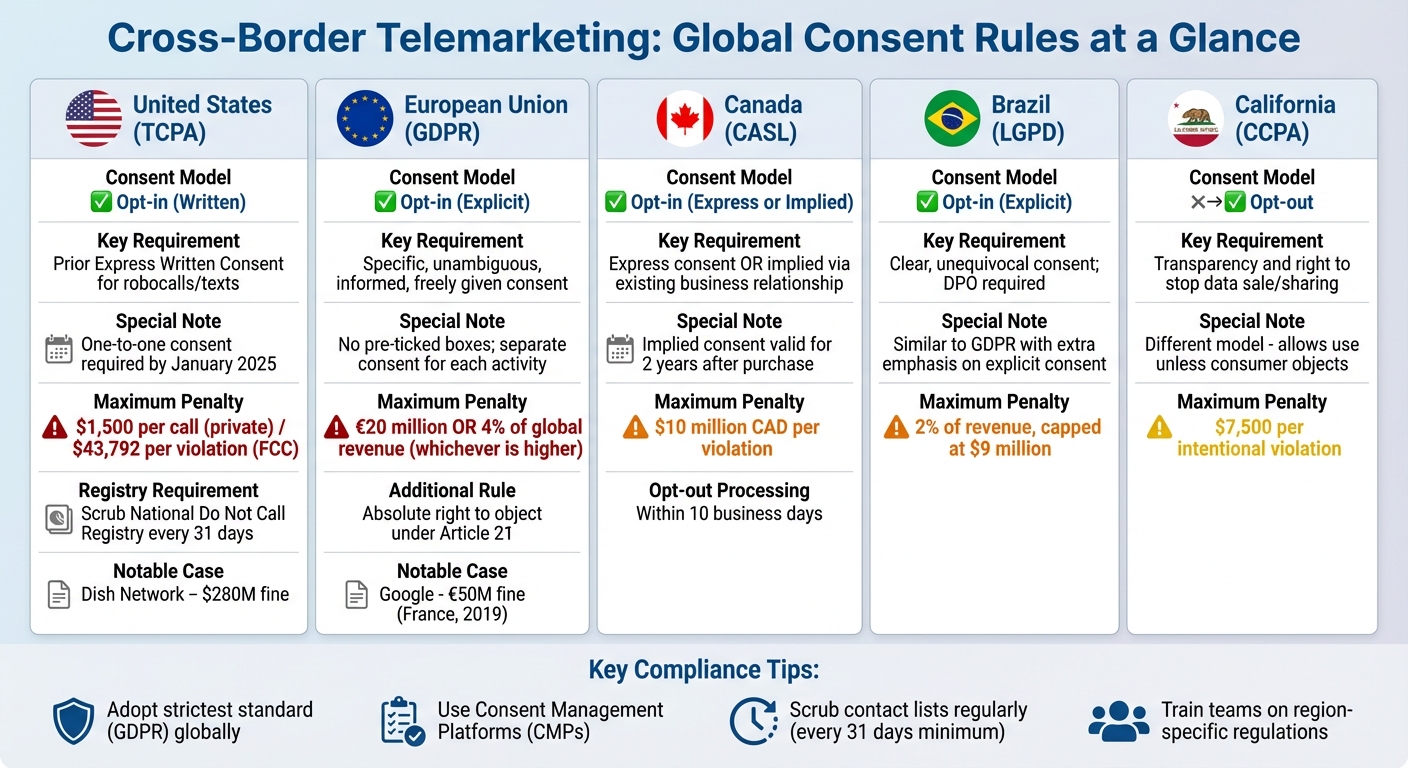
Global Telemarketing Consent Requirements and Penalties Comparison
Window to the Law: Updated Guidance for TCPA Compliance
sbb-itb-a8d93e1
Major Consent Regulations for Telemarketing
Telemarketing across borders requires a clear understanding of how different countries define and enforce consent. Each regulation has its own focus – whether it’s on technology, privacy rights, or business relationships. Let’s start with the U.S., where the TCPA sets a baseline for global consent practices.
United States: TCPA Overview
The Telephone Consumer Protection Act (TCPA) regulates how calls are initiated rather than simply targeting specific numbers. If you’re using an Automatic Telephone Dialing System (ATDS) or prerecorded/artificial voices to contact wireless numbers, you must obtain Prior Express Written Consent (PEWC). This means securing a signed agreement from the consumer before reaching out, and electronic signatures are acceptable. For non-marketing calls or texts, prior express consent is enough.
Starting in January 2025, brands will need to secure their own individual consent, eliminating bundled agreements. Consumers can also revoke consent in any reasonable way – like replying with "STOP" or "QUIT" – and these requests must be honored immediately.
Telemarketers are required to scrub contact lists against the National Do Not Call Registry at least every 31 days. Importantly, the TCPA now includes AI-generated voices under the same consent rules.
European Union: GDPR and Telemarketing
The General Data Protection Regulation (GDPR) prioritizes privacy rights, with consent being one of six legal bases for processing personal data under Article 6. In telemarketing, consent must be freely given, specific, informed, and unambiguous. GDPR Article 4 defines consent as:
"Any freely given, specific, informed and unambiguous indication of the data subject’s wishes by which he or she, by a statement or by a clear affirmative action, signifies agreement to the processing of personal data relating to him or her."
Pre-ticked boxes, silence, or inactivity don’t count as valid consent. Each activity requires separate consent – such as separating consent for identity verification from telemarketing. GDPR Article 21 also grants individuals the absolute right to object to direct marketing, requiring businesses to stop immediately when requested.
In 2019, Google faced a €50 million fine from France’s CNIL for failing to meet transparency and consent standards. The issue? Users couldn’t provide separate, informed consent for each service. Additionally, the ePrivacy Directive complements the GDPR by requiring prior opt-in consent for electronic marketing. Some EU nations allow "soft opt-in" for existing customers, but businesses must still check numbers against national "Do Not Call" registries, like the UK’s Telephone Preference Service (TPS).
Canada: CASL Consent Standards
Canada’s Anti-Spam Legislation (CASL) separates consent into two types: express and implied. Express consent requires a clear, affirmative action – similar to GDPR – while implied consent comes from an existing business relationship. For instance, if someone bought something from your business within the last two years, you might have implied consent to send them updates about related products.
Opt-out requests must be processed quickly, usually within 10 business days. Businesses also need to keep detailed records of when and how consent was obtained. For companies operating across North America, understanding CASL’s dual-consent framework is essential.
Other Regions: Brazil LGPD and Beyond
Brazil’s Lei Geral de Proteção de Dados (LGPD) shares similarities with the GDPR but places extra emphasis on explicit consent. It requires clear, unequivocal consent, mandates appointing a Data Protection Officer (DPO), and imposes penalties of up to 2% of a company’s revenue, capped at $9 million. This highlights the challenges of managing compliance across multiple regions.
In the U.S., some states like Florida, Maryland, and Oklahoma have introduced "mini-TCPA" laws, which can be stricter than the federal TCPA. This adds another layer of complexity for businesses navigating state-specific rules.
| Region | Key Regulation | Consent Requirement | Maximum Penalty |
|---|---|---|---|
| United States | TCPA | Prior Express Written Consent for robocalls/texts | $1,500 per violation (private); up to $26,000 (FCC) |
| European Union | GDPR | Explicit, informed, unambiguous consent | Up to €20 million or 4% of global revenue |
| Canada | CASL | Express or implied (via existing relationship) | Up to $10 million CAD per violation |
| Brazil | LGPD | Explicit consent; DPO required | 2% of revenue, capped at $9 million |
Comparing Consent Requirements Across Regulations
Navigating the maze of global telemarketing regulations starts with understanding how consent rules differ. The key distinction lies in opt-in versus opt-out models. Regulations like GDPR, TCPA, CASL, and LGPD require explicit permission before making marketing calls. On the other hand, CCPA operates on an opt-out basis, allowing data use unless the individual actively objects.
Consent requirements vary significantly in their stringency. GDPR sets a high bar, demanding consent that’s "specific, unambiguous, informed, and freely given", meaning passive actions like pre-checked boxes won’t cut it. TCPA mandates prior express written consent for robocalls and prerecorded messages, with a stricter one-to-one consent rule coming into effect in January 2025 – eliminating bundled consents for multiple sellers. CASL permits implied consent within existing relationships for up to two years, while LGPD mirrors GDPR’s emphasis on clear, informed consent.
The stakes for non-compliance are high, as enforcement penalties demonstrate. GDPR violations can lead to fines of up to €20 million or 4% of global annual turnover, whichever is higher. In 2023, Germany’s Bundesnetzagentur issued €1.435 million in fines for illegal telemarketing, including €285,000 penalties against energy suppliers for aggressive unsolicited calls. In the U.S., TCPA violations carry penalties of up to $43,792 per infraction, while CASL allows fines as high as $10 million CAD. CCPA imposes penalties of $7,500 for intentional violations. These variations highlight the need for a unified compliance approach for businesses operating globally.
For cross-border telemarketers, adopting the strictest consent standard offers a safer path. Following GDPR’s explicit opt-in requirements – obtaining clear, affirmative consent before contacting individuals, maintaining detailed consent records, and promptly reporting and respecting opt-out requests – can help ensure compliance across multiple jurisdictions.
Here’s a quick comparison of consent requirements and penalties across major regulations:
| Regulation | Region | Consent Model | Key Requirement | Maximum Penalty |
|---|---|---|---|---|
| GDPR | European Union | Opt-in (Explicit) | Specific, unambiguous affirmative action | €20M or 4% of global turnover |
| TCPA | United States | Opt-in (Written) | Prior express written consent (one-to-one by 2025) | $43,792 per violation |
| CASL | Canada | Opt-in (Express) | Explicit consent for automated dialing; implied for existing relationships | $10M CAD |
| CCPA | California | Opt-out | Transparency and right to stop data sale/sharing | $7,500 per intentional violation |
| LGPD | Brazil | Opt-in | Prior and informed consent | 2% of Brazil revenue (max R$50M) |
How to Manage Cross-Border Telemarketing Consent
Managing telemarketing consent across different countries is no small feat. It requires more than just ticking boxes – it’s about creating a system that respects regional laws while maintaining consistent practices throughout your operations.
Understanding Regional Differences
When it comes to compliance, the location of your contacts matters more than where your business is based. For instance, if a company in New York is reaching out to people in Germany, GDPR regulations apply. On the other hand, calls to California residents must align with CCPA rules.
Each jurisdiction has its own requirements for consent. GDPR and CASL demand explicit opt-in consent for marketing, while CCPA follows an opt-out model. To simplify compliance, consider adopting GDPR’s opt-in standard globally, then add region-specific elements like CASL’s requirement for a physical mailing address or CCPA’s "Do Not Sell" link.
Regularly clean your contact lists to ensure compliance with national, state, and internal Do Not Call registries. This includes routine checks against the U.S. Do Not Call Registry to avoid violations and stop spam calls.
Timing also matters. In the U.S., the TCPA restricts telemarketing calls to between 8:00 AM and 9:00 PM local time. Additionally, each region may have unique disclosure requirements, so ensure your agents are trained to handle these differences.
To manage all these complexities, consider leveraging technology that automates consent tracking and compliance.
Using Consent Management Tools
Manually tracking consent can quickly become overwhelming, especially when dealing with multiple jurisdictions. Consent Management Platforms (CMPs) simplify this process by automating the collection, documentation, and storage of user consent. These platforms can geotarget consent prompts and integrate with your CRM to handle opt-out requests immediately. While TCPA allows up to 10 business days to process opt-outs, GDPR requires that withdrawing consent be as simple as granting it.
One of the most important features of a CMP is its ability to maintain detailed records. It should log timestamped data showing when, how, and where each person gave consent, including the exact language of the disclosure they saw. This documentation can be crucial if you face legal or regulatory challenges.
Modern CMPs also connect seamlessly with tools like Google Consent Mode v2 or IAB TCF v2.2, ensuring that consent statuses are automatically communicated to your advertising and analytics partners. To protect your records during vendor transitions, export consent data to a secure internal CRM or data warehouse.
If you’re working with third-party lead providers, take extra precautions. Verify that they have collected explicit, one-to-one consent that specifically names your brand. This is especially important as the FCC’s January 2025 rule will prohibit bundled consent.
Finally, make compliance an ongoing effort. Conduct quarterly audits of your entire system. Check that opt-in forms use updated disclosure language, test responses to "HELP" and "STOP" keywords, and confirm that suppression lists sync across all platforms. As Intelemark puts it:
"Compliance isn’t about the one-time effort to avoid a fine – it’s about a continual effort to stay in line with shifting regulations".
Creating a Global Consent Compliance Policy
Developing a global compliance policy is essential for protecting your business while respecting consumer rights. Think of it as an operational guidebook that shapes how you handle consent – from obtaining it to responding effectively when someone opts out. This policy builds on regional consent rules, creating a unified framework for your operations.
Core Elements of a Compliance Policy
A solid compliance policy should cover several critical areas:
- Explicit Consent Acquisition: Always secure prior written consent with clear disclosures about your company, purpose, and offerings. Use unchecked boxes by default to ensure consent is voluntary, and make it clear that consent is not tied to a purchase.
- Data Scrubbing Protocols: Regularly update your contact lists by cross-checking them with the National Do Not Call Registry, the Reassigned Numbers Database for recycled numbers, and your internal suppression list. Ensure opt-out requests are processed within 14 days.
- Record-Keeping Standards: Keep detailed records of who consented, when and how they did so, and the exact wording used during the process. Retain these records for three to five years. For example, HelloFresh faced a £140,000 fine in the UK for using a single checkbox to bundle multiple consents, which failed to meet specific requirements.
- Time and Frequency Restrictions: Limit calls to between 8:00 AM and 9:00 PM local time.
- Robust Opt-Out Mechanisms: Provide clear and simple opt-out options, such as replying with "Stop" or "End", and process these requests within 10 business days. Paul St. Clair, Head of Compliance at Convoso, emphasizes:
"The consumer’s intent is the deciding factor. If a consumer reasonably communicates that they want communications to stop, that request must be honored, even if the language they use is informal or unconventional".
- Continuous Review and Training: Treat your policy as a living document. Conduct quarterly legal reviews and provide ongoing training on regional laws and best practices. Recent data shows that only 59% of businesses are fully compliant with GDPR, and nearly 90% of call centers report gaps in data privacy management.
To strengthen your efforts, consider incorporating external consumer protection services.
Using Consumer Protection Services Like ReportTelemarketer.com
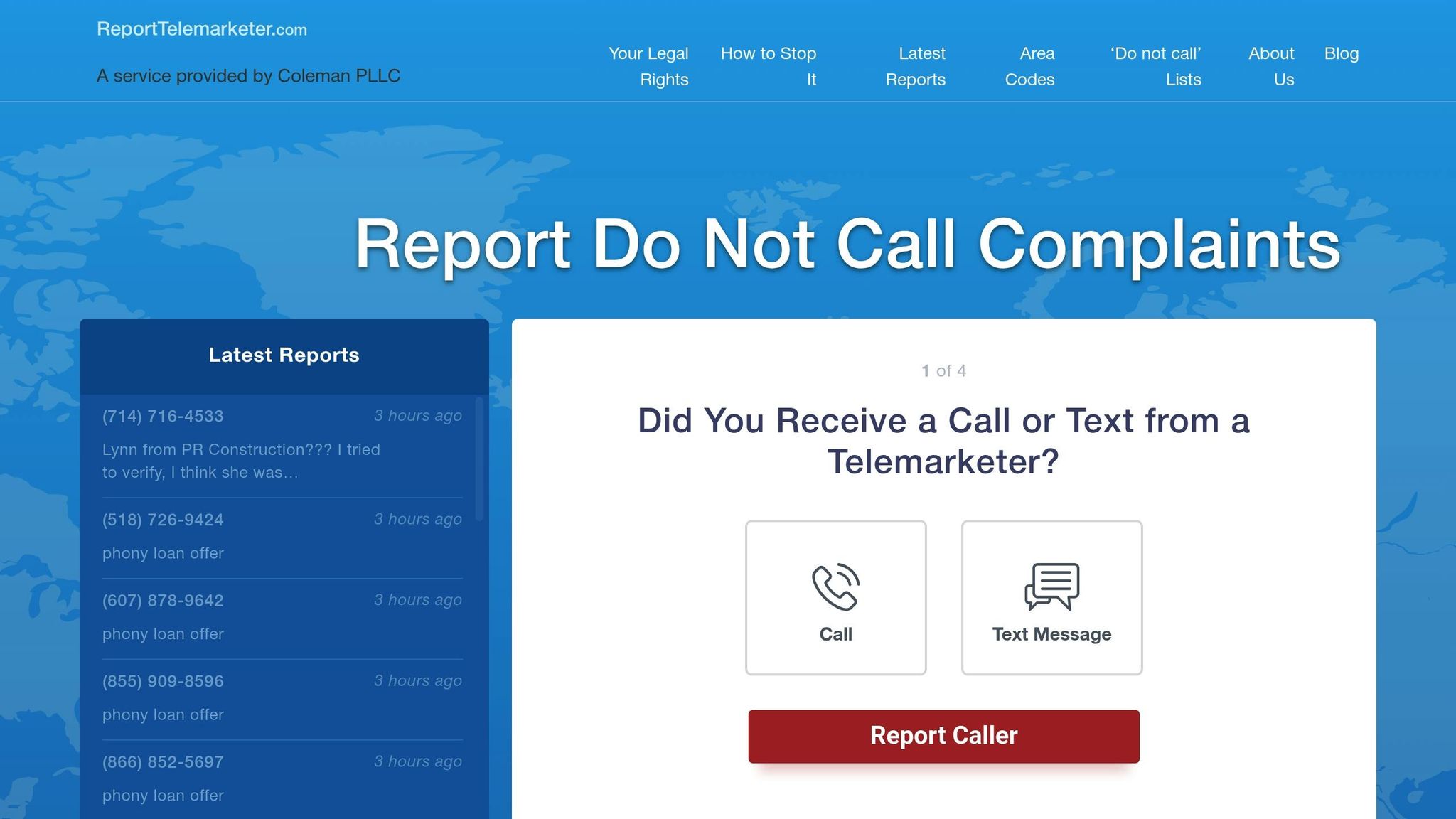
External consumer protection services can complement your internal compliance measures by identifying potential issues before they escalate. These platforms empower consumers to report violations and hold businesses accountable, helping you refine your practices.
For instance, ReportTelemarketer.com allows individuals to report unwanted telemarketing calls and texts. The platform investigates these complaints, identifies breaches of consumer protection laws, and takes action through cease-and-desist letters or formal complaints. This service is free for consumers, with attorney fees claimed from telemarketers. Such accountability is crucial in an industry where TCPA violations can lead to fines ranging from $500 to $1,500 per call or text.
Businesses that monitor these services can identify weaknesses in their consent collection, data scrubbing, or opt-out processes. Take the example of Sumco Panama, which faced a record $299 million FCC fine for over 5 billion unauthorized robocalls. Non-compliance not only risks financial penalties but can also severely damage your reputation.
Conclusion
Adhering to cross-border telemarketing consent rules does more than just help businesses avoid hefty fines – it builds trust with consumers. The financial risks of non-compliance are steep: GDPR violations can result in penalties of up to €20 million or 4% of global revenue, while TCPA fines range from $500 to $1,500 per call or text. Recent enforcement actions serve as a reminder of the severe consequences for failing to comply.
On the flip side, strong compliance not only avoids these penalties but also offers financial benefits. Companies can save an average of $2.3 million annually by reducing data breaches and fostering customer loyalty. As Intelemark puts it, "Strong privacy can make a brand glow. As long as a company discloses exactly how it collects and uses and shares data, people will trust it". This trust gives businesses a competitive edge, especially when only 59% of companies are fully GDPR compliant.
The benefits of compliance aren’t limited to businesses – they extend to consumers and the broader market. Regulations protect individuals from billions of robocalls every month, nearly half of which are illegal. Services like ReportTelemarketer.com play a crucial role by investigating complaints, issuing cease-and-desist letters, and holding violators accountable, all at no cost to consumers. This accountability helps businesses identify and fix compliance issues before they lead to expensive lawsuits.
Looking ahead, the regulatory landscape is becoming stricter. For instance, the UK is increasing telemarketing fines from £500,000 to £17.5 million, and the FCC will require one-to-one consent starting January 2025. Companies that treat compliance as an ongoing responsibility rather than a one-time task will not only safeguard their operations but also strengthen their reputations and build the trust needed for sustained growth.
FAQs
Which country’s consent laws apply if my call center is in the U.S. but I’m calling abroad?
If your call center operates in the U.S. but makes international calls, U.S. consent laws like the TCPA (Telephone Consumer Protection Act) still apply when reaching out to U.S. consumers. This holds true no matter where the call originates. It’s crucial to comply with both U.S. regulations and the laws of the country you’re contacting.
What do I need to prove "written consent" for robocalls or SMS under the TCPA?
Under the Telephone Consumer Protection Act (TCPA), "written consent" requires that you obtain prior express written consent from the recipient before sending autodialed or prerecorded telemarketing messages. This consent must include a clear and noticeable disclosure stating that the recipient agrees to receive such messages. Additionally, the consent must be documented in writing and securely retained to serve as evidence if any disputes arise.
How do I handle leads from third parties under the 2025 one-to-one consent rule?
Starting January 27, 2025, the one-to-one consent rule will demand explicit, written consent from consumers for every seller and communication channel. This means consent must be specific to each seller – approval for one seller won’t automatically cover others. If you’re working with third-party leads, make sure they include proper consent for each individual seller. Keep thorough documentation to ensure you’re meeting the requirements of this rule.

