
Spam calls are a major frustration for many people in the U.S. The Telephone Consumer Protection Act (TCPA), passed in 1991, sets rules to limit telemarketing practices and supports tools that help stop spam calls. Here’s what you need to know:
- What TCPA Does: It restricts the use of autodialers, prerecorded messages, and telemarketing calls during certain hours. Violators can face fines of $500 to $1,500 per call.
- Call-Blocking Tools: These tools use analytics to identify and block suspicious calls, including robocalls and spoofed numbers. Examples include carrier services like AT&T’s ActiveArmor and apps like Nomorobo.
- National Do Not Call Registry: Registering your number helps reduce telemarketing calls. Businesses must honor your request to stop calling for at least five years.
- FCC Rulings: Since 2019, carriers can block spam calls by default, helping to prevent billions of unwanted calls each year.
FCC, TCPA Changes Coming: Your 2026 (And Beyond) Compliance Survival Guide | Convoso
sbb-itb-a8d93e1
TCPA Provisions That Enable Call Blocking
TCPA Consent Requirements and Call-Blocking Types Comparison
The Telephone Consumer Protection Act (TCPA) does more than just penalize violators – it lays the groundwork for carriers and tech companies to block unwanted calls. Three key elements support call-blocking tools: restrictions on automated calling equipment, the National Do Not Call Registry, and limits on telemarketing call times. Together, these rules discourage violations and enable technical solutions to protect consumers from spam.
Restrictions on Autodialers and Prerecorded Messages
Under the TCPA, using Automatic Telephone Dialing Systems (ATDS) or prerecorded messages to contact cell phones is prohibited unless prior express written consent is obtained.
The U.S. Supreme Court clarified the definition of an autodialer in Facebook, Inc. v. Duguid (April 2021). According to the Court:
"To qualify as an automatic telephone dialing system under the Telephone Consumer Protection Act, a device must store or generate telephone numbers using a random or sequential number generator." – U.S. Supreme Court
For prerecorded messages, the TCPA restricts telemarketing calls to residential lines using artificial or prerecorded voices unless prior express written consent (PEWC) is given. This includes modern tactics like AI-generated voices and ringless voicemails, which the FCC has ruled must meet full TCPA consent requirements.
These restrictions allow service providers to build call-blocking features into their systems. The FCC permits providers to block calls from invalid, unallocated, or unused numbers and those listed on Do-Not-Originate (DNO) lists.
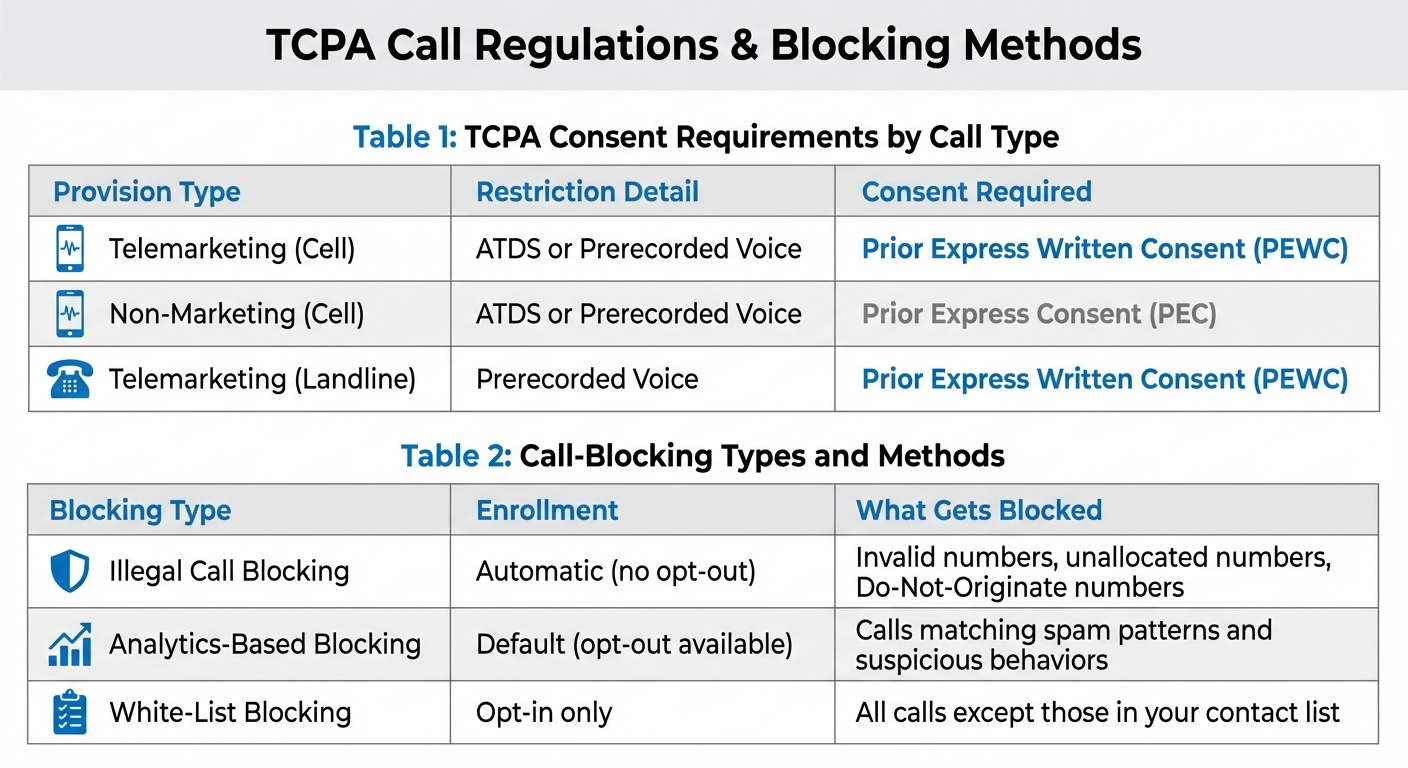
| Provision Type | Restriction Detail | Consent Required |
|---|---|---|
| Telemarketing (Cell) | ATDS or Prerecorded Voice | Prior Express Written Consent (PEWC) |
| Non-Marketing (Cell) | ATDS or Prerecorded Voice | Prior Express Consent (PEC) |
| Telemarketing (Landline) | Prerecorded Voice | Prior Express Written Consent (PEWC) |
The Do Not Call Registry and Consent Rules
The National Do Not Call Registry is a powerful tool under the TCPA, letting consumers opt out of most telemarketing calls. Once your number is registered at DoNotCall.gov, telemarketers must update their contact lists every 31 days to comply. Additionally, businesses must maintain their own internal Do Not Call lists. If you ask a caller to stop contacting you, they’re required to honor that request for at least five years.
The TCPA also requires prior express written consent (PEWC) for autodialed or prerecorded marketing calls to wireless numbers. The FCC defines this consent as:
"An agreement, in writing, that bears the signature of the person called that clearly and conspicuously authorizes no more than one identified seller to deliver… advertisements or telemarketing messages using an automatic telephone dialing system or made using an artificial or prerecorded voice." – 47 C.F.R. Sec. 64.1200(f)
Consent is tied to the individual, not just the phone number. To ensure calls don’t target new owners of recycled numbers, the Reassigned Numbers Database (RND) plays a crucial role. Consumers also have the right to revoke consent at any time, such as by replying "STOP" to a text message. Call-blocking tools rely on these registries and consent records to identify unauthorized calls. They also use analytics to flag suspicious patterns, like bursts of calls or unusually low completion rates, which often indicate a lack of proper consent.
These measures work alongside time restrictions to strengthen consumer protection.
Time Restrictions for Telemarketing Calls
The TCPA prohibits telemarketing calls before 8:00 a.m. and after 9:00 p.m. local time, even if consent has been provided.
Call-blocking tools take advantage of these time restrictions to filter calls automatically. For example, if a sales call comes in at 7:30 a.m., blocking technology identifies and stops the violation. The FCC also allows providers to block calls deemed "obviously fraudulent". This means many blocking apps and carrier services can handle early morning or late-night telemarketing attempts without you lifting a finger.
FCC Rulings Supporting Call-Blocking Tools
The FCC has taken significant steps to strengthen consumer protections under the TCPA by enabling carriers to block unwanted calls directly at the network level. These rulings work hand-in-hand with the TCPA to tackle the growing issue of robocalls and unauthorized calls.
2019 FCC Default Call-Blocking Ruling
In June 2019, the FCC issued a Declaratory Ruling (FCC-19-51) under the leadership of then-Chairman Ajit Pai. This decision allowed carriers to use analytics to automatically block spam calls for all customers – no extra sign-up required. The ruling was a direct response to the staggering 5.1 billion robocalls received by U.S. consumers in November 2018 alone.
The FCC emphasized the urgency of addressing illegal calls:
"We believe the clarification we make that voice service providers may immediately start offering call-blocking services by default – while giving consumers the choice to opt out – is essential to curtail illegal calls." – Federal Communications Commission
By early 2020, major carriers like AT&T, CenturyLink, and Verizon had implemented default network-level blocking for fraudulent calls in line with this ruling. Switching from opt-in to opt-out blocking gave millions of consumers automatic protection against spam calls. This ruling also laid the groundwork for analytics-based blocking methods, which are explained below.
Analytics-Based Blocking and Consumer Opt-Out
Analytics-based blocking uses advanced algorithms to identify spam calls by spotting unusual patterns. For instance, carriers look for behaviors like high call volumes, short call durations, and low answer rates. This technology also combats "neighbor spoofing", where scammers mimic phone numbers similar to yours to trick you into picking up.
In 2020, the FCC introduced a safe harbor provision that shields carriers from TCPA-related lawsuits when they use reasonable analytics to block calls. This move gave carriers more confidence to act aggressively against spam calls without fear of litigation.
| Blocking Type | Enrollment | What Gets Blocked |
|---|---|---|
| Illegal Call Blocking | Automatic (no opt-out) | Invalid numbers, unallocated numbers, Do-Not-Originate numbers |
| Analytics-Based Blocking | Default (opt-out available) | Calls matching spam patterns and suspicious behaviors |
| White-List Blocking | Opt-in only | All calls except those in your contact list |
Analytics tools have proven effective – when a call is flagged as spam, only 9% of consumers answer, compared to a 47% answer rate for unmarked calls. Thanks to these efforts, the wireless industry now blocks over 1 million illegal robocalls every single day.
How Call-Blocking Tools Align with TCPA Compliance
Call-blocking tools are designed to help enforce TCPA regulations by preventing illegal calls. These tools incorporate features that align with TCPA rules, effectively creating a safeguard against unauthorized telemarketing practices.
TCPA-Compliant Features in Call-Blocking Tools
Modern call-blocking systems reflect TCPA guidelines through several important features. For instance, DNC scrubbing cross-references incoming calls with the National Do Not Call (DNC) Registry, ensuring that telemarketing calls to registered numbers are blocked unless the caller has explicit consent or an existing business relationship. This directly supports TCPA’s restrictions on unwanted solicitation.
Another critical feature is autodialer detection, which identifies and blocks calls made using automated dialing systems without proper consent. Solutions like AT&T’s ActiveArmor, T-Mobile’s ScamShield, and Verizon’s Call Filter stop such calls at the network level, while third-party tools extend similar protections to other phone systems.
To ensure compliance with time restrictions, these tools include time-zone compliance features, which prevent telemarketing calls from being placed outside the allowed hours of 8:00 a.m. to 9:00 p.m. local time. Additionally, they block calls originating from numbers on Do Not Originate (DNO) lists, such as government or enterprise lines meant exclusively for inbound communication.
Another layer of protection comes from Reassigned Numbers Database (RND) integration, which helps avoid contacting numbers that have been reassigned to new owners who haven’t provided consent.
| Feature | TCPA Compliance Function |
|---|---|
| DNC Scrubbing | Matches incoming numbers against the National Do Not Call Registry to block unauthorized calls. |
| Autodialer Detection | Identifies and blocks automated calls made without prior consent. |
| Time-Zone Compliance | Ensures telemarketing calls are only placed between 8:00 a.m. and 9:00 p.m. local time. |
| DNO List Blocking | Blocks calls from numbers on Do Not Originate lists, such as government or enterprise inbound-only numbers. |
| RND Integration | Checks the Reassigned Numbers Database to avoid contacting individuals who now own previously consented numbers. |
These features reinforce adherence to TCPA regulations while helping ensure that unwanted calls are effectively filtered out.
Balancing Blocking with Legitimate Communication
While these tools are effective at blocking spam, they must also strike a balance to avoid interfering with legitimate communications. This is a crucial aspect of TCPA compliance. The FCC mandates that consumers must have the option to opt out of analytics-based call blocking if they fear missing important calls. As the Federal Communications Commission explains:
"A voice service provider may also block calls that it deems are unwanted based on reasonable analytics, but the provider must allow their customers to opt out of this type of blocking." – Federal Communications Commission
To address this, many providers use call labeling instead of outright blocking. Suspicious calls are flagged with labels like "Spam" or "Scam Likely", leaving the decision to answer up to the recipient. This method has been effective – only about 9% of consumers answer calls labeled as spam, compared to 47% for unmarked calls.
Additionally, emergency and non-telemarketing calls are treated differently. TCPA rules and call-blocking systems include exceptions for critical communications, such as life-or-safety-related emergencies. Features like Apple’s "Silence Unknown Callers" and Google’s "Call Screen" allow users to customize their settings, ensuring that calls from trusted contacts or important organizations are not blocked, while telemarketing calls are filtered out.
Combining Call-Blocking with Reporting Services
Call-blocking tools act as your first line of defense, immediately stopping unwanted calls. But to tackle the problem at its root, reporting platforms step in to target illegal calling operations. Together, this combination not only offers immediate relief but also contributes to long-term prevention efforts.
The Federal Trade Commission (FTC) emphasizes the importance of reporting:
"We take the illegal callers’ phone numbers you report and release them to the public each business day. This helps phone companies and other partners that are working on call-blocking and call-labeling solutions." – Federal Trade Commission
By reporting these calls, you’re not just protecting yourself – you’re helping improve call-blocking algorithms for everyone. In 2019 alone, the Federal Communications Commission (FCC) received nearly 193,000 complaints about unwanted calls, while the FTC averaged 315,000 robocall complaints monthly. These reports are vital for federal agencies to track and penalize violators.
The FCC Enforcement Bureau echoes this sentiment:
"The Enforcement Bureau relies on information and complaints from consumers to help us identify illegal robocall and robotext campaigns that bombard Americans with unwanted messages every year." – Federal Communications Commission
This collaborative approach supports the Telephone Consumer Protection Act (TCPA) by enhancing privacy protections and improving call-blocking tools. For example, in early 2020, the FCC and FTC issued joint warnings to gateway providers, compelling them to stop fraudulent COVID-19 robocalls within 48 hours.
How ReportTelemarketer.com Strengthens TCPA Protections
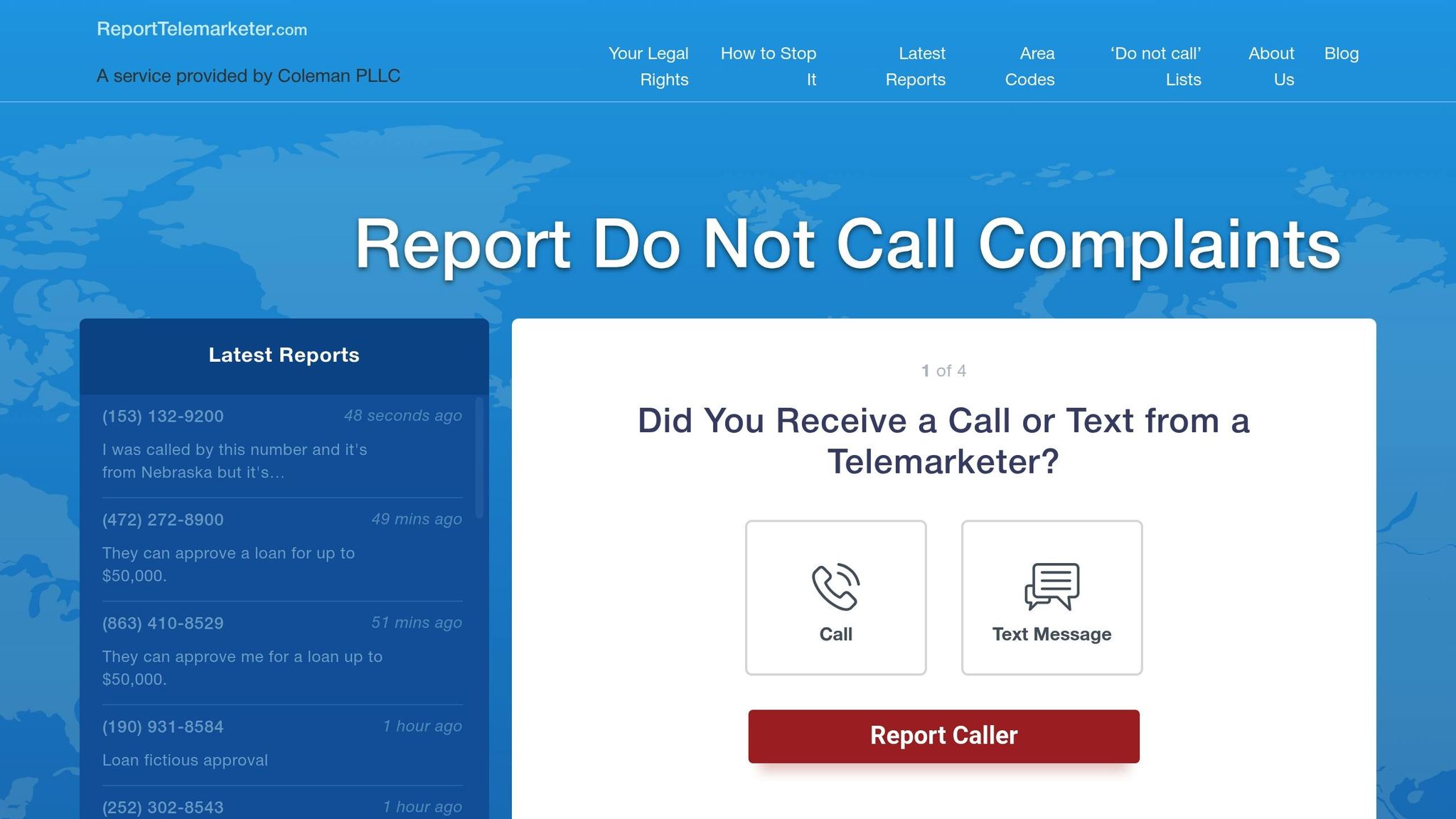
Platforms like ReportTelemarketer.com take reporting a step further by streamlining the process for consumers. When you report an unwanted call through their system, they gather key details – such as caller ID, callback numbers, and the timing of calls – to support cease-and-desist actions or formal complaints.
Beyond reporting, the platform assists in recovering damages under the TCPA. Consumers may be entitled to $500 per violation, with penalties rising to $1,500 for willful violations. This approach ensures violators are held accountable without requiring you to pay upfront legal fees.
Free and Accessible Solutions
Cost is often a barrier to taking action, but ReportTelemarketer.com eliminates that hurdle. Their services are completely free, operating on a contingency basis by recovering attorney fees from telemarketers when violations are proven. This means you get professional legal support without financial risk.
Additionally, free call-blocking tools from carriers like AT&T ActiveArmor, T-Mobile ScamShield, and Verizon Call Filter work in tandem with reporting services to combat the staggering 54.6 billion robocalls made to U.S. mobile phones in 2019. Together, these tools and platforms empower consumers to fight back against unwanted calls effectively.
Best Practices for Using TCPA-Supported Call-Blocking Tools
Steps to Enable Blocking and Monitor Calls
Start by activating call-blocking services offered by your phone carrier. Providers like AT&T (ActiveArmor), T-Mobile (ScamShield), and Verizon (Call Filter) offer tools – either free or at a low cost – that block calls from suspicious, unassigned, or "Do Not Originate" numbers automatically. Once carrier-level blocking is set up, you can strengthen your defense by tweaking your device’s settings.
For added protection, adjust your phone’s built-in features. If you’re using an iPhone, enable "Silence Unknown Callers." Samsung users can turn on "Smart Call", while Google Pixel devices offer "Call Screen", which answers calls automatically and provides live transcripts so you can decide whether to pick up. These tools work hand-in-hand with carrier services to filter out billions of unwanted calls each year. Together, they help enforce TCPA guidelines, keeping your phone safer from illegal telemarketing.
Another key step is registering your number with the National Do Not Call Registry at DoNotCall.gov or by calling 1-888-382-1222. While this won’t stop scammers, it helps distinguish illegal calls from legitimate ones. Plus, your registration stays active indefinitely unless your number is disconnected or reassigned.
Make it a habit to check your blocked call logs regularly. This ensures that important calls, like those from healthcare providers or emergency services, aren’t being filtered by mistake. To avoid missing critical messages, route blocked calls to voicemail so legitimate contacts can leave a message. Monitoring these logs also helps you spot patterns of persistent violations that might need further action.
Reporting Persistent Telemarketing Violations
If telemarketing calls persist despite blocking efforts, take steps to document and report Do Not Call violations. Keep a record of the caller’s number, caller ID, date, time, and whether the call was a robocall or from a live person. Also, note whether the call came to a landline or wireless phone, as TCPA rules differ for each.
Report these violations to the FCC at consumercomplaints.fcc.gov and the FTC at DoNotCall.gov. Your reports help improve call-blocking algorithms and support enforcement actions. The FTC shares reported numbers with carriers to refine their blocking tools, while the FCC uses complaint data to identify and penalize illegal campaigns. Businesses that violate the National Do Not Call Registry can face fines of up to $50,120 per call.
For ongoing issues, consider using platforms like ReportTelemarketer.com. They investigate complaints, send cease-and-desist letters, and file formal reports – all at no cost to you. Their legal team can document violations, which may entitle you to $500 per violation under the TCPA, with penalties rising to $1,500 for intentional violations. For example, in March 2021, the FCC issued a record-breaking fine for spoofed robocalls. By reporting violations, you play a part in holding offenders accountable.
Lastly, don’t press any buttons to "opt out" during a robocall. Doing so confirms your number is active and could lead to even more calls. Instead, hang up immediately and report the call through the appropriate channels.
Conclusion
The TCPA is the backbone of modern call-blocking tools, placing limits on autodialers and prerecorded messages, requiring prior express written consent, and empowering providers to block suspicious calls. Thanks to the FCC’s 2019 ruling, which allows analytics-based call blocking, providers now stop billions of unwanted calls each year.
This framework goes beyond just blocking calls – it also encourages active consumer participation through reporting. As the FCC highlights:
"The Enforcement Bureau relies on information and complaints from consumers to help us identify illegal robocall and robotext campaigns that bombard Americans with unwanted messages every year." – Federal Communications Commission
When you report unwanted calls, you’re not just helping yourself – you’re improving blocking algorithms and aiding enforcement efforts. Platforms like ReportTelemarketer.com extend these protections by investigating complaints and taking legal action, all at no cost to you. Together, TCPA-backed tools and consumer reporting form a strong defense that minimizes unwanted calls while preserving legitimate communication.
Take charge of your phone by enabling your carrier’s call-blocking services, signing up for the National Do Not Call Registry, and reporting persistent offenders. When technology and enforcement work hand in hand, you gain the power to control your communication and protect your privacy.
FAQs
Does TCPA let my phone carrier block spam calls automatically?
No, the TCPA doesn’t specifically give your phone carrier the authority to automatically block spam calls. However, phone companies offer FCC-supported call-blocking tools and services that can automatically block or flag unwanted calls, helping to protect consumers from spam.
What counts as “written consent” under the TCPA?
Under the TCPA (Telephone Consumer Protection Act), written consent means obtaining clear and explicit permission from the recipient before sending autodialed or prerecorded calls or texts, particularly for telemarketing purposes. This consent must be documented and granted ahead of time, ensuring the recipient fully understands and agrees to receive such communications.
How do I prove a robocall violated the TCPA?
To demonstrate that a robocall violated the TCPA, it’s important to keep track of specific details. Record the date, time, the caller’s number, and the content of the message – especially if it was automated or prerecorded. Make sure to save evidence showing the call was made without your explicit consent. Additional proof, like call logs or recordings, can be incredibly helpful. You can also file a complaint with the FCC or a consumer protection agency to bolster your case.

