
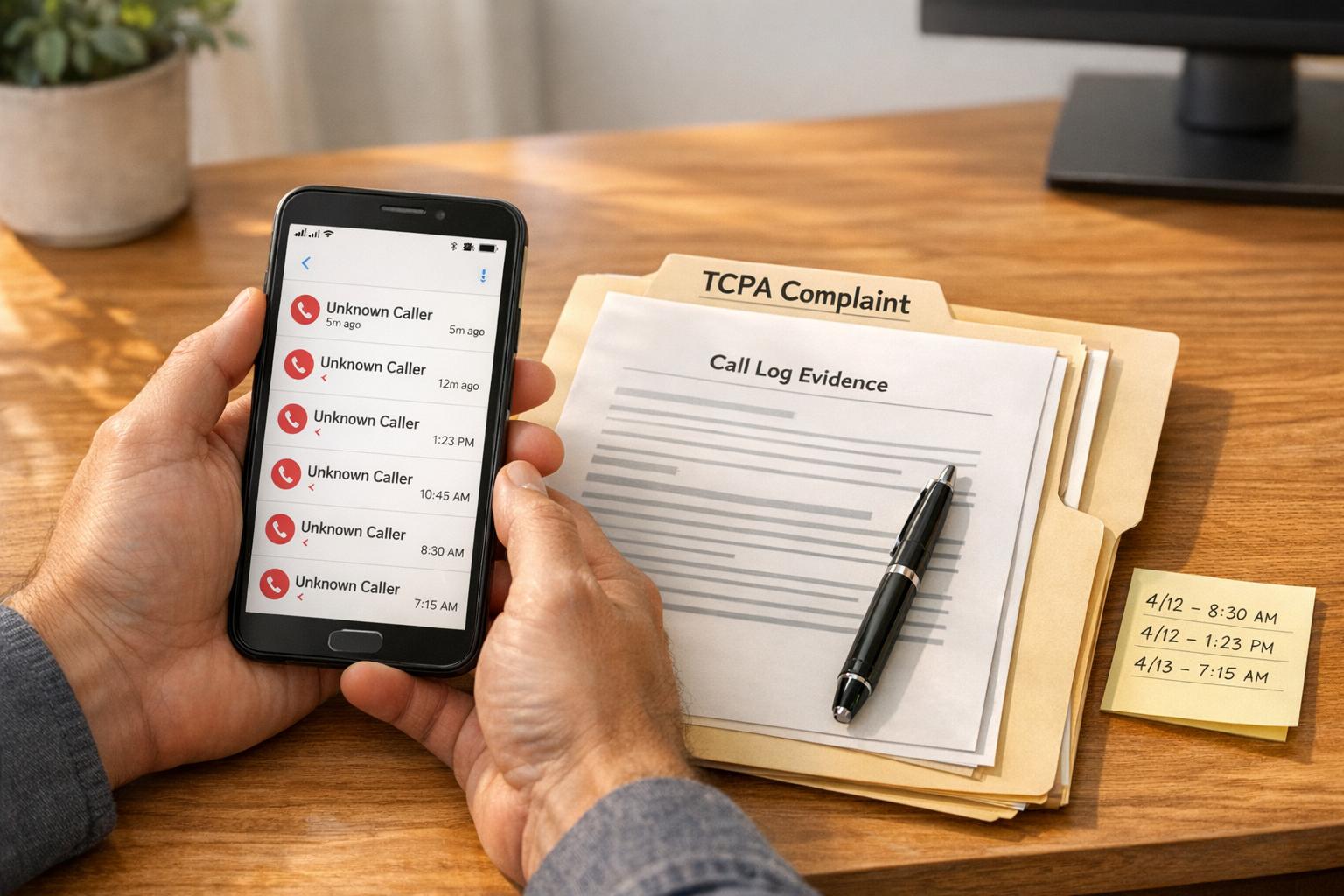
Spam calls can disrupt your life and mental health, but you have legal rights to fight back. Under the Telephone Consumer Protection Act (TCPA), you can seek compensation for each illegal call – $500 per violation or up to $1,500 for willful misconduct. Emotional distress claims are valid if the calls cause severe anxiety, insomnia, or other significant harm. Here’s what you need to know:
- Document Everything: Keep detailed logs of spam calls, including dates, times, caller IDs, and any messages or conversations.
- Track Emotional Impact: Maintain a journal of symptoms like stress or insomnia. Seek medical or mental health records to support your claim.
- Understand Your Rights: The TCPA prohibits calls using prerecorded voices, autodialers, or calls outside 8 a.m.–9 p.m. without consent.
- File Your Claim: Organize evidence, consult a lawyer, and decide whether to pursue an individual lawsuit or join a class action.
With proper documentation and legal support, you can hold telemarketers accountable and potentially receive compensation for the harm caused.
Legal Basis for Emotional Distress Claims
Defining Emotional Distress from Spam Calls
Emotional distress caused by spam calls goes beyond simple irritation – it’s a legally recognized harm that can qualify for compensation. Under the Telephone Consumer Protection Act (TCPA), emotional distress falls under "actual damages", which include non-economic harm stemming from unsolicited calls or texts. This harm can manifest as anxiety, depression, insomnia, chronic headaches, or other symptoms that interfere with your daily life. However, the distress must be severe enough to meet legal standards. Courts typically require evidence that the behavior was extreme and outrageous, exceeding what is considered acceptable. Examples include repeated calls targeting vulnerable individuals, late-night disturbances, or overly aggressive tactics. In some states, demonstrating physical symptoms like weight loss or ulcers can further strengthen your case. With these criteria in mind, the TCPA offers robust protections to make pursuing claims more straightforward.
TCPA Consumer Protections
The TCPA provides strong safeguards through its strict liability provisions. Essentially, this means that you don’t need to prove the caller intentionally broke the law or acted out of negligence. The simple act of making a prohibited call is enough to establish a violation, making it far easier for consumers to seek justice compared to traditional emotional distress lawsuits.
The law explicitly bans several practices, including marketing calls using artificial or prerecorded voices (such as AI-generated voices) without prior written consent, calls made outside the hours of 8 a.m. to 9 p.m. local time, and calls to numbers listed on the National Do Not Call Registry. In one notable case from March 2021, the FCC imposed a $225 million penalty on individuals responsible for spoofed robocalls falsely promoting health insurance. This action highlights the seriousness with which federal regulators approach these violations.
The TCPA’s primary goal is to minimize nuisance calls and safeguard your privacy. If you believe your rights under the TCPA have been violated, you have up to four years to file a lawsuit.
sbb-itb-a8d93e1
How to Document Spam Calls and Emotional Harm
To build a strong case, you need to clearly link repeated spam calls to the emotional distress you’ve experienced. Without this connection, even genuine suffering can be difficult to prove in court.
Logging Call Details
Start by keeping a detailed call log. You can use a notebook or a simple spreadsheet to track each spam call. For every call, record the following:
- Date and time of the call
- Phone number shown on your caller ID
- Name of the caller (if provided)
- Business name they claim to represent
- Any callback number or address they give
If you’ve asked the caller to stop contacting you, make sure to document the exact date and time you revoked consent. Save copies of any "STOP" text replies or written requests you sent to the caller.
Preserve all evidence – this includes voicemails, screenshots of spam text messages, and any other communication. These items can verify the caller’s identity and reveal if they used prohibited prerecorded or AI-generated voices. For live calls, jot down a brief summary of the conversation, including the nature of their solicitation.
Be on the lookout for timing violations. Calls made before 8:00 a.m. or after 9:00 p.m. in your local time zone are generally illegal under the Telephone Consumer Protection Act (TCPA). Mark these in your log. Also, note any delay between answering the call and the caller speaking, as this often points to the use of automated dialing systems. Use reliable tools to report unwanted spam calls and track these violations. Pair these detailed call records with notes on how the calls have impacted you personally to create a more compelling case.
Recording Emotional Impact
Proving emotional harm goes beyond simply stating that you felt upset. Keep a symptom journal to document specific effects like anxiety, insomnia, or depressive episodes after receiving spam calls. Emotional distress can be hard to prove without solid evidence, so thorough documentation is key.
Consider seeking help from mental health professionals, such as therapists or psychiatrists. They can provide formal diagnoses, treatment plans, and progress reports, which can serve as valuable evidence. Keep records of any prescriptions or evaluations – they carry significant weight when presenting your case. If the harassment has led to physical symptoms, such as stress-related headaches, heart issues, or skin conditions, visit a doctor to establish a medical link between these symptoms and the calls.
Also, document how the calls disrupt your daily life. For example, if they interfere with your work, keep records of lost productivity, reprimands from supervisors, or missed wages. Note how the harassment affects your sleep, relationships, or ability to carry out normal activities. This kind of evidence shows the depth of the harm, from career setbacks to strained personal connections, which courts often consider when evaluating emotional distress claims. This careful documentation will prepare you for the next steps in organizing your case.
Steps to File Your Claim
Once you’ve gathered your evidence, it’s time to take the necessary steps to file your claim and seek compensation for emotional distress.
Organizing Your Evidence
Start by creating a comprehensive file that ties together all the evidence linking the calls to your emotional and physical harm. Your formal complaint should clearly outline each violation of the TCPA. For instance, this could include calls made outside the allowed hours (before 8:00 a.m. or after 9:00 p.m.), instances of autodialers or prerecorded messages used without your consent, or calls made after you had revoked permission. Be sure to record the date and time of each incident.
Include all relevant documentation, such as call logs, voicemails, screenshots of text messages, and written notices revoking consent. If you requested the company’s Do Not Call policy and they failed to provide it, make note of that too – it counts as an additional violation. To support your claim of emotional distress, include medical records, therapy notes, or a journal documenting your symptoms. Attorney Steven Ellison explains:
"Generally speaking, emotional distress reaches the level of severe when no reasonable person should be expected to endure it".
Keep in mind that the statute of limitations for TCPA claims is generally four years. If you’re thinking about filing in small claims court for individual violations, many jurisdictions provide simplified forms that don’t require extensive legal knowledge.
Once your evidence is fully prepared, consulting with legal professionals can help you determine the best course of action.
Getting Legal Help
After organizing your evidence, decide whether to move forward independently or with legal assistance. Choosing the right attorney can make a big difference. Use resources like directories from the National Association of Consumer Advocates, the American Bar Association, or FindLaw to find attorneys experienced in consumer protection cases.
Many consumer protection lawyers offer free initial consultations and may work on a contingency basis, meaning their fees are covered only if you win your case. During your consultation, ask about their experience with emotional distress claims and whether they’ve handled similar cases, as the legal standards for these claims can vary widely depending on the state.
If you’d prefer not to hire an attorney right away, services like ReportTelemarketer.com can investigate telemarketing violations for free. They can file cease-and-desist letters or formal complaints on your behalf without any upfront costs. Attorney fees are later claimed from the telemarketers when applicable. This option is particularly useful if you’re unsure about pursuing a full lawsuit or simply want the calls to stop while keeping the option for damages open.
Legal professionals or consumer advocacy services can also help you determine whether your case is better suited for an individual lawsuit or as part of a class action. In 2024, the top 10 TCPA class action settlements reached a combined $84.73 million, with an average settlement of $6.6 million. If multiple consumers have experienced similar violations, a class action could be a practical and impactful route to consider.
The Claims Process and Potential Outcomes
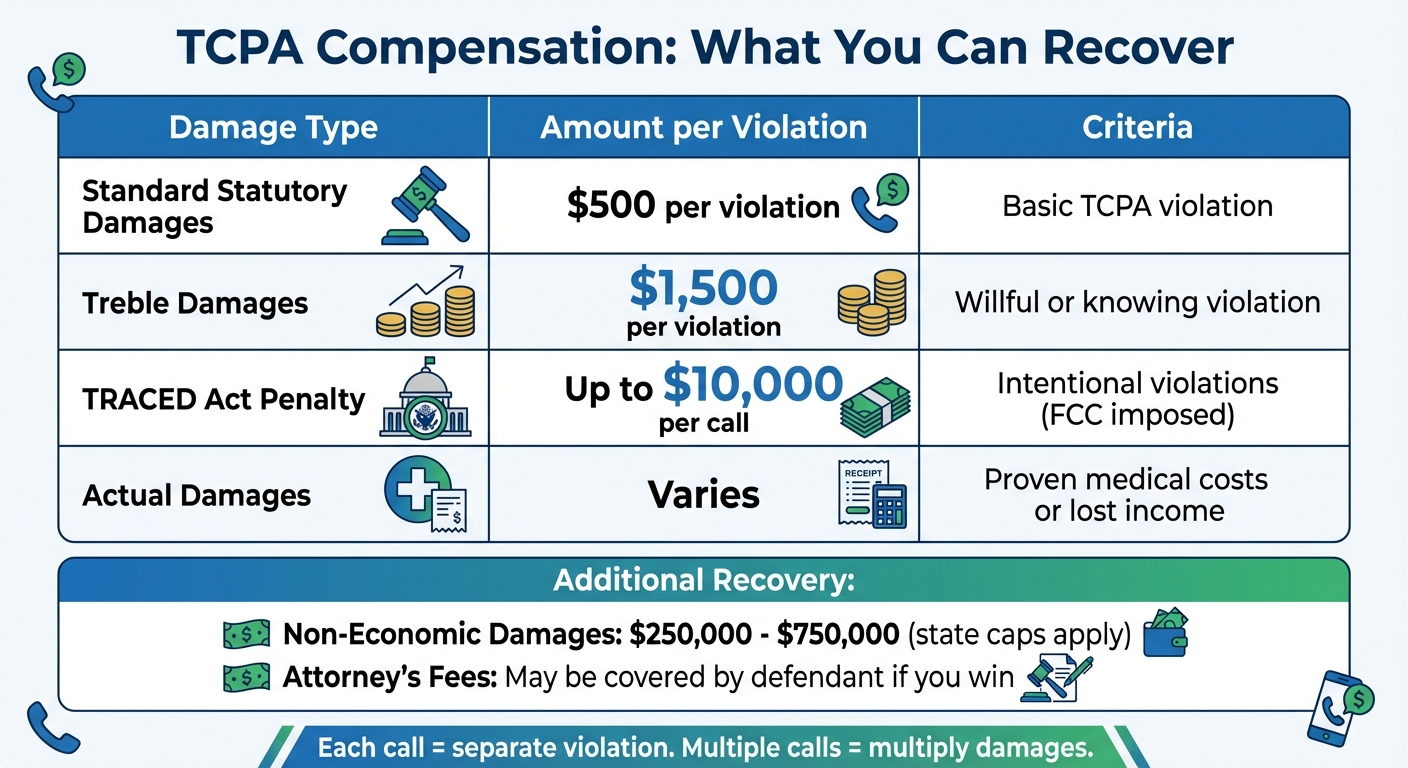
TCPA Compensation Amounts and Damage Types for Spam Call Violations
Legal Procedure Timeline
When your claim moves forward, understanding the steps involved becomes crucial. Claims can be filed in Federal District Court or pursued through FCC legal action. The process typically begins with the discovery phase, where both parties exchange evidence. During this stage, your attorney might subpoena carriers to trace spoofed or unidentified numbers.
After discovery, many cases lean toward settlement discussions rather than going to trial. To succeed, you’ll need to prove each part of your claim by a "preponderance of the evidence". For emotional distress claims, documentation showing severe harm is necessary. Keep in mind, this process can take time, so patience is key.
Most disputes are resolved without a trial, often through settlements or by joining class-action lawsuits. These lawsuits allow multiple victims to share a collective payout. For instance, the 2020 case Wakefield v. ViSalus, Inc. awarded $925 million to over 1.8 million victims of illegal prerecorded calls. Similarly, in 2021, Life Time Fitness agreed to a $15 million settlement for unsolicited telemarketing calls.
Compensation You Can Receive
Under the TCPA, compensation is designed to account for both the frequency and severity of violations. Statutory damages start at $500 per violation, with each call or text counting as a separate offense. If the court determines the violation was willful or knowing, these damages can increase to $1,500 per violation. Additionally, the TRACED Act allows the FCC to impose civil penalties of up to $10,000 per call for intentional violations.
In addition to statutory damages, you may recover actual damages for measurable financial losses. This could include medical expenses for stress-related conditions like anxiety or insomnia, lost wages, or even costs for call-blocking services. Non-economic damages, covering subjective losses such as mental anguish or reduced quality of life, may also be awarded. However, some states cap non-economic damages between $250,000 and $750,000. If your claim is successful, the defendant may also be required to pay your attorney’s fees.
| Damage Type | Amount per Violation | Criteria |
|---|---|---|
| Standard Statutory | $500 | TCPA violation |
| Treble Damages | $1,500 | Willful or knowing violation |
| TRACED Act Penalty | Up to $10,000 | Intentional violations (FCC imposed) |
| Actual Damages | Varies | Proven medical costs or lost income |
Next Steps
Taking action against spam calls not only safeguards your privacy and mental well-being but also helps you reclaim your legal rights while potentially earning compensation. Each lawsuit filed plays a role in holding telemarketers accountable. As attorney Laurence Banville, Esq., explains: "It’s shocking how common phone harassment is. Most people just live with the abusive calls or try to ignore them. We can help you fight back".
Start by registering your number on the National Do Not Call Registry. This step is straightforward, and within 31 days, legitimate sales calls should stop. Meanwhile, keep documenting unwanted calls as outlined earlier. When a telemarketer contacts you, make it clear that you want your number added to their internal do-not-call list and explicitly revoke any consent they may claim to have. Once your records are thorough, seek professional assistance to strengthen your case.
ReportTelemarketer.com is a helpful resource offering free legal support to combat illegal calls. This platform investigates telemarketers, identifies violations of consumer protection laws, and takes action – whether through cease and desist letters or formal complaints – to put an end to the harassment. Best of all, their services come at no upfront cost, with fees only applying if they win your case. With this kind of legal backing, you can confidently move forward in protecting your rights.
Don’t wait. Legal action is often the most effective way to stop phone harassment. Before proceeding, review the potential damages under the TCPA (Telephone Consumer Protection Act). Report violations to the FTC and FCC, and consult experienced TCPA attorneys to take immediate steps toward enforcing your rights.
FAQs
What proof do I need to show emotional distress caused by spam calls?
To prove emotional distress caused by spam calls, you’ll need solid evidence showing how these calls have affected your mental and emotional well-being. This could include personal stories about your experiences, medical or psychological records documenting anxiety or trauma, and, if relevant, expert opinions that back up your claims.
It’s important to establish a direct link between the spam calls and your emotional suffering. Keeping a detailed record of the calls – dates, times, and the nature of the interactions – can make your case stronger. Present your evidence in a clear and well-organized manner to effectively support your claim.
How can I find a lawyer to help with emotional distress claims for spam calls?
If you’re dealing with emotional distress caused by spam calls and want to pursue a claim under the TCPA (Telephone Consumer Protection Act), finding the right lawyer is key. Look for attorneys who focus on telemarketing law or personal injury cases, especially those with a track record in handling TCPA violations like unauthorized calls, harassment, or violations of do-not-call rules.
To start your search, check legal directories, reach out to your local bar association, or connect with consumer protection organizations for recommendations. Make sure the lawyer you choose understands both the emotional distress component of your case and the specific legal intricacies of the TCPA. This combination of expertise will give you the best chance of achieving a favorable outcome.
What’s the difference between filing an individual lawsuit and joining a class action for spam calls?
The key difference between an individual lawsuit and a class action for spam calls lies in the scale of the claim and how it’s managed.
Individual lawsuits are filed by one person seeking compensation for their own experience. For example, this could include emotional distress caused by repeated robocalls or telemarketing harassment. These cases focus solely on the harm done to that specific individual.
In contrast, class actions bring together a group of people who have faced similar violations, such as excessive robocalls or breaches of the Telephone Consumer Protection Act (TCPA). These lawsuits are ideal for addressing widespread issues and can lead to larger settlements or penalties against the telemarketer. That said, the compensation each person receives in a class action is often smaller than what might be awarded in an individual case.
Both approaches are valid under the TCPA, and the choice depends on whether you want to pursue your own claim or join others with a shared complaint.

