

Ohio Revised Code 109.87 enforces federal telemarketing laws in Ohio, holding telemarketers accountable for illegal practices like robocalls, misleading sales tactics, and unsolicited texts. Violators face fines of $500 per offense, or $1,500 if intentional, with enforcement led by the Ohio Attorney General. The law, updated in 2022, also applies to modern communication methods like VoIP and texts. Consumers can report violations to the Attorney General or platforms like ReportTelemarketer.com for support. Telemarketers must comply with strict rules, including clear caller ID, consent for robocalls, and limited call hours (8:00 a.m. to 9:00 p.m.). This protects Ohio residents from deceptive practices while ensuring telemarketing transparency.
Ohioans demand spam, scam and robocalls stop
sbb-itb-a8d93e1
What Ohio Revised Code Section 109.87 Covers
Ohio Revised Code Section 109.87 brings federal telemarketing laws into Ohio’s legal framework, allowing the state to enforce these rules. It specifies:
"No seller or telemarketer shall engage in any act or practice in violation of any provision of a federal act or rule."
This means that violating federal telemarketing laws also constitutes a breach of Ohio law. The section ensures consistency by adopting the same definitions as the federal statutes. This alignment helps eliminate ambiguity about what actions are permitted or prohibited.
Banned Telemarketing Practices
The law outlines several actions that telemarketers are strictly prohibited from doing. For instance, telemarketers are required to:
- Display accurate caller ID information.
- Restrict their calls to the hours of 8:00 a.m. to 9:00 p.m.
- Avoid using robocalls or prerecorded messages without prior written consent .
Additionally, telemarketers cannot request unconventional payment methods like MoneyGram or Western Union, nor can they withdraw funds without explicit consent. Misleading consumers about terms, products, or their registration status to secure a sale is also illegal.
During the first 60 seconds of any call, telemarketers must clearly state their real name, the company they represent, and the purpose of the call. Sending unsolicited ads via text messages, faxes, or emails without prior approval is another prohibited practice.
These rules apply to all forms of communication used in telemarketing, ensuring comprehensive consumer protection.
Types of Communication Regulated
Section 109.87 applies to a variety of telecommunication methods, including landline calls, cellphone calls, text messages, faxes, and automated or prerecorded messages (robocalls). Whether a telemarketer uses live calls or automated systems, the same rules apply. This broad coverage prevents companies from sidestepping the law by simply switching communication methods. By encompassing all these forms of contact, the statute ensures that telemarketing practices remain accountable under the federal regulations adopted by Ohio.
Penalties and How the Law Is Enforced
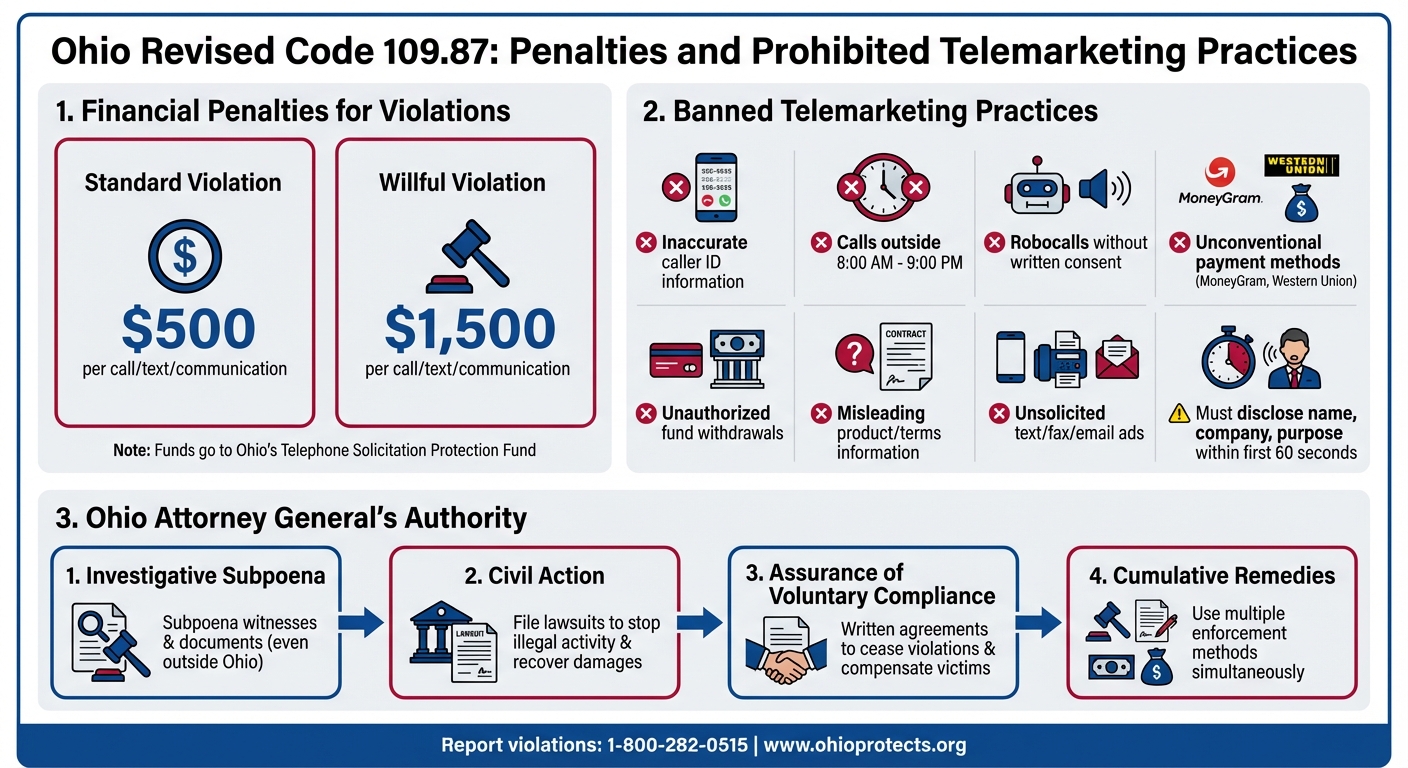
Ohio Telemarketing Law Violations: Penalties and Prohibited Practices Under ORC 109.87
Telemarketers who break Ohio Revised Code Section 109.87 face financial penalties and potential legal action from the Ohio Attorney General. These measures aim to discourage illegal practices and provide compensation to affected consumers.
Fines for Breaking the Law
Violators can be fined $500 per call, text, or other prohibited communication, with the penalty increasing to $1,500 for willful violations. The money collected from these civil penalties goes into Ohio’s "telephone solicitation protection fund", which is used to support enforcement efforts.
The Ohio Attorney General‘s Enforcement Powers
The Ohio Attorney General plays a central role in enforcing these laws. Through the Telemarketing Registration and Enforcement Unit within the Consumer Protection Section, the Attorney General ensures compliance and addresses violations. This includes the authority to gather evidence, such as call records, scripts, or financial documents, and to subpoena witnesses. As outlined in the statute:
"For purposes of an investigation… the attorney general may administer oaths, subpoena witnesses, adduce evidence, and require the production of any relevant matter."
The Attorney General can also take legal action in state or federal courts to stop illegal practices or recover damages for affected Ohio residents. Before filing a lawsuit, violators may be offered an Assurance of Voluntary Compliance, a written agreement requiring them to stop the illegal behavior and, in some cases, reimburse consumers. However, the Attorney General cannot pursue state-level action if the Federal Trade Commission (FTC) or Federal Communications Commission (FCC) has already acted on the same issue.
| Enforcement Power | Description |
|---|---|
| Investigative Subpoena | Authority to subpoena witnesses and documents, even outside Ohio |
| Civil Action | Ability to file lawsuits to stop illegal telemarketing or recover damages |
| Assurance of Voluntary Compliance | Agreement requiring violators to stop illegal activity and, potentially, compensate victims |
| Cumulative Remedies | The option to use multiple enforcement methods simultaneously |
If consumers experience violations, they can report them to the Ohio Attorney General’s Office by calling 1-800-282-0515 or visiting www.ohioprotects.org. To strengthen their complaint, consumers should note details such as the date, time, caller’s name, and the phone number displayed during the violation.
How Consumers Are Protected
Ohio law goes beyond enforcement actions by offering consumers strong legal tools to protect themselves.
Classification as Unfair or Deceptive Trade Practices
Under the Ohio Consumer Sales Practices Act (CSPA), specifically Section 1345.02, any violation of Section 109.87 is considered an unfair or deceptive trade practice. This classification gives consumers the ability to take legal action on their own. They can seek damages, request declaratory judgments, and even recover attorney’s fees. This is in addition to any enforcement actions taken by the Attorney General.
How This Law Works with Federal Regulations
Section 109.87 aligns with federal laws like the Telephone Consumer Protection Act (TCPA) and the Telemarketing and Consumer Fraud and Abuse Prevention Act. By prohibiting practices that violate these federal standards, Ohio ensures that any breach of federal law also violates state law. This dual approach provides Ohio consumers with an extra layer of protection, combining federal safeguards with the state’s enforcement efforts. Additionally, services like ReportTelemarketer.com enhance these protections by offering practical tools to address illegal calls.
Using ReportTelemarketer.com to Stop Illegal Calls
For consumers dealing with unwanted telemarketing calls, ReportTelemarketer.com (https://reporttelemarketer.com) offers a simple and effective solution. This free service investigates telemarketers and identifies violations of laws like Section 109.87. Once a violation is confirmed, the platform takes action by sending cease and desist letters or filing formal complaints – all at no cost to the consumer. If legal action is needed, their legal team works to recover attorney’s fees directly from the telemarketers, ensuring the process remains affordable. This service works alongside the Ohio Attorney General’s Office, giving consumers professional legal support to enforce their rights under both state and federal laws.
Conclusion
Ohio Revised Code Section 109.87 lays out firm safeguards to protect consumers from illegal telemarketing practices. By aligning with federal laws like the Telephone Consumer Protection Act and the Telemarketing and Consumer Fraud and Abuse Prevention Act, Ohio strengthens its ability to regulate voice calls, text messages, and fax transmissions. This dual enforcement approach helps close potential loopholes and provides a solid legal foundation for consumer protection.
The Ohio Attorney General plays a key role in enforcing these rules, with the authority to issue subpoenas and take civil action against violators. Penalties collected from these actions contribute to the Telemarketing Fraud Enforcement Fund, ensuring continued efforts to combat telemarketing fraud.
If you’re dealing with unwanted calls, understanding your rights under Section 109.87 is crucial. You can report violations directly to the Ohio Attorney General’s Office at www.ohioprotects.org or by calling 1-800-282-0515. Additionally, ReportTelemarketer.com offers free support in investigating telemarketing violations. Their legal team handles everything from cease-and-desist letters to formal complaints, recovering attorney fees from violators without charging consumers.
Whether you’re a consumer aiming to stop intrusive calls or a telemarketer ensuring compliance, Section 109.87 sets clear boundaries and enforces meaningful consequences. Alongside the Ohio Consumer Sales Practices Act and accessible reporting tools, this law provides a robust framework where consumers can take action and violators face accountability.
FAQs
Does Ohio Revised Code 109.87 apply to texts and VoIP calls?
Ohio Revised Code 109.87 focuses on real-time, two-way voice communications, which include systems requiring internet protocol-compatible devices. However, the law does not specifically cover text messages or VoIP calls.
What proof should I save before reporting a telemarketing violation?
When dealing with potential violations, it’s crucial to gather and preserve evidence. This could include items like call recordings, call logs, or any relevant documentation that highlights the issue. These materials can play a key role in backing up your report and ensuring the matter is investigated thoroughly.
Can I sue a telemarketer myself under Ohio law?
Yes, under Ohio law, you can take legal action against a telemarketer if they violate federal telemarketing regulations, like the Telephone Consumer Protection Act (TCPA). The TCPA gives individuals the right to pursue damages and hold telemarketers accountable for illegal practices.

