
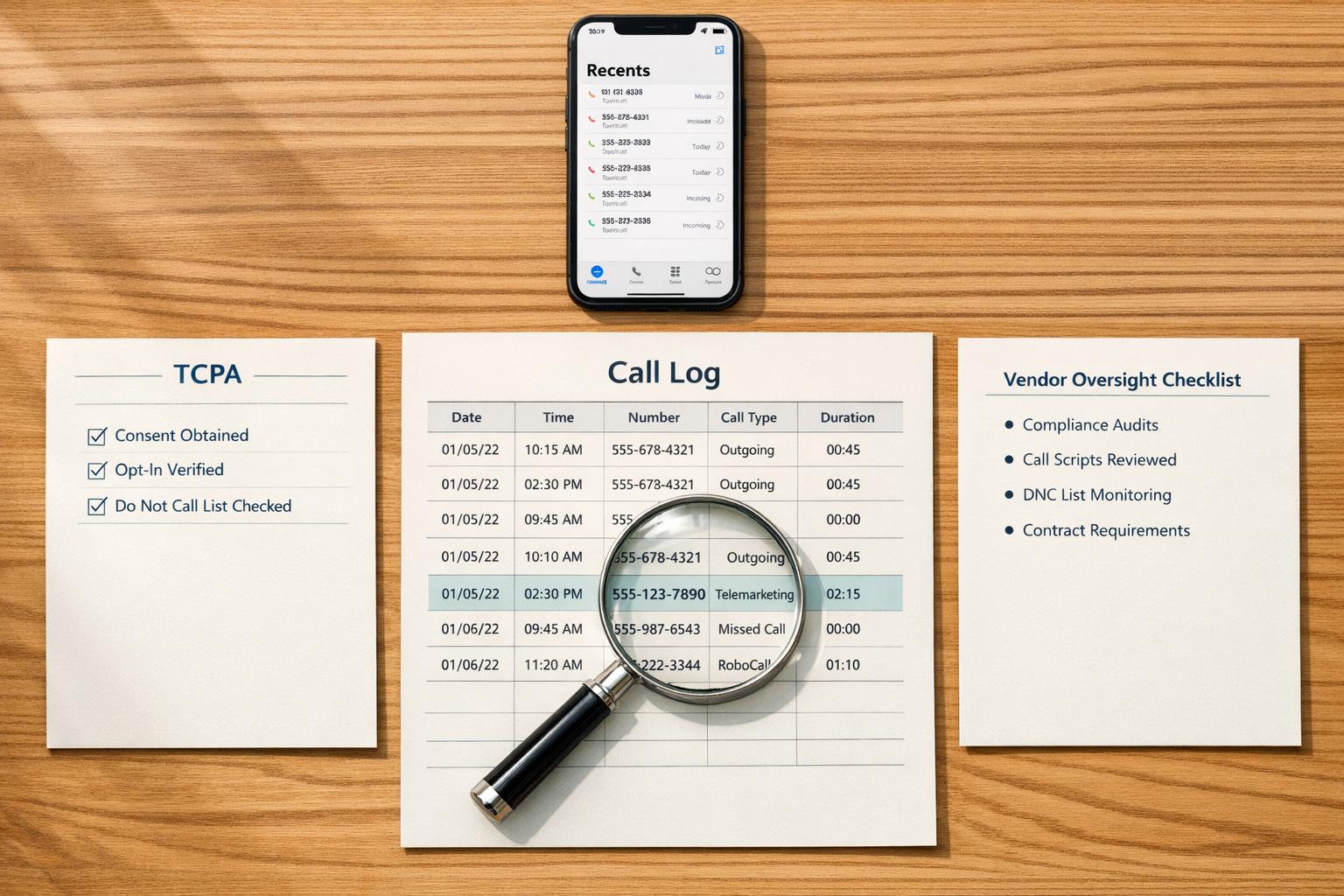
The Telephone Consumer Protection Act (TCPA) sets strict rules for telemarketing, requiring businesses to secure consent before making automated calls or sending prerecorded messages. Recent court cases have clarified how evidence must be presented in TCPA claims, focusing on detailed documentation and compliance with evolving standards. Here’s what you need to know:
- Clear Evidence Is Key: Courts demand proof of violations, such as report unwanted phone calls with call logs, consent records, and consumer statements.
- Consent Rules Are Changing: Some states now accept oral consent for telemarketing, but documentation is critical.
- Vendor Oversight Matters: Companies are held responsible for third-party telemarketing violations.
- Recent Cases: Notable settlements include Truist Bank ($4.1M) and SiriusXM ($28M), highlighting the cost of non-compliance.
Proper documentation, including call logs and consent records, is essential to succeed in TCPA cases. Courts now require more precise evidence, making it crucial for businesses and consumers to stay informed about these evolving rules.
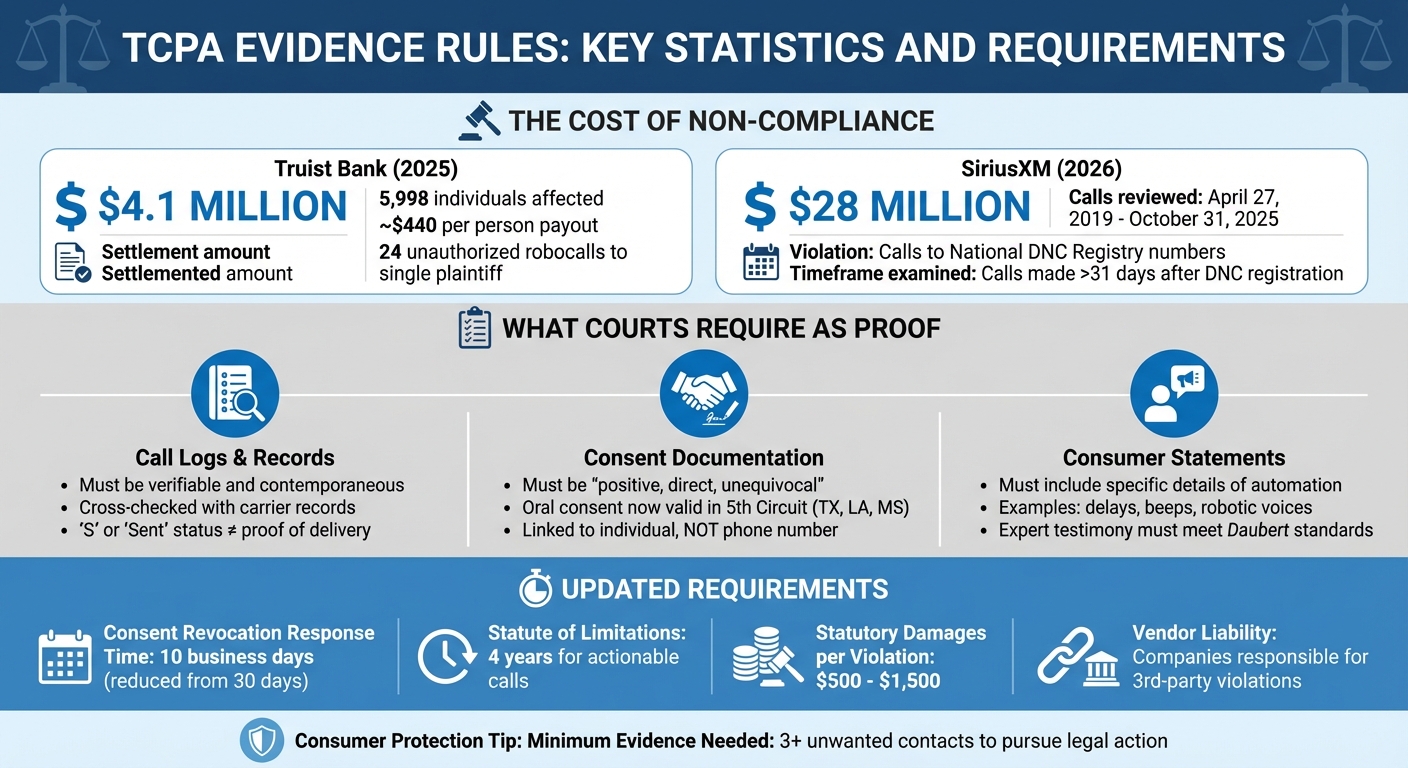
TCPA Settlement Amounts and Key Evidence Requirements for Telemarketing Compliance
Recent Court Cases Defining TCPA Evidence Standards
Truong, et al. v. Truist Bank (2025)
Recent court decisions have shed light on how evidence standards are evolving under the Telephone Consumer Protection Act (TCPA). One notable case is Truong, et al. v. Truist Bank. In May 2025, Truist Bank agreed to a $4.1 million settlement in a class-action lawsuit after Kevin Truong, a Texas resident, received 24 unauthorized robocalls on his cellphone. The prerecorded calls were intended for a Truist account holder, but Truong had no connection to the bank and had not given consent to be contacted.
The settlement covered about 5,998 individuals, with each receiving approximately $440 without needing to file a claim. This case emphasized a key legal principle: consent is linked to a specific individual, not just a phone number. If a company contacts someone who did not provide consent – even if the number was in their customer database – this constitutes a violation. Using outdated records or recycled phone numbers is not a valid defense. As Kara Urbaniak, a Marketing Compliance Expert at CompliancePoint, explained:
"Consent is tied to an individual, not a phone number. In other words, mistaken identities or outdated records do not equal consent."
This ruling underscores the importance of maintaining detailed, verifiable records of consent, including when, how, and from whom it was obtained. Additionally, companies must have systems in place to track whether phone numbers have been reassigned.
SiriusXM TCPA Class Action Settlement (2026)

Another significant case is Campbell et al. v. Sirius XM Radio, Inc., which resulted in a $28 million preliminary settlement in November 2025. The lawsuit alleged that Sirius XM made illegal telemarketing calls to individuals listed on the National Do Not Call (DNC) Registry and its internal do-not-call lists. The case reviewed calls made between April 27, 2019, and October 31, 2025, and class membership required proof of receiving more than one telemarketing call within a 12-month period.
This settlement highlighted several critical compliance issues. For instance, calls made more than 31 days after a number was added to the National DNC Registry were closely examined. Furthermore, some class members demonstrated that they had explicitly requested the calls to stop but were still contacted. As part of the settlement, Sirius XM agreed to adopt new practices to improve oversight of its telemarketing vendors, emphasizing that companies cannot escape liability by outsourcing their telemarketing activities. According to ClassAction.org:
"Sirius XM has agreed to implement certain business practices to ensure clear communication with its customers and third-party telemarketing vendors regarding its phone call policies to better comply with state and federal laws."
This case serves as a reminder that vendor oversight is critical, and companies must ensure third-party vendors follow all applicable laws.
What These Cases Teach About Evidence Requirements
The rulings in these cases illustrate the increasingly high standards for evidence in TCPA claims. Courts now demand detailed, contemporaneous documentation to support claims of consent or violations. Self-serving affidavits or after-the-fact screenshots are no longer sufficient. Instead, companies must provide records created at the time of the alleged consent or violation.
Additionally, these cases highlight the importance of actively managing relationships with third-party vendors. Outsourcing telemarketing efforts does not shield companies from liability, making thorough oversight and compliance monitoring essential.
sbb-itb-a8d93e1
Types of Evidence Courts Require in TCPA Cases
Call Logs and Marketing Records
Call logs and marketing records play an essential role in TCPA cases, but courts expect these records to be reliable and verifiable. Dialer systems often include statuses like "Sent" or "S", but these don’t necessarily prove a call was successfully completed. As Eric J. Troutman of Troutman Amin, LLP explains:
"Dispositions from a dialer system may mean anything from a number was eligible to be dialed… to the data was transmitted to a handset answered but the call dropped before a response."
In the July 2024 case Lyngaass v. Icvia, a Pennsylvania court dismissed expert testimony about fax transmission logs after the expert admitted that an "S" disposition could result in "false positive reporting", meaning the log might show success when the transmission actually failed. Courts frequently cross-check a defendant’s internal call logs with subpoenaed records from a plaintiff’s carrier to uncover inconsistencies.
Service agreements and contracts are equally important, as they can confirm when a consumer provided their phone number and agreed to be contacted. Companies should also retain documentation of their procedures, such as "screen pops" that prompt agents to deliver required disclosures during calls. According to Troutman:
"One of the most important pieces of evidence in any case for a TCPA defendant is evidence of their policies and procedures."
Consent Documentation
Reliable consent documentation carries as much weight as accurate call logs. Courts interpret "express consent" as being "positive, direct, unequivocal", leaving no room for assumptions or inferences. A notable shift occurred in February 2026 when the Fifth Circuit ruled in Bradford v. Sovereign Pest Control of TX, Inc. that oral consent is valid for telemarketing calls in Texas, Louisiana, and Mississippi. This ruling diverged from the FCC’s earlier stance, which required written consent.
In the Bradford case, Radley Bradford gave his cellphone number in a service agreement and acknowledged its use for contact. Over the years, he accepted prerecorded calls to schedule inspections and renewed his service plan without raising objections. The Fifth Circuit concluded these actions signified valid consent, even without written proof. Chief Judge Jennifer Walker Elrod stated:
"The statute provides no basis for concluding that telemarketing calls require prior express written consent but not oral consent."
However, legal experts warn that oral consent must be rigorously documented to stand up to scrutiny. Paul Bond and Kristen N. Ricci of Holland & Knight advise:
"Where consent is obtained orally, it should be carefully documented and independently verifiable to withstand future scrutiny."
To ensure compliance, companies should record the context in which a number was provided, clearly noting explicit consent for contact. It’s worth noting that some federal circuits still require written consent, and state-specific laws, such as those in Texas, may impose additional requirements.
Consumer Statements and Expert Testimony
In addition to documented records, consumer observations and expert analysis are crucial in building a strong TCPA defense. Consumer statements should include specific details that point to automation rather than vague accusations. Blake Landis of Troutman Amin, LLP explains:
"A complaint must do more than simply parrot the definition of ATDS when bringing a claim… specific facts suggesting ATDS use might include delays before hearing messages, calls ending with beeps, instructions to call 1-800 numbers, unusual phone numbers, or robotic voices."
Expert testimony is vital for interpreting call logs and identifying class members, but it must meet strict Daubert standards to ensure reliability. For instance, in the August 2025 case Davis v. Capital One, N.A., the Fourth Circuit rejected a plaintiff’s expert who used the Reassigned Number Database and third-party data to identify non-customers, citing unreliable methodology. When the defendant’s expert analyzed a sample of 5,000 numbers, it turned out that 75% of individuals labeled as "non-customers" were actually customers.
Defendants can also use expert testimony to challenge the accuracy of dialer data. Reports labeled "Sent" often don’t account for carrier blocks, dropped calls, or network issues. As Troutman points out:
"The data sets in a defendant’s possession are generally unreliable to show what really happened on the physical handset from a class member. This is something for TCPA defendants to keep in mind. Never just concede that events in a call log are as supposedly reflected."
How to Protect Your Rights as a Consumer
Recording Telemarketing Communications
Start protecting yourself by keeping detailed records that meet the updated evidence standards required by the Telephone Consumer Protection Act (TCPA). Courts now expect clear documentation showing who called, when they called, and why the call might violate the law. As Abrams Justice Trial Attorneys put it:
"Documentation transforms your frustration into clear, actionable evidence. It’s the difference between feeling powerless and taking control."
To stay organized, create a dedicated call log. This could be a simple spreadsheet or a note on your phone. Record key details like the date, time, caller ID, and whether the call involved a live person or an automated message. Pay attention to signs of an automated dialing system, such as delays, beeps, or robotic voices. Blake Landis of Troutman Amin, LLP highlights that complaints must be specific, not vague, to hold up in court.
Visual and audio proof can make a big difference. Take screenshots of your call history and text message threads as soon as possible. Save voicemails by forwarding them to your email or uploading them to a secure cloud service. A key case, Frato v. Cap. Mgmt. Servs. L.P. (January 2025), showed how critical documentation is. The plaintiff’s case was dismissed because it relied on assumptions rather than solid evidence of automated calls.
If you revoke consent, make sure to document it. Screenshot any "STOP" replies you send to text messages and note the exact time and date you verbally ask a caller to stop contacting you. In Gilleland v. Express Scripts, Inc. (September 2025), the plaintiff’s testimony about revoking consent created enough doubt to keep the case moving forward, even though the company’s records didn’t reflect a "Do Not Call" request. Also, registering your number on the National Do Not Call Registry and saving the confirmation email adds another layer of proof.
Identifying the source of the calls can get tricky, especially when telemarketers use spoofed numbers or third-party call centers. Consumer advocate Peter Schneider of Northwest Debt Resolution, LLC advises briefly engaging with the sales pitch to figure out which company is behind the call. He explains:
"In court, the side with recordings has the upper hand. No defense attorney has ever said, ‘Who are you going to believe, me or your lying ears?’"
If you live in a state where all-party consent is required for recording, simply starting the call with "This is a recorded line" can provide the necessary legal notice.
Once you’ve gathered strong evidence, you can take the next step by seeking expert help.
Getting Help from ReportTelemarketer.com
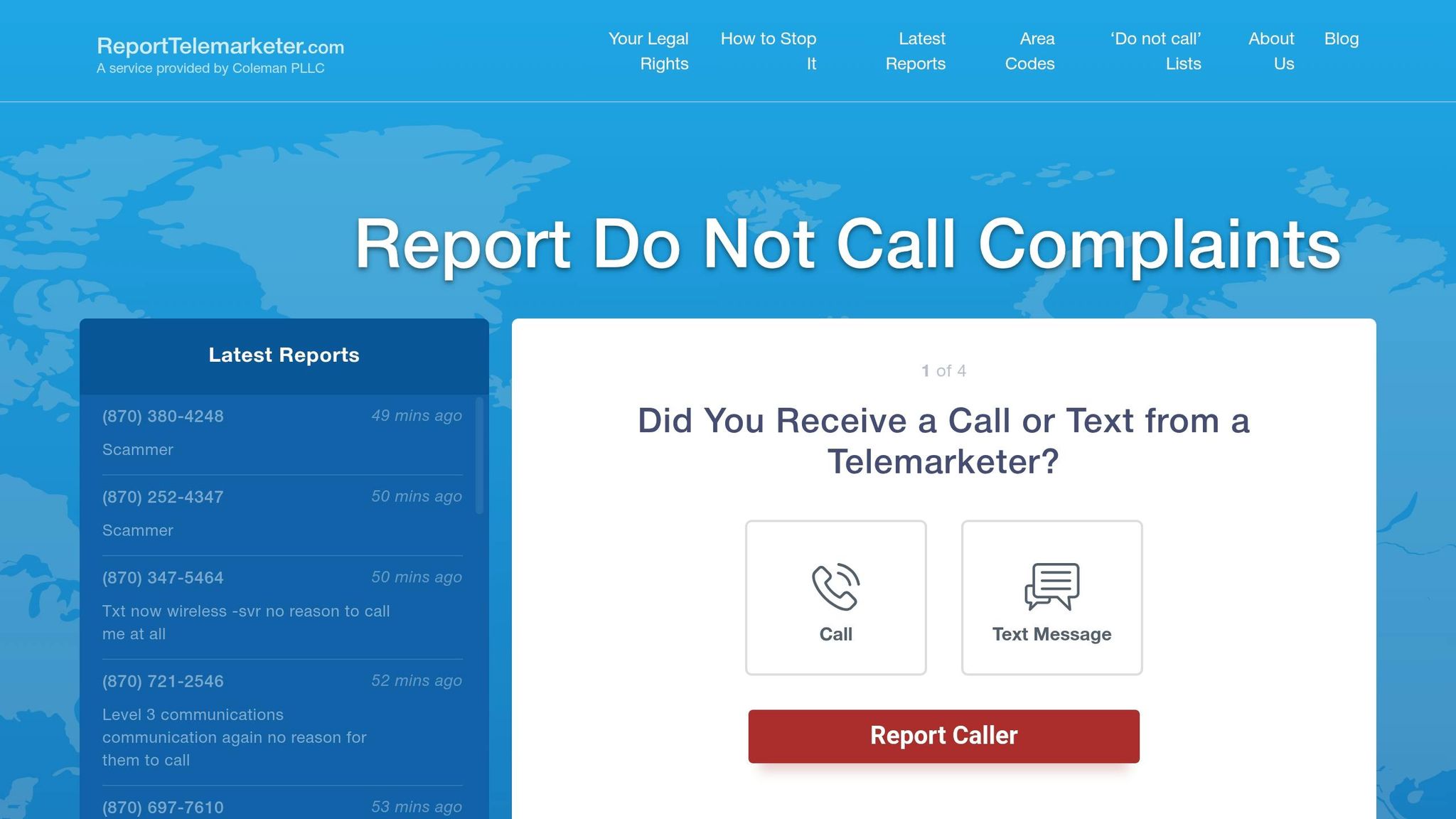
After documenting a pattern of unwanted calls or texts, professional services can help you take action. Attorneys often require evidence of at least three unwanted contacts before moving forward with a case. These claims can lead to significant financial penalties for violators.
ReportTelemarketer.com (https://reporttelemarketer.com) offers a free service to investigate telemarketers and work to stop the calls. Using advanced tools, the platform identifies violations – even when callers use spoofed numbers or offshore call centers – and handles cease and desist letters or formal complaints for you. By presenting the evidence you’ve carefully collected, the service ensures your case meets the strict standards courts now expect.
The best part? There are no upfront costs for consumers. Attorneys claim their fees from the telemarketers when applicable, meaning you can pursue legal action without financial worry. The platform’s legal team is well-versed in navigating the complex demands of TCPA cases.
Additionally, ReportTelemarketer.com makes information about reported telemarketers publicly available. This helps other consumers identify problematic callers while keeping your personal details private. The site also provides educational resources to help you understand telemarketing laws and your rights, making it easier to build a strong case. By reporting violations, you’re not just protecting yourself – you’re also helping combat illegal telemarketing practices on a larger scale.
TCPA Compliance and Litigation Update
Conclusion: Changes in TCPA Evidence Rules
Recent court rulings have raised the bar for proving claims under the TCPA. General or vague accusations are no longer enough – courts now require clear evidence of automation. Blake Landis of Troutman Amin, LLP sums it up perfectly:
"If you bring a TCPA claim, you better come with receipts – because courts aren’t letting cases slide on vague allegations."
This shift isn’t just about evidence. Courts are also rethinking how traditional defenses are handled. For instance, district courts are no longer consistently aligning with FCC interpretations, which has led to varying standards across the country. In the Fifth Circuit (covering Texas, Louisiana, and Mississippi), oral consent is now considered valid for telemarketing calls, even without written agreements. Additionally, businesses must now act faster when consent is revoked, removing consumers from contact lists within 10 business days instead of the previous 30-day timeframe. These updates underscore how crucial it is to meet the stricter evidence standards now required.
Proper documentation has never been more important. Each unsolicited call could result in statutory damages ranging from $500 to $1,500, and with the TCPA’s four-year statute of limitations, any calls within that window could be actionable. Keeping detailed records – such as call logs, screenshots, and recordings – can make or break a case.
If you’ve documented violations, platforms like ReportTelemarketer.com (https://reporttelemarketer.com) can assist in meeting these new requirements. They handle everything from investigations to filing formal complaints, with no upfront cost. By acting, you’re not just protecting yourself – you’re also helping to reduce illegal telemarketing practices that impact millions of people across the U.S. These changes highlight the importance of strong evidence and professional guidance in navigating the evolving TCPA landscape.
FAQs
What evidence do I need to prove a TCPA robocall violation?
To establish a TCPA robocall violation, you need solid evidence that proves the use of an automated dialing system (ATDS) or a prerecorded voice. General claims or assumptions won’t cut it – courts demand concrete, factual details that clearly show the calls were made using an ATDS as outlined by law. Stick to specifics and avoid vague accusations to strengthen your case.
Does giving my phone number mean I consented to telemarketing calls?
Recent court decisions, including one by the Fifth Circuit, indicate that simply providing your phone number might be interpreted as oral or implied consent for telemarketing calls under the TCPA. This marks a shift, as written consent is no longer always mandatory. However, the context of each situation plays a big role in how consent is evaluated and understood.
How can I document and report unwanted calls so my evidence holds up in court?
To build a strong case in court, it’s crucial to keep detailed records of every unwanted call. Make note of the date, time, and phone number for each instance. If it’s permitted in your region, recording these calls can provide additional support. Save any related texts or emails as well, and document every time you’ve asked the telemarketer to stop contacting you. Courts need clear and solid evidence, so thorough documentation is key.

