
When it comes to stopping unwanted marketing communications, revocation of consent and opt-out are two distinct processes governed by different laws. Here’s what you need to know:
- Revocation of Consent: This applies when you’ve previously given permission for automated calls or texts and now want to withdraw it. Under the TCPA, you can revoke consent using any reasonable method (e.g., texting "STOP", emailing, or calling). Businesses must honor the request within 10 business days.
- Opt-Out: This applies when businesses contact you by default or share your data unless you actively stop them. Examples include unsubscribing from emails under the CAN-SPAM Act or using the "Do Not Sell My Personal Information" link under the CCPA. Methods are often more standardized and vary by regulation.
Key Differences:
- Legal Basis: Revocation is governed by the TCPA and FCC, while opt-out falls under laws like the CCPA and CAN-SPAM.
- Scope: Revocation focuses on automated marketing communications, while opt-out can apply to broader data use or telemarketing.
- Methods: Revocation allows for flexible methods, while opt-out often involves specific steps like clicking links or registering on a list.
Both processes empower you to control your privacy but operate under separate rules. Businesses must comply with these regulations or face hefty fines.
Revocation of Consent vs Opt-Out: Key Differences and Requirements
Main Differences Between Revocation of Consent and Opt-Out
Legal Basis and Regulatory Framework
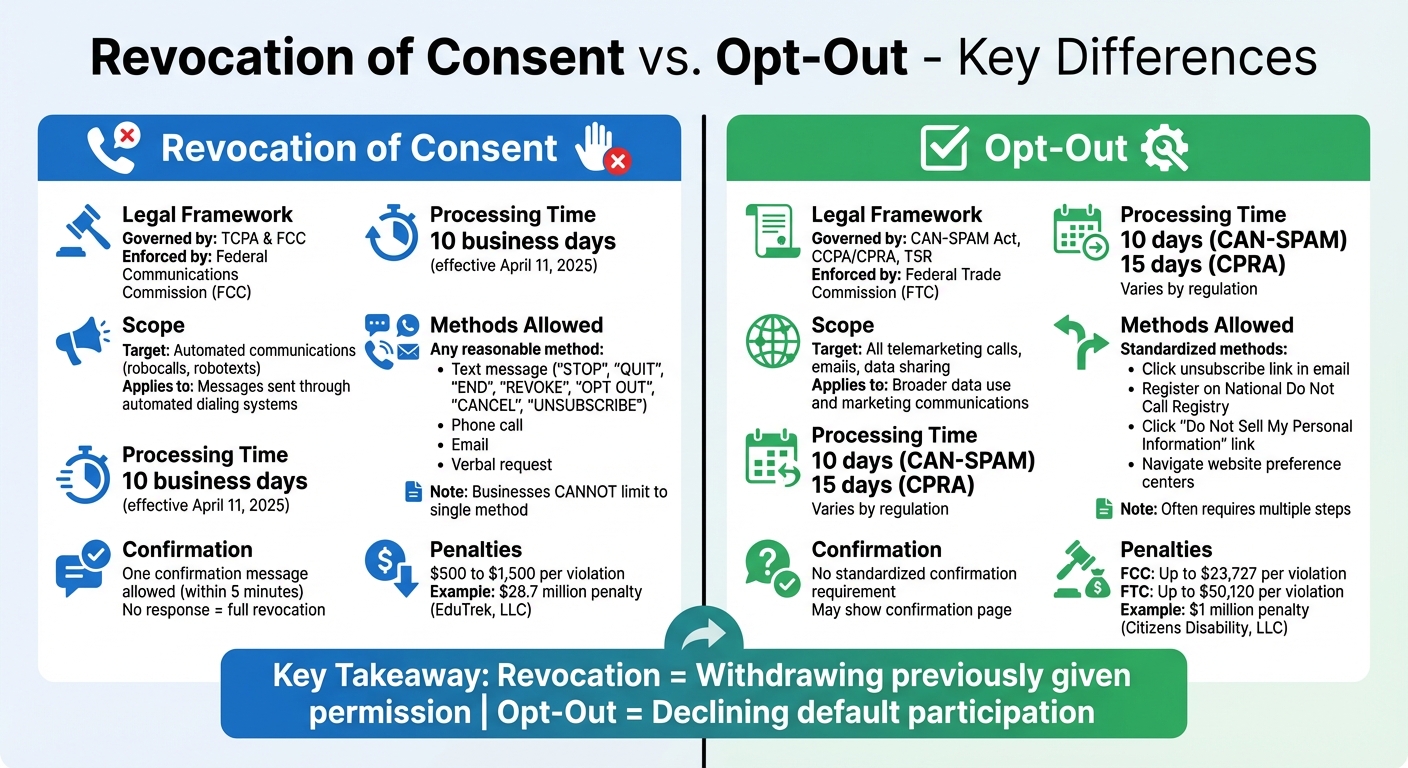
The legal rules surrounding revocation of consent and opt-out processes are distinct and governed by different regulations. Revocation of consent falls under the Telephone Consumer Protection Act (TCPA) and is enforced by the Federal Communications Commission (FCC). Starting April 11, 2025, the FCC will require companies to process revocation requests within 10 business days, down from the previous 30-day window.
On the other hand, opt-out mechanisms are regulated by the Federal Trade Commission (FTC) under the Telemarketing Sales Rule (TSR) and the National Do Not Call Registry.
A key difference lies in how requests are handled. Under FCC rules, companies must accept revocation requests through any reasonable method – whether it’s a verbal request, text message, or email. As Rebecca Ellen Nelson, Associate at BCLP, explains:
Revocation extends to both robocalls and robotexts regardless of the medium used to communicate the revocation of consent.
In contrast, opt-out processes often require consumers to use standardized methods, such as registering their phone number on the National Do Not Call Registry.
These regulatory distinctions dictate how businesses implement each process.
Scope of Application
The scope of application for revocation of consent and opt-out processes also differs. Revocation of consent is specifically designed to address automated communications, such as robocalls, robotexts, and messages sent through automated dialing systems. This aligns with the TCPA’s goal of protecting consumers from intrusive automated marketing.
Opt-out mechanisms, however, cover a broader range of communications. For instance, the National Do Not Call Registry applies to all telemarketing calls, whether made by a human or an automated system.
Another important distinction is how businesses handle communications after a revocation request. If consent is revoked in response to a marketing message, the business may still send informational or transactional messages (e.g., appointment reminders or account updates). However, if consent is revoked in response to an informational message, the business must stop all non-emergency communications, including marketing. This nuance does not typically apply to opt-out mechanisms, which generally halt all solicitations from the entity.
| Feature | Revocation of Consent (TCPA/FCC) | Opt-Out (TSR/DNC Registry) |
|---|---|---|
| Primary Regulator | FCC | FTC |
| Target Technology | Automated communications | All telemarketing calls |
| Compliance Window | 10 business days | Varies by specific regulation |
| Method of Request | Any "reasonable" means (verbal, text, email) | Standardized methods (e.g., registry enrollment, automated keypress) |
| Communication Scope | Automated marketing messages | All solicitations from the entity |
sbb-itb-a8d93e1
How Procedures Differ and What It Means for Consumers
Processing Times and Methods
The time it takes to process requests varies depending on the regulation. For instance, the TCPA requires revocation to be completed within 10 business days. Similarly, under CAN-SPAM, email opt-outs must also be processed within 10 days. On the other hand, California’s CPRA extends this window slightly, allowing up to 15 days for opt-out requests.
When it comes to revoking consent, the FCC allows consumers to use any reasonable method – whether it’s sending a text, making a call, or sending an email. Importantly, businesses cannot limit consumers to a single option. For text messages, standard keywords like "STOP", "QUIT", "END", "REVOKE", "OPT OUT", "CANCEL," or "UNSUBSCRIBE" are widely accepted to halt automated communications. Calls, keypresses, or other reasonable methods are also valid.
As the Federal Communications Commission (FCC) explains:
Callers are not permitted to "designate any exclusive means" for revocation.
This approach stands in contrast to opt-out mechanisms, which often require more effort. For example, opting out typically involves locating and clicking specific links, such as a "Do Not Sell or Share My Personal Information" link on a website or an unsubscribe link buried in an email footer. While email opt-out links must remain active for at least 30 days after the message is sent, no such rule applies to revocation requests.
These differences in procedures influence how follow-up actions are handled, as explained below.
Confirmation and Follow-Up Requirements
Once a revocation request is submitted, businesses must follow specific confirmation protocols to ensure the consumer’s intent is clear. For instance, if revocation happens via text, businesses are allowed to send one confirmation message – but only if it’s sent within 5 minutes of the request. If the consumer doesn’t reply to this confirmation, the business is required to treat the silence as a full revocation for all automated calls and texts.
The FCC reinforces this point:
A consumer’s failure to respond to the confirmation text must be treated as a revocation of consent for all robocalls and robotexts from the sender.
In contrast, opt-out processes don’t include a standardized confirmation step. Clicking an unsubscribe link or adjusting privacy settings may lead to a confirmation page, but there’s no regulatory obligation for businesses to send a follow-up message. This lack of consistency can leave consumers uncertain whether their request has been processed successfully.
The effort required from consumers also varies significantly. Revoking consent is generally straightforward – such as replying "STOP" to a text message. Meanwhile, opting out often involves more steps, like navigating through website menus, finding preference centers, or searching for hard-to-spot links. Knowing these differences can help consumers decide the best way to manage unwanted communications.
What This Means for Consumers and Businesses
How Consumers Benefit
The ability to revoke consent gives consumers an easier way to stop unwanted communications. It’s as simple as replying "STOP" to a text or making a quick phone call to end further messages. Unlike opt-out processes that often involve multiple steps, revocation works immediately.
Courts are increasingly interpreting the Telephone Consumer Protection Act (TCPA) in ways that favor consumers. They acknowledge that people have the right to change their minds about receiving marketing messages, preventing businesses from using complicated procedures to trap them into continued communication.
From a privacy standpoint, opt-in models – where consent is explicitly granted and can later be withdrawn – are considered more effective. They ensure that consent is "freely given, specific, informed, and unambiguous". This system puts control directly in the hands of consumers, sparing them from the hassle of dealing with unwanted communications after the fact.
Compliance Requirements for Businesses
While consumers benefit from straightforward ways to revoke consent, businesses face stricter rules and steep penalties for non-compliance. Companies are required to honor opt-out requests within 10 business days. Although this provides flexibility for consumers, it poses technical challenges for businesses, which must ensure that revocation signals are processed across all communication channels.
The financial risks for businesses are significant. TCPA violations carry penalties ranging from $500 to $1,500 per individual call or text message. For example, in January 2024, a federal court ordered EduTrek, LLC and its owners to pay $28.7 million in civil penalties for making millions of illegal telemarketing calls to consumers on the Do Not Call Registry. Similarly, in September 2025, Citizens Disability, LLC agreed to a $1 million penalty for making tens of millions of illegal and misleading calls.
New Media Rights emphasizes the importance of compliance:
Not complying with the TCPA could be one of the most expensive decisions a business makes.
For businesses that fail to meet these standards, services like ReportTelemarketer.com step in to hold them accountable. This platform investigates complaints about telemarketers, identifies violations of consumer protection laws, and takes action such as sending cease-and-desist letters or filing formal complaints. By offering this free service, consumers can stop unwanted calls while ensuring businesses face consequences for breaking the rules.
HERE IT IS! THAT MASSIVE TCPA FCC REVOCATION RULE WEBINAR YOU ALL NEED TO SEE! (Sorry we sold out!)
Conclusion
Understanding the difference between revocation and opt-out is crucial for protecting consumers and helping businesses avoid costly penalties. Revocation happens when someone initially gives permission but later withdraws it for calls or texts. Opt-out assumes participation unless the individual actively declines.
This distinction becomes even more important when considering legal variations across regions. For example, the GDPR requires explicit consent, while U.S. laws like the CPRA and CAN-SPAM Act often operate on opt-out systems for data sales and marketing emails. When it comes to telemarketing, the FCC has made it clear that revoking consent should be "simple and easy" for consumers, and businesses must comply with such requests within 10 business days.
The financial risks for non-compliance are significant. TCPA violations can cost anywhere from $50 million to $150 million for a 100,000-call campaign, with additional FCC fines reaching $23,727 per violation and FTC fines climbing up to $50,120 per violation. As compliance experts at LeadCompliant emphasize:
"Compliance is a competitive advantage, not just a cost center. Companies that build strong, documented compliance programs generate better leads and face fewer lawsuits."
To avoid these penalties, businesses must respect and enforce consent boundaries. For consumers, taking action is straightforward – replying "STOP", clicking "Unsubscribe", or learning how to stop spam text messages are effective ways to assert their preferences. If businesses fail to honor these requests, platforms like ReportTelemarketer.com can help you stop spam calls and investigate violations to ensure compliance.
FAQs
Does texting “STOP” revoke consent for all future calls and texts?
Texting “STOP” can cancel consent, but how well it works depends on whether the system is opt-in or opt-out. In an opt-out setup, consent is assumed until you take action to withdraw it – so texting “STOP” usually does the job. On the other hand, opt-in systems require explicit consent upfront, and revoking it might involve extra steps. Be sure to check the consent model used to understand how to properly withdraw your permission.
If I revoke consent, can a company still send account or appointment messages?
When you revoke consent, it usually halts messages that require explicit permission, such as marketing communications. However, notifications tied to your account – like appointment reminders or service updates – may still be sent. These are often classified as transactional or service-related and don’t depend on marketing consent. The exact nature of these messages can vary based on their context and purpose. Once you’ve withdrawn consent, businesses are prohibited from sending messages that require your explicit approval.
Should I revoke consent, opt out, or do both to stop unwanted contact?
To put an end to unwanted contact, it’s smart to take two steps: revoke consent and opt out. These actions target different areas. Revoking consent means you’re withdrawing your permission for a company to use your data or reach out to you. On the other hand, opting out is a legal right that allows you to stop marketing efforts, data sharing, or specific practices altogether. Doing both gives you greater control and helps enforce your consumer rights to block unwanted communications.

