
Robocalls without your permission are illegal. They disrupt your day, invade your privacy, and often lead to scams. Federal laws, like the Telephone Consumer Protection Act (TCPA), protect you by requiring telemarketers to get your written consent before contacting you with automated calls or prerecorded messages. Violators face fines starting at $500 per call, which can increase to $1,500 for intentional breaches.
Key Takeaways:
- Consent is mandatory for telemarketing calls to cell phones and landlines.
- You can revoke consent anytime by replying "STOP" to texts or verbally requesting removal.
- Penalties are steep: Up to $1,500 per call, with no cap on damages in lawsuits.
- Use tools like call-blocking apps and the Do Not Call Registry to reduce unwanted calls.
- Report violations to agencies like the FCC or platforms like ReportTelemarketer.com to take legal action.
Protect your rights by staying informed and taking action against illegal robocalls.
Rep. Pfluger Participates in E&C Subcommittee Hearing on Stopping Illegal Robocalls and Robotexts
The TCPA: Legal Rules for Robocalls
The Telephone Consumer Protection Act (TCPA) is the federal law that regulates how telemarketers can contact you. Enacted in 1991 and updated over the years, it lays out strict rules for automated calls and texts. Companies that break these rules can face hefty penalties – and you have the right to take action if they do.
TCPA Consent Requirements
Telemarketers are required to get your prior express written consent before making telemarketing or advertising calls using an autodialer or prerecorded voice to your cell phone. This isn’t just a guideline – it’s the law.
The same rule applies to prerecorded advertising messages sent to residential landlines. Since 2012, telemarketers can no longer use an "established business relationship" as a loophole to avoid getting consent for robocalls to your home phone. For non-marketing calls – such as debt collection or informational messages – companies still need your "prior express consent", though it doesn’t have to be in writing.
TCPA regulations cover all calls using artificial or prerecorded voices, including those generated by AI. Even if the technology makes robocalls sound more human, companies still need your written approval before contacting you.
| Call Type | Destination | Consent Required |
|---|---|---|
| Telemarketing (Autodialed/Robocall) | Cell Phone | Prior Express Written Consent |
| Telemarketing (Prerecorded) | Landline | Prior Express Written Consent |
| Non-Marketing (Autodialed/Robocall) | Cell Phone | Prior Express Consent |
If you’ve given consent, you still have the right to withdraw it at any time.
Consumer Rights to Revoke Consent
Even if you initially agreed to receive calls, you can easily revoke your consent. For text messages, replying with STOP, QUIT, END, REVOKE, or OPT OUT does the trick. You can also verbally request removal during a call. Starting April 11, 2025, federal rules will require companies to honor your revocation request within 10 business days.
Every automated marketing call or text must include an interactive opt-out option, allowing you to notify the company to stop immediately. If a telemarketer ignores your request and continues contacting you, they’re violating the law – and you have the power to hold them accountable. These protections make it easier to take practical steps to block and report unwanted calls.
Legal Penalties for Telemarketers
TCPA Robocall Penalties and Fines: What Telemarketers Face for Violations
Fines and Damages for TCPA Violations
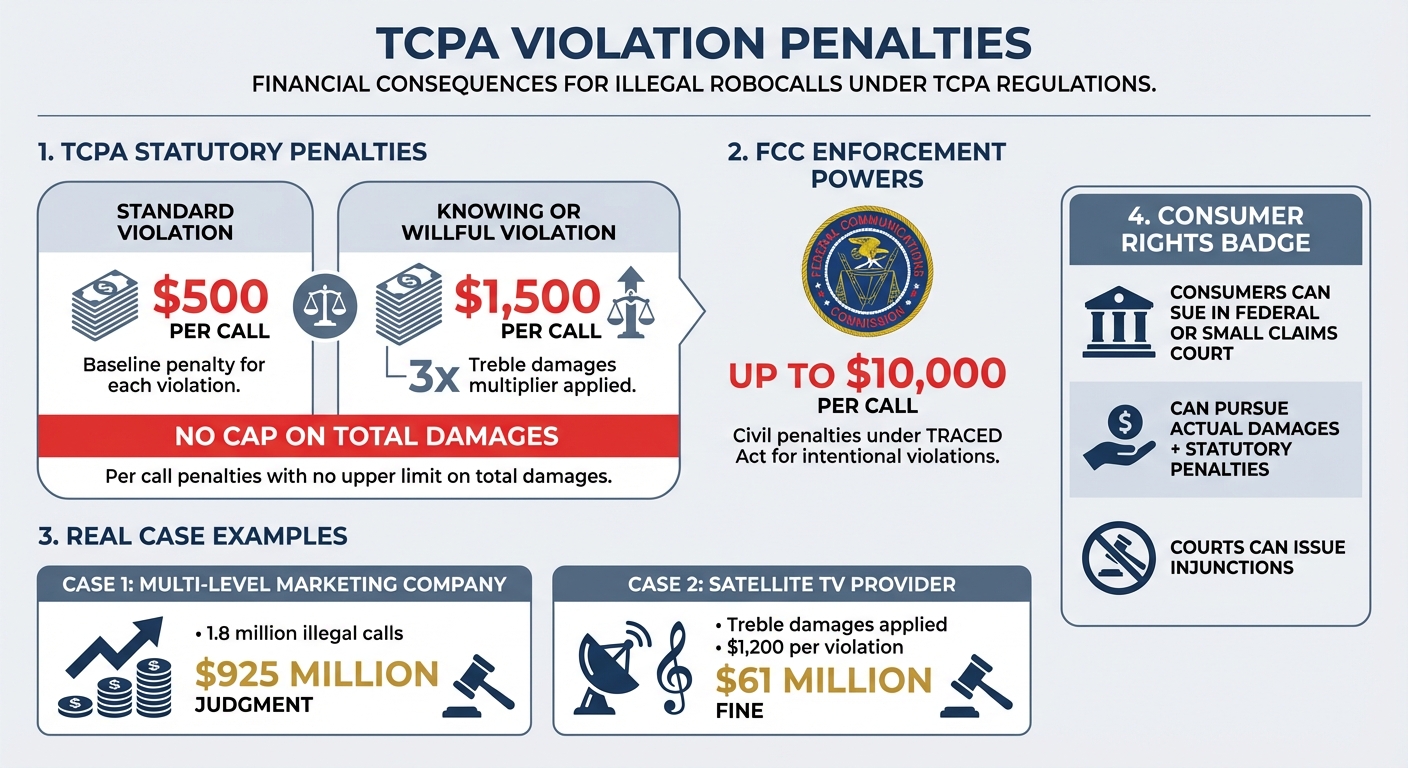
Violating the Telephone Consumer Protection Act (TCPA) can be costly. Each illegal call comes with a penalty of $500, and that amount jumps to $1,500 per call if the violation is deemed knowing or willful.
There’s no upper limit on the total damages under the TCPA. This opens the door for class-action lawsuits with judgments that can reach staggering amounts – sometimes in the hundreds of millions or even billions. For instance, a jury once ordered a multi-level marketing company to pay $925 million after it made 1.8 million illegal calls. In another case, a satellite TV provider faced a $61 million fine when the court applied treble damages of $1,200 per violation.
Consumers also have the right to take telemarketers to court – whether in federal court or small claims court – to seek damages. In addition to statutory penalties, individuals can pursue actual damages if they’ve experienced measurable financial harm due to the violations. Courts may also issue injunctions, requiring telemarketers to immediately stop their unlawful activities.
These hefty fines and legal actions highlight the importance of regulatory oversight, as demonstrated by the FCC’s enforcement efforts.
FCC Enforcement and Compliance Rules
The Federal Communications Commission (FCC) plays a critical role in ensuring telemarketers comply with TCPA rules. The agency uses several tools to enforce compliance, including issuing Notices of Apparent Liability (NAL), which propose fines for violations, and Forfeiture Orders, which require companies to pay those fines.
To combat illegal robocalls, the FCC can also send Cease-and-Desist letters, ordering service providers to stop transmitting unlawful robocall traffic. For repeat offenders, the FCC may even activate a specialized task force, referred to as a C-CIST, to coordinate enforcement actions on a global scale. Under the TRACED Act, the FCC has the authority to impose civil penalties of up to $10,000 per call for intentional violations.
sbb-itb-a8d93e1
How to Stop Robocalls and Report Violations
Steps to Block and Stop Robocalls
If you pick up a robocall, the best thing to do is hang up immediately. Don’t press any buttons to "opt-out", and avoid answering any questions – especially with "Yes." Scammers can manipulate such responses to authorize fraudulent charges.
Start by registering your wireless and landline numbers with the National Do Not Call Registry at DoNotCall.gov or by calling 1‑888‑382‑1222. While this won’t stop scammers, it helps distinguish illegal calls from legitimate telemarketers, who are legally required to stop calling within 31 days of registration. If you’ve previously given consent for calls, make sure to revoke it.
Take advantage of your carrier’s call-blocking tools – like AT&T ActiveArmor, T‑Mobile ScamShield, or Verizon Call Filter – and use built-in smartphone features such as Apple’s "Silence Unknown Callers", Google Pixel’s "Call Screen", or Samsung’s "Smart Call." Third-party apps like Nomorobo, Hiya, and YouMail are also effective at blocking scam numbers. To add another layer of protection, set a password for your voicemail account. Some services allow access based solely on caller ID, which scammers can easily spoof.
Keep a record of every unwanted call, noting the date, time, caller ID, and a brief summary. This documentation is crucial for legal action or filing complaints with agencies like the FTC or FCC. Keep in mind that the statute of limitations for filing lawsuits under the TCPA (Telephone Consumer Protection Act) is four years.
Once you’ve implemented these blocking measures, you’ll be better prepared to report violations and protect your rights.
Report Violations with ReportTelemarketer.com
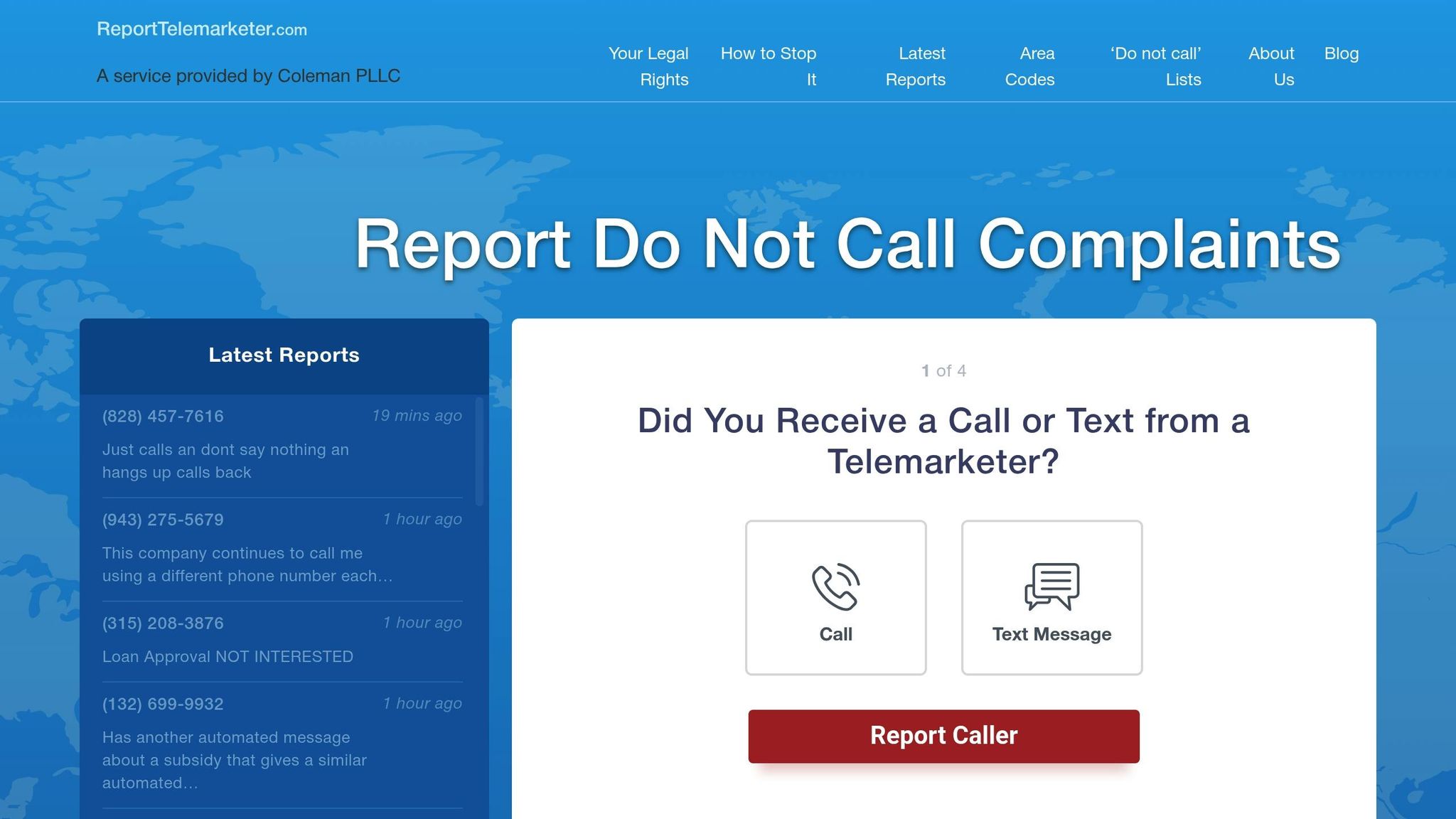
If blocking robocalls doesn’t fully solve the problem, reporting violations is the next step. With the details from your call log, you can take legal action through platforms like ReportTelemarketer.com.
ReportTelemarketer.com provides a free service for consumers to report robocall violations and pursue action against illegal telemarketers. Using proprietary tools, the platform investigates telemarketing practices to identify those using automated dialing systems or prerecorded messages without proper consent. If a violation is confirmed, they assist in filing cease-and-desist letters or formal complaints to put a stop to the illegal calls.
Under the TCPA, you could be entitled to up to $500 per violation, or as much as $1,500 per violation if the telemarketer acted knowingly and willfully. ReportTelemarketer.com helps consumers seek this financial compensation without any upfront costs, as attorney fees are recovered from the telemarketers when applicable. The platform also ensures user privacy while making reported telemarketers publicly visible, helping others avoid similar harassment. Backed by an experienced legal team and comprehensive resources, ReportTelemarketer.com provides strong support for anyone wanting to end unwanted calls and hold violators accountable.
Conclusion: Protect Your Rights Against Robocalls
The Telephone Consumer Protection Act (TCPA) puts some serious penalties on unauthorized robocalls – up to $500 per call, or $1,500 if the violation is intentional. On top of that, the FCC can issue fines as high as $10,000 for each deliberate call.
Telemarketers are required to get your written consent before making autodialed or prerecorded calls. And here’s the good news: you can revoke that consent at any time by texting "STOP" or simply asking to be removed. These rules are in place to ensure you have control over who gets to contact you.
Why take action? Unwanted calls are the top complaint filed with the FCC. Your reports play a crucial role in helping investigators crack down on violators.
So, what can you do to protect your privacy? Start by registering your number on the National Do Not Call Registry. Keep a record of every unwanted call, and take advantage of call-blocking tools offered by your phone carrier. If the calls don’t stop, you can turn to platforms like ReportTelemarketer.com. They can help you pursue legal action without any upfront costs – attorney fees are recovered directly from the telemarketers. Take charge and stop illegal robocalls today!
FAQs
What can I do if I get a robocall without my permission?
If you get an unsolicited robocall, the best move is to hang up right away. Don’t press any buttons or interact with the call – doing so could actually result in more unwanted calls.
Once you’ve hung up, take steps to report the incident. File a complaint with the Federal Trade Commission (FTC) and double-check that your number is listed on the National Do Not Call Registry. These actions help authorities crack down on illegal telemarketing. For extra help, platforms like ReportTelemarketer.com can assist in investigating and stopping these nuisance calls.
What evidence do I need to prove a telemarketer violated the TCPA?
To demonstrate that a telemarketer has violated the Telephone Consumer Protection Act (TCPA), start by gathering essential evidence. Keep a detailed record of the date, time, and phone number of the call. Make note of whether the call involved a recorded message or was made without your consent. If you have written consent for the call, hold onto it; if not, document that no consent was provided. For additional proof, consider requesting call logs from your phone carrier.
With this information in hand, you can either file a formal complaint with the FCC or explore legal action. This evidence plays a crucial role in proving a TCPA violation and safeguarding your rights against unwanted telemarketing calls.
How can I block and report unwanted robocalls effectively?
To put an end to those annoying robocalls, start by registering your phone number with the National Do Not Call Registry. This step helps block most telemarketers from reaching out to you. Then, take advantage of the call-blocking features built into your smartphone or activate spam-blocking services provided by your carrier. These tools can automatically filter out suspicious calls.
Still getting robocalls? You can file a complaint with the Federal Trade Commission (FTC). Be ready to share details like the caller ID, date, and time of the call. Another option is to report the call to ReportTelemarketer.com, a free service dedicated to investigating and taking action against telemarketers who break consumer protection laws.

