
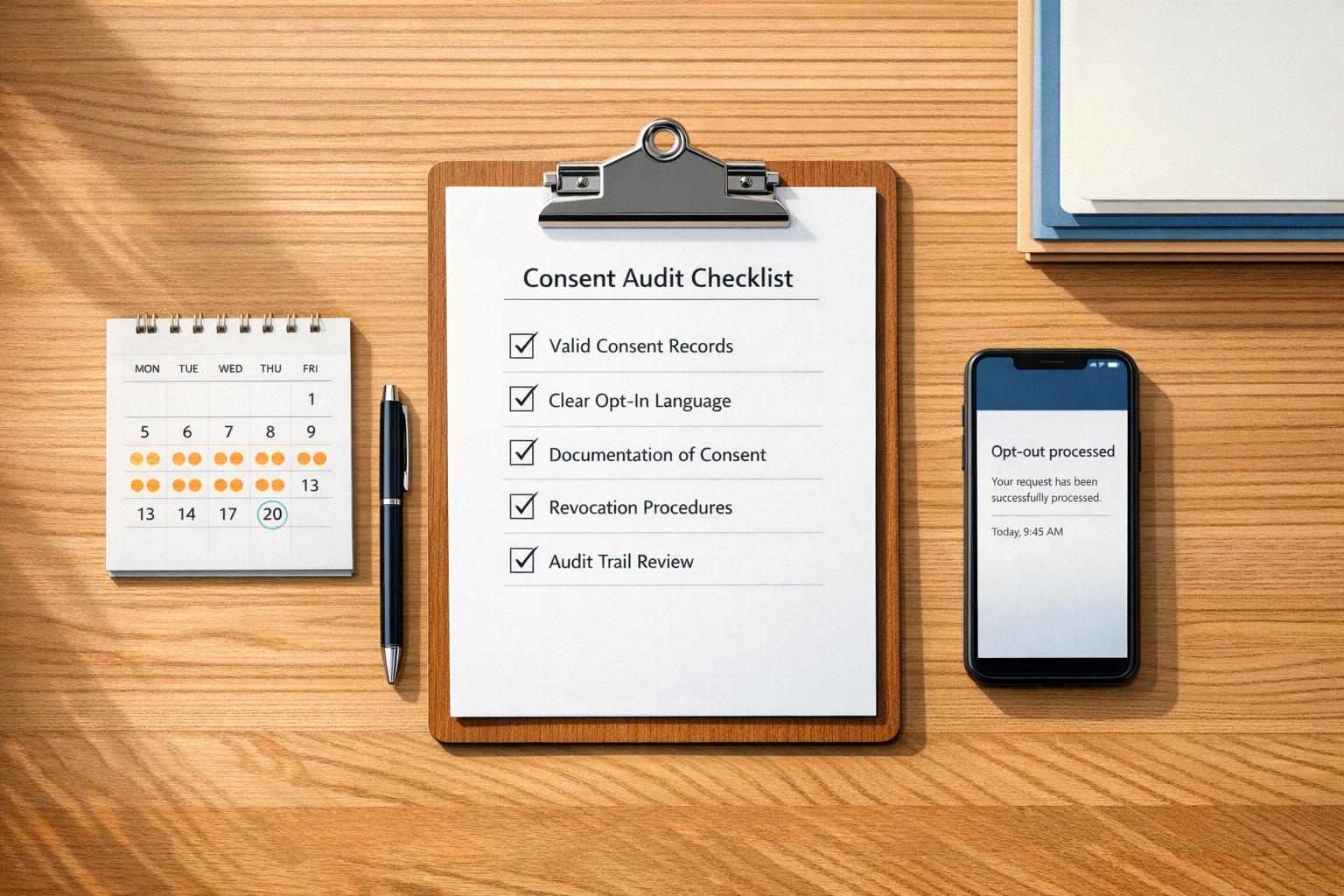
Non-compliance with the Telephone Consumer Protection Act (TCPA) can cost businesses anywhere from $500 to $1,500 per violation, with class-action settlements averaging $6.6 million. The TCPA governs automated calls, texts, and prerecorded messages, requiring businesses to obtain clear, valid consent before contacting consumers. With stricter state laws and increasing litigation, staying compliant is more critical than ever.
Key Takeaways:
- Consent is mandatory: Businesses must document clear, unambiguous consumer consent for marketing communications.
- Audits are essential: Regularly review consent records, opt-out processes, and third-party lead documentation to avoid penalties.
- New rules to note: Starting April 2025, opt-out requests must be processed within 10 business days, and AI-generated voices require explicit consent.
Quick Checklist for TCPA Compliance:
- Consent Documentation: Keep detailed records (timestamps, IP addresses, disclosures) for 4–6 years.
- Opt-Out Handling: Ensure systems honor requests immediately and within the 10-day window.
- Third-Party Vendors: Audit lead providers and call centers to verify compliance.
- Call Practices: Adhere to time-of-day rules (8 a.m.–9 p.m.) and scrub contact lists to stop spam calls against the Do Not Call Registry every 31 days.
Failure to comply with TCPA regulations can damage your reputation, disrupt operations, and lead to costly lawsuits. Regular audits and proper documentation are your best defense.
2025 TCPA Changes You NEED to Know | Simplify Compliance & Build Trust 🚀
sbb-itb-a8d93e1
What Counts as Valid TCPA Consent
Prior Express Consent vs Prior Express Written Consent Requirements
Grasping what qualifies as valid consent is at the heart of any TCPA compliance effort. The TCPA outlines two levels of consent, each with its own requirements. Let’s break down these consent types and what they mean for your business.
Prior Express Consent vs. Prior Express Written Consent
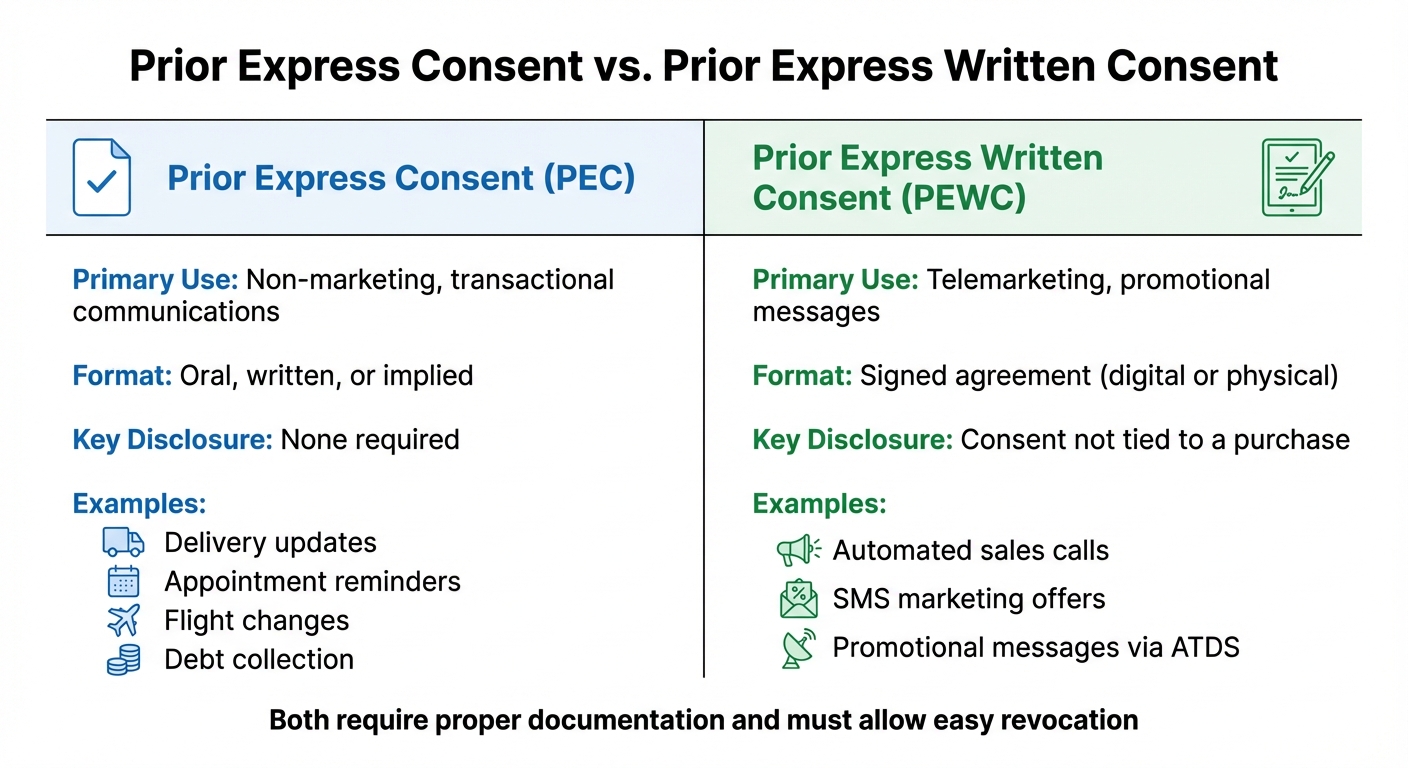
The TCPA distinguishes between Prior Express Consent (PEC) and Prior Express Written Consent (PEWC). Understanding which applies to your communications is essential.
Prior Express Consent is the standard for non-marketing communications, such as appointment reminders, delivery updates, debt collection, or flight changes. This type of consent can be given orally, in writing, or even implied. For instance, if a customer provides their phone number while making a purchase, it’s typically implied they consent to receive updates about their order.
Prior Express Written Consent, on the other hand, is required for telemarketing or advertising messages sent using an automated telephone dialing system (ATDS), artificial voice, or prerecorded voice. This must be a signed agreement, and "signed" can include digital methods like checking an unchecked box on a form or pressing a key during a call, as long as it meets E-SIGN Act standards.
| Feature | Prior Express Consent (PEC) | Prior Express Written Consent (PEWC) |
|---|---|---|
| Primary Use | Non-marketing, transactional | Telemarketing, promotions |
| Format | Oral, written, or implied | Signed agreement |
| Key Disclosure | None required | Consent not tied to a purchase |
| Example | Delivery updates | Automated sales calls, SMS offers |
The scope of each type of consent also differs. PEC is specific to the purpose for which the number was provided, whereas PEWC must clearly identify the advertiser authorized to contact the consumer. Following changes by the FCC, businesses must now obtain consent for individual advertisers, closing the loophole that allowed broad "marketing partner" permissions.
Accurate and thorough documentation of consent is key to staying compliant.
Required Elements of Valid Consent
For consent to be valid, it must meet several essential criteria. Missing any of these could invalidate the consent.
Clear and conspicuous disclosure is the first requirement. Consumers need to know they’re agreeing to receive telemarketing calls or texts, possibly delivered using an ATDS or artificial/prerecorded voice. As David Klein, Managing Partner at Klein Moynihan Turco LLP, explains:
"The consumer’s consent to receive such solicitations must be unambiguous, meaning that the consumer must receive a ‘clear and conspicuous disclosure’…"
The consent must also identify the specific seller who will be contacting the consumer. Vague terms like "partners" or "affiliates" won’t cut it. Additionally, the consumer must provide the exact phone number they agree to be contacted on. For example, if they list a work number, you can’t use that consent to call their personal cell phone.
Another critical element is that consumers must be informed that giving consent is not a condition of purchasing goods or services. This ensures they don’t feel pressured into agreeing to marketing communications.
The consent must include an affirmative action – what the law calls a "signature." This could be checking a box, clicking a button, or providing a voice recording. Pre-checked boxes are strictly prohibited; the consumer must actively opt in.
Lastly, valid consent must include a clear explanation of revocation rights, letting consumers know they can withdraw their permission at any time. Keep detailed records of consent, including dates, times, IP addresses, and the exact language shown to the consumer. These records should be retained for at least four to six years to protect against legal challenges and help consumers report unwanted phone calls.
How Consumers Can Revoke Consent
Once consent is given, consumers must have an easy way to revoke it.
Revocation can be done at any time using any reasonable method. Businesses are required to process these requests within 10 business days. As Richard B. Newman, FTC Defense Lawyer at Hinch Newman LLP, explains:
"Revocation of prior express consent for autodialed, prerecorded or artificial voice calls (and autodialed texts) must be permitted to be made by ‘any reasonable means.’"
You can’t limit consumers to a single revocation method. Acceptable options include replying to texts with keywords like STOP, QUIT, or UNSUBSCRIBE; using an automated system during a call; or submitting a request through your website.
Even "natural language" opt-outs, such as a text saying "Please don’t contact me anymore", must be honored. These are assessed using a "totality of the circumstances" approach.
The timeline for processing revocations has also changed. Starting in April 2025, businesses must handle these requests within 10 business days (down from 30). For certain exempt calls, like package delivery notifications, the window is even shorter – only six business days.
You’re allowed to send a one-time confirmation text acknowledging the opt-out, but it must be free of marketing content. David Klein advises:
"If a consumer does not reply to the confirmation text, the caller/texter must treat the consumer’s silence as equivalent to the revocation of consent for all automated commercial telemarketing calls and texts."
Including promotional content in these confirmation messages could lead to TCPA violations.
If a consumer opts out after receiving an exempt informational call, such as a fraud alert, you must treat it as a global request to stop all non-emergency robocalls and texts. While the FCC has delayed broader enforcement of this "one opt-out = stop all" rule until January 31, 2027, businesses should start updating their systems now to comply.
Maintaining detailed records of revocation requests is just as important as documenting consent. These records are crucial for defending against potential claims and ensuring compliance.
How to Set Up a Consent Audit Process
Create a well-structured audit process to identify and address compliance issues before they lead to penalties.
Setting Audit Goals and Scope
Start by defining the scope of your audit. This should cover all consent points, including web forms, third-party lead sources, SMS campaigns, and voice calls. Be sure to account for both federal TCPA rules and any applicable state-level "mini-TCPA" regulations.
Next, establish clear objectives for your audit. For example:
- Confirm that prior express written consent is properly documented, including timestamps, IP addresses, and the exact disclosure language shown to consumers at the time of opt-in.
- Assess lead sources, particularly third-party providers, to ensure they have compliance measures in place and that the consent documentation aligns with what you’ve acquired.
- Review call logs to ensure compliance with time-of-day restrictions (8 a.m. to 9 p.m. local time) and verify that automated dialers only contact consumers who have given consent. Predictive dialers should maintain a drop rate below 3%.
Additionally, test your opt-out processes. This includes scrubbing contact lists against the National Do Not Call Registry every 31 days and ensuring opt-out requests are processed immediately. Convoso highlights the importance of documentation in compliance efforts:
"Documentation is your defense. Records should capture: Date, time, and method of consent; The specific seller(s) and products/services consent covered; Supporting proof."
These steps ensure your practices align with TCPA guidelines. Once your goals are set, decide on the best timing for these audits.
When to Conduct Audits
Regular audits are key to staying compliant. Conduct internal audits quarterly or biannually, and schedule third-party reviews periodically. However, don’t rely solely on rigid schedules. Certain events – like adopting new dialing technology, changing lead sources, seeing a rise in consumer complaints, or responding to regulatory updates – should prompt immediate spot-check audits.
Some ongoing tasks should also be prioritized. Scrub contact lists every 31 days and monitor call practices monthly to address issues as they arise. Opt-out handling requires continuous attention, especially with the new 10-business-day processing rule that takes effect on April 11, 2025. This leaves little room for delays.
Annual staff training and frequent updates to marketing scripts (every 3–6 months or after regulatory changes) are also essential.
| Audit Component | Recommended Frequency | Key Objective |
|---|---|---|
| National DNC Scrubbing | Every 31 Days (Minimum) | Maintain safe harbor eligibility |
| Internal Compliance Review | Quarterly | Identify operational gaps and record errors |
| Call Practices Monitoring | Monthly/Real-time | Verify time-of-day rules, drop rates (<3%), and caller ID |
| Staff Training | Annually | Keep team updated on evolving FCC rules |
| Script/Disclosure Review | Every 3–6 Months | Ensure language meets compliance standards |
| Opt-Out Processing Test | Continuous | Confirm 10-business-day window and "STOP" functionality |
Who Should Be Involved in Audits
A successful audit process requires collaboration across various departments. TCPA compliance isn’t a solo effort – it demands a team approach with clearly defined roles.
- Legal Counsel: Guides policy creation, reviews disclosure statements, and keeps you informed about changes to federal and state laws.
- Compliance Officers: Oversee the audit process, manage schedules, and maintain centralized records. Assign a specific individual to ensure accountability.
- Marketing and Sales Teams: Ensure lead generation and outreach efforts strictly target consumers who have opted in.
- IT and Design Teams: Handle technical elements like web form disclosures, data scrubbing, session replay management, and record-keeping.
- Call Center Managers: Monitor live calls, enforce script compliance, and ensure opt-out requests are processed immediately.
- Third-Party Vendors: Require vendors like marketing agencies and lead providers to supply detailed logs of their TCPA compliance measures and consent-tracking processes. Remember, you’re responsible for the messages they send on your behalf.
Anders Uhl, CMO at ClickPoint Software, underscores the importance of thorough compliance:
"A single missed opt-out can trigger liability. Implement a centralized suppression system that updates immediately across all channels."
With TCPA violations carrying penalties of $500 to $1,500 per call or text – and average class-action settlements exceeding $6 million – getting the right people involved is essential.
What to Check During a Consent Audit
Once your audit framework is in place, the next step is to dig into the details of your consent records and supporting systems. This is where you identify any weak spots that could jeopardize your TCPA compliance. Attention to detail is key here, as even small oversights can lead to big problems.
Reviewing Consent Records
Start by documenting all the essential details of consent: timestamps, IP addresses, source URLs, and the text of disclosures. These records are your first line of defense when it comes to TCPA compliance. As DNC.com puts it:
"If you can’t prove you have TCPA consent, then it’s like you never did." – DNC.com
For written consent – whether it’s on paper or electronic – make sure it clearly states the authorized phone number and confirms the consumer’s understanding that they may receive messages sent via automated technology. For web-based consent, keep screenshots or session replays that show the opt-in action alongside the disclosure text. These records should clearly demonstrate that the consumer was informed that providing consent wasn’t a condition for making a purchase and that automated systems or prerecorded messages might be used.
Don’t forget to check your opt-out and revocation logs. Every "STOP" request or verbal revocation should be logged with the date, time, and method of the request. Cross-check these logs with your active contact lists to ensure that opt-outs are processed within the required 10 business days. Store these records for 4 to 6 years to cover the TCPA statute of limitations. To ensure integrity, consider using an independent third party to store immutable copies of these records.
Testing Opt-Out Processes
Your opt-out systems need to work flawlessly across all channels – whether it’s SMS, IVR, or live calls. Start by testing SMS campaigns. Your system should recognize standard keywords like STOP, QUIT, and UNSUBSCRIBE, as well as informal phrases like "don’t text me." Every opt-out, no matter how it’s phrased, should trigger immediate removal across all systems.
Test whether an opt-out in one system synchronizes across all platforms and internal Do Not Call (DNC) lists. For instance, if someone texts "STOP", they should be removed from all outreach channels, not just SMS. Ensure your system confirms opt-out requests right away and halts all contact after the 10-business-day window. With TCPA penalties ranging from $500 to $1,500 per violation, even one delay can lead to hefty fines. Consumers who receive these illegal communications can report annoying phone calls to trigger regulatory scrutiny. As Quo puts it:
"TCPA compliance isn’t a one-time checklist – it’s an ongoing commitment to protecting your customers and your business." – Quo
Once your opt-out processes are secure, move on to reviewing your list management practices.
Verifying List Management Practices
Proper list management plays a crucial role in staying compliant. Make sure your contact lists are scrubbed against the National Do Not Call Registry at least every 31 days. Keep detailed logs of each scrub, including the date, registry version, and numbers removed. Also, screen your lists against the Reassigned Numbers Database (RND) to avoid contacting numbers that have been reassigned to new users.
Organize your lists based on the type of consent you’ve obtained. For example, someone who agreed to receive informational texts shouldn’t end up on a list for promotional calls. Additionally, exclude emergency lines, government numbers, toll-free numbers (where the recipient might incur charges), and duplicate leads to avoid unnecessary contact.
Finally, implement controls to ensure calls are made only during legally allowed hours – typically between 8:00 a.m. and 9:00 p.m. local time. Be mindful of stricter state-specific rules, like those in Alabama and Mississippi. Anders Uhl, CMO at ClickPoint Software, highlights the importance of thorough record-keeping:
"A defensible consent record includes the disclosure text shown, timestamp, form or entry point URL, user agent, IP (and reverse IP), location data, and the specific consent action." – Anders Uhl, ClickPoint Software
Auditing Third-Party Vendors and High-Risk Areas
When it comes to TCPA compliance, keeping an eye on third-party vendors is just as important as conducting internal audits. Many TCPA violations trace back to third-party vendors, lead providers, or outsourced call centers. The catch? Even if a vendor claims full compliance, your business is still accountable for their mistakes. That’s why regular audits of these partnerships are non-negotiable.
Checking Lead Sources and Documentation
Buying leads doesn’t just mean acquiring potential customers – it also means taking on the responsibility for ensuring proper consent. Leads sourced from vendors must come with proof of consent specifically tied to your brand. Generic approvals won’t cut it. Trusting a vendor’s word isn’t enough; you need solid, verifiable evidence.
For every lead, you should secure a digital record that includes:
- Timestamp
- IP address
- Referring URL
- User agent
- Screenshot or session replay of the opt-in form
Tools like TrustedForm or LeadExec can help automate this process, generating unique identifiers for each consent event. The screenshot should clearly show your brand name, the disclosure text, and the consumer’s affirmative action, such as checking a box or clicking "Submit."
Pay close attention to the disclosure text. It must explicitly inform the consumer that:
- They consent to receive marketing calls or texts.
- Autodialed or prerecorded technology may be used.
- Consent is not a condition of purchase.
If any of these elements are missing or unclear, the lead is invalid. As ActiveProspect warns:
"Lead buyers cannot rely on the lead seller to gather consumer consent and provide the consent to the lead buyer if needed." – ActiveProspect
Instead of reviewing every single lead, sample 5% of each batch weekly. If a vendor’s leads consistently fail documentation checks, it’s time to reevaluate that relationship. Vendors unable to provide proper consent records should be replaced without hesitation.
Your audits shouldn’t stop at lead sources – extend them to outsourced call centers as well.
Reviewing Call Centers and Agency Practices
Outsourced call centers can be another compliance minefield. One misstep by an agent could lead to violations. Regularly review call scripts to ensure they include mandatory elements like your company name, the purpose of the call, and an interactive opt-out feature.
It’s also important to listen to sample call recordings. Check that agents:
- Honor opt-out requests immediately.
- Make calls only between 8:00 a.m. and 9:00 p.m. local time.
- Follow state-specific rules, such as Florida’s stricter time windows or Oregon’s daily call attempt limits.
Additionally, confirm that call centers regularly scrub their call lists against the National Do Not Call Registry and the Reassigned Numbers Database to avoid contacting numbers that are no longer valid.
Your vendor contracts should include clauses that allow you to audit their operations and hold them accountable for compliance missteps. These agreements should cover lead origins, call logs, opt-out processes, and indemnification for any compliance-related liabilities. Conduct quarterly audits, evaluating vendors based on lead volume, audit results, and consumer complaint trends.
Using Consumer Complaints to Identify Problems
Consumer complaints can be a goldmine of information when it comes to spotting compliance issues. They act as an early warning system, highlighting potential flaws in consent processes. Platforms like ReportTelemarketer.com let consumers report unwanted calls, giving you a chance to catch non-compliance before it escalates into lawsuits.
Create an internal dashboard to track complaints by vendor, campaign, and lead source. If one vendor is generating an unusually high number of complaints, dig deeper. Review their consent records, call scripts, and list management practices. A pattern of violations could lead to penalties ranging from $500 to $1,500 per call or text.
Consumer complaints aren’t just noise – they’re an opportunity to fix problems fast. As Convoso emphasizes:
"Consent is not optional – it’s the foundation of every compliant campaign." – Convoso
Maintaining Compliance Over Time
Ensuring long-term compliance isn’t just about conducting a single audit – it’s about making compliance a consistent part of your business operations. TCPA compliance requires constant monitoring, regular updates to policies, and diligent record-keeping. With regulations and technologies always evolving, businesses that treat compliance as an ongoing process are the ones that successfully avoid costly lawsuits.
Measuring Compliance Performance
Tracking the right metrics can help you spot potential issues before they escalate into penalties, which can reach up to $1,500 per violation. Focus on key performance indicators like complaint rate, opt-out processing times, and consent record accuracy. For instance, a dashboard can help you monitor:
- Complaint rates: The number of complaints per 10,000 contacts.
- Opt-out processing times: These must be under 10 business days starting April 11, 2025.
- Consent record accuracy: The percentage of contacts with valid and documented consent.
In 2025, a regional bank revamped its consent capture processes and dialer controls for marketing and real estate cold calling outreach. By centralizing its "permissions spine" and automating pre-campaign scrubbing, the bank reduced TCPA complaints by 70% and improved lead response times by 40% within six months. This example highlights how treating compliance as a measurable business function can yield significant operational benefits.
| Metric | Description |
|---|---|
| Complaint Rate | Number of complaints or "Spam" flags per 10,000 contacts |
| Consent Record Coverage | Percentage of contacts with standardized, verifiable, and versioned consent records |
| Opt-Out Rate | Percentage of recipients who revoke consent; spikes may indicate campaign or script issues |
| Response Time | Time taken to process opt-out or complaint requests (must be under 10 days) |
| Training Completion | Percentage of staff who have completed TCPA training modules |
Regularly reviewing these metrics can prevent compliance issues. For instance, a sudden increase in opt-out rates might point to a problematic campaign or lead source. Similarly, a drop in training completion rates should prompt immediate refresher sessions. These insights not only help refine internal policies but also ensure staff stays well-informed.
Updating Policies and Training Staff
As laws evolve, so must your policies. In January 2024, the FCC classified AI-generated content as an "artificial voice" under the TCPA, requiring the same consent as prerecorded messages. Additionally, states like Texas, Oregon, and Florida have introduced stricter "mini-TCPAs" that impose tighter calling windows and extend SMS regulations. To stay compliant, schedule annual policy reviews to update documentation, call scripts, and consent forms. Train your staff regularly using role-specific modules and track their progress through your compliance dashboard.
"Treat TCPA as a design constraint, not a blocker: engineer consent, controls, and evidence into your revenue engine."
By making policy updates and training a priority, businesses can stay ahead of regulatory changes and maintain compliance.
Recording Audit Results and Taking Action
Every audit should generate a detailed report outlining what was reviewed, the findings, and any corrective actions planned. These reports should be stored for four to six years to comply with the TCPA’s statute of limitations. Keeping thorough records can serve as a strong defense in case of lawsuits or regulatory inquiries.
Once an audit is complete, act on the findings immediately. For example, if vendor leads lack proper consent, replace the vendor and remove those contacts. If call center agents fail to honor opt-outs within 10 business days, retrain them and implement automated safeguards. Assign clear responsibilities, set deadlines, and track progress to ensure all gaps are addressed. These actions, combined with regular audits and vendor evaluations, strengthen your overall TCPA compliance program.
To qualify for the "safe harbor" defense against unintentional violations, maintain written internal Do Not Call procedures, ensure continuous staff training, and use automated systems to scrub contact lists against federal, state, and internal DNC databases before launching any campaign.
Conclusion and Next Steps
Staying compliant with TCPA regulations isn’t a one-and-done task – it’s an ongoing commitment. In any dispute, your business must be able to prove it obtained valid consent. With TCPA class actions spiking by 112% in Q1 2025 and average settlements climbing to over $6.6 million, the stakes are high. Violations can cost anywhere between $500 and $1,500 per call or text.
To minimize risks, make quarterly audits a routine part of your operations. Use these audits to review consent records, ensure opt-out processes are functioning correctly, and verify vendor documentation. Additionally, scrub your call lists every 31 days to maintain safe harbor protections. Keep in mind that consent is tied to the consumer, not just their phone number, so regularly checking the Reassigned Numbers Database is essential. These steps, combined with internal and vendor audits, create a strong foundation for compliance.
"Your lead is not contact information… Your lead is consumer intent, captured at the moment of expression, packaged with documented permission to make contact. Without that permission… you are selling liability." – LeadGen Economy
In addition to internal audits, external monitoring tools can add another layer of protection. Services like ReportTelemarketer.com help identify compliance risks by tracking consumer complaints and spotting patterns of non-compliance early. This is especially important when working with third-party vendors, as your business is still legally responsible for every message they send on your behalf.
Lastly, keep detailed records of your audits, consent captures, and opt-out requests for at least five to six years. As the regulatory environment evolves – with new FCC rules, state-level "mini-TCPA" laws, and AI voice regulations – staying proactive with regular audits and swift corrective actions can protect both your customers and your business from expensive legal battles.
FAQs
What proof should I keep to defend TCPA consent?
To uphold TCPA consent, it’s crucial to maintain detailed, documented proof. This includes items like screenshots of consent forms, timestamps, referring URLs, and records of disclosures that align with TCPA requirements. These records should be kept for at least four years to ensure you’re meeting compliance standards. Having thorough documentation is key to proving valid consumer consent under the TCPA.
How do I audit third-party leads for valid consent?
When reviewing third-party leads for TCPA compliance, start by checking key documentation such as timestamped consent forms, referring URLs, and the exact consent language used. It’s crucial to ensure the consent aligns with TCPA’s requirement for "prior express written consent." This means the consent must be clear, specific, and obtained through an affirmative action (like checking a box or clicking a button).
To stay on the safe side, keep these records for at least four years. Consider using tools that can capture metadata and even replay the consent process. This added layer of verification can help demonstrate compliance if questions arise.
What must change before April 11, 2025?
By April 11, 2025, businesses will need to follow updated FCC rules under the TCPA that make it easier for consumers to revoke consent for robocalls and texts. These changes are designed to strengthen consumer protection and establish clearer, more straightforward opt-out procedures.

