

Telemarketers who repeatedly violate the Telephone Consumer Protection Act (TCPA) face escalating penalties, including fines up to $1,500 per violation, class-action lawsuits, and even state-level enforcement.
The TCPA, enacted in 1991, requires telemarketers to obtain express consent before contacting individuals. Violations include robocalls, texts, and calls to numbers on the National Do Not Call Registry. Repeat offenses are treated more harshly, with courts tripling damages for intentional misconduct.
Key points:
- Penalties: $500 per violation; $1,500 for willful violations.
- Repeat offenders: No cap on damages; liabilities can reach millions in class actions.
- Consumer tools: Platforms like ReportTelemarketer.com help report violations and gather evidence.
- State laws: Many states impose additional fines and stricter rules, especially for targeting seniors.
To protect yourself, document unwanted calls, use the National Do Not Call Registry, and report violations to authorities or platforms like ReportTelemarketer.com. Repeat offenders face mounting legal and financial consequences.
TCPA Compliance and Litigation Update
TCPA Enforcement Framework
The TCPA operates within a layered enforcement system where federal agencies, state authorities, and individual consumers work together to hold telemarketers accountable. This structure ensures that repeat violators face scrutiny from multiple angles. Let’s explore the roles of key regulatory bodies that oversee and enforce TCPA compliance.
Key Regulatory Bodies: FCC, FTC, and State Authorities
Federal and state agencies play a pivotal role in ensuring compliance with the TCPA. The FCC takes the lead in interpreting and updating telemarketing regulations, including technical rules on autodialer usage and maintaining the National Do Not Call Registry. The FTC, on the other hand, focuses on protecting consumers by cracking down on deceptive and abusive telemarketing practices while also managing the National Do Not Call Registry.
State attorneys general contribute by enforcing both TCPA provisions and state-specific consumer protection laws, often through targeted lawsuits. This collaborative approach between federal and state entities creates a robust system that quickly addresses non-compliance, especially for repeat offenders.
How the National Do Not Call Registry Works

The National Do Not Call Registry serves as a cornerstone of TCPA enforcement, providing consumers with a straightforward way to avoid unwanted telemarketing calls. Managed by the FTC, this registry allows individuals to add their phone numbers for free by visiting DoNotCall.gov or calling 1‑888‑382‑1222. Once a number is registered, it stays on the list indefinitely unless the consumer removes it or the number is disconnected and reassigned.
For telemarketers, staying compliant means regularly updating their call lists to ensure they don’t contact numbers on the registry. Reaching out to a registered number, unless exempted, is considered a violation. The registry also tracks complaints and maintains records, which help regulators identify and address patterns of non-compliance.
For consumers who want to take immediate action, platforms like ReportTelemarketer.com provide tools to report violations. These platforms can investigate complaints and even take steps like filing cease and desist letters or formal complaints to stop unwanted calls. Additionally, consumers can report issues directly to the FTC.
The success of the National Do Not Call Registry depends on accurate record-keeping by both telemarketers and consumers. Maintaining detailed records ensures that violations can be effectively addressed and reinforces the broader enforcement framework.
Penalty Structure for Repeat Violations
Under the TCPA enforcement framework, penalties for repeat violations become increasingly severe. The system ramps up fines for intentional and ongoing noncompliance, making it clear that repeat offenders face serious consequences.
Standard vs. Willful TCPA Violations
TCPA violations fall into two main categories: standard and willful. Standard violations often result from negligent mistakes, like improperly configured opt-out systems. These violations can lead to damages of up to $500 per call, text, or fax, with each contact treated as a separate violation. For instance, sending 10,000 noncompliant texts could expose a business to $5 million in penalties, even if the errors were unintentional.
Willful violations, on the other hand, carry much steeper penalties – up to $1,500 per incident. These occur when businesses knowingly ignore legal requirements, such as continuing to contact individuals after opt-out requests, relying on flawed consent methods, or repeating violations after prior warnings or enforcement actions. Evidence like internal emails showing awareness of rules, ignored compliance advice, or a high volume of consumer complaints can demonstrate willful misconduct.
From January 1 to April 30, 2025, around 880 TCPA lawsuits were filed, marking a 44% increase compared to the same period in 2024. Notably, about 80% of these cases were class actions, significantly raising the stakes for businesses that engage in repeated noncompliance. In April 2025 alone, 235 lawsuits were filed, compared to 135 in April 2024.
| Aspect | Standard TCPA Violation | Willful / Knowing TCPA Violation |
|---|---|---|
| Typical statutory damages | Up to $500 per unlawful call, text, or fax | Up to $1,500 per unlawful call, text, or fax via treble damages |
| Regulator view of conduct | Negligent or careless noncompliance, often first-time issues | Intentional disregard of the law, repeated violations, or deceptive practices |
| Risk for repeat offenders | High due to per-violation counting | Extremely high; patterns of willful violations can lead to multi-million-dollar liabilities |
These escalating penalties aim to deter businesses from engaging in large-scale noncompliance.
Treble Damages and Federal Forfeiture Penalties
One of the TCPA’s strongest deterrents against repeat offenders is treble damages. When courts determine that violations were willful or knowing, they triple the base statutory penalty – turning $500 per violation into $1,500. For companies with thousands of violations, this can quickly escalate into multi-million-dollar liabilities, threatening their financial stability.
The TCPA’s four-year statute of limitations allows plaintiffs to file claims for violations spanning several years. Class actions often extend this liability window, and since there’s no cap on total damages, businesses can face enormous settlements or judgments if their actions affect large groups of consumers.
Federal regulators also impose separate forfeiture penalties, which are independent of private lawsuits. The Federal Communications Commission (FCC) can issue significant fines, often calculated per violation or per day for ongoing misconduct. In major cases, these penalties can reach six or seven figures, especially when companies disregard prior orders, engage in deceptive practices, or target large numbers of consumers.
Repeat offenders face even steeper penalties. A second or third enforcement action often results in much higher fines, emphasizing the importance of addressing compliance issues after initial warnings. This creates a strong incentive for businesses to implement robust TCPA compliance measures.
Proposed legislation aims to give the FCC more authority to collect forfeiture penalties directly, specifically targeting repeat telemarketing violations. Combined with the rise in private class actions, this creates a dual pressure on violators from both government agencies and consumers.
Detailed consumer reports, including dates, times, caller IDs, and call content, play a crucial role in building cases against repeat offenders. Such documentation helps regulators and attorneys identify systemic violators, argue for higher damages, and demonstrate the persistent harm caused by illegal practices.
Common scenarios leading to multi-million-dollar settlements include large-scale robocall campaigns by call centers or lead generators that continue despite consumer complaints, lawsuits, or regulatory warnings. Even when settlements represent a fraction of the theoretical maximum, they often still reach the tens of millions of dollars, factoring in class member payments, legal fees, and compliance monitoring obligations.
sbb-itb-a8d93e1
State-Level Penalties for Repeat Offenders
Federal TCPA enforcement sets the groundwork for penalties, but many states tack on their own layers of consequences, making the stakes even higher for repeat offenders. These state-specific laws operate independently of federal rules, meaning companies can face penalties at both levels for the same violations. By adding more severe repercussions, states aim to deter persistent violators and raise the financial and operational risks of noncompliance.
How States Escalate Penalties for Repeat Offenders
State telemarketing laws often ramp up penalties for repeat offenses. A company that continues illegal practices after warnings or settlements can find itself in a much higher penalty range.
Most states use a tiered penalty system. First-time violations might result in fines ranging from a few hundred to a few thousand dollars per call. But for repeat or intentional violations, those fines can climb to several thousand dollars per call. These state penalties stack on top of federal TCPA damages – so a company already facing $1,500 per call in federal penalties could also owe an additional $3,000 to $5,000 per call under state law.
States also track violations within specific timeframes, often 12 to 24 months, to identify repeat offenders. Regulators look for patterns of "willful and repeated" conduct or multiple violations involving the same entity during this period.
For documented repeat offenders, states have a range of enforcement tools. Attorneys general often seek permanent injunctions to limit or ban telemarketing activities. Courts may require companies to implement strict compliance programs, complete with independent monitoring at the company’s expense. In more severe cases, states can suspend, deny, or revoke telemarketing licenses, effectively shutting down operations.
When fraud is involved, things escalate further. Repeat violations tied to fraudulent schemes can lead to criminal charges like wire fraud or identity theft, which could result in jail time for company executives.
Multistate coordination amplifies the risks. When a telemarketer targets consumers across several states, attorneys general often collaborate, pooling evidence and pursuing joint enforcement actions. These coalitions can aggregate victim counts and escalate penalties to national levels. A company that might survive enforcement from one state could face financial ruin when multiple states act together, with total penalties and restitution orders reaching tens or even hundreds of millions of dollars.
Enhanced Protections for Seniors and Vulnerable Groups
Many states have adopted stricter measures to protect seniors and other vulnerable populations from telemarketing abuses, imposing higher penalties for violations involving these groups.
For example, elder abuse statutes in many states significantly increase per-violation penalties when the victim is a senior citizen. States typically define vulnerable consumers by age (often 65 or older), disability status, or legal guardianship. Violations targeting these groups may incur separate penalties for each affected individual, and treble damages may apply for fraudulent or exploitative practices – on top of federal penalties.
Some states take it a step further, classifying telemarketing scams against seniors as felonies. This allows prosecutors to pursue incarceration and asset forfeiture in addition to civil penalties and restitution. When evidence shows a deliberate pattern of targeting older or disabled consumers, company executives could face criminal charges and prison time.
States also impose stricter regulations to protect vulnerable groups. For instance, certain jurisdictions ban high-pressure or deceptive solicitations targeting seniors, regardless of consent. Others require enhanced disclosures and consent standards, making it harder for telemarketers to claim they had proper authorization. Additionally, calling hour restrictions for vulnerable populations are often more stringent, and specific financial offers may be outright prohibited.
Regulators rely heavily on consumer complaints to identify patterns of abuse. Complaint data from state hotlines, the FTC’s database, and platforms like ReportTelemarketer.com helps build cases against companies. This documentation is crucial for proving repeat violations and justifying higher penalties, especially when targeting of seniors or other vulnerable groups is evident.
Recent enforcement actions reflect the growing seriousness of these violations. States have secured multimillion-dollar settlements that combine steep per-call penalties with restitution funds for victims and permanent telemarketing bans. In elder-focused scams, regulators often use telemarketing laws alongside general fraud statutes to obtain treble damages, criminal convictions, and lifetime bans on telemarketing activities for responsible individuals. These outcomes highlight the severe consequences for companies that repeatedly target vulnerable consumers.
Private Lawsuits and Consumer Reporting Services
While federal and state regulators tackle repeat telemarketers through enforcement actions, individual consumers have a powerful option of their own: filing lawsuits under the Telephone Consumer Protection Act (TCPA). These lawsuits, combined with consumer reporting platforms that track abusive patterns, create a strong secondary line of defense against persistent violators. This approach doesn’t rely solely on government intervention, giving consumers a proactive way to address the issue.
Private Lawsuits Against Repeat Offenders
The TCPA empowers consumers to take legal action on their own. It allows individuals to sue telemarketers in federal or state courts for illegal calls or unauthorized texts. Each call or text counts as a separate violation, meaning repeated offenses can significantly increase potential damages.
For standard violations, consumers can claim up to $500 per call or text. If the telemarketer’s actions are found to be knowing or willful, this amount triples to $1,500 per incident. With no cap on total damages, telemarketers making hundreds or thousands of illegal calls could face financial exposure running into the millions. This is especially true for repeat offenders who blatantly disregard complaints or warnings.
The TCPA’s four-year statute of limitations allows lawsuits to address violations over an extended period. For telemarketers who repeatedly ignore opt-out requests or target numbers on the Do Not Call Registry, this timeline can become a serious liability.
Class actions are another powerful tool for holding repeat offenders accountable. Between January 1 and April 30, 2025, TCPA class action filings surged by 44%, with April alone seeing an increase of over 70%. These lawsuits enable one individual to represent a larger group that has experienced similar violations, making it possible to address widespread campaigns affecting thousands or even millions of people. For offenders, class actions aggregate damages across all illegal communications, potentially leading to multi-million-dollar penalties that force operational changes or even drive bad actors out of business.
When telemarketers continue their behavior despite complaints, opt-out requests, or prior enforcement actions, courts are more likely to classify the conduct as knowing or willful. Evidence such as prior settlements, repeated violations of Do Not Call rules, or internal policies that ignore consent requirements can lead to higher penalties, stricter monitoring, and court-ordered compliance measures.
Consumers can strengthen their cases by keeping detailed records of unwanted calls and texts. Maintaining a log with dates, times, phone numbers, message summaries, and any prior opt-out requests helps establish patterns of repeated or intentional violations.
How ReportTelemarketer.com Documents Violations
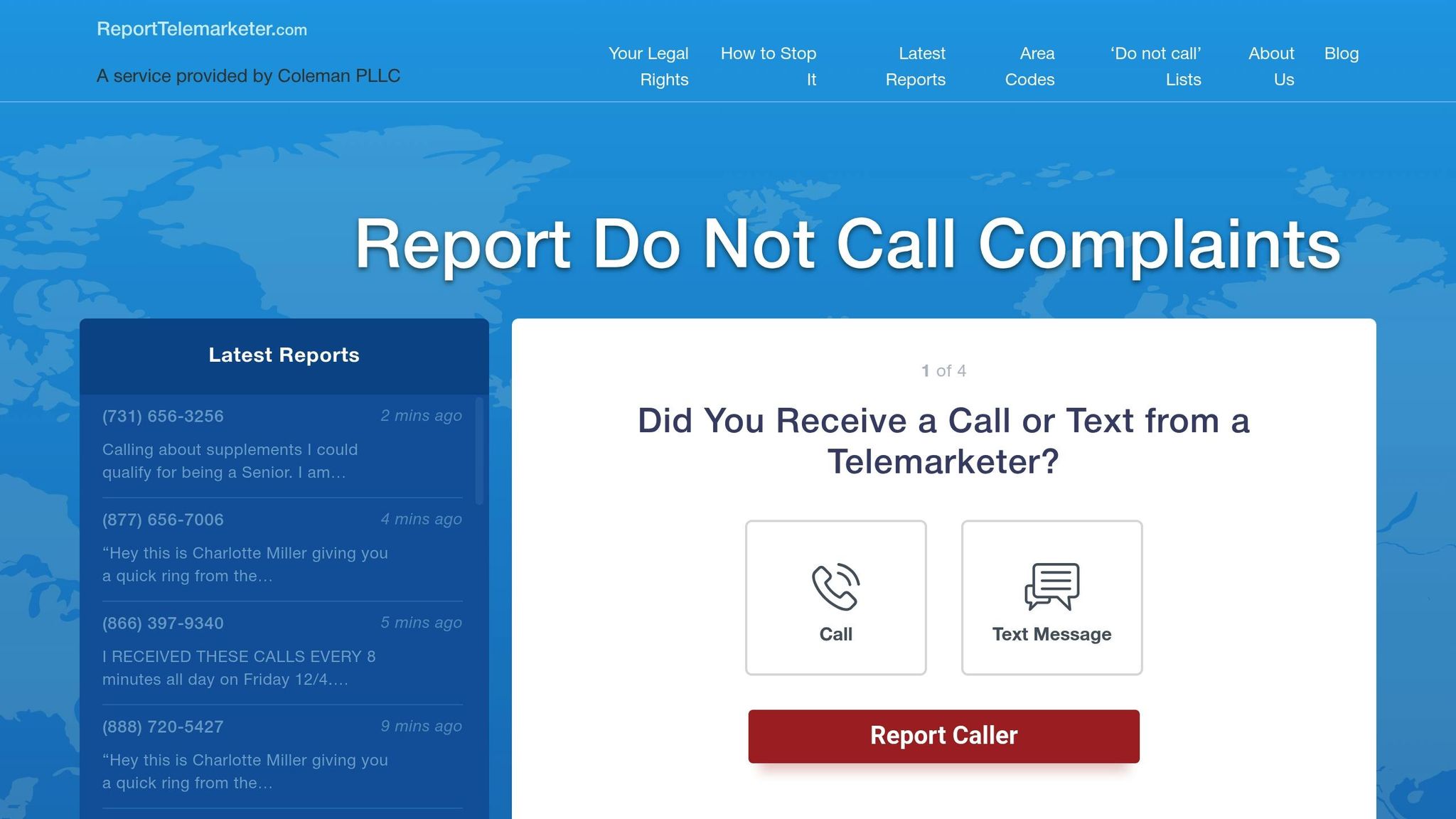
Consumer reporting platforms like ReportTelemarketer.com play a key role in documenting and addressing telemarketing abuses. This free service helps individuals report unwanted calls and texts, investigate potential TCPA violations, and take action to stop the harassment.
The platform allows users to submit detailed reports, including the caller’s number, call or text timestamps, and whether the consumer’s number is on the Do Not Call Registry. It also gathers information on the nature of the message – such as whether it was prerecorded or sent via an autodialer – and the consumer’s consent status. This level of detail is crucial for identifying repeat or willful violations, which can support both private lawsuits and regulatory actions.
After a report is filed, ReportTelemarketer.com’s team uses specialized tools to investigate the telemarketer behind the calls. If they confirm unauthorized activity, they may issue a cease and desist letter or file a formal complaint. In some cases, the platform collaborates with attorneys to recover legal fees directly from the telemarketer, making legal action accessible even for small claims.
The platform also features a "Latest Reports" section, where recent complaints – including caller numbers, timestamps, and violation summaries – are publicly displayed. This transparency helps expose repeat offenders and document ongoing issues. For instance, multiple complaints against the same company or number can reveal systemic noncompliance.
Aggregated data from services like ReportTelemarketer.com is invaluable for identifying patterns of abuse, such as high call volumes from a single number or repeated contact with Do Not Call-listed numbers. This information can be shared with attorneys or regulators as evidence, supporting class actions or individual lawsuits. It also bolsters claims that violations were intentional, increasing the likelihood of favorable outcomes like settlements or court orders.
Since its inception, ReportTelemarketer.com has assisted over 30,000 individuals, offering its services at no cost to consumers. Legal fees are recovered from offending telemarketers, ensuring accessibility for anyone dealing with unwanted calls.
For those facing repeated harassment, the most effective approach is to register on the National Do Not Call Registry, keep a detailed log of unwanted calls or texts, and use platforms like ReportTelemarketer.com in conjunction with filing complaints to the FCC or FTC. This comprehensive strategy builds a strong case against persistent violators. If the harassment continues, consulting an attorney or using a reporting service can help determine whether a lawsuit – individual or class action – is a viable option, potentially leading to financial damages for the consumer and stronger deterrents for telemarketers.
Experts in TCPA litigation emphasize the importance of thorough recordkeeping. Preserving original call logs and electronic evidence can be critical for proving willfulness, which is necessary for treble damages. They also recommend coordinating efforts through class actions or centralized reporting platforms, targeting offenders with clear patterns of abuse, and using legal discovery to uncover internal practices that demonstrate systemic violations of the TCPA.
Conclusion: Protecting Consumers from Repeat Offenders
The TCPA is a powerful tool designed to keep persistent telemarketers in check. By imposing escalating penalties for repeated violations, it ensures that businesses engaging in illegal practices face significant consequences. When offenders make hundreds or even thousands of unauthorized calls or texts, the financial impact can be immense. Courts and regulators are quick to increase penalties when they detect patterns of abuse, which forces businesses to take compliance seriously.
These enforcement measures hit illegal telemarketing where it hurts most – its profitability. By raising the cost of unlawful calls and texts, the law not only deters bad actors but also encourages legitimate businesses to follow the rules. Adopting compliance programs that respect consumer consent, honor quiet hours, and adhere to Do Not Call lists becomes a necessity, not an option. With the combined weight of federal TCPA penalties, state mini-TCPA statutes, and private lawsuits, telemarketers who repeatedly break the law face mounting financial and reputational risks.
Reporting unwanted calls and texts does more than address personal frustrations – it helps authorities identify and act against serial offenders. Many telemarketers try to evade detection by rotating phone numbers or using spoofing techniques, but consumer reports are vital for exposing these practices. Platforms like ReportTelemarketer.com play a pivotal role in this process, collecting reports and coordinating legal actions, such as cease and desist letters or formal complaints, at no cost to consumers. Attorney fees are instead sought from the violators themselves.
"As a consumer protection firm, we use the telephone consumer protection laws to stop telemarketers from harassing consumers", explains Stefan Coleman, Lawyer and Founder of ReportTelemarketer.com.
If you’re receiving unwanted calls or texts, document everything. Save call logs, take screenshots, and keep voicemail recordings. Note the dates, times, and any opt-out requests you’ve made. This information can be submitted to government complaint portals, shared with a consumer rights attorney, or provided to reporting services that assess potential violations of the TCPA or state telemarketing laws.
Federal and state protections work hand in hand to hold repeat offenders accountable. The TCPA sets a nationwide standard, while many states add their own layers of penalties, such as enhanced damages for seniors or additional remedies like license revocation. This multi-layered approach ensures that telemarketers face consequences from multiple angles. Seniors and vulnerable individuals, often targeted by aggressive or fraudulent campaigns, benefit from these extra protections, which aim to deter abuse against them.
Private lawsuits add another layer of enforcement by allowing individuals or groups of consumers to seek damages directly. These lawsuits create additional financial and reputational pressure on telemarketers who repeatedly ignore the law.
Whether you file a government complaint, pursue a private lawsuit, or use a reporting service, your actions strengthen the system and help protect others. Platforms like ReportTelemarketer.com, along with agencies like the FCC and FTC, rely on consumer reports to build cases against repeat offenders. Every report contributes to making illegal telemarketing practices less profitable and far riskier for those who refuse to follow the rules. Together, these efforts form a strong defense against ongoing telemarketing violations.
FAQs
What distinguishes standard TCPA violations from willful ones, and how do these affect penalties for repeat offenders?
The main distinction between standard and willful TCPA violations comes down to intent. Standard violations typically happen when a telemarketer unintentionally breaks TCPA rules – often due to negligence or oversight. In contrast, willful violations involve knowingly ignoring or deliberately breaking the law.
For those who repeatedly violate the TCPA, the penalties can become much steeper. Standard violations carry fines of up to $500 per incident. However, willful violations can result in fines as high as $1,500 for each occurrence. For telemarketers who intentionally and repeatedly disregard the law, these fines can accumulate quickly, acting as a powerful incentive to follow the rules.
What steps can consumers take to document and report telemarketing violations, especially for repeat offenders?
To tackle telemarketing violations, begin by jotting down important details about the unwanted calls or texts. This includes the date, time, caller ID, and any messages left. If the same number contacts you repeatedly, keep a log of those instances – it can help build a stronger case against persistent offenders.
Once you’ve collected this information, you can file a complaint through consumer protection platforms like ReportTelemarketer.com. These services investigate your claims, check for possible legal violations, and take steps to stop the nuisance calls or messages. Thorough documentation plays a key role in increasing the likelihood of effective legal action.
What penalties can telemarketers face under state laws for repeatedly violating the TCPA, especially when targeting seniors and vulnerable individuals?
State laws often tack on extra penalties for telemarketers who repeatedly break the Telephone Consumer Protection Act (TCPA), especially when their actions take advantage of seniors or other vulnerable individuals. These added consequences might include steeper fines, tighter restrictions on telemarketing practices, and in extreme cases, even criminal charges for deliberate or severe violations.
When telemarketers target groups like seniors, they face increased scrutiny and harsher legal repercussions because of the greater risk of exploitation. Many states have specific laws aimed at protecting these populations, which can result in hefty financial penalties or lawsuits for habitual offenders. If you think you’ve been targeted by illegal telemarketing, reporting the incident can help ensure the responsible parties are held accountable.

