

Non-compliance with updated TCPA rules can lead to fines of $500–$1,500 per violation. Starting April 11, 2025, businesses must process opt-out requests within 10 business days, honor revocations made through any reasonable method, and send confirmation texts within five minutes. These changes aim to simplify consent withdrawals and protect consumers from unauthorized communications. Key updates include:
- Reduced processing time: Opt-out requests must be handled in 10 business days (down from 30).
- "Reasonable manner" standard: Consumers can revoke consent via text, email, calls, or informal phrases like "No more texts."
- Confirmation texts: Required within 5 minutes of opt-out requests, with no marketing content allowed.
- Global revocations: Opt-outs apply to all non-emergency communications unless clarified otherwise.
Businesses must also maintain centralized Do Not Contact databases, audit opt-out records, and update consent regularly to avoid violations. With TCPA class-action lawsuits rising by over 39% in early 2024, compliance is critical to avoid costly penalties and safeguard consumer trust.
2025 TCPA Regulations: What You Need to Know About Updated Opt-Out Rules
sbb-itb-a8d93e1
TCPA Opt-Out Compliance Checklist
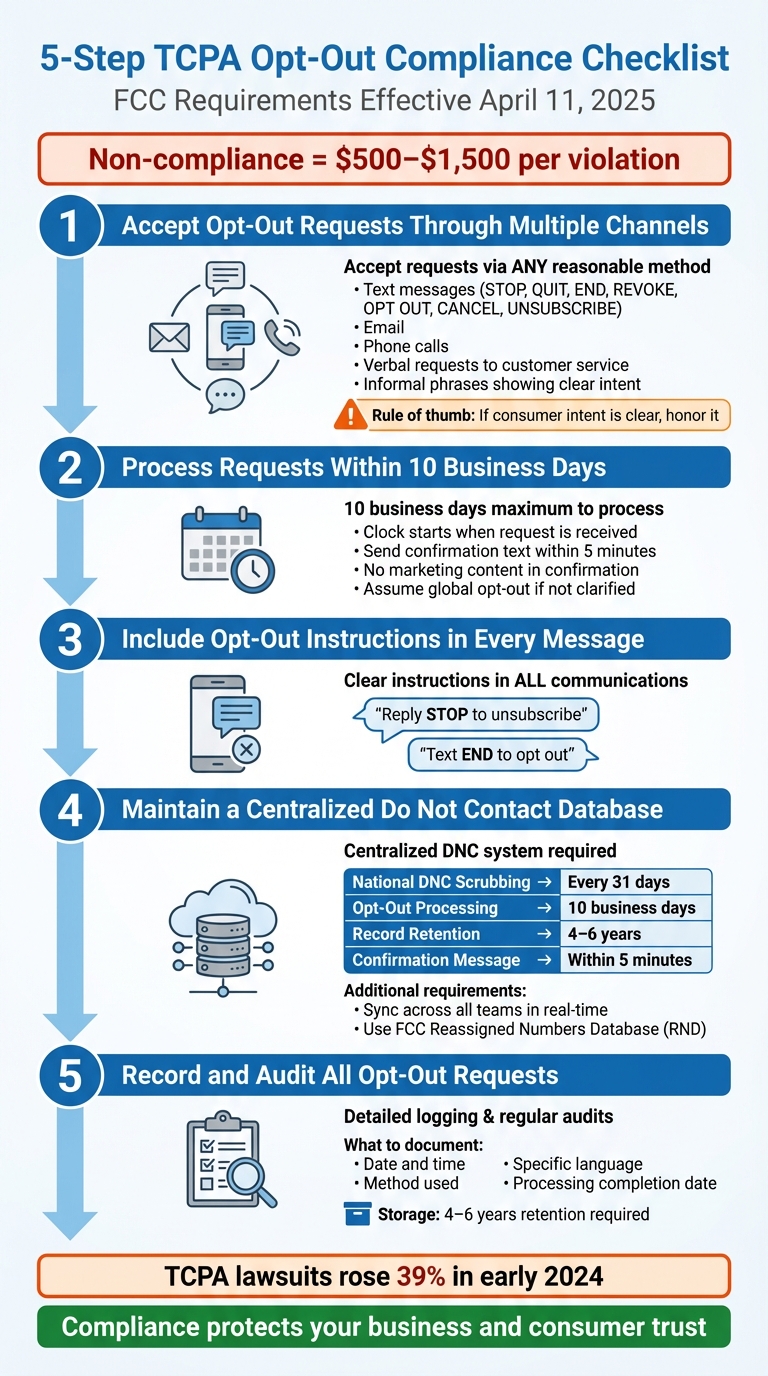
5-Step TCPA Opt-Out Compliance Checklist for 2025
Creating a compliant opt-out system involves five critical steps. These steps align with the FCC requirements that took effect on April 11, 2025, and help reduce the risk of statutory damages.
Accept Opt-Out Requests Through Multiple Channels
Your telemarketing system must accommodate opt-out requests through any reasonable method – not just specific keywords or channels. This includes accepting revocations via text message, email, phone calls, and even verbal requests made to customer service representatives.
The FCC recognizes keywords like STOP, QUIT, END, REVOKE, OPT OUT, CANCEL, and UNSUBSCRIBE as valid signals. It’s also important to train staff to identify informal language that clearly indicates a revocation. For instance, phrases that express intent to opt out should be honored. As ActiveProspect puts it:
The rule of thumb: if the consumer’s intent is clear, honor it. If the intent is not clear, have an internal process with criteria, examples, guidance, and document the decisions.
For prerecorded or AI-generated calls, you must include an automated, interactive opt-out feature. This allows consumers to stop future calls immediately by pressing a key or using a voice command. Since January 2024, the FCC has classified AI-generated content as an "artificial voice", subjecting it to the same opt-out rules as traditional robocalls.
Once opt-out requests are received, the next step is to ensure they are processed quickly.
Process Requests Within 10 Business Days
After receiving an opt-out request, you have up to 10 business days to process and honor it across all applicable campaigns. The clock starts as soon as the request is received. Within five minutes of the request, you may send a single confirmation text to clarify its scope – such as whether it applies only to marketing messages or all communications. This confirmation must not include any marketing content. If no clarification is provided, assume the opt-out applies to all communications.
Include Opt-Out Instructions in Every Message
Every telemarketing communication – whether a text, email, or prerecorded call – must include clear opt-out instructions. For example, text messages should say something like "Reply STOP to unsubscribe" or "Text END to opt out." Providing simple and accessible instructions ensures consumers can easily revoke their consent.
Maintain a Centralized Do Not Contact Database
A centralized "Do Not Contact" database is crucial for preventing data silos and ensuring compliance. This system must address two key obligations: the National Do Not Call (DNC) Registry and your company-specific DNC list.
- Scrub outbound calling lists against the National DNC Registry at least once every 31 days to qualify for safe harbor protections.
- Use the FCC’s Reassigned Numbers Database (RND) to identify numbers that have changed ownership since consent was originally obtained.
Ensure your database syncs in real time across marketing, customer service, and compliance teams.
| Requirement | Standard/Frequency |
|---|---|
| National DNC Scrubbing | Every 31 days |
| Opt-Out Processing Window | 10 business days |
| Record Retention | 4–6 years |
| Clarification Message Timing | Within 5 minutes |
Record and Audit All Opt-Out Requests
Keep a detailed log of every opt-out request, including the date, time, method, and specific language used. These records should be stored for four to six years, as required by the TCPA and FTC Telemarketing Sales Rule.
Your audit trail should document when each request was received, how it was processed, and when it was completed. If a consumer claims they opted out but continued to receive communications, your records must confirm whether the request was honored within the appropriate timeframe.
Conduct regular spot checks on your consent documentation and DNC scrubbing logs to verify your system’s effectiveness. Automated tools, such as session replays or lead certifications, can provide strong evidence in case of disputes.
These foundational steps are crucial for immediate opt-out compliance and lay the groundwork for broader TCPA adherence. By following these measures, you not only meet FCC requirements but also create a robust system for managing consumer preferences effectively.
Long-Term Compliance Strategies
Meeting the April 11, 2025 FCC requirements is just the beginning. Keeping up with TCPA compliance demands consistent effort in three key areas: staff training, consent management, and technology infrastructure. These strategies go beyond immediate compliance, helping businesses maintain adherence over time.
Train Staff to Identify Opt-Out Requests
Your team needs to understand that consumers can revoke consent using any reasonable method – not just by texting "STOP." Any clear expression of intent must be honored immediately.
ActiveProspect advises: "The rule of thumb: if the consumer’s intent is clear, honor it. If the intent is not clear, have an internal process with criteria, examples, guidance, and document the decisions".
To make this stick, implement role-specific onboarding and quarterly training sessions. Use interactive tools like e-learning modules, real-world case studies, and pre-call checklists to reinforce compliance.
Intelemark, a telemarketing firm, highlights that "compliance isn’t a onetime thing. Teams receive frequent workshops and webinars to introduce new guidelines, share lessons learned on recent calls, and introduce new tools".
Regular audits are also key. Monitor live or recorded calls to ensure agents are following disclosure protocols and recognizing opt-out signals. Failure to honor these requests can lead consumers to report robocall violations to regulatory bodies. These practices ensure your team consistently meets compliance standards while reinforcing the immediate opt-out steps discussed earlier.
Accurate record-keeping is just as important as thorough training.
Update Consent Records Regularly
Consent isn’t permanent. To avoid contacting people who no longer wish to hear from you, run re-consent campaigns every 6–12 months for inactive contacts or leads acquired over a year ago. Keep in mind that Established Business Relationship (EBR) exemptions expire after 18 months for purchases and just 3 months for inquiries.
Use automated tools to identify phone numbers that have been reassigned since you obtained consent.
As DNC.com warns: "If you can’t prove you have TCPA consent, then it’s like you never did".
By integrating re-consent efforts into your compliance framework, you can maintain a clean and accurate database. This not only supports immediate opt-out processing but also ensures you’re prepared for audits.
To further reduce human error, automation plays a crucial role.
Implement Automated Compliance Systems
Invest in software that centralizes and syncs consent data across your CRM, dialers, and marketing platforms in real time. These systems should automatically scrub contact lists against National, State, and internal DNC registries before each campaign.
Choose tools that can interpret natural language opt-outs beyond standard keywords, recognizing phrases that clearly indicate a desire to stop communications. Automated systems should also enforce legal calling hours (8:00 a.m. to 9:00 p.m. local time) and apply frequency caps automatically. Additionally, they must create immutable audit trails that log consent captures, timestamps, and opt-out events for the required 4–5 year retention period.
The Pedowitz Group suggests viewing "TCPA as a design constraint, not a blocker: engineer consent, controls, and evidence into your revenue engine".
Automation not only helps with immediate opt-out processing but also strengthens long-term compliance by creating a scalable, efficient system that supports your business growth.
How ReportTelemarketer.com Can Help
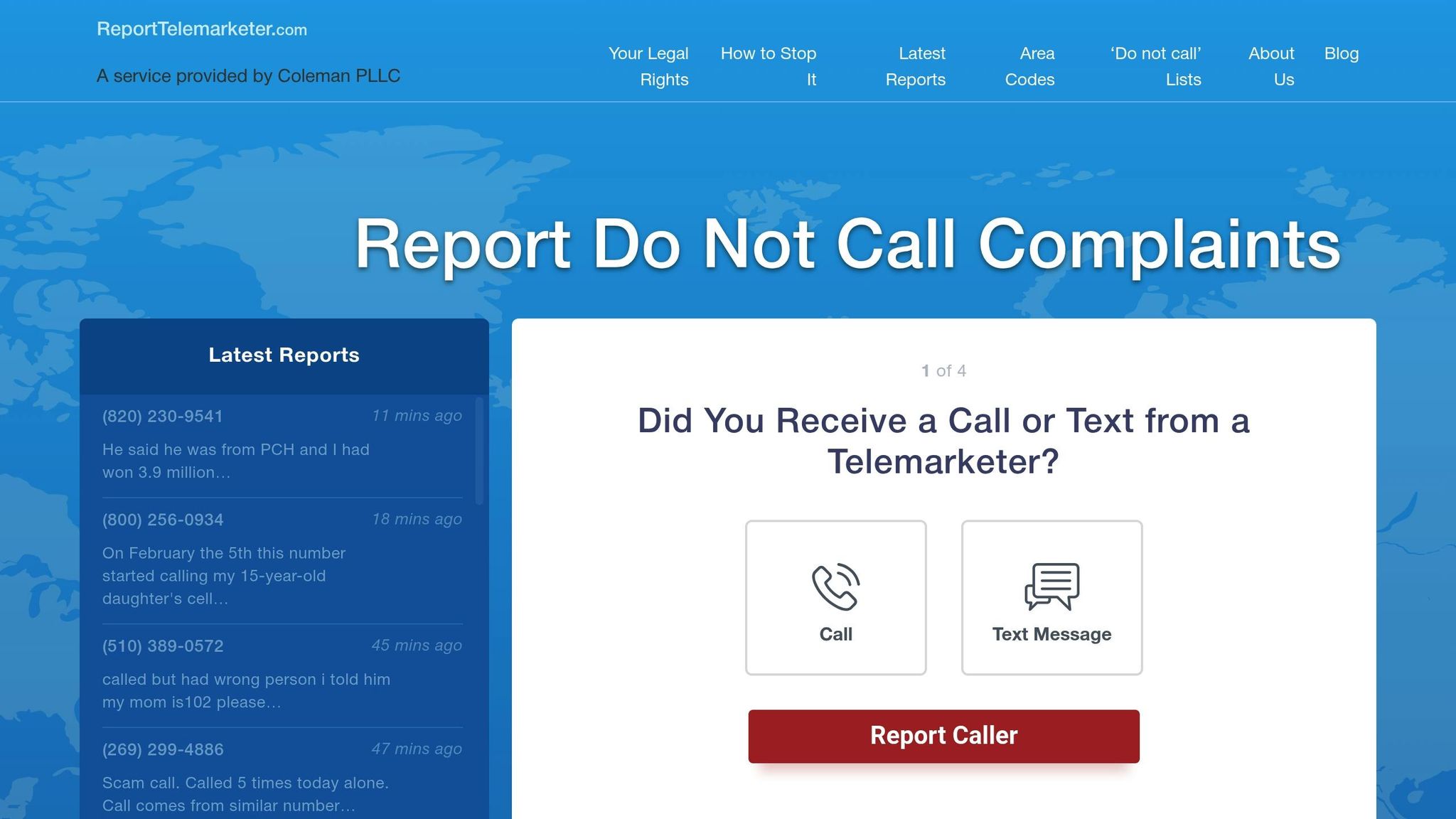
Stopping telemarketers who violate the Telephone Consumer Protection Act (TCPA) can feel overwhelming, but that’s where ReportTelemarketer.com steps in. This platform provides a way to take action when telemarketers ignore opt-out requests or make unsolicited robocalls. It’s a free service designed to help consumers report violations and hold businesses accountable.
Services Offered by ReportTelemarketer.com
ReportTelemarketer.com simplifies the process of reporting unwanted calls and texts. Once a report is submitted, their legal team uses advanced tools to identify TCPA violations, such as failing to honor opt-out requests within the required 10 business days. From there, the team takes action by sending cease-and-desist letters or filing formal complaints against the offending businesses. Importantly, any legal fees are recovered directly from the telemarketers, ensuring the service remains free for consumers. This proactive approach not only addresses individual complaints but also discourages future violations.
Benefits of Using ReportTelemarketer.com
One major advantage of using ReportTelemarketer.com is the access to expert legal support. Consumers don’t have to navigate the complexities of TCPA protection laws on their own. The platform also keeps user information private while making details about reported telemarketers publicly available, helping to alert others about these non-compliant practices.
For those dealing with repeat offenders, the platform even helps consumers seek financial compensation. With settlements for TCPA violations often ranging from $10,000 to $250,000, this service offers a meaningful way to push back against unlawful activity. The presence of platforms like ReportTelemarketer.com highlights the growing importance of TCPA compliance, as businesses face not only financial penalties but also reputational risks if they fail to follow the rules.
Conclusion
Key Steps for TCPA Opt-Out Compliance
For any business involved in telemarketing, adhering to TCPA regulations isn’t optional – it’s a must. To stay compliant, businesses need to follow a clear checklist: accept opt-out requests through any reasonable method, process these requests within 10 business days, maintain a centralized Do Not Contact database, and retain records for at least four years. Non-compliance comes with hefty financial penalties, making the cost of proper systems a worthwhile investment.
The updates effective April 11, 2025, require businesses to act promptly. As ActiveProspect advises: "The rule of thumb: if the consumer’s intent is clear, honor it". This simple yet crucial principle should guide how every opt-out request is handled. By following these steps, businesses not only reduce risks but also lay the groundwork for external compliance support.
Using ReportTelemarketer.com for Compliance Support
When businesses fail to meet these requirements, consumers now have a powerful tool to hold them accountable. ReportTelemarketer.com offers free support by identifying violations, issuing cease-and-desist letters, and filing formal complaints – all at no cost to the consumer. This creates strong motivation for businesses to maintain compliance, as the consequences of neglect include fines, legal action, and damage to their reputation.
Ensuring compliance with telephone opt-out regulations involves more than just internal processes. It also empowers consumers with tools like ReportTelemarketer.com to demand accountability. For businesses, treating compliance as an opportunity to build trust and safeguard their reputation can turn a legal obligation into a competitive edge. Whether you’re setting up these systems for the first time or reviewing current practices, this checklist offers a practical guide to staying compliant while fostering a trustworthy market environment.
FAQs
What qualifies as a “reasonable” opt-out?
Under the TCPA, a "reasonable" opt-out method is one that’s clear and easy for consumers to use. This could include options like responding with a simple keyword such as “STOP” via text or using voice commands to request no further contact. Once a consumer makes such a request, businesses are required to process it within ten business days. This ensures consumers have control over unwanted communications while giving businesses straightforward rules to follow.
Do opt-outs apply to all messages or just marketing?
Businesses must respect opt-out requests for both marketing and informational messages. Once a consumer opts out, companies are required to stop sending future communications, with the exception of emergency alerts. This aligns with TCPA regulations and prioritizes consumer preferences.
What proof should we keep to defend against TCPA claims?
To protect your business from TCPA claims, it’s crucial to keep clear and detailed records of consumer consent. This includes documenting when consent was given and how it was obtained. Alongside this, maintain comprehensive call and message logs to show that your communications align with TCPA guidelines. Solid documentation can be a key safeguard for your business.

