
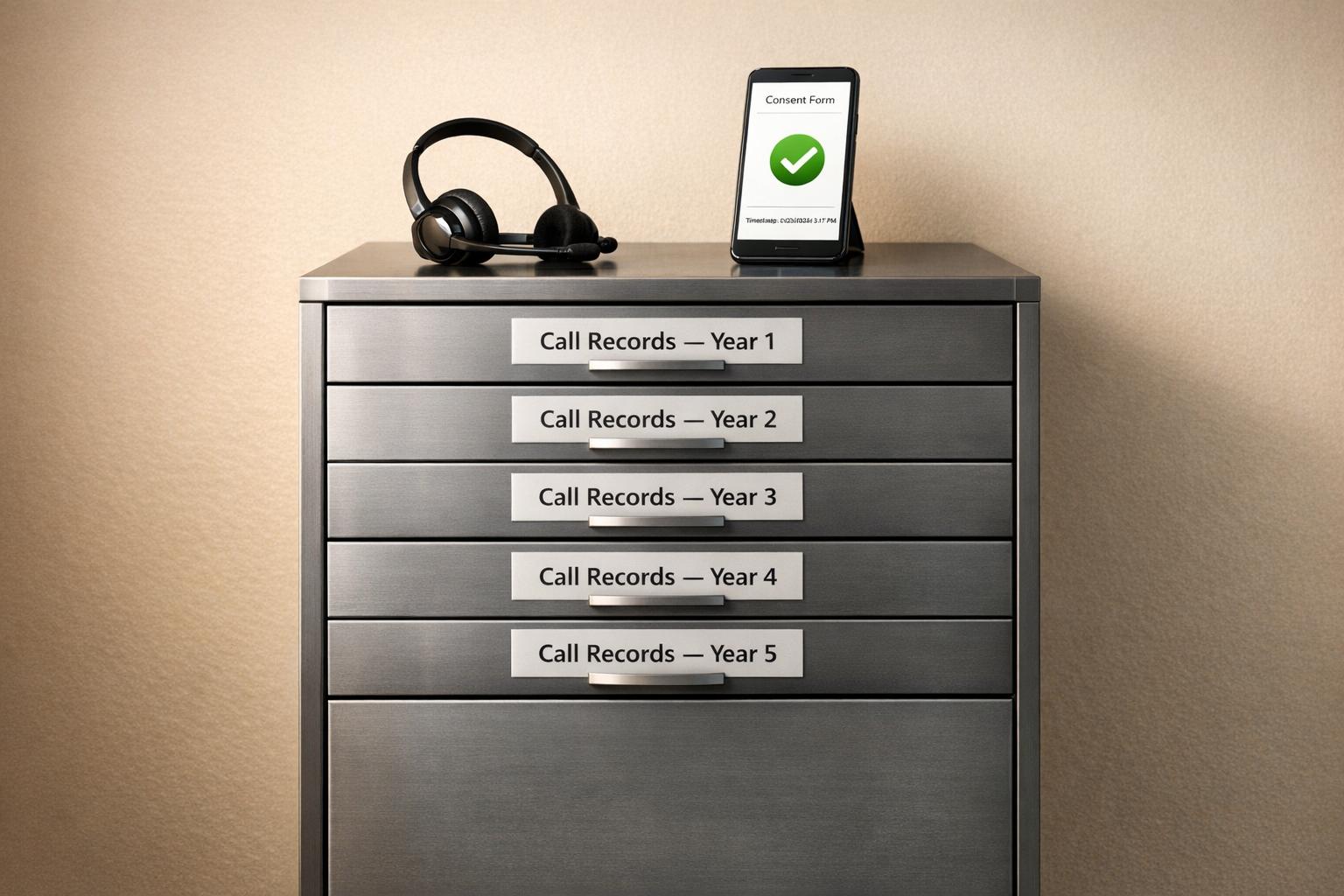
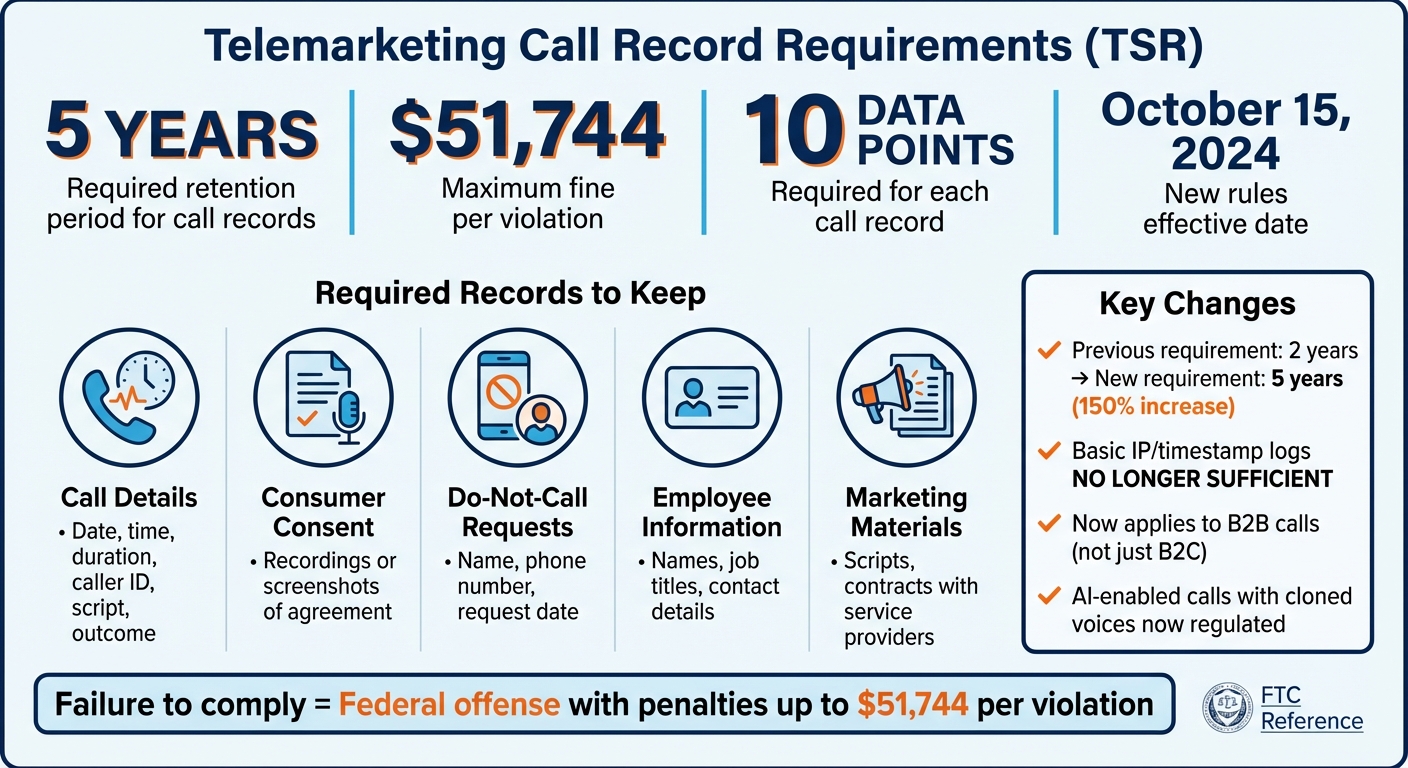
Telemarketers must keep detailed call records for five years, as required by the Federal Trade Commission (FTC) under the Telemarketing Sales Rule (TSR). This rule ensures accountability and helps regulators investigate and report unwanted phone calls. Records must include:
- Call details: date, time, duration, caller ID, script used, and call outcome.
- Consumer consent: proof of agreement to be contacted, including recordings or screenshots.
- Do-Not-Call requests: consumer’s name, phone number, and request date.
- Employee information: names, job titles, and contact details.
- Marketing materials and contracts with service providers.
Failure to comply can result in fines of up to $51,744 per violation. The updated rules, effective October 15, 2024, extend the retention period from two to five years and tighten documentation requirements, particularly for consent records. These changes aim to improve enforcement and protect consumers from improper telemarketing practices.
TSR Call Record Requirements: 5-Year Retention Rules and Penalties
Big New FTC Rules for Phone Sales – Urgent!
sbb-itb-a8d93e1
TSR Requirements for Call Record Retention
The Telemarketing Sales Rule (TSR), outlined in 16 CFR § 310.5, lays out strict recordkeeping rules for telemarketing operations. Both sellers and telemarketers are required to maintain detailed records of their activities, ensuring there’s an audit trail regulators can use when investigating potential violations. These rules specify exactly what records need to be kept and how long they must be retained.
What Call Records Include
Call records under the TSR go beyond just phone numbers and timestamps. For every telemarketing call – whether it’s incoming or outgoing – companies must document key details. This includes the identities of the parties involved, call parameters, message content, caller ID information, and the call’s disposition. The disposition tracks the outcome of the call, such as whether it was answered, dropped, or forwarded to another number or IP address.
In addition to call details, telemarketers are required to keep other records, including:
- Employee information (names, any fictitious names used, home addresses, phone numbers, and job titles)
- Copies of all marketing materials and scripts
- Contracts with service providers
- Documentation of Do-Not-Call requests
- Records of express consent
However, telemarketers who manually dial a single number are not required to retain caller ID or robocall disposition records.
Once these records are created, they must be preserved according to specific retention timelines.
The 5-Year Retention Period
The TSR mandates that all required records be retained for a five-year period from the date they are created. This is an increase from the previous two-year requirement, giving regulators more time to investigate complex cases.
For most records, the retention clock starts ticking from the date they are created. However, advertising materials and service provider contracts have their retention period begin once they are no longer in use or have expired. In cases where a business closes or changes ownership, responsibility for maintaining the records falls to either the original business owner or the successor. These records must be preserved for the remainder of the five-year period.
While sellers and telemarketers can agree in writing on which party will handle the recordkeeping, the seller ultimately holds responsibility for ensuring compliance and must maintain access to the records.
Types of Records Telemarketers Must Keep
Telemarketers are required to maintain specific records across several categories to comply with the Telemarketing Sales Rule (TSR). These records ensure transparency and help regulators verify adherence to the law.
Call Detail Records
Every telemarketing call generates a detailed record that includes key information about the call. This covers the telemarketer and seller involved, the call’s subject, the intended recipient (whether a consumer or business (such as real estate agents cold calling)), and whether prerecorded messages were used. Essential details include:
- Caller and recipient phone numbers
- Date and time (logged in Coordinated Universal Time)
- Call duration and outcome
- Scripts and prerecorded messages used
- Caller ID and proof of authorization
For manually dialed single numbers, caller ID and call disposition details can be omitted. Additionally, telemarketers must document any consumer instructions or consent provided during these calls.
Do-Not-Call Requests
When a consumer asks not to be contacted, telemarketers must log their name, phone number, the date of the request, and the associated seller or charity. This documentation helps protect against unintentional violations of do-not-call rules and helps consumers stop spam calls. As explained by legal experts at Venable LLP:
"The newly added recordkeeping requirements are meant to help the FTC identify the telemarketer and seller and to link the content of the telemarketing calls with the call detail records to determine TSR violations".
Records of explicit consumer approvals are also maintained under express consent documentation.
Express Consent Records
For calls requiring prior consent, telemarketers must keep detailed records of the consumer’s name, phone number, the original consent request, its purpose, the consumer’s consent, and the date it was obtained. Using shortcuts like an IP address and timestamp is not sufficient.
If consent is given verbally, telemarketers must retain recordings of the entire interaction, including the request and the consumer’s agreement. For online consent, companies should save a screenshot of the webpage along with metadata showing the consumer’s submission. These records are critical for defending against claims of unauthorized calls.
Verifiable Authorizations
When a consumer agrees to be charged, particularly in free-to-pay conversions or when preacquired information is involved, telemarketers must keep verifiable authorization records. These include:
- The consumer’s identity
- How the authorization request was presented
- The request’s purpose
- The consumer’s authorization and the date it was granted
Failing to maintain these records can lead to severe penalties, with fines as high as $50,000 per call or $51,744 per violation. Keeping accurate and complete records is not optional – it’s a safeguard against costly regulatory actions.
Recent Changes to TSR Recordkeeping Rules
The Federal Trade Commission (FTC) has introduced updates to the Telemarketing Sales Rule (TSR) in 2024, refining the requirements for recordkeeping. One of the most notable changes is the extension of the retention period for telemarketing records. Previously set at 24 months, this has now been increased to 5 years – a 150% jump. While the final rule was announced in early 2024, these new requirements officially took effect on October 15, 2024.
The updated rules are designed to enhance the FTC’s ability to identify telemarketers and sellers, as well as link call content to call detail records to uncover potential TSR violations. A key part of this update involves expanding the scope of call data collection. Telemarketers must now document 10 specific data points for each call. These include whether the call was business-to-business (B2B) or business-to-consumer (B2C), the call’s outcome (answered, dropped, or transferred), and details about any prerecorded messages used during the interaction.
Another significant change is the tightening of consent documentation standards. Basic logs of IP addresses and timestamps are no longer enough. For online consent, telemarketers are now required to save screenshots of the consent page, complete with submission metadata. For verbal consent, companies must retain recordings of the entire exchange, covering both the request for consent and the consumer’s affirmative response.
The scope of the rules has also been broadened. They now apply to B2B calls, prohibit material misrepresentations, and impose strict regulations on AI-enabled calls that use cloned voices. Violations of these provisions can result in penalties of up to $51,744 per infraction.
Penalties for Failing to Keep Required Records
Keeping accurate records isn’t just about staying organized – it’s about avoiding serious legal trouble. Failing to comply with TSR recordkeeping rules is considered a federal offense. For telemarketers and sellers, the penalties for neglecting this responsibility can be steep.
Civil penalties can climb as high as $51,744 per violation, with some reports suggesting fines of up to $50,000 for each call. Now, imagine a telemarketing campaign involving thousands of calls – those fines could quickly spiral into millions of dollars in liability.
Enforcement isn’t limited to a single agency either; multiple authorities can step in to take action. However, there is a way to reduce the risk of these penalties: safe harbor provisions. If errors are identified and corrected promptly, telemarketers may avoid some of the harsher consequences.
"The failure to maintain proper records is deemed a violation of the TSR and subject to monetary civil penalties of up to $51,744, per violation/call." – Richard B. Newman, FTC Defense Lawyer, Hinch Newman LLP
Safe harbor provisions offer protection for those who make inadvertent mistakes, provided they meet specific conditions. These include having documented procedures in place, training staff, monitoring compliance, and correcting errors within 30 days of discovering them. Without these safeguards, even small missteps can lead to hefty fines.
How ReportTelemarketer.com Helps Consumers
With strict regulations in place and penalties for violations, consumers now have a practical way to protect themselves from unwanted telemarketing. Understanding your rights under the Telemarketing Sales Rule (TSR) is one thing, but enforcing those rights can be daunting. That’s where ReportTelemarketer.com steps in, providing tools to stop intrusive calls and texts.
The platform offers a three-part solution: reporting violations, initiating cease-and-desist actions, and educating consumers on their rights.
Reporting Unwanted Calls
Thanks to the updated TSR guidelines, ReportTelemarketer.com simplifies the process of documenting and reporting violations. The platform helps you track telemarketers who break the rules by collecting key details like the calling number, date, time, and call duration. This documentation is essential, especially when telemarketers claim they have your consent but fail to provide the legally required proof.
Filing Cease-and-Desist Letters
Reporting a call is just the beginning. ReportTelemarketer.com uses advanced tools to investigate reported telemarketers and take direct action to stop the harassment. This includes filing cease-and-desist letters or even formal complaints on your behalf. Best of all, the service operates on a contingency basis, meaning you won’t face any upfront costs.
Understanding Your Rights
The platform also serves as an educational resource, helping you understand telemarketing laws and how to assert your rights. For example, telemarketers are required to retain records for five years. This knowledge gives you an advantage when disputing unwanted calls. The platform’s legal team is there to guide you through consumer protection laws, ensuring you feel informed and empowered. This aligns perfectly with the TSR’s goals of promoting accountability and fairness.
Conclusion
The TSR now requires telemarketers to retain detailed call records for five years, up from the previous two-year requirement. This longer retention period strengthens the ability to identify violations and hold telemarketers accountable.
To comply, telemarketers must meet strict documentation standards. Each call record must include 10 specific data points. Failure to adhere to these rules can result in hefty penalties – up to $50,000 per call. Additionally, the rules demand thorough proof of consent. Basic details like IP addresses and timestamps are no longer sufficient; telemarketers must provide comprehensive records to support claims of consent.
This extended timeframe benefits consumers by allowing them to report annoying phone calls, even those made years earlier. If telemarketers fail to produce the required documentation, it strengthens your case when challenging violations.
FAQs
When does the 5-year recordkeeping period start for telemarketing records?
The 5-year period for keeping telemarketing records starts from the day the record is created. This rule helps ensure adherence to federal regulations and provides proper documentation for telemarketing activities.
What proof counts as valid consumer consent under the updated TSR rules?
Valid consumer consent under the updated TSR rules requires express informed consent for telemarketing transactions. This means businesses must keep records, such as recordings, where customers clearly state their agreement.
What should I do if a telemarketer claims I consented but won’t provide records?
If a telemarketer insists that you gave consent but refuses to back it up, ask for written proof. By law, telemarketers must keep call records for up to five years to support such claims. If they can’t or won’t provide this documentation, it might be time to report them to consumer protection agencies.

