
In 2025, TRAI introduced major changes to combat and stop spam calls in India, addressing long-standing issues like delays in spam call reporting, misuse of 10-digit numbers, and weak enforcement. Key updates included:
- Faster Complaint Handling: Telecom operators now have 5 days (down from 30) to resolve issues. Consumers get 7 days (up from 3) to report spam.
- Stronger Penalties: Fines range from ₹200,000 ($2,400) for first offenses to ₹1 million ($12,000) for repeat violations.
- Digital Consent Framework: A system to verify and manage customer permissions in real time.
- AI-Powered Spam Detection: Telecom providers use machine learning to block billions of spam calls and detect suspicious patterns.
- Sender Traceability: All promotional messages are routed through secure platforms with clear labeling (e.g., "-P" for promotions).
The results were immediate: spam complaints dropped by 28.8%, and over 1.88 million telecom resources were disconnected. These reforms, combined with India’s Digital Personal Data Protection Act, aim to protect consumer privacy and ensure stricter compliance.
While progress has been made, challenges like spam on OTT platforms and evolving fraud tactics remain. Continuous updates and enforcement are essential to keep spammers in check.
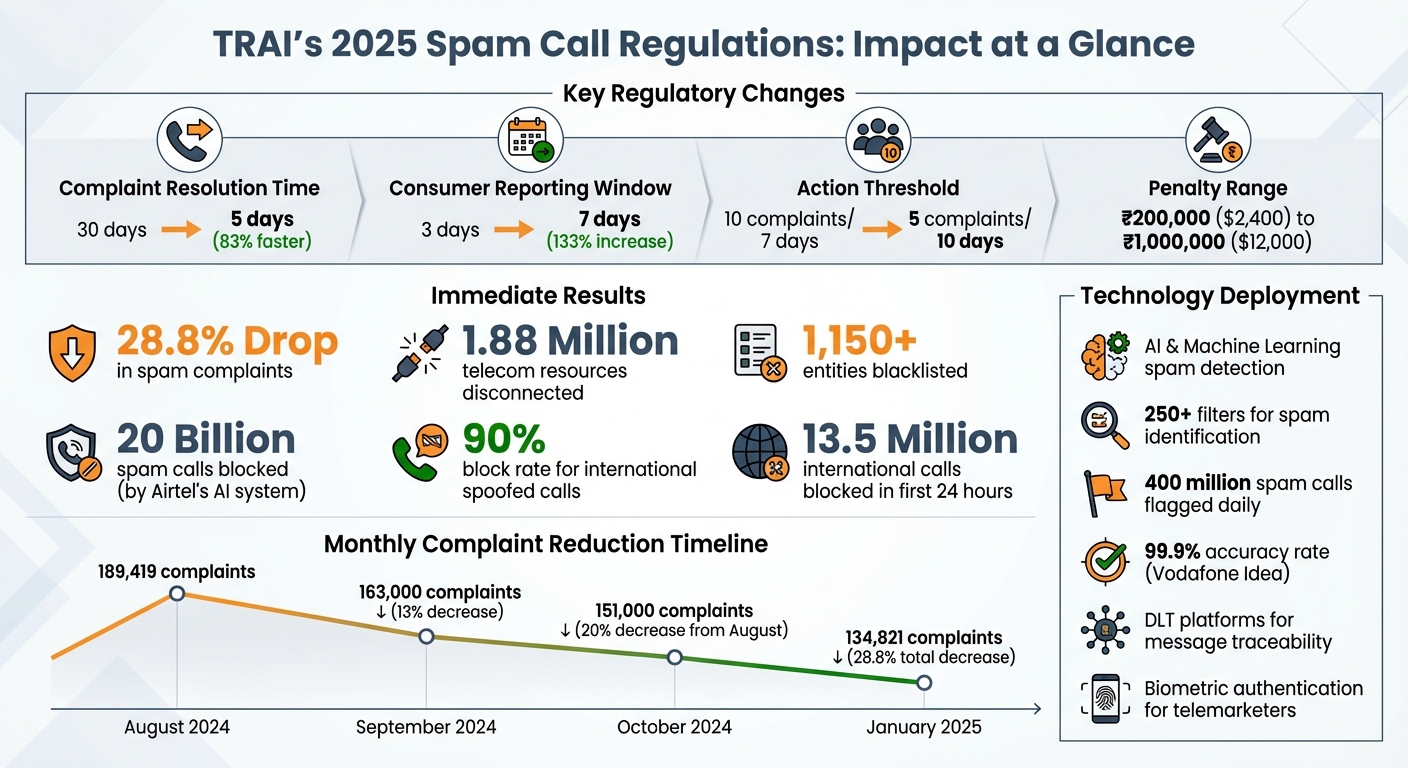
TRAI 2025 Spam Call Regulations Impact: Key Statistics and Results
TRAI‘s New Traceability Guidelines Explained
These guidelines aim to make it easier for consumers to report unwanted phone calls and hold telemarketers accountable.
sbb-itb-a8d93e1
What Changed in TRAI’s 2025 Regulations
TRAI’s 2025 amendments introduced three major changes aimed at reshaping telemarketing practices: a Digital Consent Framework to verify customer permissions, faster complaint resolution timelines to hold telemarketers accountable, and stricter sender authentication measures to ensure traceability of promotional messages. These updates build upon earlier efforts to address loopholes that allowed spam to thrive, setting the stage for more advanced solutions to combat unwanted calls and stop spam text messages.
Digital Consent Framework
On June 16, 2025, TRAI launched a pilot program for its Digital Consent Framework, starting with the banking and financial services sector. This initiative creates a unified digital platform where customer consent is recorded, verified, and audited in real time, ensuring that consent is both traceable and legitimate.
"The issue is that a lot of entities claim to have the consent of users for receiving commercial calls and messages… Therefore, the regulator wants the consent to be recorded digitally and also integrated into the new consent mechanism", said Anil Kumar Lahoti, Chairman of TRAI.
Once a company records consent, consumers receive a confirmation SMS with an immediate opt-out option. Additionally, biweekly summaries are sent with secure links to review or revoke permissions. If a customer opts out, the sender is prohibited from requesting consent again for 90 days. For ongoing transactions, consent is valid for a maximum of seven days.
Faster Complaint Resolution Timelines
The complaint resolution process has been revamped to ensure quicker action and stricter penalties. First-time offenders now face a 15-day suspension of all outgoing services, while repeat violations can result in a one-year disconnection and blacklisting across telecom providers.
| Feature | Pre-2025 Regulation | 2025 Amendment |
|---|---|---|
| Complaint Resolution Time | 30 days | 5 days |
| Reporting Window | 3 days | 7 days |
| Action Threshold | 10 complaints/7 days | 5 complaints/10 days |
Telecom operators that fail to enforce these rules face hefty fines: ₹200,000 ($2,400) for a first offense, ₹500,000 ($6,000) for a second, and ₹1,000,000 ($12,000) for subsequent violations.
Sender Authentication and Traceability Requirements
To enhance transparency and accountability, all promotional messages must now pass through TRAI-approved Distributed Ledger Technology (DLT) platforms, ensuring tamper-proof records from sender to recipient. Message headers are also required to include specific suffixes to clarify the nature of the communication:
- "-P" for Promotional messages
- "-S" for Service-related messages
- "-T" for Transactional messages
- "-G" for Government communications
Additionally, promotional calls are restricted to the 140 series, while transactional and service calls use the new 1600 series. The use of regular 10-digit mobile numbers for telemarketing is strictly banned, with violations leading to immediate disconnection.
Telemarketers must now undergo physical verification, biometric authentication, and link their registration to a valid mobile number. To further crack down on spam, telecom operators are required to deploy AI-powered spam filters and honeypots (dummy numbers) to detect suspicious call patterns in real time.
These reforms not only tighten regulatory control but also lay the groundwork for leveraging technology to detect and prevent spam – a subject explored in the following section.
Technology Used to Stop Spam Calls
The Telecom Regulatory Authority of India (TRAI) introduced groundbreaking regulations for 2025, requiring telecom operators to adopt advanced technologies to block spam calls proactively. This marks a shift from merely addressing complaints to actively identifying and stopping unwanted calls before they reach users.
AI and Machine Learning for Spam Detection
Telecom operators are now leveraging AI and machine learning to analyze call patterns in real time. These systems identify spam by spotting unusual behaviors like high call volumes, extremely short call durations, or irregular call patterns.
For instance, in September 2024, Bharti Airtel launched a machine learning system equipped with 250 filters to detect various spam types, including scams related to banking and fraudulent marketing. These measures also help in stopping real estate agent cold calls and other unsolicited solicitations. This system tracks suspicious activities like frequent SIM swaps – such as changing a SIM card five times in a single month – and uses geolocation data to verify the legitimacy of calls. By October 2025, this technology had successfully blocked over 20 billion spam calls.
Meanwhile, Vodafone Idea (Vi) integrated its proprietary algorithm with data from the Department of Telecommunications’ "Chakshu" portal. Speaking about its accuracy, Rohit Misra, Vice-president of Digital Operations at Vi, noted:
"Today, if we are alerting a user about a likely spam caller, 99.9% of the time this turns out to be accurate".
By December 2025, operators flagged approximately 400 million spam calls daily. Of these, 75 million were flagged based on matches with customer registers, while 320 million came from regular 10-digit numbers. Telecom providers also utilize honeypots – dedicated systems designed to collect data on spammers – to enhance their detection capabilities.
These AI-powered solutions work alongside stricter regulations targeting auto-dialers.
Advance Notifications for Auto-Dialers
In addition to AI-driven detection, advance notifications add another layer of accountability. Companies using auto-dialers must inform their telecom provider before launching campaigns. Promotional calls are assigned the 140 series, while transactional messages use the 1600 series, making it easier to identify the nature of the communication.
This notification requirement allows telecom operators to monitor for misuse. If an auto-dialer operates outside its declared purpose, its services are immediately suspended.
To further strengthen these measures, providers use Distributed Ledger Technology (DLT) to maintain secure, tamper-proof records of auto-dialer campaigns. This system also incorporates URL whitelisting, which blocks SMS containing unapproved web links. For example, if a bank sends a link that hasn’t been pre-approved, the system automatically prevents the message from being delivered, effectively stopping phishing attempts.
How the 2025 Rules Affected Spam Call Volumes
The stricter regulations introduced in 2025 had an immediate impact on spam call volumes. These rules reshaped telemarketing practices and significantly cut down the number of unwanted calls. The results were quickly noticeable, with measurable drops in consumer complaints.
Drop in Monthly Consumer Complaints
Consumer complaints about spam calls saw a steep decline as soon as the new rules were implemented. By September 2024, complaints fell to 163,000, marking a 13% decrease in just one month. The downward trend continued into October 2024, with complaints dropping further to 151,000 – a 20% reduction compared to August.
This progress was driven by faster response times and stricter thresholds for enforcement. Previously, penalties were triggered after 10 complaints in 7 days, but under the new rules, action is taken after just 5 complaints within 10 days. This quicker enforcement cycle left spammers with less time to target consumers before facing consequences.
The impact wasn’t limited to domestic calls. TRAI’s upgraded spam-tracking system achieved an impressive 90% block rate for international spoofed calls. In its first 24 hours, the system identified and blocked 13.5 million incoming international calls that were disguised as Indian numbers. As complaints dropped, enforcement actions ramped up, leading to a sharp decline in non-compliant telemarketers.
Fewer Blacklisted Telemarketers
The tougher penalties pushed telemarketers to comply with the new regulations. Between September and October 2025, TRAI blacklisted 318 telemarketing companies that failed to register, in one of its most aggressive enforcement efforts. This crackdown significantly reduced new violations.
Violators now face immediate disconnection, up to two years of blacklisting, and heavy fines. Telecom providers are also held accountable, with escalating financial penalties for repeated violations.
To avoid these consequences, over 13,000 principal entities registered their entire message chains with TRAI, ensuring full traceability of messages from sender to recipient. TRAI made it clear that compliance was mandatory, stating:
"All PEs and telemarketers (TMs) are advised to complete the declaration of chains on priority as any message that fails to adhere to the defined telemarketer chain will be rejected".
Connection to India’s Digital Personal Data Protection Act
TRAI’s 2025 regulations don’t stand alone – they are tightly integrated with India’s Digital Personal Data Protection (DPDP) Act, 2023, creating a powerful combination of privacy safeguards and compliance measures. Together, these frameworks ensure that telecom operators are responsible for both curbing spam calls and safeguarding personal data.
One key element of this alignment is secure consent logging. Telecom operators and businesses are now required to securely store consent records and ensure that personal data isn’t shared with third parties without explicit permission. This system builds on Distributed Ledger Technology (DLT) standards, which provide a reliable method for tracking and securing consent.
The collaboration between TRAI and the DPDP Act also standardizes how consent is collected, respected, and audited across industries like telecom and finance. The TRAI-RBI Digital Consent Framework ensures that businesses follow consistent rules when seeking consumer permission. TRAI Chairman Anil Kumar Lahoti emphasized the importance of this approach:
"The regulator wants the consent to be recorded digitally and also integrated into the new consent mechanism".
Consent-Based Communication Requirements
The 2025 regulations place consumer consent at the heart of all marketing communications. Every promotional message must include a clear and functional opt-out option, reflecting the DPDP Act’s principle that withdrawing consent should be as simple as granting it.
To prevent abuse, the rules also impose strict time limits on consent validity. For instance, transactional consent is valid for only 7 days, while inferred consent for service-related messages lasts only as long as the contract remains active. This ensures that businesses can’t misuse a single transaction to justify ongoing, unwanted messaging.
If a consumer opts out, businesses face a 90-day restriction before they can request consent again. This "consent fatigue protection" prevents consumers from being repeatedly bombarded with marketing requests after declining. The enforcement of these rules has been robust – 211 principal entities and over 100,000 SMS templates have already been blacklisted for failing to comply.
| Requirement | 2025 Regulation Detail | DPDP Act Alignment |
|---|---|---|
| Consent Duration | 7 days for transactions; contract duration for services | Purpose Limitation & Storage Limitation |
| Opt-Out Mechanism | Mandatory opt-out in every promotional message | Right to Withdraw Consent |
| Re-solicitation | 90-day ban after a user opts out | Prevention of Harassment/Privacy Protection |
| Data Integrity | Mandatory use of DLT for consent logs | Accountability & Transparency |
| Identification | Standardized headers (-P, -S, -T, -G) | Transparency & Right to Information |
How ReportTelemarketer.com Helps Consumers
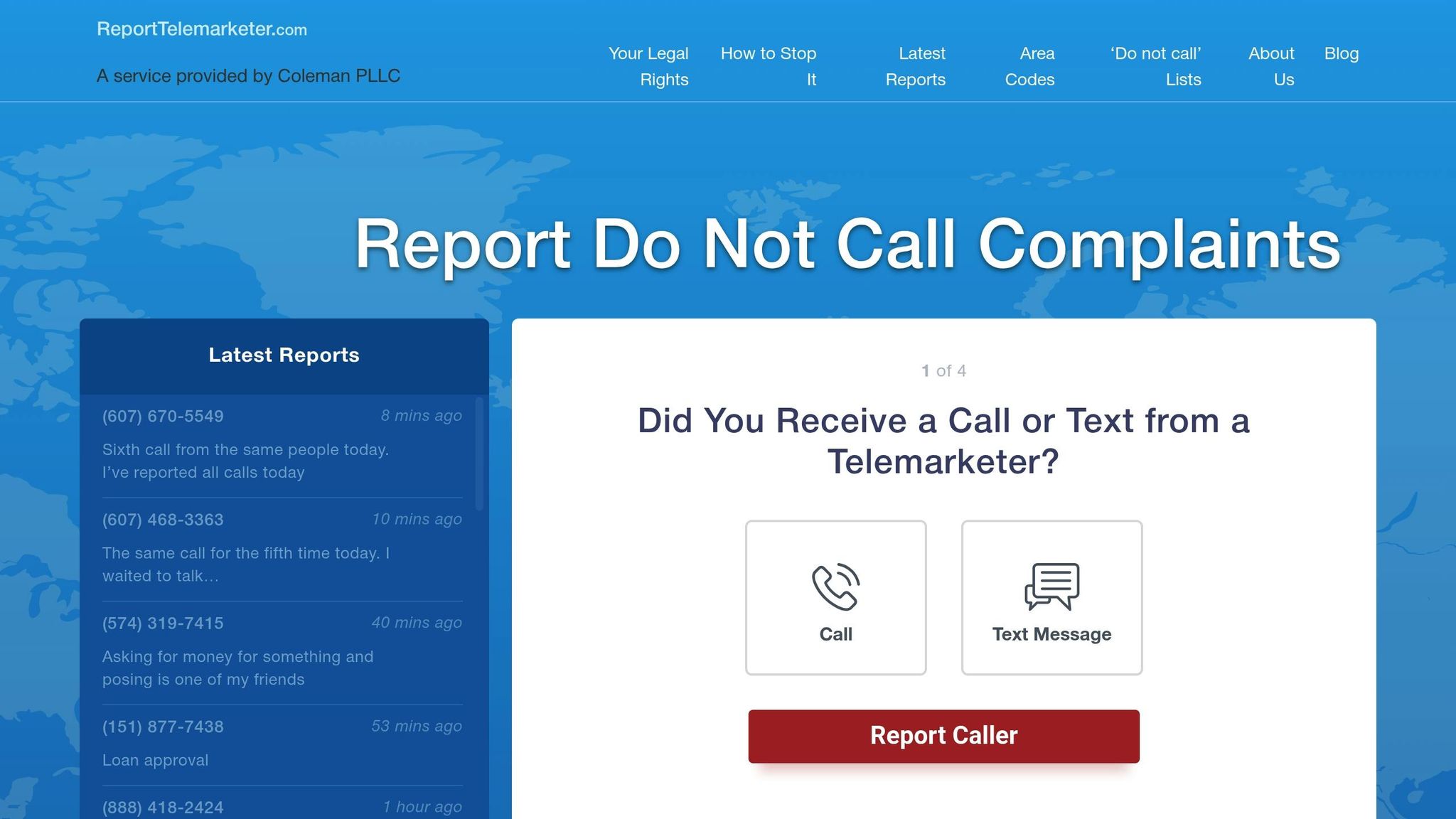
While regulations like TRAI’s 2025 guidelines aim to curb spam in India’s telecom sector, U.S. consumers still face a flood of unwanted calls and texts. ReportTelemarketer.com steps in to tackle this issue head-on. This free service empowers users to fight back against telemarketing violations, bridging gaps left by existing systems and complementing regulatory efforts.
Reporting Spam Calls and Texts
With ReportTelemarketer.com, users can report spam calls and texts easily. The process involves submitting evidence, such as call logs or text messages, to support the complaint. Once a report is filed, the platform’s legal team uses proprietary tools to investigate whether the telemarketer has violated consumer protection laws. From validating the complaint to escalating it, the platform simplifies the entire process. Beyond just reporting, it ensures that serious violations are pursued through legal channels.
Taking Legal Action Against Telemarketers
The platform goes beyond reporting by taking meaningful action against offenders. It issues cease-and-desist letters, files formal complaints, and even seeks compensation on behalf of users. All of this is done at no cost to consumers, as attorneys’ fees are recovered directly from the telemarketers when possible.
This approach not only holds violators accountable but also ensures user privacy is safeguarded. Additionally, the platform maintains a public database of reported telemarketers, helping others recognize and steer clear of repeat offenders.
Conclusion
TRAI’s 2025 regulations have brought a noticeable shift in tackling spam calls and texts in India. Complaints from consumers dropped from 189,419 in August 2024 to 134,821 by January 2025. Additionally, over 1.88 million telecom resources were disconnected, and more than 1,150 entities were blacklisted. These figures highlight how stricter enforcement and the use of AI-driven monitoring tools have significantly curbed spam.
With extended reporting windows, clear opt-out mechanisms, and standardized message headers, identifying and reporting spam has become more straightforward. As TRAI Chairperson Anil Kumar Lahoti emphasized, "Reporting was a crucial element to addressing spam". Improvements like the revamped Do-Not-Disturb app ensure that consumer complaints lead to actionable outcomes rather than being lost in red tape. These advancements show progress but also point to areas that still need attention.
What’s Next for Consumer Protection
While the regulations have been effective, some gaps remain. For instance, OTT platforms like WhatsApp are not covered, leaving room for spammers to exploit. Fraudsters are constantly evolving their tactics, which means regulators must stay one step ahead by frequently updating anti-spam measures. Another challenge is the reliance on consumers to report violations. If complaints are not filed within the 7-day window, spammers can continue their activities unchecked. These issues highlight the need for continuous improvements in both technology and oversight.
Long-term success will depend on sustained technological investment and rigorous enforcement. Telecom providers need to refine their AI monitoring systems and expand the use of "honeypots" to identify spammers before they reach consumers. Stricter verification processes, such as biometric authentication for telemarketers, can help prevent fraudulent identities from slipping through. Consistently enforcing financial penalties – ranging from ₹200,000 ($2,400) for a first offense to ₹1,000,000 ($12,000) for repeat violations – will also act as a strong deterrent.
Although TRAI’s regulations have transformed spam control in India, similar strategies can benefit U.S. consumers. Platforms like ReportTelemarketer.com offer a comparable way for Americans to hold violators accountable. Whether in India or the U.S., the takeaway is clear: effective consumer protection combines robust regulations with active public participation.
FAQs
How do I report a spam call under the new 7-day window?
Under TRAI’s updated regulations, you now have 7 days to report a spam call, up from the previous 3-day limit. When filing a complaint, you’ll need to provide details like your phone number, the spammer’s number, the date of the call, and a short description of what happened. This longer window gives you more flexibility to take action and helps strengthen protections against unwanted calls.
What do the -P, -S, -T, and -G labels mean on messages?
The labels "-P", "-S", "-T", and "-G" are part of TRAI’s 2025 SMS classification system. These labels help identify the nature of SMS messages:
- P: Promotional messages
- S: Service-related messages
- T: Transactional messages
- G: Government-authorized messages
Launched on May 6, 2025, this system is designed to minimize spam and provide greater clarity for consumers.
Are WhatsApp and other OTT spam messages covered by TRAI’s 2025 rules?
TRAI’s 2025 rules are specifically designed for traditional communication channels and do not extend to spam messages or calls made through over-the-top (OTT) apps like WhatsApp. These platforms operate outside the scope of the new regulations.

