
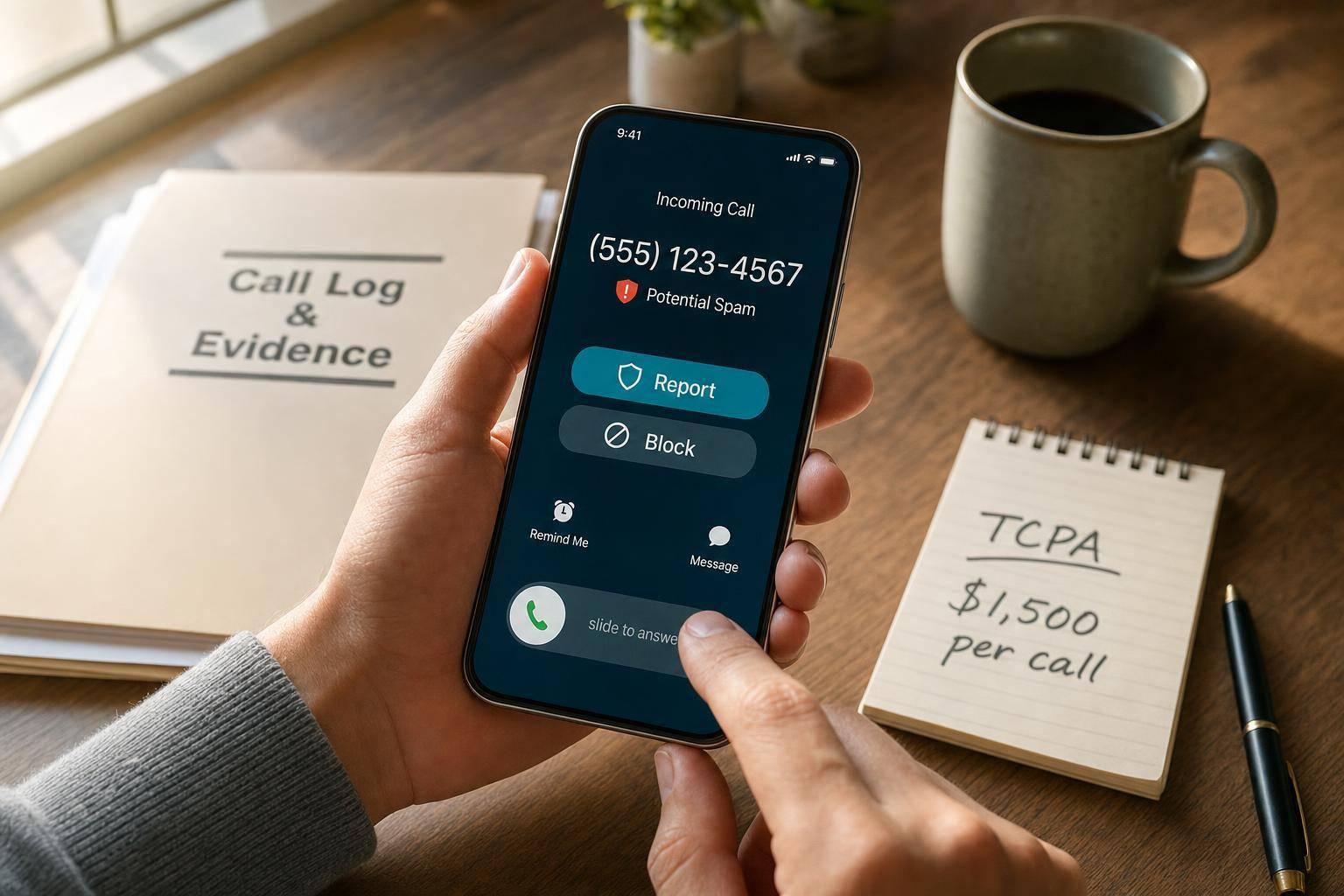
Caller ID spoofing makes your legal rights harder to use because you can’t tell who is actually calling. If the number is fake, your stop request may go nowhere, blocking one number may do almost nothing, and filing a claim can get harder because the caller is hidden.
Here’s the short version:
- Spoofing means the caller fakes the number or name on your screen
- It weakens consent and opt-out rights because you may not know which company is behind the call
- It makes scam calls more dangerous by letting callers pose as banks, agencies, or local numbers
- It hurts blocking tools since callers can rotate through new fake numbers
- It slows legal action because tracing the caller takes time and may fail
- Current laws like the Telephone Consumer Protection Act help, but only if the caller can be found
- Your best move is to save records, file complaints, and act fast
A few numbers show the scale: the FCC received more than 52,000 spoofing complaints in 2018, and in 2023 the Industry Traceback Group started 3,737 tracebacks of suspected illegal robocalls. That tells me the problem is not just annoying calls. It’s a caller identity problem that weakens privacy, control, and enforcement.
If I had to boil it down to one point, it’s this: when caller ID can’t be trusted, consumer rights become much harder to use in practice.
How Spoofing Undermines Specific Consumer Rights
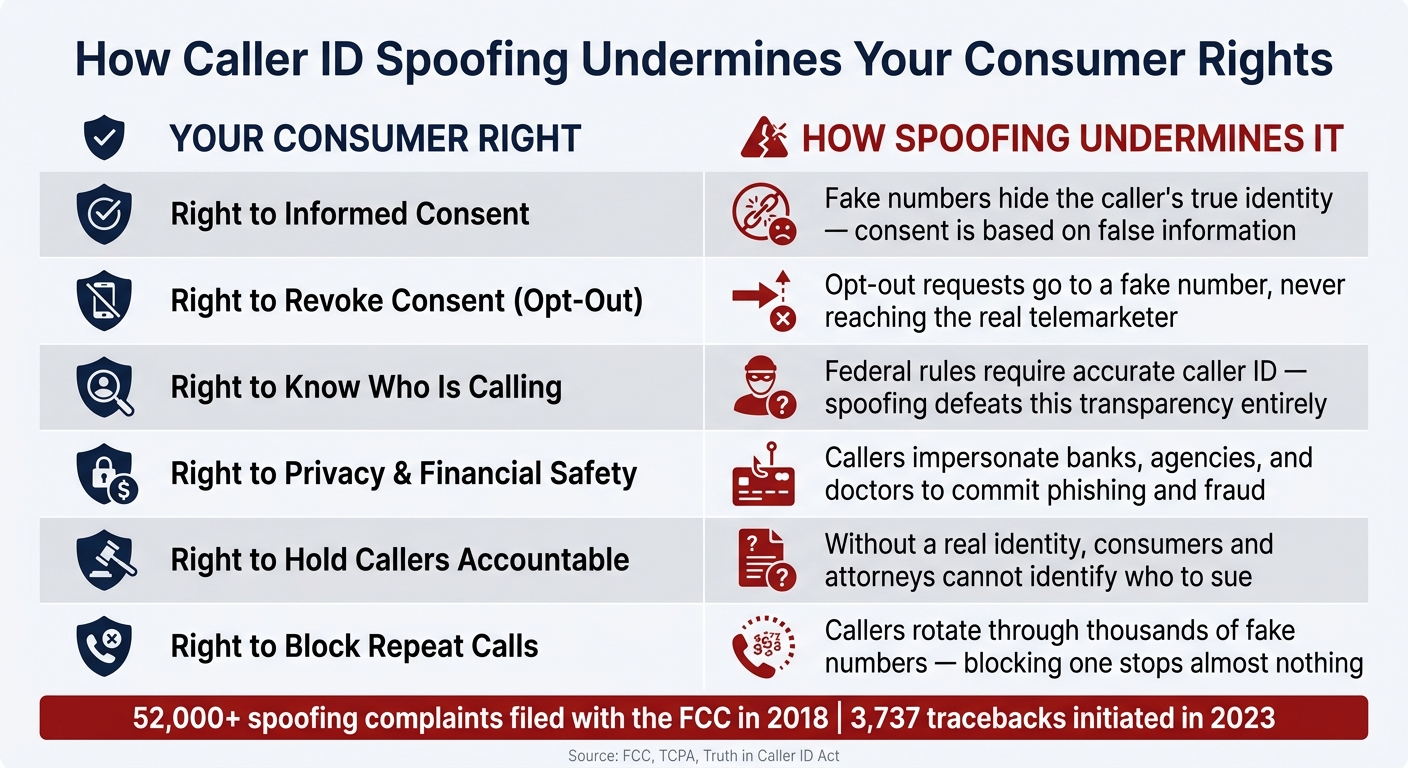
How Caller ID Spoofing Undermines Your Consumer Rights
Spoofing cuts into several consumer rights because it hides who is actually calling. And once the caller’s identity is hidden, basic protections start to fall apart.
| Consumer Right | How Spoofing Undermines It |
|---|---|
| Right to give informed consent | Consumers can’t meaningfully agree to receive calls or texts from a caller whose true identity is hidden behind a fake number. |
| Right to revoke consent | Opt-out requests go to a fake number, not the real telemarketer, so the actual caller may never receive – or honor – the revocation. |
| Right to know who is calling | Federal rules require telemarketers to identify themselves accurately, and spoofed caller ID defeats that transparency. |
| Right to privacy, security, and financial safety | Spoofed calls can impersonate trusted institutions to carry out phishing, identity theft, or financial fraud. |
| Right to hold the caller accountable | Without the real caller’s identity, consumers and attorneys face major obstacles identifying who to hold legally accountable. |
| Right to block repeat calls | Number rotation and neighbor spoofing mean blocking one number may do little to stop the next call from a different fake number. |
Why Consent and Opt-Out Rights Are Harder to Use
The TCPA gives consumers the right to withhold or revoke consent for autodialed and prerecorded telemarketing calls and texts. But spoofing gets in the way by hiding the real caller. If a number is spoofed, any consent the consumer gives rests on false caller information, not on a real, identifiable business or person.
Opt-out rights run into the same problem. A stop request may go to a fake number instead of the actual telemarketer. Then the same caller can keep dialing from a different spoofed number, with no clear paper trail tying those calls to one source. That’s the core issue: traceability.
How Spoofing Damages Privacy, Security, and Trust in Caller ID
Caller ID is not proof of identity. The FTC warns consumers not to trust caller ID, noting that calls could be "anyone calling from anywhere in the world." That’s what makes spoofing so dangerous. A call can appear to come from a bank, a government agency, or a doctor’s office, all to get account details, login codes, or other sensitive data.
It also wears down trust in the whole system. Once people stop believing what they see on their screen, many stop answering unfamiliar numbers or learning how to stop spam calls altogether. That can mean missed fraud alerts, missed appointment reminders, and missed urgent calls. When caller identity can’t be trusted, blocking tools lose force and legal action gets harder too.
Why Call-Blocking Tools Become Less Effective
Spoofing weakens number blocking because the caller can keep changing the number. Blocking works best when one caller sticks to one number. Illegal telemarketers don’t do that. They cycle through big pools of numbers or create a new spoofed number for each call, so blocking one number only stops that one attempt.
Neighbor spoofing makes the problem worse. By copying your area code and sometimes your first three digits, spoofers make the call look local. That can make you more likely to answer, and it also gets harder to tell fake numbers from real nearby contacts. The FCC has authorized carriers to block calls from invalid, unassigned, or unused numbers because those patterns often point to spoofing. Still, spoofers keep finding room to operate, which is exactly why stricter rules and stronger enforcement matter.
sbb-itb-a8d93e1
Where U.S. Laws Help and Where They Fall Short
Several federal laws and network tools are meant to protect consumers and report spoofed telemarketing calls. But there’s a catch: these protections work best when someone can figure out who actually placed the call. Spoofing scrambles that process. The TCPA gives consumers a path to sue, the Truth in Caller ID Act bans deceptive caller ID practices, and STIR/SHAKEN adds call verification at the network level. Still, each one runs into the same wall when the caller hides behind a fake number.
TCPA Rights and the Limits of Private Enforcement
These rules only go so far if the caller can’t be traced. The TCPA lets consumers sue directly over illegal robocalls and texts and seek $500 per violation, or up to $1,500 if the conduct was willful or knowing. A person does not need to prove actual financial loss.
The main problem is practical, not legal. When a caller spoofs a number, the number shown on the screen may belong to an innocent third party or may not lead back to anyone who can be found at all. If the actual business or person behind the campaign can’t be identified, a TCPA case can stall before it even begins.
Truth in Caller ID Act and Telemarketing Transparency Rules
Law by itself can’t fix this. The phone network also has to confirm who is behind a call. The Truth in Caller ID Act of 2009 makes it unlawful to transmit misleading or inaccurate caller ID information with the intent to defraud, cause harm, or to steal money or information.
Its weak spot is pretty plain. Enforcement still depends on finding the party behind the spoofed call and proving intent. That can be hard when callers hide behind layered routing or operate from overseas.
FCC telemarketing rules and the FTC’s Telemarketing Sales Rule (TSR) also require telemarketers to display a real caller ID and a working callback number. Spoofing undercuts that setup by swapping in a false number that may belong to an innocent person or connect to nothing at all.
Why Technical Tools Have Not Fully Solved Spoofing
STIR/SHAKEN works a bit like a digital stamp. Participating carriers attach a cryptographic signature to a call, and the receiving carrier can check whether the caller ID was verified at the source. That has cut down some kinds of spoofing on modern digital networks.
But the gap is still large. STIR/SHAKEN only works on modern digital networks. If a call passes through older phone systems, the authentication data can be stripped out along the way. And it verifies the carrier that first placed the call into the network, not the caller’s actual identity. So it can reduce some spoofing without giving consumers a clear line back to the party behind the call.
That leaves a clear next move: tighter verification and faster enforcement.
Solutions That Can Restore Consumer Rights
Restoring consumer rights takes more than one fix. It takes verified caller identity, faster enforcement, and better reporting from consumers. In plain English, three things need to work together: tougher identity rules for telemarketers, faster action based on complaint data, and simple steps people can use right now to protect themselves.
Requiring Verified Caller Identity for Telemarketers
The root issue is simple: telemarketers can put almost any number on your screen. That has to change. Instead of relying on whatever number appears in caller ID, the system needs a way to verify that the number is legitimate.
Under the FCC’s STIR/SHAKEN framework, the highest level of authentication – A-level attestation – means the provider originated the call and is allowed to use the number shown. That sets a meaningful standard. If a telemarketer can’t meet it, that call becomes much easier to flag and block.
Policymakers should require A-level attestation for all telemarketing traffic and deny safe-harbor protection to calls with lower attestation levels. That rule should work alongside mandatory number and brand registration in carrier or industry registries, so every telemarketing call can be traced back to a party that can be held responsible.
Verification helps, but only if regulators can trace the caller and stop the campaign.
Faster Enforcement and Better Use of Consumer Complaint Data
Once caller identity is traceable, complaint data becomes much more useful. It can show where repeat spoofing campaigns are coming from and which providers are involved.
The Industry Traceback Group (ITG) initiated 3,737 tracebacks of suspected unlawful robocalls in 2023, and 85% of completed tracebacks ended with the originating provider issuing a warning or terminating the caller. Those results depend on complaint data helping investigators follow the trail.
When regulators and carriers match STIR/SHAKEN metadata – such as attestation levels and originating providers – with consumer complaint patterns, they can spot which providers are carrying an outsized share of suspicious traffic. The FCC and FTC already use complaint data to decide where to focus enforcement. More detailed complaints make it easier to trace and shut down a large spoofing campaign. And once a spoofed campaign is stopped, blocking tools and opt-out rights start to mean something again.
Steps Consumers Can Take Now to Protect Themselves and Build a Record
Consumers can help right now by keeping a record of every suspicious call. If a call is unexpected – even if it shows a local area code – treat it as unverified until you know who is behind it. That record can support complaints and make enforcement stronger.
- Save the caller ID information right after the call.
- Note the date, time, message, and company name.
- Keep any voicemail or call recording, if you have it.
- Record whether you gave prior consent to be contacted by that company – this detail is critical for TCPA claims.
- Log repeat contacts, including slightly different numbers that seem tied to the same campaign.
Filing a detailed complaint with the FCC or FTC, including those details, gives investigators the raw material they need. If the calls keep coming, ReportTelemarketer.com can investigate the source, document violations, and file cease-and-desist letters or formal complaints.
Enforcing Your Rights and Key Takeaways
Spoofing hides who is calling. That makes opt-out rights and call blocking much harder to use. When caller identity is masked, enforcement often comes down to the record you create. The fastest way to respond is simple: build a clear paper trail, file complaints fast, and take legal action if the calls keep coming.
How Reporting and Legal Help Can Stop Repeat Spoofed Calls
Think of every unwanted call or text as evidence worth saving. Write down the date and time, your number, the number that showed up on your screen, what the caller said, and whether you told them to stop. Save voicemails, screenshots, and text messages. Also note whether your number is listed on the National Do Not Call Registry.
That record gives regulators something they can work with. File complaints with the FCC’s Consumer Complaint Center and the FTC’s complaint assistant as soon as you have enough detail. The more specific your complaint is, the easier it is for investigators to trace repeat violators under the TCPA and related laws. The FTC has brought 151 enforcement actions tied to Do Not Call, robocalls, spoofed caller ID, and assisting or facilitating violations, recovering over $178 million in civil penalties and $112 million in restitution or disgorgement.
If the calls don’t stop, ReportTelemarketer.com offers a free next step. It investigates who is actually behind the spoofed number, sends cease-and-desist letters, and can file regulatory complaints or help pursue TCPA claims. Under the TCPA, consumers may seek $500 per illegal call or text, and up to $1,500 per call or text for knowing or willful violations.
Documentation puts power back in your hands. Each option does a different job:
- FCC / FTC: file a complaint with call logs and screenshots
- ReportTelemarketer.com: trace the source, send cease-and-desist letters, and file regulatory complaints
- TCPA lawsuit: seek statutory damages and an order to stop repeat calls
Key Points for Consumers Dealing with Spoofed Telemarketing
Spoofing can feel slippery, but repeat patterns often become traceable once people keep records and report them. In 2023, the FCC received roughly 135,000 unwanted-call complaints, and major enforcement actions have already led to steep penalties, including a $225 million fine against Texas-based telemarketers responsible for about 1 billion spoofed robocalls. Save your evidence, report the calls fast, and pick the remedy path that matches your situation.
FAQs
How can I tell if a call is spoofed?
Watch for a few common red flags: pressure to act right away, requests for personal or financial details, and company information that feels vague or incomplete. If the number looks unfamiliar or comes from an area code you don’t know, slow down. When in doubt, let the call go to voicemail.
STIR/SHAKEN can help verify caller identity, but it is not foolproof. If suspicious calls keep coming, write down the caller ID, along with the date and time, and report them to ReportTelemarketer.com.
Can I still sue if the caller used a fake number?
Yes. You can still take legal action if a caller used a fake number.
Caller ID spoofing that misleads or defrauds people can violate the Truth in Caller ID Act and the Telephone Consumer Protection Act. In plain English, the caller doesn’t get a free pass just because the number on your screen was fake.
If this happened to you, keep records of the call, including:
- the date
- the time
- what was said
That paper trail matters. Spoofing may be treated as a willful violation, which can increase statutory damages to $1,500 per call.
What evidence should I save after a spoofed call?
Save the call or text log with the exact date and time, caller ID details, and what was said or sent. For texts and voicemails, keep screenshots that show the phone number and the full message.
Also keep any opt-out replies you sent, along with any follow-up messages you received. Write down whether your number is on the National Do Not Call Registry, plus any callback number, company name, representative name, and links that were mentioned.

