
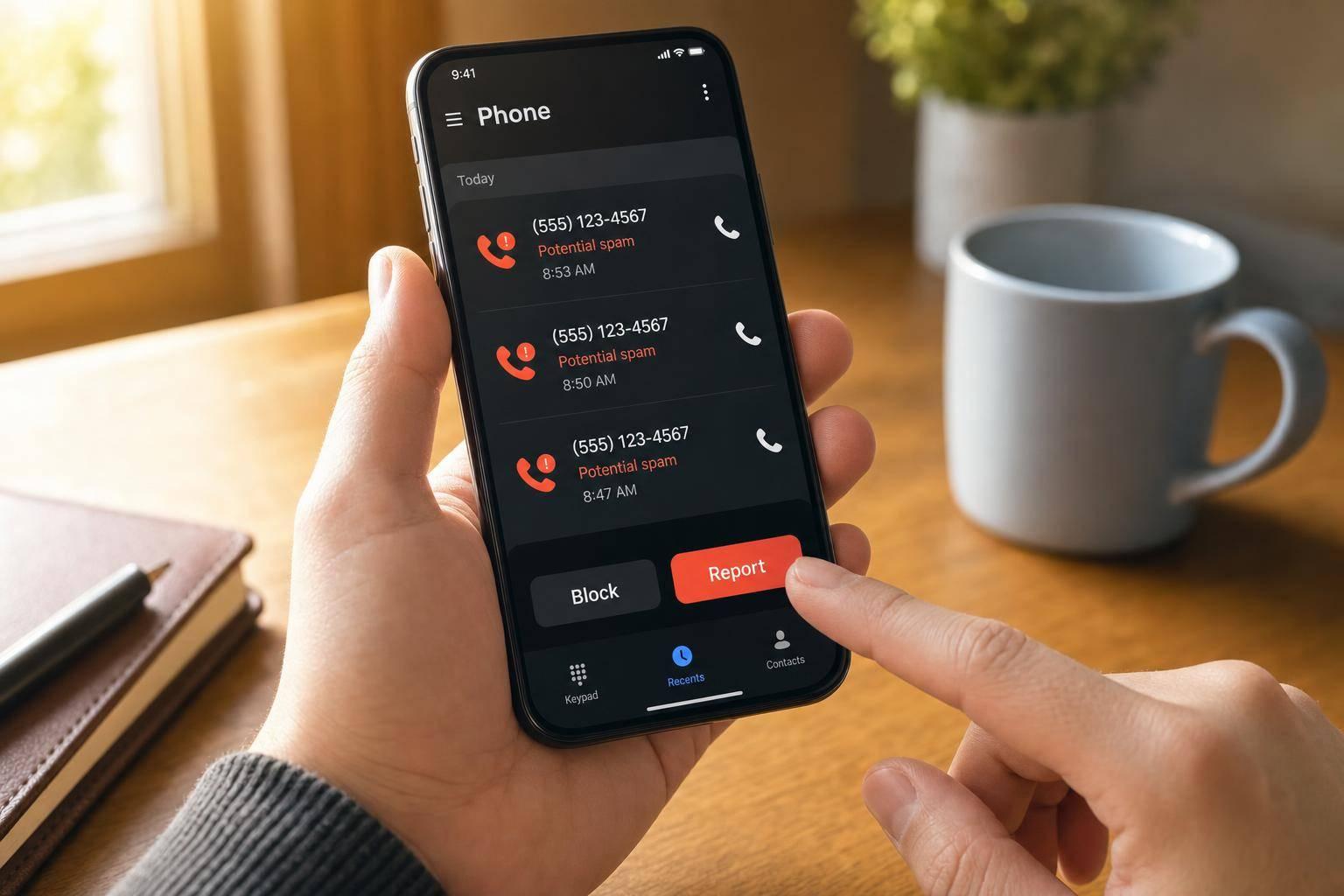
You may be able to get $500 to $1,500 per illegal call or text under the TCPA. I’d sum it up this way: each unlawful robocall, spam text, or prerecorded telemarketing call can count separately, so repeated contact can add up fast even if you lost $0 out of pocket.
Here’s the short version:
- $500 per violation is the usual starting point
- Up to $1,500 per violation may apply if the caller acted knowingly or willfully
- Each call, text, or voicemail may count on its own
- Calls after you say “stop” can strengthen a claim
- You should keep call logs, screenshots, voicemails, and dates
- Many TCPA claims use a 4-year filing window
For example, if I got 10 illegal texts, the baseline estimate could be $5,000. If those texts came after I revoked consent and a court found the conduct willful, the total could reach $15,000.
The main issue is simple: not every annoying call breaks the TCPA, but when one does, the law often treats every contact as a separate event. That’s why good records matter so much.
What Counts as a TCPA Violation Per Call or Text
Autodialed Calls and Texts Without Consent
Now that the per-call penalty part is clear, the next step is simple: what counts as its own violation?
An autodialed call or text uses an automated dialing system to contact your number without human dialing. When that system contacts your cell phone without valid consent, each call or text can count as a separate TCPA violation.
For telemarketing calls and texts to cell phones, companies usually need prior express written consent. So if you never gave that consent, or if you took it back and the company kept contacting you anyway, every new autodialed call or text may count on its own.
That point matters more than it may seem at first. A single message might not look like much. But if a business sends the same kind of text again and again, the count can add up fast.
Prerecorded Voice Calls and Do Not Call Violations
Robocalls that use prerecorded or artificial voices can also be separate violations when they are made for telemarketing without the consent the law requires. That rule can apply to cell phones and residential landlines.
Do Not Call rules work in a similar way. If your number is on the National Do Not Call Registry, repeated telemarketing calls can each be separate violations. The same goes for calls that keep coming after you tell a business to stop calling.
In plain English: once you’ve said “stop,” more calls can mean more problems for the caller.
How One Campaign Can Create Many Separate Violations
This is where things can snowball. A single campaign can lead to many violations because each illegal contact is counted on its own.
And sometimes one call does more than one thing wrong. For example, an autodialed prerecorded telemarketing call to a number on the Do Not Call Registry may run into both the robocall rules and the do-not-call rules at the same time.
So the math is not always just about the number of calls. It can also depend on which TCPA rules each contact broke. Once you sort out which calls or texts qualify, you can total the potential damages.
sbb-itb-a8d93e1
Make Them Pay YOU…. $500–$1500 Per Call Under the TCPA
How Much Money a Consumer May Recover
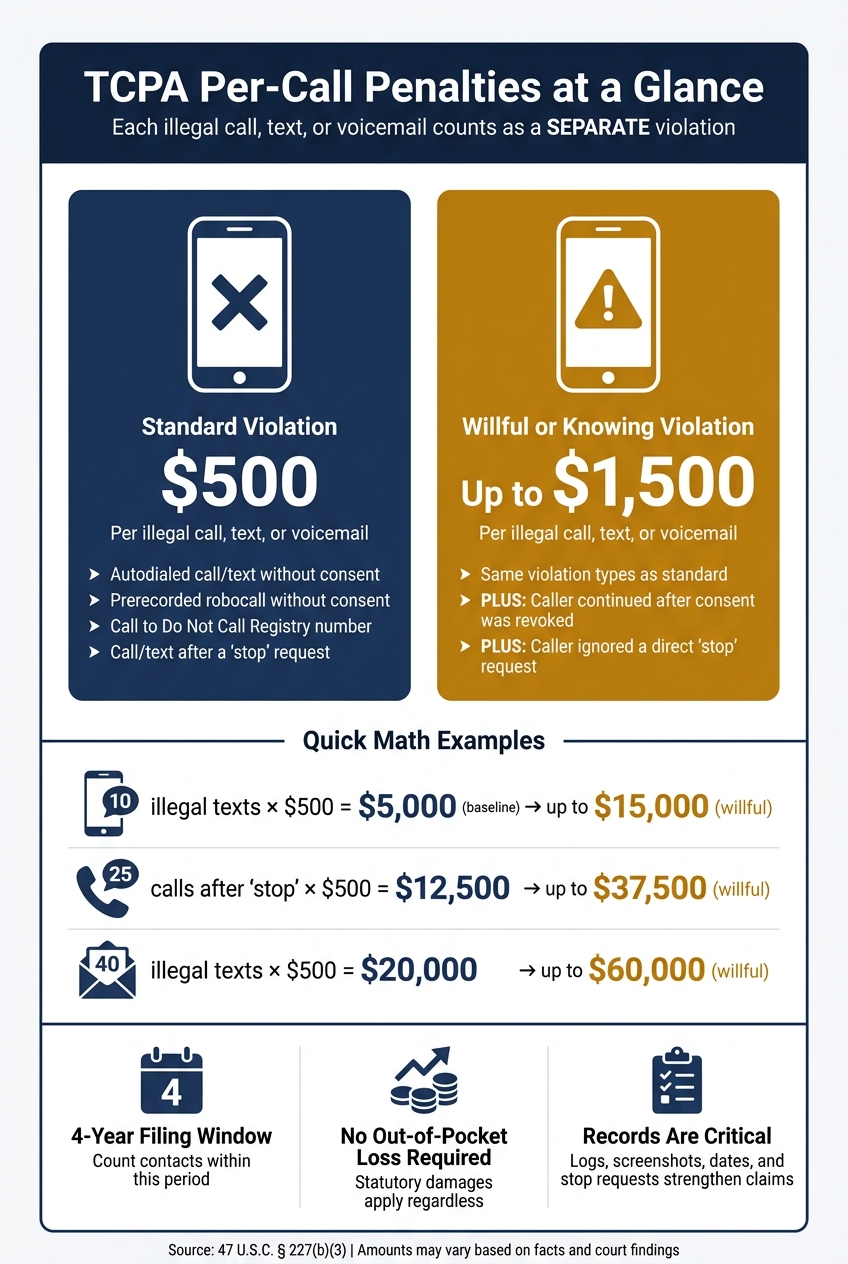
TCPA Violation Penalties: $500 vs $1,500 Per Call Explained
Standard Damages: $500 Per Violation
Once you know which calls or texts count, the next step is simple: put a dollar amount on each one.
For most TCPA claims, a consumer can recover at least $500 per violation, or actual damages if that amount is higher. That figure comes from 47 U.S.C. § 227(b)(3). And you do not have to show out-of-pocket loss to get the statutory amount.
That point matters. In many cases, unwanted calls do not lead to a big direct charge. Instead, they waste your time, interrupt your day, and invade your privacy. So the numbers can add up fast. For example, 40 illegal texts = $20,000.
Willful or Knowing Violations: Up to $1,500 Per Violation
If the caller acted willfully or knowingly, damages can jump to $1,500 per violation. That often comes up when a company keeps calling after consent was revoked or after you made a do-not-call request.
Say a company made 25 more autodialed marketing calls after you told them to stop. The starting point is 25 × $500 = $12,500. If a court decides the conduct was willful, those same 25 calls could support up to 25 × $1,500 = $37,500.
Those are the base figures. The next section walks through how to add them up for a claim. You can also learn how to stop spam calls to prevent future violations.
Damages Table: $500 vs. $1,500 Per Violation
| Violation Type | Standard Damages (Per Violation) | Max Damages If Willful/Knowing |
|---|---|---|
| Autodialed call or text to cell phone without prior express consent | $500 | Up to $1,500 |
| Prerecorded/artificial voice (robocall) without consent | $500 | Up to $1,500 |
| Telemarketing call to a number on the National Do Not Call Registry | $500 | Up to $1,500 |
| Call or text continuing after a "stop" request | $500 | Up to $1,500 |
How to Calculate Your Potential TCPA Compensation
You can get a rough estimate of your claim by using the per-violation amounts above.
Count Each Illegal Call, Text, or Voicemail
Start by pulling together your call logs, text screenshots, saved voicemails, caller IDs, and the date and time for each contact. In most cases, each qualifying call, text, or prerecorded voicemail counts on its own under the Telephone Consumer Protection Act.
TCPA claims also usually follow a four-year window tied to each violating call or text. So when you estimate your claim, only include contacts that fall within that period.
Multiply by $500 or Up to $1,500
Here’s the basic math:
- Violations × $500 = estimated baseline damages
- Violations × up to $1,500 = possible enhanced damages if the conduct was willful or knowing.
Say you got 8 prerecorded calls after you told the caller to stop. Your baseline estimate would be $4,000. If the facts show the caller acted willfully, that amount could go up to $12,000.
That said, what you may recover depends on the facts and the proof you have.
Document Facts That Support a Stronger Claim
If the caller kept contacting you after you made a clear stop request, that can help support an argument that the violation was willful or knowing. That might include a text reply saying STOP, a verbal request, or a written complaint.
It also helps to keep:
- Proof that your number was on the National Do Not Call Registry when the calls came in
- Timestamps for each contact
- Any original sign-up forms or consent language showing whether you agreed to be contacted
Keep all of these records in one place before you report the calls or ask for help. It makes the next step easier and less messy.
Getting Help and Next Steps
If you’ve already counted the calls and pulled your records together, the next move is simple: report the pattern and have the claim reviewed.
How ReportTelemarketer.com Can Help
Once your records are in order, you can use them to either stop the calls or see whether you may have a claim.
ReportTelemarketer.com lets you submit the caller’s number, date, time, and call details. The team looks into who sent the calls, reviews complaint history, checks Do Not Call violations, and looks at whether prior consent was valid under the TCPA. When the facts point to a TCPA violation, the service may take steps to stop future contact, including cease and desist letters or complaints. If the facts back a claim, attorneys can pursue it and seek fees from the telemarketer when allowed.
These records matter because each contact can affect the total damages.
Documentation Checklist: What to Track and Why
Track the details below to support your claim. Strong records help show each violation and can support higher damages.
| Consumer Task | Why It Matters for Per-Call Damages | How ReportTelemarketer.com Supports |
|---|---|---|
| Log each contact with date and time | Supports the total violation count | Organizes contacts into a timeline for counting |
| Save the caller’s phone number and company name | Identifies the entity behind the calls | Investigates the sender |
| Note whether the call was live, prerecorded, or autodialed | Determines how the contact is analyzed under the TCPA | Reviews contact details to classify the call type |
| Record any stop requests and the date you made them | Supports the higher damages tier for willful or knowing violations | Documents escalation patterns after an opt-out |
| Use registry proof to support the violation count | Calls to a registered number can each be separate violations | Checks registry status and whether prior consent is valid under the TCPA |
| Keep evidence together | Helps the claim be reviewed faster | Centralizes evidence in an organized case file |
Once your records are complete, you can start sizing up the likely damages and what to do next.
Conclusion: Key Points to Remember
The TCPA allows $500 per illegal call, text, or voicemail, or up to $1,500 for willful or knowing violations. Since each contact counts on its own, repeated calls can pile up fast.
Not every unwanted call qualifies as a TCPA violation, and whether someone can recover depends on the facts. Still, careful documentation and prompt reporting make it easier to show what happened and get a potential claim reviewed fairly. ReportTelemarketer.com is free and can help you submit your records fast.
FAQs
What proof do I need?
To build a strong TCPA case, document every unwanted call or text. Save the date, time, length of the call, and phone number. Keep screenshots, call logs, and voicemails too.
If you asked to opt out, keep proof of that request. That can include sent texts, emails, or notes about a verbal request. ReportTelemarketer.com can help you organize those records and look into whether a violation took place.
Can one call break more than one TCPA rule?
Yes. One call can break more than one Telephone Consumer Protection Act rule. For example, a caller might use an unauthorized autodialer and also leave out a required opt-out option.
Even so, courts usually award statutory damages per call. They generally don’t stack separate penalties for each rule broken within that same call.
Does it matter if I never lost money?
No. Under the TCPA, you do not need to prove actual financial harm to be eligible for compensation.
The law allows statutory damages for each violation: $500 per violation, or up to $1,500 for willful or intentional violations. So even if you didn’t lose money out of pocket, you may still seek compensation.

