
Public awareness campaigns can help fight telemarketing abuse, a problem costing Americans $40 billion annually. These campaigns inform people about their rights, encourage reporting violations, and protect vulnerable groups like seniors. Key steps include setting clear goals, building partnerships with agencies like the FTC and FCC, and tailoring messages to specific audiences. Campaigns should highlight laws like the Telephone Consumer Protection Act (TCPA) and tools like the National Do Not Call Registry. Platforms like ReportTelemarketer.com can provide data to target efforts effectively. Success depends on clear planning, consistent messaging, and tracking results to measure impact.
How to Run a Public Awareness Campaign Against Telemarketing Abuse
Step 1: Building the Foundation for Your Campaign
Set Campaign Goals and Objectives
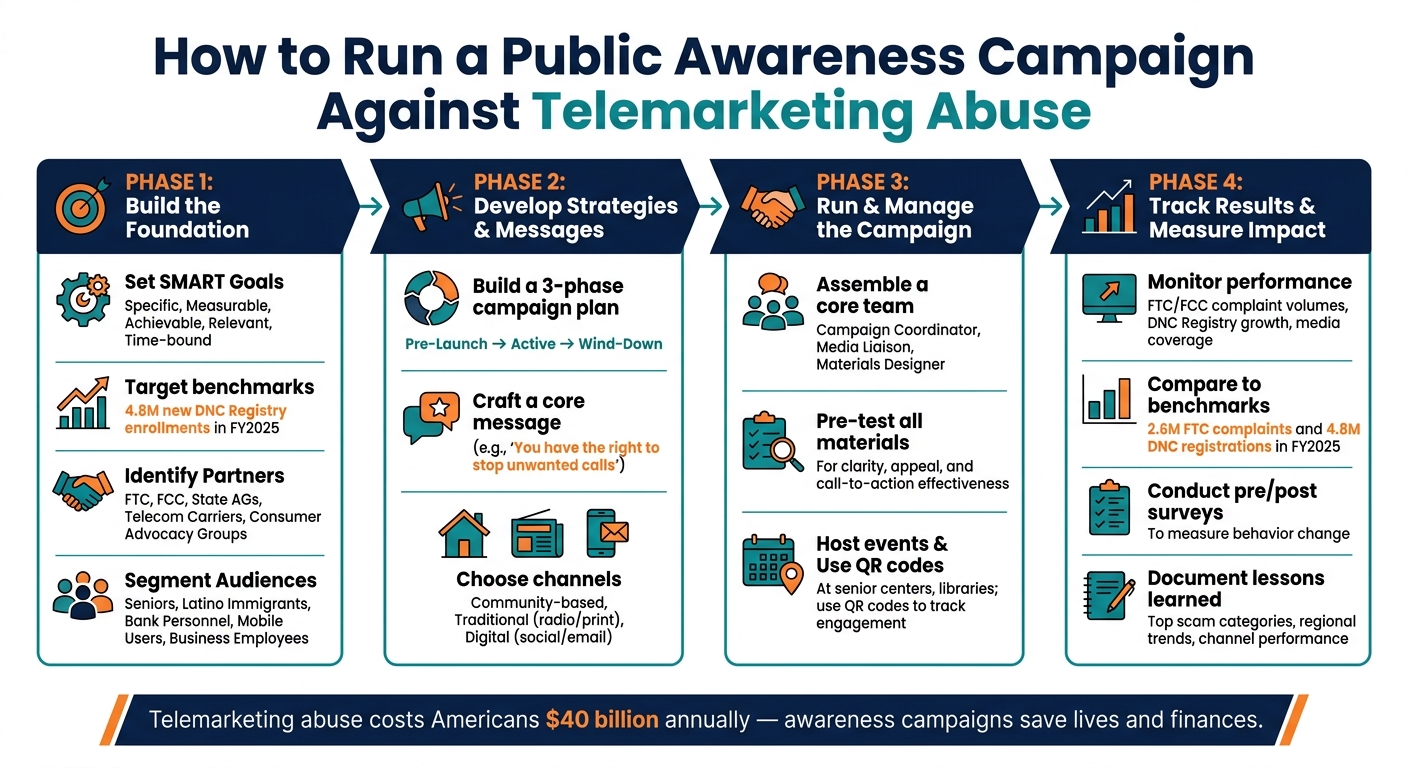
Start by defining clear goals using the SMART framework – Specific, Measurable, Achievable, Relevant, and Time-bound. These objectives help establish what success looks like for your campaign.
Some strong initial goals include:
- Boosting the number of complaints filed with the FTC and FCC.
- Driving new enrollments in the National Do Not Call Registry (DNC Registry).
- Educating consumers on protective behaviors, such as hanging up immediately when asked for money or personal details.
For perspective, 4.8 million new numbers were added to the DNC Registry in FY 2025 alone. This benchmark can guide your enrollment targets. To keep your campaign focused, consider targeting one or two specific scam categories. This approach simplifies messaging and makes it easier to track results.
Once your goals are set, the next step is to identify key partners to help amplify your campaign’s impact.
Identify Stakeholders and Partners
Building strong partnerships is essential for success. Core stakeholders include the FTC, FCC, and state Attorney General offices. State offices, in particular, can act quickly on local issues and have the authority to file civil lawsuits directly. Legal experts – especially those experienced with the Telephone Consumer Protection Act (TCPA) – can also assist individuals in recovering damages of $500 to $1,500 per illegal call.
Telecommunications companies like AT&T and Verizon, along with providers of call-blocking apps, offer critical technical support. Grassroots credibility can be bolstered by working with consumer advocacy groups and community organizations. To keep efforts organized, use a simple matrix to document each partner’s role and contact information.
"The FTC does not resolve individual complaints, but they use the information to take action against companies that rack up high volumes of reports." – WhosCalling.io
Additionally, platforms like ReportTelemarketer.com can be valuable allies. Their aggregated data on scam patterns and phone number abuse provides actionable insights for regulators and campaign partners.
With your partnerships in place, the next step is tailoring your campaign to reach the right people.
Identify and Segment Target Audiences
Effective messaging starts with understanding your audience. Collaborate with your partners to pinpoint both primary audiences (those directly impacted) and secondary audiences (gatekeepers who can intervene).
For example, seniors are a key primary audience since they are often targeted by scammers. Within this group, Latino elderly immigrants may face additional challenges, such as language barriers, and could benefit from peer counseling through local Hispanic councils. Secondary audiences, like bank employees trained to detect unusual financial transactions, can help stop fraud before it escalates.
Here’s a breakdown of audience segments and suggested outreach methods:
| Audience Segment | Key Vulnerability | Recommended Approach |
|---|---|---|
| Elderly Seniors | High financial loss potential; frequently targeted | Sunday newspaper inserts; senior center booklets |
| Latino Immigrants | Socioeconomic barriers; language gaps | Peer counseling; local Hispanic Council networks |
| Bank Personnel | Positioned to detect unusual transactions | Fraud recognition training |
| Mobile Users | targeted by robotexts and spoofed calls | "7726" spam forwarding; carrier-level blocking |
| Business Employees | Solicited at work for personal services | Workplace awareness programs; internal DNC lists |
Geographic targeting is another crucial factor. Scammers often focus on specific area codes. For example, FTC complaint data highlights high scam activity in regions like the 315 area code (Syracuse, NY) and the 202 area code (Washington, DC). By incorporating regional data into your audience segmentation, you can ensure your campaign reaches the people who need it most.
sbb-itb-a8d93e1
Step 2: Developing Campaign Strategies and Messages
Build a Campaign Plan
Once you’ve identified your target audiences, it’s time to create a campaign plan that answers key questions: What are we doing? Who are we doing it for? When will it happen? And how will we measure success?
Start by breaking your campaign into phases. For example, an anti-telemarketing campaign could follow three stages: a pre-launch phase to build partnerships and test materials, an active phase to carry out outreach efforts, and a wind-down phase to gather data and document results. Set clear milestones and deadlines for each stage, and use a straightforward ownership model like RACI (Responsible, Accountable, Consulted, Informed) to clarify who handles approvals and decisions.
From the outset, include budget planning and tracking in your strategy. Identify your media spend, production costs, and performance metrics. These might include enrollments in the Do Not Call Registry, FTC complaint submissions, or website traffic. As Cody Cagnina, a public health marketing expert, explains:
"Every dollar spent on planning saves multiple dollars in execution. The most impactful public health campaigns aren’t the ones with the biggest budgets – they’re the ones with the clearest strategy."
With your campaign plan in place, shift your focus to crafting clear, audience-specific messages.
Write Key Messages
Develop a central message that is clear and supported by strong proof points. For example, in a campaign against telemarketing abuse, the core message could be: "You have the right to stop unwanted calls – here’s how." All campaign materials – whether social media posts, flyers, or press releases – should consistently echo this message.
Tailor your messaging to resonate with different audience groups. Focus on what matters most to them: ending harassment, safeguarding their finances, or understanding their rights. Use simple, conversational language that would feel natural in a TV interview. For instance:
- Seniors may respond well to messages emphasizing financial protection.
- Younger mobile users might engage more with practical steps, like forwarding spam texts to 7726 or filing complaints at ReportFraud.ftc.gov.
Accuracy is critical. Ensure your messages comply with legal guidelines. For example, the Telephone Consumer Protection Act (TCPA) prohibits telemarketers from calling before 8:00 a.m. or after 9:00 p.m. local time. Always include a clear call to action, such as directing users to ReportTelemarketer.com to report violations.
Choose the Right Communication Channels
Select communication channels based on your audience research and messaging goals. The Agency for Toxic Substances and Disease Registry (ATSDR) emphasizes:
"Do not assume that the easiest or most comfortable way of communicating… is best for the community."
For seniors, traditional methods like newspaper inserts or printed materials at senior centers can be highly effective. Younger, tech-savvy audiences, on the other hand, may respond better to social media campaigns or search engine ads. For community-specific groups, collaborating with trusted local organizations – such as Hispanic councils or faith-based groups – and using their established networks can make a big impact.
A well-rounded campaign combines various channel types: community-based (e.g., in-person events and partnerships), traditional (e.g., local radio and print), and digital (e.g., social media, email, and landing pages). The goal is to reach your audience through multiple touchpoints, reinforcing your message at every opportunity. If your budget is limited, focus on the channels where your audience already spends time and address potential barriers, like limited internet access or language differences.
Step 3: Running and Managing the Campaign
Set Up the Campaign Team
Now that your strategy and messaging are ready, it’s time to assemble the team that will execute your campaign. Start with a small, diverse core team and bring in local volunteers to help build trust within the community.
Assign specific roles early on. For instance, appoint a Campaign Coordinator to guide overall strategy, a Media Liaison to handle press interactions, and a Materials Designer to create visuals. To keep things running smoothly, consider using digital tools like Zapier for project management. These tools can help automate routine tasks, giving your team more time to focus on impactful work.
Remember to prioritize your team’s well-being. Campaigns like these often deal with emotionally taxing topics, such as financial scams or elder abuse. The Activist Handbook emphasizes the importance of group care:
"Group care is the practice of taking care of each other within a group of activists. This includes providing emotional and physical support, setting healthy boundaries, and encouraging self-care."
Once your team is in place, you’re ready to move on to creating effective campaign materials.
Create and Test Campaign Materials
Before finalizing any campaign materials, test them with a small group from your target audience. Pre-testing can reveal unexpected issues – a message that seems clear to your team might confuse or alienate your audience. As UNESCO highlights:
"Pre-testing is an essential step in the development of any communication material to ensure that the message is clear and that it does not have any unintended negative connotations."
Evaluate your materials for clarity, appeal, relatability, and how well they inspire action. Every piece – whether it’s a flyer, poster, or social media post – should include a clear call to action. For example, encourage people to visit ReportTelemarketer.com to report unwanted calls. Consistency is key: maintain uniform branding with the same logos, colors, and slogans across all materials.
Once your materials are ready, focus on connecting with your audience through campaign events.
Plan and Run Campaign Events
Choose venues that your audience already visits, such as senior centers or local libraries, to maximize participation. Create an event timeline and assign responsibilities for each task to specific team members. This ensures accountability and avoids last-minute chaos. As one expert puts it:
"A campaign calendar should show who owes what by when. If it only shows launch day, it isn’t a real plan."
Before the event, double-check everything: confirm your spokesperson’s availability, test all digital links, and ensure printed materials are ready to go. At in-person events, use tools like QR codes or custom landing pages to connect offline interactions with measurable online actions. This not only helps track engagement but also demonstrates the campaign’s impact.
Step 4: Tracking Results and Measuring Impact
Track Campaign Metrics
Once your campaign is up and running, keeping a close eye on specific metrics is essential for understanding its impact. These metrics provide a clear picture of how well your efforts are resonating with your audience.
Monitor key indicators like event attendance, the distribution of campaign materials, and media coverage. On the reporting side, keep track of complaint volumes submitted to the FTC and FCC. These numbers are a direct reflection of whether your audience is taking action. For context, compare your results to benchmarks like the 2.6 million FTC complaints and 4.8 million new DNC registrations recorded in FY2025.
| Metric Category | What to Track |
|---|---|
| Reporting Activity | Complaints filed with FTC/FCC, reports to State AG, texts forwarded to 7726 |
| Registry Growth | New numbers added to the DNC Registry during the campaign period |
| Call Characteristics | Robocalls vs. live calls, caller ID spoofing trends, call categories |
| Enforcement Impact | Lawsuits initiated, fines collected, scam rings identified |
Measure Awareness and Behavior Change
While activity metrics show what happened, behavior change metrics tell you if your campaign truly influenced people.
Conduct pre- and post-campaign surveys to measure shifts in awareness and reporting habits. Look for more detailed reports from participants – those that include timestamps, caller ID details, and specifics about the call. An increase in such high-quality reports is a strong indication that your educational messages resonated.
Platforms like ReportTelemarketer.com can provide additional insights. Their data shows that when users engage more, actionable outcomes follow. To date, the platform has helped over 30,000 people combat telemarketing abuse. An uptick in users pursuing legal investigations or cease-and-desist actions after your campaign suggests that your audience isn’t just aware – they’re taking steps to protect themselves. As Stefan Coleman, Lawyer and Founder of ReportTelemarketer.com, explains:
"As a consumer protection firm, we use the telephone consumer protection laws to stop telemarketers from harassing consumers."
After analyzing quantitative trends, dive into qualitative feedback to fine-tune your future campaigns.
Document Lessons Learned
Once your campaign concludes, take time to evaluate the data and extract meaningful insights. Identify which scam categories generated the most reports. For instance, debt reduction scams are overwhelmingly automated, with 89% being robocalls, while tech support scams often involve live interactions. If your campaign messaging focused on one type of scam but your audience reported another more frequently, it’s a clear sign to recalibrate your approach next time.
Also, examine regional trends. Compare local complaint data to regional benchmarks, such as the activity in area code 315. Take note of what worked well, which channels underperformed, and which audience segments were most responsive. These insights will provide a stronger starting point for your next campaign.
Planning a Successful Awareness Campaign in 5 Steps
Conclusion: Key Steps for Running Effective Campaigns
To tackle telemarketing abuse effectively, a successful public awareness campaign hinges on three core elements: clear goals, strong partnerships, and consistent execution. Together, these components help transform awareness into meaningful action.
A well-structured campaign sets the stage, but it’s the strategic partnerships that amplify its reach and impact. Working with telecom carriers, the FTC, FCC, State Attorneys General, and platforms like ReportTelemarketer.com creates a multi-layered approach. Each partner brings something unique to the table: telecom carriers can cut off abusive calls, agencies use aggregated data to build enforcement cases, and legal teams enforce the TCPA to stop harassment and secure compensation for consumers.
Accurate and thorough reporting is another key driver. It fuels enforcement efforts and helps identify scam networks. Every single report generated by your campaign becomes part of a larger, collective effort to fight back.
As Daniel Mercer, Senior Consumer Advocacy Editor, explains:
"Treat a complaint like a mini advocacy campaign, not a one-off message. Campaigns get seen because they are structured, public-facing, measurable, and persistent."
FAQs
What’s the first step to launch an anti-telemarketing awareness campaign?
To kick things off, it’s important to map out a solid plan. Start by identifying your target audience and the core messages you want to communicate. This step helps ensure your campaign stays on track and delivers results.
Another crucial step is teaching people how to report telemarketing calls. Share tips on documenting key details, such as the caller’s name, phone number, date, and time of the call. Accurate records like these play a big role in tackling telemarketing abuse through the proper channels.
Which partners should I involve for the biggest impact?
To make your public awareness campaign against telemarketing abuse more effective, consider teaming up with organizations that can help extend your reach and provide additional resources. Potential partners include government entities like consumer protection offices, advocacy groups, and public health organizations. Collaborating with services such as ReportTelemarketer.com or regulatory bodies like the FTC and FCC can bolster enforcement efforts. Meanwhile, public health organizations can play a role in encouraging positive behavior changes.
What metrics show the campaign changed behavior?
Key indicators show progress in the fight against illegal robocalls. These include a drop in complaints about such calls, an increase in numbers registered on the Do Not Call Registry, and a decline in reports of illegal telemarketing. The FTC monitors these trends closely, providing insight into how well the campaign is shaping behavior.

