

Telemarketing privacy assessments ensure compliance with regulations like the TCPA, TSR, and state laws. They help businesses manage consumer data responsibly, avoid hefty fines, and maintain trust. Key steps include:
- Assigning Roles: Designate a Compliance Officer and ensure all team members understand their responsibilities.
- Consent Management: Secure written consent for marketing calls and texts, with detailed records for at least five years.
- Data Security: Use encryption, multi-factor authentication (MFA), and role-based access controls (RBAC) to protect sensitive information.
- Opt-Out Handling: Process Do Not Call (DNC) requests immediately and scrub calling lists regularly.
- Vendor Oversight: Audit lead suppliers and ensure compliance with consent and DNC requirements.
- Call Recording Compliance: Follow all-party consent rules and secure recordings to avoid legal risks.
- Data Retention: Retain required records for at least five years and automate deletion of outdated data.
Neglecting these steps can lead to severe penalties, such as Dish Network‘s $280M fine for telemarketing violations. Platforms like ReportTelemarketer.com empower consumers to report violations, emphasizing the importance of compliance.
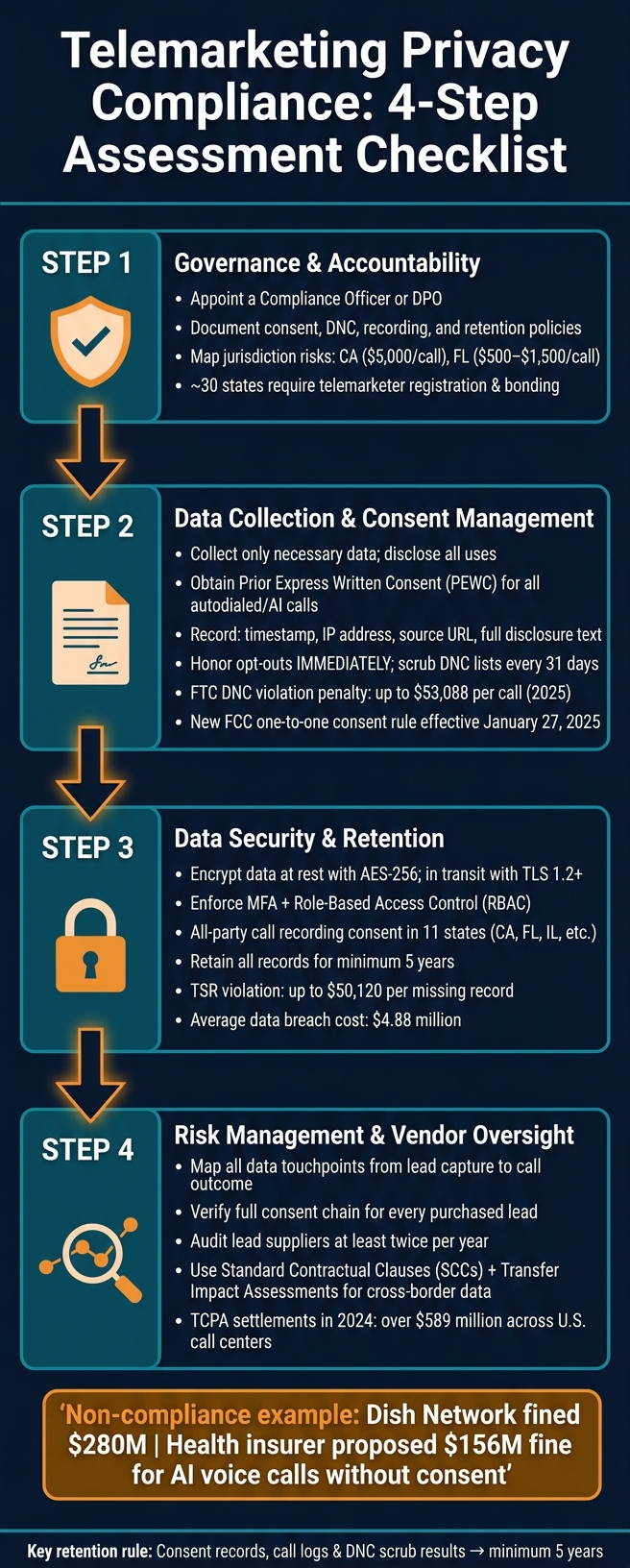
Telemarketing Privacy Compliance: 4-Step Assessment Checklist
Tech Talk: Outbound Compliance | DNC List & Attempt Controls
sbb-itb-a8d93e1
Step 1: Governance and Accountability
This step sets the stage for managing telemarketing privacy with care and precision, ensuring all aspects are handled responsibly.
Assigning Roles and Responsibilities
Clear accountability is the backbone of effective privacy management. Without it, compliance gaps are inevitable. Every telemarketing operation should appoint a Compliance or Privacy Officer to oversee privacy programs, audit policies, and keep leadership informed. Larger organizations, especially those under GDPR or managing significant volumes of sensitive data, may also need a Data Protection Officer (DPO).
Other roles play equally important parts:
- Campaign Managers: Oversee script updates and coach agents.
- IT and Security Teams: Manage technical safeguards like encryption and access controls.
- Telemarketing Agents: Handle opt-out requests in real-time and ensure mandatory disclosures are made. This is a critical step to help consumers stop spam calls and maintain brand reputation.
Here’s a quick breakdown of responsibilities:
| Role | Responsibility |
|---|---|
| Compliance Officer | Auditing programs, monitoring regulations, board reporting |
| IT/Security | Managing encryption, MFA, and securing sensitive data |
| Campaign Manager | Script management and agent training |
| Agent | Capturing opt-outs and making mandatory disclosures |
| Qualified Individual | Overseeing the information-security program (FTC Safeguards) |
Documenting Policies and Procedures
Having thorough, well-documented policies is essential. These should address key areas like consent management, Do Not Call list scrubbing, call recording rules, data retention, and incident response. FlyFone emphasizes the importance of documentation:
"If you can’t produce documentation showing explicit written consent, you don’t have it legally."
Consent records should include detailed information such as the disclosure language, source URL, consumer IP address, and exact timestamp. Additionally, agent training logs – covering attendance, materials, and test results – must be updated regularly. Retain consent records, call logs, and Do Not Call scrub results for at least five years to ensure compliance and support any legal defense.
Looking ahead, a key change takes effect on January 27, 2025: sellers must secure separate written consent from consumers. Broad "partner network" authorizations will no longer meet compliance standards. Make sure your consent processes are updated to reflect this requirement.
Lastly, review jurisdiction-specific risks to align your policies with local laws.
Identifying Target Jurisdictions and High-Risk States
Organize your target markets based on factors like penalty severity, private right of action availability, and litigation frequency. For instance, California’s Penal Code § 632.7 imposes a $5,000 penalty per call, while Florida’s FTSA allows consumers to sue for $500 to $1,500 per call.
As noted in the TCPA Guide, "Florida’s FTSA gives consumers a private right of action at $500 per call – $1,500 if willful. And 35+ other states have their own versions."
Additionally, about 30 states require telemarketers to complete registration and bonding processes before they can operate. States like Pennsylvania, Indiana, and Colorado maintain their own Do Not Call registries, which must be scrubbed along with the National Do Not Call Registry. While federal law permits calls between 8:00 a.m. and 9:00 p.m., some states enforce stricter calling hours, making it crucial to confirm local regulations for each jurisdiction you plan to target.
Step 2: Data Collection and Consent Management
Once governance structures are in place, the next step is managing data collection and ensuring proper consent. Telemarketing violations often arise from poor practices in these areas, so attention to detail is crucial.
Limiting and Disclosing Data Collection
To minimize risk, collect only the data you absolutely need. Every extra piece of information increases your exposure in the event of a breach or regulatory issue. Before launching any campaign, clearly document what data is being collected, why it is needed, and how it will be used. Transparency is key – consumers have the right to know how their information is handled, and regulators will demand proof of these disclosures.
Be precise in your disclosures. Starting January 27, 2025, the FCC’s one-to-one consent rule requires that consent forms list each individual seller by name. Broad language like "partner network" is no longer acceptable. If your lead forms still include vague references to unnamed partners, update them immediately to comply with this rule.
Obtaining and Recording Consent
Strong governance is the foundation for obtaining and maintaining verifiable consumer consent. Under the law, Prior Express Written Consent (PEWC) is mandatory for any marketing call or text made using an autodialer, prerecorded message, or AI-generated voice to a cell phone. In February 2024, the FCC confirmed that AI-generated voices are subject to the same consent requirements as traditional robocalls.
Written consent isn’t just a formality – it’s a legal requirement. Without documented proof, consent is considered nonexistent. Each consent record must include the full opt-in disclosure text, timestamp, IP address, source URL, and the specific phone number provided. These records must be kept for at least five years. Below is a summary of documentation requirements based on consent type:
| Consent Type | Required For | Documentation Needed |
|---|---|---|
| Prior Express Written Consent (PEWC) | Marketing calls/texts via autodialer or AI/prerecorded voice | Signed form, timestamp, IP address, source URL, and full disclosure text |
| Prior Express Consent | Non-marketing autodialed or prerecorded calls | Record of how and when the number was voluntarily provided |
| One-to-One Consent | Each specific seller named in a lead form | Screenshot of the form showing the seller’s name |
| Internal DNC | Any consumer requesting no further contact | Date, time, and channel of the opt-out request |
Failing to adhere to these rules can lead to severe penalties. For example, in 2025, a health insurance marketplace faced a proposed $156 million fine for using AI voice agents to make telemarketing calls without proper written consent. This highlights the importance of compliance for any organization.
Handling Opt-Outs and Do Not Call Requests
Securing consent is only half the battle – you also need to honor opt-out requests promptly. When a consumer asks to be removed from your list, that action must happen immediately, not hours or days later.
"When a customer says ‘Remove me from your list,’ … that number must go on your internal DNC list immediately – during the call, not at end-of-day batch processing."
Your systems should be set up to handle this in real time. Configure your dialer to apply internal DNC suppression as soon as an opt-out is logged, overriding any active campaign logic. Starting April 11, 2025, businesses must honor consent revocation requests within 10 business days across all channels.
Opt-out requests can come in various forms: a verbal request to a live agent, replying "STOP" to a text, pressing a button in an IVR system, or submitting a written notice. Train your agents to recognize and act on all these methods immediately.
For numbers on the National Do Not Call Registry, ensure your calling lists are scrubbed at least every 31 days. In 2025, the FTC raised penalties for contacting numbers on the registry to as much as $53,088 per call. Keeping a detailed log of your scrubbing process – including the date, the registry data used, and the outcome of each match – can serve as a critical defense if your practices are ever questioned.
Step 3: Data Security and Retention
Protecting and properly disposing of collected data is the next critical step.
Applying Data Security Controls
For any telemarketing operation, AES-256 encryption for data at rest and TLS 1.2+ for data in transit are the baseline security measures. Beyond encryption, limit access by applying the principle of least privilege, ensuring agents can only access the data needed for their roles. Implementing Role-Based Access Control (RBAC) simplifies this process, while Multi-Factor Authentication (MFA) adds an essential layer of security to prevent unauthorized logins.
The risks of neglecting these measures are steep. In early 2024, Change Healthcare faced a ransomware attack after failing to enforce MFA on a single access tool. This resulted in a $22 million ransom payment and disrupted pharmacy operations nationwide for nearly a week. Alarmingly, research shows that 99.9% of compromised accounts could have been secured with MFA. With the average data breach costing $4.88 million, and 44% of consumers stating they would stop doing business with a company after a breach, the stakes couldn’t be higher.
| Security Element | Standard | Purpose |
|---|---|---|
| Data at Rest | AES-256 Encryption | Protects stored files from unauthorized access |
| Data in Transit | TLS 1.2+ / HTTPS | Secures data moving between servers and users |
| User Access | MFA + RBAC | Prevents most account takeovers |
| Network | Firewalls & Regular Patching | Blocks common injection and zero-day attacks |
| Hardware Disposal | Wiping/Shredding Software | Ensures old drives cannot be reconstructed |
These security controls are vital for reducing risks during audits and legal reviews. They also protect recorded communications, which are an integral part of telemarketing operations.
Call Recording and Monitoring Compliance
Call recordings can be a double-edged sword – they’re valuable but risky if mishandled. Eleven states, including California, Florida, and Illinois, require all-party consent for call recordings. To avoid the complexity of tracking caller locations, adopt a universal all-party consent policy. Deliver the consent disclosure at the start of every call, before any business discussion begins.
Sensitive data like credit card numbers, CVVs, and PINs should never appear in recordings or transcripts. Use pause-and-resume recording features or secure payment capture tools to mask this information, ensuring compliance with PCI DSS standards. Recordings should be encrypted and access restricted through RBAC and MFA. Capital One’s $75.5 million settlement over call recording violations highlights the importance of strict access controls.
"Compliance is not a checkbox exercise. It’s an ongoing system of controls, monitoring, and documentation that protects your business and customers from legal exposure and data breaches." – FlyFone
Setting Retention Periods and Deletion Policies
The FTC’s Telemarketing Sales Rule mandates retaining call detail records, consent records, DNC registry access logs, and promotional materials for five years. While this is the minimum required, industry best practices also recommend a five-year retention period for TCPA defense purposes.
Once data has served its purpose or its retention period expires, it should be deleted or anonymized automatically. Automated systems reduce the risk of human error and limit exposure during breaches. Establish clear retention policies, assign timelines for each data category, and perform quarterly audits to confirm deletions. Under the TSR, failure to maintain even one required record can result in fines of up to $50,120 per violation.
Step 4: Risk Management and Vendor Oversight
After covering governance and data management, let’s dive into external and international risks – key areas for ensuring privacy compliance.
Securing internal systems isn’t enough. Vendors and campaign operations—such as real estate cold calling—bring their own set of legal challenges.
Evaluating Privacy Risks in Telemarketing Campaigns
Start by creating a data touchpoint map. This outlines every stage where consumer data is handled – from the moment it’s collected via a lead capture form to the final call outcome. For each touchpoint, document the data collected, disclosures shown, and how consent is recorded. This approach helps you identify potential vulnerabilities before regulators do.
Then, align each touchpoint with relevant laws like CCPA, HIPAA, or PCI DSS, depending on the customer’s location and the nature of the call. For example, TCPA violations cost U.S. call centers over $589 million in settlements in 2024, with penalties ranging from $500 to $1,500 per call. Violations of the FTC’s DNC Registry rules can now result in fines of up to $53,088 per call as of 2025.
Pay special attention to two areas of risk:
- Remote agent environments: These setups often involve unsecured home Wi-Fi, personal devices, and overheard conversations, which can lead to data breaches.
- Consent record quality: Missing or incomplete records – like those without timestamps, IP addresses, or the exact language shown to consumers – can fail to hold up in legal disputes. Consent that hasn’t been updated in over a year is another red flag.
"Documentation is the backbone of any defensible compliance program… If you cannot produce these records quickly and completely, your defense weakens dramatically." – LeadCompliant
Once internal risks are addressed, it’s time to focus on external partners.
Overseeing Third-Party Vendors and Processors
The Telemarketing Sales Rule holds all parties accountable – even those who didn’t make the calls themselves – if they provided "substantial assistance" to a non-compliant telemarketer. This means your liability doesn’t stop with your own operations.
When working with lead suppliers, don’t take their word for it. Verify the consent chain. Ensure the consumer’s prior express written consent (PEWC) specifically names your company – not just a vague list of “marketing partners.” Under the FCC’s new one-to-one consent rule (effective 2025), blanket consent for multiple partners no longer meets legal standards.
Vendor contracts should mandate compliance with TCPA, TSR, and state laws. Conduct a thorough audit of lead supplier practices at least twice a year and integrate automated tools for DNC scrubbing and real-time consent checks into your workflow. Manual end-of-day checks aren’t enough anymore.
| Compliance Area | Requirement | Frequency |
|---|---|---|
| Consent Collection | PEWC naming each specific seller | Every lead captured |
| DNC Scrubbing | National and state registry checks | Before every campaign |
| Vendor Audits | Review consent documentation and practices | Semi-annually, minimum |
| Opt-Out Processing | Honor requests across all systems | Within 10 business days |
| Record Retention | Consent logs and DNC scrub records | Minimum 5 years |
Domestic compliance is just part of the picture – international data flows bring additional challenges.
Managing Cross-Border Data Transfers
Even routine actions like using cloud storage with servers abroad or allowing overseas contractors to access your CRM can trigger cross-border data transfer risks. These scenarios require careful oversight.
The main tools for managing international transfers include Standard Contractual Clauses (SCCs), Binding Corporate Rules (BCRs), and Data Processing Agreements (DPAs). However, SCCs alone aren’t enough anymore. In 2023, Meta Platforms Ireland faced a €1.2 billion fine for transferring user data to the U.S. via SCCs without adequate safeguards.
As Emily Winks, a data governance expert, explained:
"Even commonly used mechanisms like SCCs are no longer sufficient without additional context-specific safeguards." – Emily Winks, Data Governance Expert
To manage these risks:
- Maintain a data flow inventory that tracks every cross-border transfer, including API calls, backup locations, and third-party SaaS tools.
- Use data minimization techniques like tokenizing personal identifiers and sharing only the essential dataset required for the campaign.
- Before transferring data to a new vendor or country, conduct a Transfer Impact Assessment (TIA) to ensure the destination offers protections equivalent to the originating country.
Conclusion: Key Steps for Telemarketing Privacy Compliance
Telemarketing Privacy Checklist Recap
Ensuring telemarketing privacy compliance revolves around four main pillars. Governance involves assigning responsibilities, maintaining updated policies, and keeping pace with FCC, FTC, and state-level regulations. Consent management focuses on securing prior express written consent (PEWC) that explicitly names each seller. Data security emphasizes tools like automated DNC scrubbing and real-time consent validation to replace error-prone manual methods. Vendor oversight ensures thorough checks on the consent chain for purchased leads and regular audits of supplier practices, ideally twice a year. These steps work together to create a robust compliance framework.
| Compliance Area | Core Requirement | Frequency |
|---|---|---|
| Consent | PEWC naming each specific seller | Every lead |
| DNC Scrubbing | National, state, and internal lists | Before every campaign |
| Record Retention | Consent logs, call records, scrub results | Minimum 5 years |
| Agent Training | Scripts, disclosures, opt-out procedures | Quarterly |
By focusing on governance, consent, security, and vendor oversight, this checklist provides a roadmap for compliance while demonstrating a commitment to consumer protection.
Protecting Consumers Through Transparency
Privacy compliance goes beyond regulatory requirements – it’s about fostering trust. Transparency builds confidence by prioritizing consumer fairness. This includes practices like displaying accurate caller IDs, informing consumers about call recordings, and promptly processing opt-out requests. Companies that embed these principles into their daily operations are better prepared to face scrutiny from regulators or legal challenges. As Keith P. Enright, Chief Privacy Officer at Lucira Technologies, aptly pointed out:
"An incomplete or improperly conducted assessment creates, rather than limits exposure, as it can create a false sense of security."
How ReportTelemarketer.com Can Help
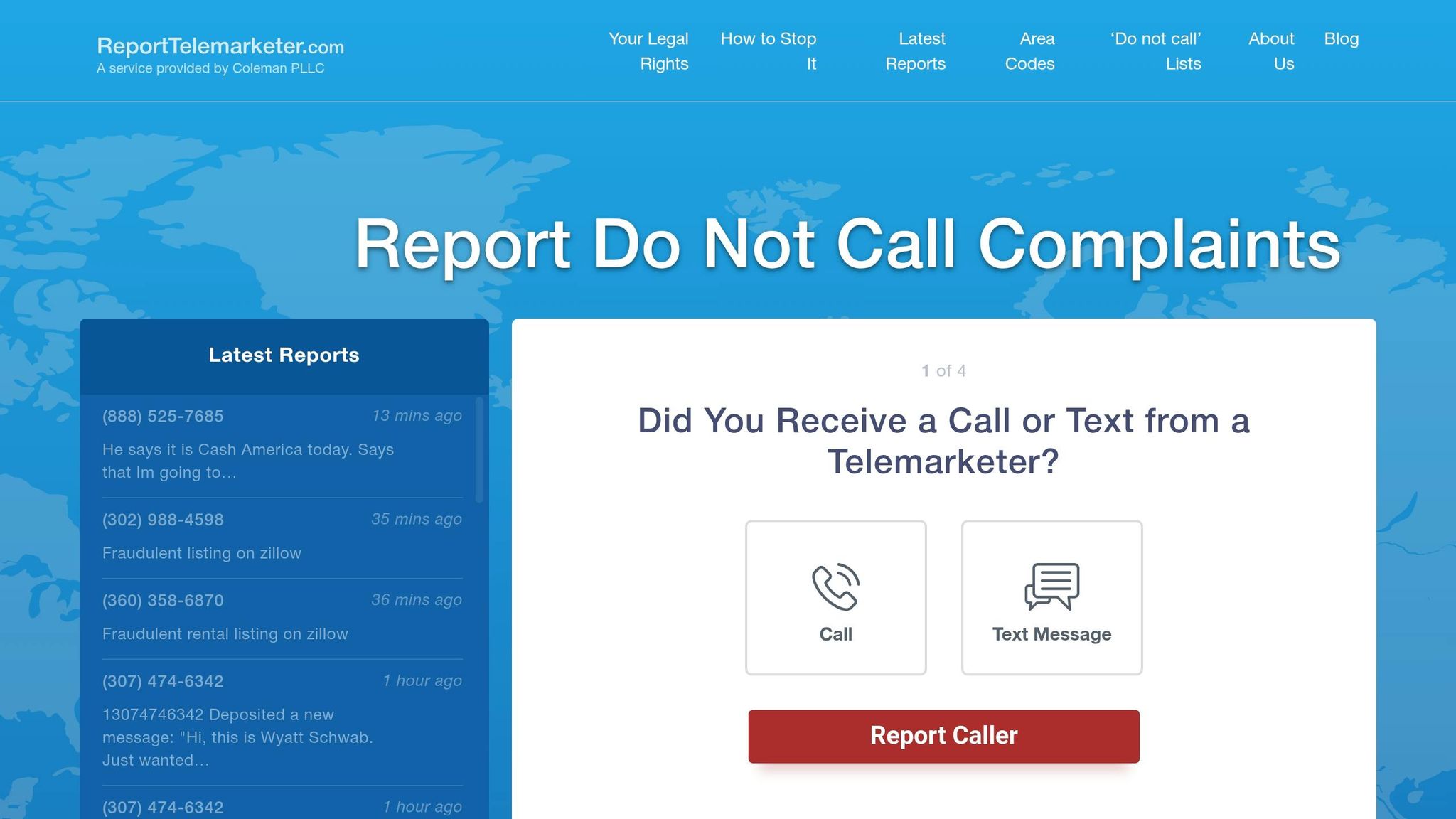
ReportTelemarketer.com is a free platform that empowers consumers to report unwanted calls and texts. It investigates telemarketers, identifies legal violations, and takes action by filing cease and desist letters or formal complaints. The service ensures there’s no out-of-pocket cost, as attorney fees are recovered directly from the telemarketer when applicable. By advocating for consumer rights, platforms like ReportTelemarketer.com play an essential role in holding telemarketers accountable and protecting individuals from privacy violations.
FAQs
What counts as valid written consent for telemarketing?
Valid written consent for telemarketing must include a clear acknowledgment from the consumer that they agree to be contacted. This consent should specify who will be making the calls or sending messages, outline the methods of contact (like calls or texts), and clarify that agreeing to be contacted is not a condition for making a purchase. Additionally, the consumer must actively provide this consent, such as through a signature or an electronic agreement.
How do we handle opt-outs and DNC requests correctly?
To manage opt-outs and Do-Not-Call (DNC) requests effectively, it’s crucial to have clear procedures in place. Make sure every request is documented thoroughly, including all relevant details and timestamps, and update your calling database without delay. Regularly cross-check your call lists with the National Do Not Call Registry to stay compliant and avoid potential penalties. Keeping accurate records and ensuring timely updates are key steps in following telemarketing regulations.
What records must we keep for 5 years, and why?
To stay compliant with telemarketing regulations such as the TCPA (Telephone Consumer Protection Act) and DNC (Do Not Call) rules, you need to keep detailed records for at least five years. These records should include:
- Consent documentation: Proof that individuals agreed to receive calls.
- Call activities: Logs of call dates, times, and outcomes.
- Opt-out and compliance records: Evidence of honoring opt-out requests and following legal guidelines.
By maintaining these records, you can verify your adherence to the law and shield your organization from potential penalties or legal disputes. This practice isn’t just about following regulations – it’s also a smart way to ensure your business operates responsibly and defensibly.

