
Spam calls are more than just annoying interruptions – they can pose serious risks, including financial scams. Here’s how you can protect yourself and take action:
- Understand the Types of Spam Calls: Robocalls, telemarketing, and scams are the main categories. Caller ID spoofing and AI-generated voices are also common tactics.
- Know Your Rights: Laws like the TCPA and TRACED Act protect you. Illegal calls can result in fines of $500–$1,500 per violation.
- Prepare Before Reporting: Record key details like the caller ID, time, and nature of the call. Avoid sharing personal information.
- Where to Report: File complaints with the FTC (DoNotCall.gov) or FCC (consumercomplaints.fcc.gov). For legal action, use services like ReportTelemarketer.com, which can help stop calls and recover damages.
- Use Tools to Block Calls: Enable spam filters on your phone or use apps like RoboKiller or Hiya to block unwanted numbers.
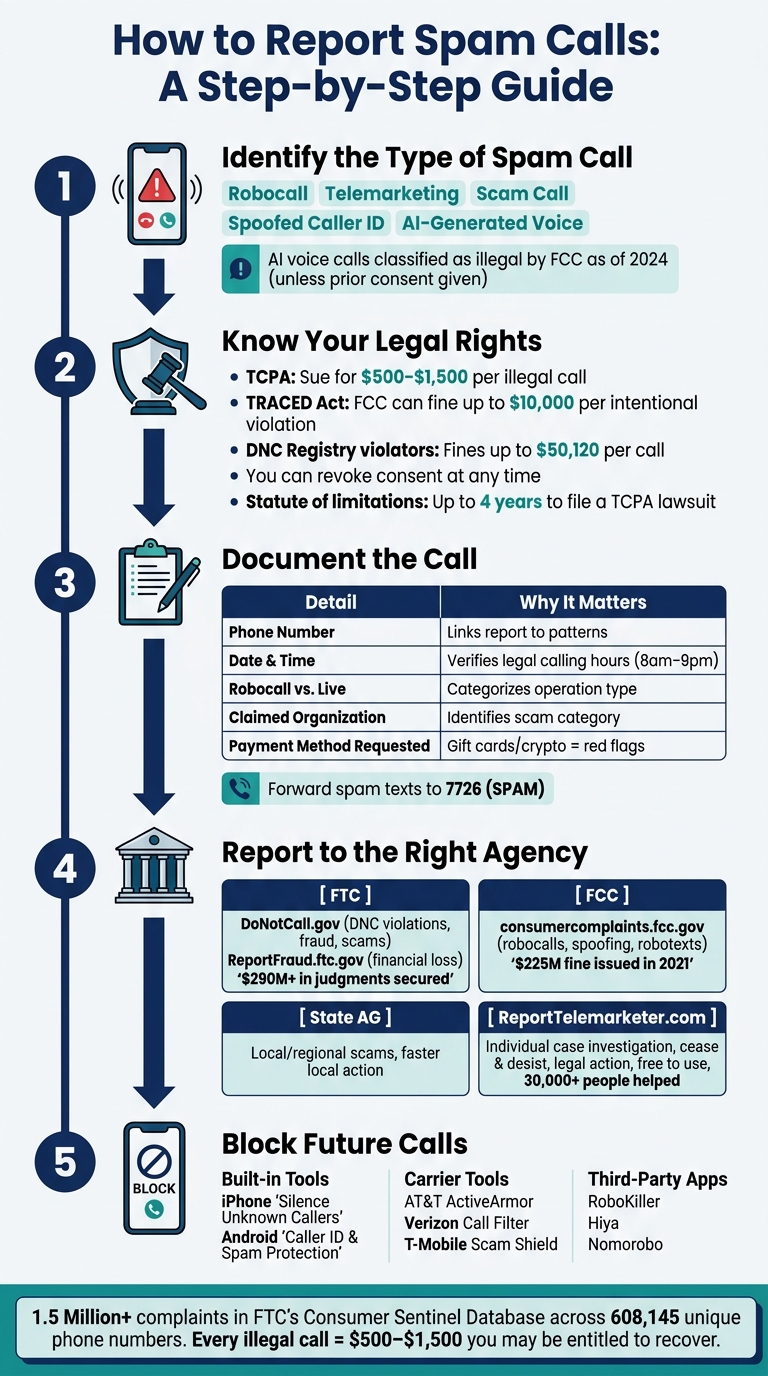
How to Report Spam Calls: Step-by-Step Guide
Spam Calls and Your Rights as a Consumer
Types of Spam Calls
Spam calls come in various forms, each with different legal implications. Illegal robocalls, for instance, use autodialers and prerecorded messages without obtaining consent. Meanwhile, telemarketing calls are only lawful if they adhere to strict consent guidelines. Another category, scam calls, often involves impersonators pretending to be from government agencies, banks, or other trusted entities to trick people into giving up money or personal information. Then there’s caller ID spoofing, where the caller disguises their real number, often making it look local or credible. Under the Truth in Caller ID Act, this practice is illegal if it’s done with the intent to deceive or defraud.
A newer issue involves AI-generated voice calls. As of early 2024, the FCC officially classified these voices as "artificial" under the TCPA, making such calls illegal unless the recipient has given prior consent.
U.S. Consumer Protection Laws Overview
Several federal laws work together to shield consumers from spam calls:
| Law | What It Covers |
|---|---|
| TCPA (Telephone Consumer Protection Act) | Regulates autodialers, prerecorded messages, and unwanted faxes |
| TSR (Telemarketing Sales Rule) | Bans deceptive telemarketing practices and supports the Do Not Call Registry |
| Truth in Caller ID Act | Prohibits malicious caller ID spoofing aimed at fraud or harm |
| TRACED Act | Increases penalties and extends the statute of limitations for violations |
The FTC oversees the National Do Not Call Registry and investigates deceptive business practices, while the FCC enforces telecom rules, including those under the TCPA, and combats spoofing. The FCC has levied substantial penalties against illegal robocallers. For example, in March 2021, it issued a $225 million penalty against John C. Spiller, Jakob A. Mears, and Rising Eagle Capital Group LLC for making roughly 1 billion spoofed robocalls promoting misleading health insurance plans.
"Stopping illegal robocalls is the Federal Communications Commission’s (FCC) top consumer protection priority." – Federal Communications Commission
These laws give consumers the tools they need to fight back and stop spam calls.
Consumer Rights and Remedies
Consumers have robust legal rights under these laws. The TCPA allows individuals to sue telemarketers directly, with statutory damages awarded for each illegal call. If the violations are willful, the damages can be even higher. The TRACED Act further enables the FCC to impose civil penalties of up to $10,000 per call for intentional violations.
You also have the right to revoke consent at any time – simply telling the caller to "stop calling me" is often sufficient. Once consent is revoked, any further automated calls are illegal, and the company must add you to their internal Do Not Call list immediately. Additionally, you typically have up to four years from the date of a violation to file a TCPA lawsuit.
"The Telephone Consumer Protection Act gives you powerful legal rights to stop automated calls, prerecorded messages, and telemarketing harassment while recovering damages of up to $1,500 per violation." – Amy Loftsgordon, Attorney, University of Denver Sturm College of Law
sbb-itb-a8d93e1
How to Prepare Before Filing a Report
Taking action against unwanted or fraudulent calls starts with solid preparation. Knowing your rights is crucial, but creating a detailed record is just as important. Investigators rely on specific, well-documented information to build strong cases. By gathering the right details, you set yourself up for success when using reporting tools.
"A telemarketer complaint is only as effective as the information it contains." – Whoscalling.io
Key Details to Collect
Right after receiving a spam call, jot down the most important details. These include the caller ID, timestamp, type of call (live or robocall), the organization they claimed to represent, and any payment method they requested. Certain payment methods, like gift cards, cryptocurrency, or wire transfers, are red flags for scams and are closely monitored by federal agencies.
| Detail to Collect | Why It Matters |
|---|---|
| Phone Number | Links your report to others involving the same number. |
| Date and Time | Verifies patterns and identifies violations of legal calling hours (8 a.m.–9 p.m.). |
| Robocall vs. Live | Helps categorize the type of operation for the FCC or FTC. |
| Claimed Organization | Pinpoints the scam category, such as government impersonation. |
| Payment Method Requested | Indicates potential fraud; gift cards and crypto are common scam tools. |
If you’re registered on the National Do Not Call Registry, make a note of whether you told the caller to stop. To confirm your registration, visit donotcall.gov. Receiving a call 31 days or more after registration is a clear violation of the law and should be documented.
Once you’ve collected these details, focus on organizing and maintaining accurate records.
Tools for Keeping Records
Consistency is key when tracking spam calls. Use a spreadsheet or a note-taking app to log each incident. Include screenshots of caller IDs or timestamps immediately after the call. Save prerecorded voicemails as they serve as direct evidence of automated calls.
For spam texts, forward the message to 7726 (SPAM). Major U.S. carriers like AT&T, T-Mobile, and Verizon use this number to investigate the sender. After filing a report with the FTC or FCC, write down the confirmation number alongside the corresponding entry in your log. This organization will be invaluable if you need to escalate the case to a lawsuit.
"A detailed call log is the foundation for every other enforcement step: agency complaints, cease and desist letters, and lawsuits all rely on your records." – LegalClarity Team
Protecting Your Privacy
Be cautious during suspicious calls. Avoid giving verbal consent or pressing buttons, even if prompted to "opt out", as this can confirm your number is active and lead to more calls.
When documenting or filing reports, never include sensitive personal information like your Social Security number, bank account details, Medicare number, or any one-time verification codes. If a caller claims to represent a legitimate company, hang up and verify by calling the official number listed on the company’s website or a recent bill. Never rely on contact information provided by the caller.
With clear records and your privacy safeguarded, you’ll be well-prepared to move forward with reporting tools and templates. You can also take immediate action to block and report spam calls using your phone’s built-in features.
Where to Report Spam Calls in the U.S.
When you’re ready to take action against spam calls, it’s important to know where to report them. The U.S. offers several channels depending on the nature of the incident and the outcome you’re seeking.
Federal Agencies
Federal agencies are at the forefront of enforcing telemarketing laws. The Federal Trade Commission (FTC) and the Federal Communications Commission (FCC) are the primary authorities for handling spam call complaints.
The FTC is the go-to agency for most unwanted calls. You can file complaints at DoNotCall.gov for non-monetary issues or ReportFraud.ftc.gov if you’ve experienced financial loss. While the FTC doesn’t resolve individual complaints, your report contributes to identifying patterns, publicizing offending phone numbers, and building cases against violators. For example, the FTC has secured over $290 million in judgments against illegal telemarketers and shut down operations responsible for billions of robocalls.
The FCC, on the other hand, focuses on robocalls, robotexts, and caller ID spoofing. Complaints can be submitted at consumercomplaints.fcc.gov. Like the FTC, the FCC doesn’t handle individual cases but takes strong enforcement actions. In one notable case from March 2021, the FCC issued a $225 million fine against Rising Eagle Capital Group LLC for caller ID spoofing violations. Violators of the National Do Not Call Registry can face fines of up to $50,120 per call.
| Agency | Where to Report | Best For |
|---|---|---|
| FTC | DoNotCall.gov / ReportFraud.ftc.gov | DNC violations, fraud, scams |
| FCC | consumercomplaints.fcc.gov | Robocalls, spoofing, robotexts |
State and Local Reporting Options
While federal agencies tackle large-scale scams, state attorney general offices are better equipped to address localized issues. They can often act more quickly to deal with scams targeting specific regions. For instance, in Texas, reports can be filed with both the attorney general’s office and the Texas Public Utility Commission via texasnocall.com. If the caller is focusing on your area, filing a state-level report alongside a federal one can be a smart move.
"State-level reports are especially important for scams targeting specific regions." – Leo, ScamVerify
These state and local channels complement federal efforts, giving you more ways to fight back against spam calls.
ReportTelemarketer.com
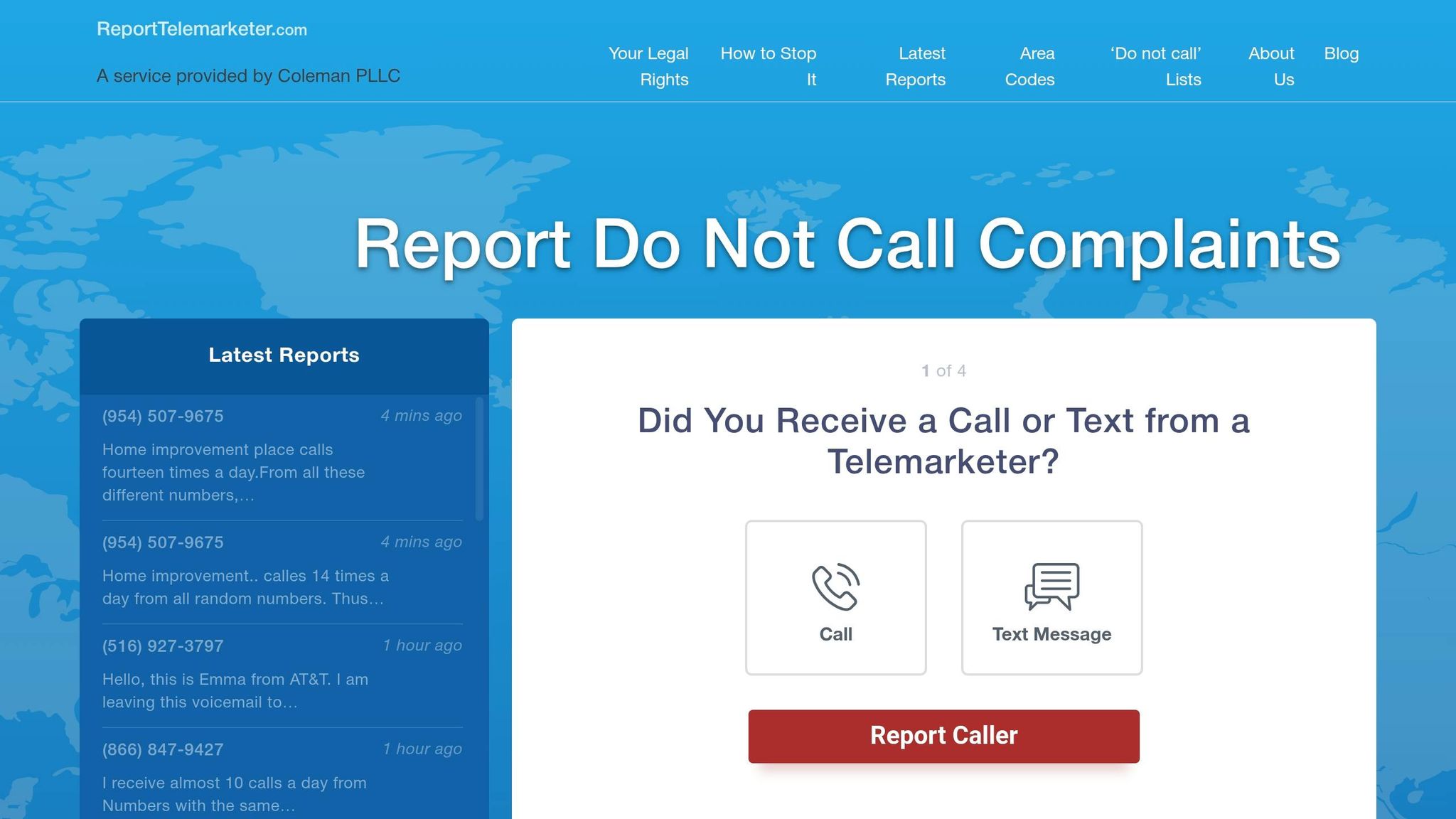
While federal and state agencies are effective, they don’t investigate individual complaints or provide direct follow-ups.
"Filing a complaint [with the FTC] does not open a personal case or create any entitlement to a callback, a case number, or a resolution." – Lookup Plainly Editorial Team
That’s where ReportTelemarketer.com steps in. Founded by attorney Stefan Coleman, this consumer protection law firm specializes in investigating individual reports. Using proprietary tools, they identify the telemarketer behind the calls and can send cease and desist letters or file formal complaints. The service has already helped over 30,000 people stop unwanted calls – and it’s free to use. The firm recovers its attorney’s fees directly from the telemarketer after the calls stop.
"As a consumer protection law firm, we offer our services at no out of pocket cost to you… we claim our attorney’s fees from the telemarketer." – Stefan Coleman, Founder of ReportTelemarketer.com
Under the Telephone Consumer Protection Act (TCPA), you may also be eligible to recover $500 to $1,500 per illegal call. If a number persists in calling you despite being on the Do Not Call list, ReportTelemarketer.com provides a direct route to stop the harassment – and possibly recover damages in the process.
Next, you’ll explore templates and tools to simplify the reporting process.
Reporting Templates and Tools
Spam Call Reporting Template
Providing a detailed report can make all the difference for investigators tackling spam calls. Generic complaints like "I got a strange call" offer little to no actionable information. Instead, take a moment after the call ends to record the following details:
| Field | Details to Record |
|---|---|
| Date and Time | The exact time the call occurred |
| Caller ID Number | The number displayed, even if it appears spoofed |
| Caller ID Name | Any name shown on your screen |
| Call Type | Specify if it was a live person, robocall, or silent/probe call |
| Claimed Entity | The company or agency the caller claimed to represent |
| The "Ask" | What they wanted – such as money, personal information, or gift cards |
| Your Response | Whether you asked them to stop or mentioned the Do Not Call Registry |
For robocalls, ignore the caller ID shown and instead note any callback number mentioned in the message. Be sure to include any personal details you may have accidentally shared during the call.
Once you’ve compiled this information, you can use phone features and apps to simplify the reporting and blocking process.
Apps and Features for Reporting
After organizing your report, take advantage of your smartphone’s built-in features to block and manage spam calls. For iPhone users, enabling Silence Unknown Callers (found under Settings > Phone) will filter out calls from numbers not saved in your contacts. On Android devices, turning on Caller ID & spam protection in the Phone app offers similar protection by identifying and blocking suspicious numbers.
Major U.S. carriers also provide free tools to help combat spam calls:
- AT&T ActiveArmor
- Verizon Call Filter
- T-Mobile Scam Shield
For more advanced blocking, third-party apps like RoboKiller, Hiya, and Nomorobo tap into community databases to identify and block offenders effectively. If you’re dealing with spam texts, simply forward the message to 7726 (SPAM), which alerts your carrier to investigate the issue at the network level.
Using ReportTelemarketer.com as Your Main Reporting Tool
While your phone’s tools and apps are great for blocking and logging spam calls, they won’t take legal action on your behalf. That’s where ReportTelemarketer.com steps in. This platform simplifies the legal process with a straightforward three-step method: you submit your report, their experts identify the telemarketer, and they handle the legal follow-up, such as filing a cease and desist letter or a formal complaint.
"Our services do not cost you anything out of pocket and we do all of the work for you." – Stefan Coleman, Lawyer and Founder, ReportTelemarketer.com
If you’re dealing with repeated calls from the same telemarketer, submit a separate report for each instance. This helps build a stronger case. Thanks to the Telephone Consumer Protection Act (TCPA), each illegal call could result in $500 in statutory damages. Plus, their attorney’s fees are recovered directly from the telemarketer after a successful resolution.
Conclusion
By following the steps and utilizing the tools mentioned earlier, you can help turn individual spam call reports into meaningful collective action. Each report you file contributes to a larger effort to combat telemarketing abuse. For instance, the FTC’s Consumer Sentinel database now includes over 1.5 million complaints tied to 608,145 unique phone numbers. This data is crucial for regulators as they work to identify scam operations, push carriers to enhance call-filtering systems, and build cases against major offenders.
Thanks to the Telephone Consumer Protection Act (TCPA), every illegal call you receive could entitle you to statutory damages ranging from $500 to $1,500 per violation. This isn’t just a legal technicality – it’s a right you can actively enforce.
"Taking action not only ensures personal security and peace of mind, but also supports broader initiatives aimed at combating telemarketing practices." – Legal Reader
If you want your reports to lead to real outcomes – not just another entry in a government database – ReportTelemarketer.com offers a direct solution. Created by consumer protection attorney Stefan Coleman, this platform allows you to submit reports while their team handles investigations and legal action. By using it, you’re not just documenting violations – you’re taking a step toward enforcing your rights and supporting efforts to stop illegal telemarketing.
FAQs
What counts as an illegal robocall?
Under the Telephone Consumer Protection Act (TCPA), robocalls – those automated calls made using an autodialer or a prerecorded/artificial voice – are generally illegal if they’re sent to your cell phone or residential landline without your prior express consent.
For calls involving telemarketing or advertising, the rules are even stricter: consent must be in writing. The good news? You can revoke your consent at any time.
On top of that, using caller ID spoofing to mislead or defraud is strictly prohibited. And if you’re worried about AI-generated voice calls, know that they’re completely banned unless you’ve explicitly agreed to receive them.
What details should I log before I report a spam call?
To put together a solid report, make sure to document everything in detail. Record the exact date and time of the call, the caller ID number (even if it seems spoofed), and whether the call came from a live person or a pre-recorded message. Be sure to include any company names mentioned, callback numbers provided, or specific details like demands or threats made during the call. Save any voicemails or screenshots, and make a note if you’ve previously revoked consent or asked not to be contacted again.
Can I get money back for repeated spam calls?
Under the Telephone Consumer Protection Act (TCPA), you could be entitled to recover $500 to $1,500 for each illegal call or text you receive. This is especially true if the calls or texts come from automated systems or continue after you’ve withdrawn your consent. ReportTelemarketer.com assists in identifying violators and can issue cease-and-desist letters or file formal complaints to put an end to these unwanted contacts – all without any upfront costs to you.

