
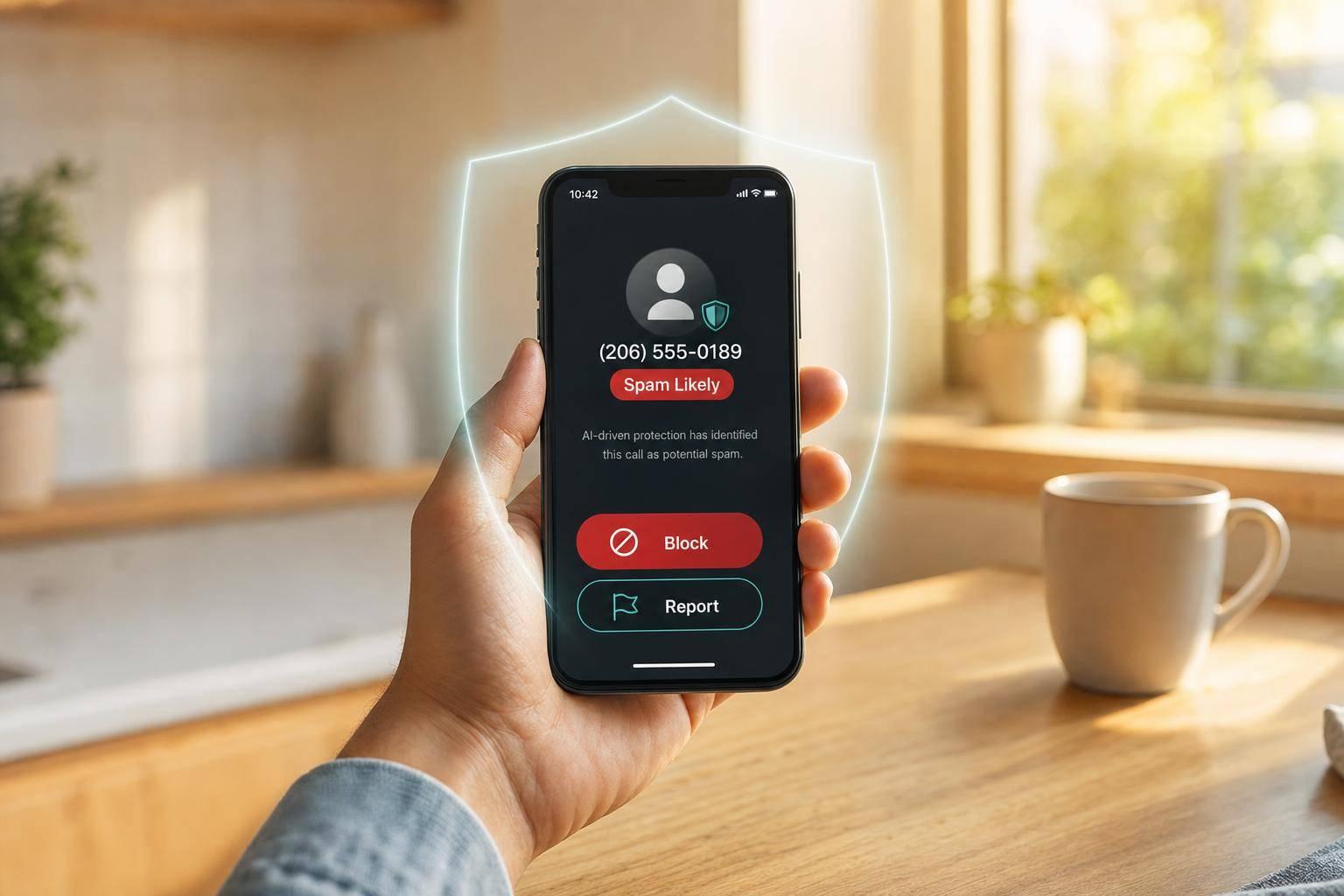
Spam call detection now goes far beyond a list of bad numbers. I’d sum it up like this: the best systems score call metadata, audio, transcripts, complaint history, and caller reputation at the same time to catch scams even when callers switch numbers.
Here’s the short version:
- I see deep learning as a way to find scam patterns, not just scam numbers.
- It can use signals like call bursts, spoofing signs, repeated scripts, flat prerecorded audio, and complaint trends.
- Metadata-only tools are cheaper and faster, but they miss call content.
- Audio and transcript models can spot robocalls, scam language, and repeated campaigns.
- Multimodal systems combine those inputs for the strongest results.
- Model quality depends on precision, recall, F1, ROC-AUC, MCC, and latency – not just accuracy.
- In the U.S., this matters beyond annoyance: under the TCPA, illegal robocalls or spam texts can lead to $500 per call or text, or up to $1,500 each for willful violations.
If I had to boil the whole article down to one point, it’s this: spam call detection works best when fast models, clean data, and careful thresholds work together.
Quick comparison:
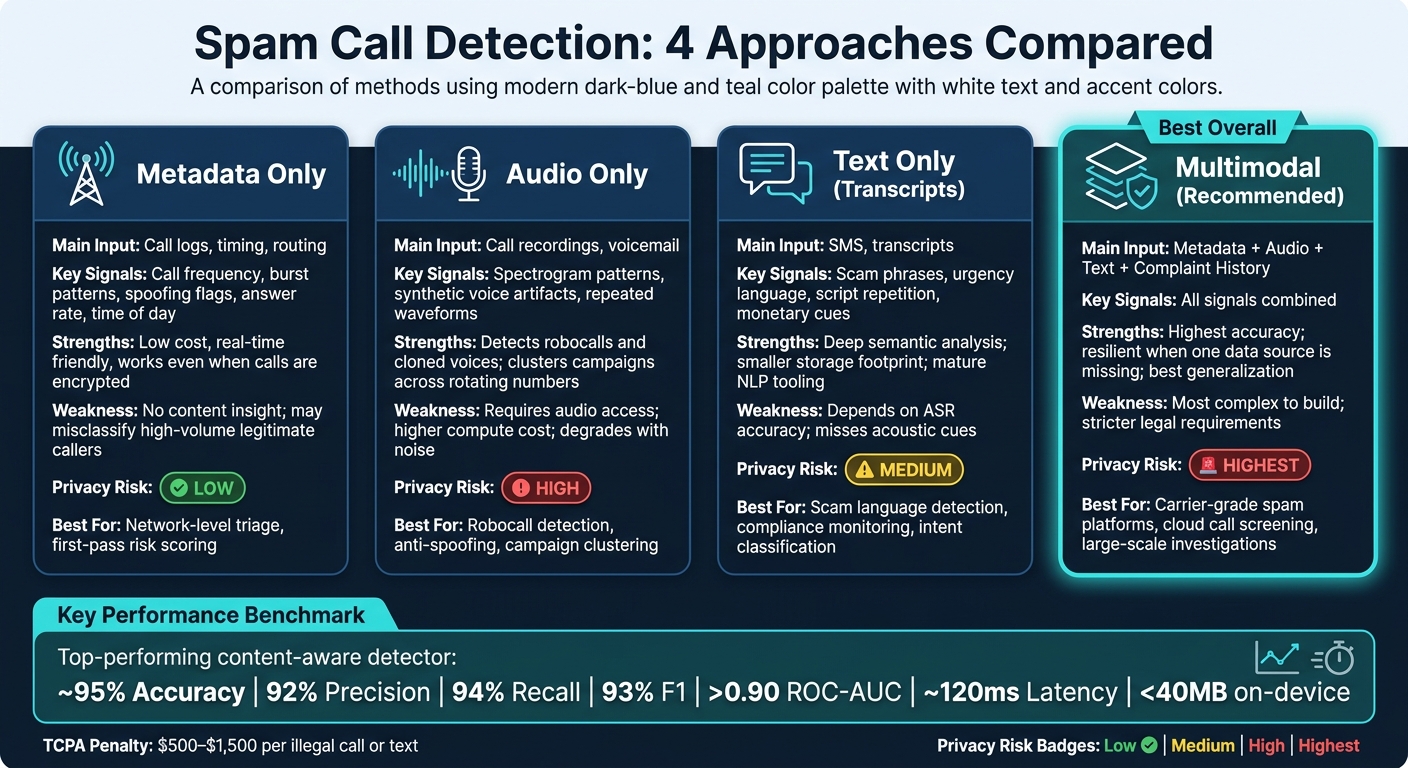
| Approach | Main Input | What it does well | Main issue |
|---|---|---|---|
| Metadata only | Call logs, timing, routing | Fast first-pass screening | No content insight |
| Audio only | Call recordings, voicemail | Finds robocall voice patterns | Needs audio access |
| Text only | SMS, transcripts | Spots scam wording and threats | Depends on ASR quality |
| Multimodal | Metadata + audio + text + complaints | Best overall detection | More build and privacy work |
I’d read the rest of the article as a plain guide to what data these systems use, which model types fit each signal, how teams test them, and where they run: on your phone, in carrier networks, or in the cloud.
Spam Call Detection: Metadata vs Audio vs Text vs Multimodal Models
The Data That Powers Spam Call Detection
Call Metadata, Complaint Reports, and Number History
Every call leaves a digital footprint. Call detail records (CDRs) track the originating number, destination, call duration, timestamp, whether the call connected, and routing data. Because this data is structured, carriers and analytics teams can collect it at scale and spot patterns fast.
That matters because spam calls tend to behave differently from normal calls. A model can flag things like unusually high outbound volume, bursts of very short calls, or numbers that show up briefly and then disappear. Those patterns often point to spam campaigns instead of ordinary person-to-person calls.
The strongest metadata signals are call frequency, burst patterns, time of day, answer rate, and spoofing indicators. A number that places hundreds of calls per hour, mostly during business hours, with a low answer rate and a caller ID that does not match routing data, is a strong spam candidate. Models turn those clues into numeric features, such as calls per hour or burstiness scores, then pair them with categorical embeddings for area codes and carrier IDs.
Complaint data adds something metadata alone can’t fully provide: reputation over time. The FTC publishes a daily list of Do Not Call and robocall complaints, including caller ID numbers and timestamps, so analytics companies and voice service providers can improve their filters. FTC complaint records also include caller ID, date, time, city, state, subject, and robocall status.
User reports on ReportTelemarketer.com add another layer. They include complaint counts, call timing, script notes, and narrative details that can help spot repeat offenders and support investigations. Fields such as caller ID, call date and time, script description, and user narrative can be turned into features like complaint count per number or shared keywords across reports. That gives models more context and also helps with later enforcement work.
Audio Recordings, Voicemail, and Speech Transcripts
When metadata is thin, noisy, or spoofed, audio and transcripts can do a lot of the heavy lifting. Deep learning systems analyze spectrograms, which show how sound changes over time, with convolutional neural networks (CNNs). These models can detect acoustic patterns tied to robocalls, like flat pacing, a lack of natural hesitation, and identical audio segments repeated across many calls. Synthetic voices can leave clues too, including overly smooth pitch shifts and low timing variation.
Audio is also useful for linking calls that seem unrelated on the surface. A spammer may rotate phone numbers, but the audio pattern often stays the same. That lets systems cluster calls into a single campaign, even when a basic blacklist would miss the connection.
Automatic speech recognition (ASR) turns audio into text, which opens the door to language analysis. Transcript models look for scam phrases, urgency language, money references, callback numbers, and URLs. Transformer-based models can pick up long-range script patterns even when the wording changes from call to call. Systems can also pull acoustic features like speaking rate and pause duration and use them alongside the transcript, giving the model both language and behavior signals.
Comparison Table: Metadata, Audio, Text, and Multimodal Models
These data sources differ in cost, access, accuracy, and privacy. It’s easier to see the tradeoffs side by side.
| Data Source | Strongest Signals | Benefits | Limitations | Privacy Considerations | Common Use Cases |
|---|---|---|---|---|---|
| Metadata only | Call frequency, burst patterns, spoofing flags, answer rate, time of day | Low cost, real-time-friendly, works even when calls are encrypted | Can’t read content; may misclassify high-volume legitimate callers like hospitals or banks | Minimal – no content access required | Network-level triage, first-pass risk scoring, large-scale carrier monitoring |
| Audio only | Spectrogram patterns, synthetic voice artifacts, repeated waveforms | Detects robocalls and cloned voices; clusters campaigns across rotating numbers | Requires audio access; higher compute cost; quality degrades with noise or poor connections | Recording and storing audio may trigger federal or state consent requirements | Robocall detection, anti-spoofing, campaign clustering |
| Text only (transcripts) | Scam phrases, urgency language, script repetition, monetary cues | Deep semantic analysis; smaller storage footprint than raw audio; mature NLP tooling | Depends on ASR accuracy; misses acoustic cues; content access raises regulatory questions | Transcript storage and analysis may require user disclosure | Scam language detection, compliance monitoring, intent classification |
| Multimodal (metadata + audio + text + complaint history) | All of the above, combined | Highest accuracy; resilient when one data source is noisy or missing; better generalization | Most complex to build; requires data synchronization; stricter legal requirements | Strictest – must address consent, retention, and access controls across all modalities | Carrier-grade spam platforms, cloud call screening, large-scale telemarketing investigations |
Carriers use STIR/SHAKEN authentication along with metadata and complaint history to label likely spam and block known fraud numbers. From there, those signals feed into the text, audio, and multimodal models that handle detection.
sbb-itb-a8d93e1
How to Detect Fraud Calls using AI | Artificial Intelligence Application|Live Bootcamp| IvyProSchool

Deep Learning Model Types Used for Spam Call Detection
Spam detection leans on different models for different signals. Text models look at messages and transcripts. Audio models listen for robocall patterns. Graph models track how numbers behave across a network. In practice, many detection systems mix these model families in the same stack.
The key move is simple: match the signal to the model.
Text and Transcript Models: CNNs, LSTMs, and Transformers
Text models work on SMS content and voicemail transcripts. They turn text into embeddings so similar phrases sit close together, which helps the system spot disguised spam language and common urgency wording.
CNNs learn short phrase patterns that often show up in spam. That includes repeated sales hooks, ALL-CAPS urgency, and phishing templates that mention bank accounts or Social Security numbers. They’re good at finding the kind of wording that repeats over and over, even when the full message changes a bit.
LSTMs read text in sequence, so they do better when the pattern unfolds over several parts of a message. For example, a text might open with a friendly greeting, switch to an account issue, and then end with a push for immediate action. That arc matters, and LSTMs are built to track it.
Transformers go a step further. Using self-attention, they connect the whole message at once. That helps them catch mixed cues in the same text, like financial terms, legal threats, and brand impersonation. In one comparison, a Transformer variant reached 98.92% accuracy and a 0.9613 F1-score on SMS spam classification.
Audio models come into play when text is missing, noisy, or not available at all.
Audio and Call-Pattern Models: Spectrogram CNNs, Hybrid Models, and Graph Methods
Audio models turn call audio into Mel-spectrograms and then use CNNs to learn robocall fingerprints. Those fingerprints can include rigid cadence, odd pauses, and repeated prompts. If you’ve ever heard a call that sounds just a little too polished and mechanical, that’s the kind of pattern these models are built to catch.
CNN-LSTM hybrids combine two jobs. The CNN picks up short acoustic cues, while the LSTM tracks how the call unfolds over time. That setup helps with interactive voice response scams, where the structure often loops in a repetitive way.
When caller IDs rotate faster than the content can be checked, graph models step in.
Graph-based models treat the whole call ecosystem like a network. Phone numbers are nodes, and calls are edges. From there, graph neural networks can spot numbers that act like hubs. They may place many outbound calls, get few answers, trigger complaints, or swap caller IDs while showing the same campaign behavior. Users can report phone numbers to help these systems identify such patterns. In other words, these models can flag suspicious numbers from behavior alone, even without call content.
Comparison Table: Strengths and Limits of Each Model Family
| Model Family | Typical Input | Strengths | Weaknesses | Computational Cost | Best Use Case |
|---|---|---|---|---|---|
| Text CNN | SMS text, short transcripts | Fast, lightweight, strong at local phrase patterns | Misses long-range context; needs relatively clean text | Low | On-device SMS filtering, real-time screening |
| LSTM / BiLSTM | Full voicemail transcripts, longer scripts | Captures sequential structure and multi-sentence fraud patterns | Slower than CNNs; harder to parallelize | Medium | Carrier-side voicemail analysis, cloud batch processing |
| Transformer (BERT-style) | SMS, transcripts, complaint narratives | Strong global context modeling; high accuracy on complex language | More compute-intensive; usually needs distillation for on-device use | High | Cloud-based analytics, bulk review |
| Spectrogram CNN | Call audio (Mel-spectrogram) | Detects robocall audio signatures without transcripts | Requires audio access; sensitive to recording quality | Medium | Carrier-side audio scanning, network appliances |
| CNN-LSTM Hybrid (audio) | Full call recordings | Combines local acoustic features with temporal call structure | Higher latency; less suited to strict real-time on-device use | Medium–High | Near-real-time carrier analysis, offline review |
| Graph Neural Network (GNN) | Call detail records, complaint data, number metadata | Detects campaign-level behavior; flags new numbers without call content | Needs large graph infrastructure; typically centralized | High (scales with graph size) | Carrier backbone, regulatory monitoring, analytics platforms |
Model choice affects more than detection speed or accuracy. It also changes how teams handle labeling, class imbalance, and evaluation.
Training, Testing, and Measuring Model Performance
After picking a model family, the next hurdle is simple: can it handle messy, live call data? A good model on paper can still fall apart once it meets actual phone traffic. That’s why training and evaluation matter just as much as model choice.
Preparing Labeled Data and Handling Class Imbalance
Good training data starts with clean, steady records. Phone numbers should be normalized into a standard format such as E.164 (+1-XXX-XXX-XXXX). Timestamps also need to line up across U.S. time zones. And obvious junk has to be removed early – numbers with too few digits, all-zero placeholders, and test records.
Once the data is cleaned, duplicates and near-duplicates need close attention. The same call may show up in both a carrier system and a phone app log. If both copies end up spread across training and test sets, the model can look better than it is. In practice, that kind of overlap inflates performance numbers and hides how the system will behave on new calls.
Train-test splits should follow time order instead of random shuffling. Training on older calls and testing on newer ones mirrors live deployment, where the model has to deal with campaigns it has not seen before. Random splits can leak future data into training, which makes results look stronger than they are.
Spam traffic is heavily imbalanced, and it shifts fast. In actual U.S. call traffic, spam makes up only a small share of all calls. That creates a trap: a model that labels every call as legitimate can still post high accuracy while catching nothing.
Teams usually deal with this in a few ways:
- Undersampling: reduce the number of legitimate-call examples
- Oversampling: duplicate spam examples or create synthetic ones with SMOTE
- Cost-sensitive learning: penalize the model more for missing a spam call
Each fix comes with a tradeoff. Too much oversampling can shrink variety in the training set. Too much undersampling throws away useful context about what normal, legitimate calls look like.
Key Metrics: Precision, Recall, F1, ROC-AUC, and Latency
Accuracy is often the first number people check. On imbalanced data, it’s often the least helpful one.
For spam detection, the metrics that matter most are precision, recall, F1, ROC-AUC, MCC, and latency.
Precision answers a very practical question: when the model flags a call as spam, how often is it right? That matters most in auto-blocking systems. If precision slips, the system can start hiding calls from doctors, schools, and banks. That kind of false positive damages consumer trust fast.
Recall asks the opposite question: of all the actual spam calls, how many did the model catch? High recall means fewer scam calls get through, which is the ultimate goal when learning how to stop spam calls.
One content-aware detector reached about 95% accuracy, 92% precision, 94% recall, F1 around 93%, ROC-AUC above 0.90, about 120 ms inference time, and under 40 MB of memory on a phone. That mix of strong detection and low delay is the benchmark for on-device use.
F1 score rolls precision and recall into one number, which is handy when you need a single point of comparison. ROC-AUC shows how well the model separates spam from legitimate calls across all possible decision thresholds. A score near 1.0 means the model does a strong job ranking spam above normal calls no matter where the cutoff sits.
MCC, or Matthews Correlation Coefficient, is especially useful on imbalanced data because it accounts for true positives, true negatives, false positives, and false negatives instead of leaning on the majority class.
Then there’s latency. This is the hard limit in practice. If a model takes too long to decide, it can’t warn the user before the call is answered. At that point, even good classification scores don’t help much.
Metrics Table: How to Judge Whether a Model Performs Well
| Metric | What It Measures | High Value Means | Low Value Means | Why It Matters for U.S. Consumers |
|---|---|---|---|---|
| Accuracy | Share of all calls correctly classified | Most calls labeled correctly | Many misclassifications | Misleading on imbalanced data; a model can score high while catching no spam |
| Precision | Of calls labeled spam, how many truly are | Few legitimate calls blocked | Many false alarms | Critical for auto-blocking; low precision hides important calls |
| Recall | Of all real spam calls, how many were caught | Most spam detected | Much spam slips through | Critical for consumer protection; low recall means more scam exposure |
| F1 Score | Harmonic mean of precision and recall | Strong balance between both | Poor balance; one metric is weak | Useful single benchmark when precision and recall both matter |
| ROC-AUC | Ability to rank spam above legitimate calls across thresholds | Strong discrimination at any threshold | Near-random classification | Helps compare models independent of threshold choice |
| MCC | Overall correlation between predictions and reality | Reliable predictions across both classes | Performance close to random | Useful when classes are imbalanced |
| Inference Latency | Time from call arrival to model decision | Decision arrives before or during ringing | Warning arrives too late to act on | Determines whether the system can screen calls in real time |
Thresholds should match the action the system will take. Auto-blocking needs high precision, because blocking a wanted call carries a high cost. Warning-only modes can lean more toward recall, since it’s better to flag more risky calls when the user still gets the final say.
Those threshold choices also shape where the model can run – on the phone, inside a carrier network, or in the cloud.
Deployment, Consumer Protection, and Key Takeaways
Where Models Run: Phones, Carrier Networks, and Cloud Services
After training and evaluation, deployment decides one simple thing: can the model act before the call is answered?
On-device apps review calls right on the phone. Since the data stays on the device, privacy is stronger, and the app can make decisions in real time. The downside is pretty plain: phones have limited CPU power, battery life, and storage. That puts a ceiling on how large or complex the model can be.
Carrier tools use metadata, reputation data, and STIR/SHAKEN attestation to label or block calls before they reach the user. They work across millions of subscribers, which gives carriers a broad view of calling patterns. But privacy here depends on the carrier’s data rules and how that data is handled.
Cloud APIs can score metadata, audio, or transcripts remotely. That setup allows for more complex model designs and faster updates. It also brings privacy and data residency questions that developers need to handle with care.
One limit shows up in every setup: STIR/SHAKEN checks identity, not intent. An authenticated call can still be spam, and a legitimate call can still be mislabeled. That’s why layered defenses beat any single filter.
Those same signals can do more than stop calls. They can also help document patterns for complaints and investigations.
How Detection Supports Reporting and Legal Action
Detection doesn’t just filter calls. It also creates evidence.
The number, timestamp, frequency, and pattern history used to flag a call are the same data points that can support complaint filings and enforcement action. In practice, that matters when a caller keeps pushing past the rules.
Under the Telephone Consumer Protection Act (TCPA), each illegal call or text can trigger statutory damages, with higher damages for willful or knowing violations.
If spam calls keep slipping through even after filters do their job, ReportTelemarketer.com offers a free next step. ReportTelemarketer.com reviews reports and can send cease-and-desist letters or file formal complaints to stop the calls. Attorney fees are sought from the telemarketer, not the consumer.
Conclusion: What Makes a Spam Call Detection System Work
No single part makes a spam detection system work. You need accurate data, the right model design, inference that runs fast enough, and a feedback loop that keeps pace as caller tactics change.
A model only helps if it can act before the call is answered. Its thresholds also need to match the cost of false positives and false negatives. Block too aggressively, and good calls get hit. Go too soft, and spam gets through. That balance is where the hard work lives.
Privacy safeguards matter just as much as model performance. Consumers need to know what data leaves their device and how that data is used. And when the technical layer misses something – because no system catches every call – clear reporting paths and legal protections like the TCPA give consumers a practical way to push back against repeated illegal telemarketing.
FAQs
How is deep learning better than a spam number list?
Deep learning works better than a static spam number list because it can react in real time. A fixed list only blocks numbers that have already been reported. Deep learning looks at call metadata – like call frequency, timing, duration, and voice traits – to spot patterns that look suspicious.
That means it can catch new or shifting threats, including spoofed numbers and automated dialing bursts, even before anyone has flagged the number.
What data helps detect spam calls most accurately?
Deep learning models spot spam calls best when they look at call metadata alongside behavior patterns. The main signals include caller ID authenticity, call frequency, call duration, and timestamps.
They may also review voice traits, suspicious calling behavior, and whether a number appears on Do Not Call lists or matches consent records. Consumer reports can help show larger patterns of abuse.
Can spam call detection work in real time?
Yes. Deep learning models can spot spam calls in real time by analyzing call metadata and calling patterns the moment a call starts.
That means unwanted telemarketing calls can be flagged and filtered before they interrupt your day.
If the spam keeps coming, ReportTelemarketer.com can help document violations, look into the callers, and support formal legal action to help stop the harassment.

