
In 2025, telemarketing lawsuits got expensive fast. I’d sum it up like this: weak consent records, late calls, ignored STOP requests, and poor vendor checks turned routine campaigns into class actions with settlement amounts from $400,000 to $28 million.
Here’s the short version:
- I see one main shift: telemarketing moved from loose rules to tighter proof requirements
- The TCPA still carries $500 per illegal call or text, or up to $1,500 if a court finds the conduct knowing or willful
- A large class can turn that into tens of millions of dollars
- In 2025, many cases focused on the same problems:
- vague or missing consent proof
- contact outside the 8:00 a.m. to 9:00 p.m. local time window
- texts sent after a consumer replied STOP
- calls or texts tied to outside lead sellers and dialing vendors
- Big settlements involving SiriusXM, Kaiser Permanente, QuoteWizard, Gen Digital, and others showed that these were not small paperwork issues
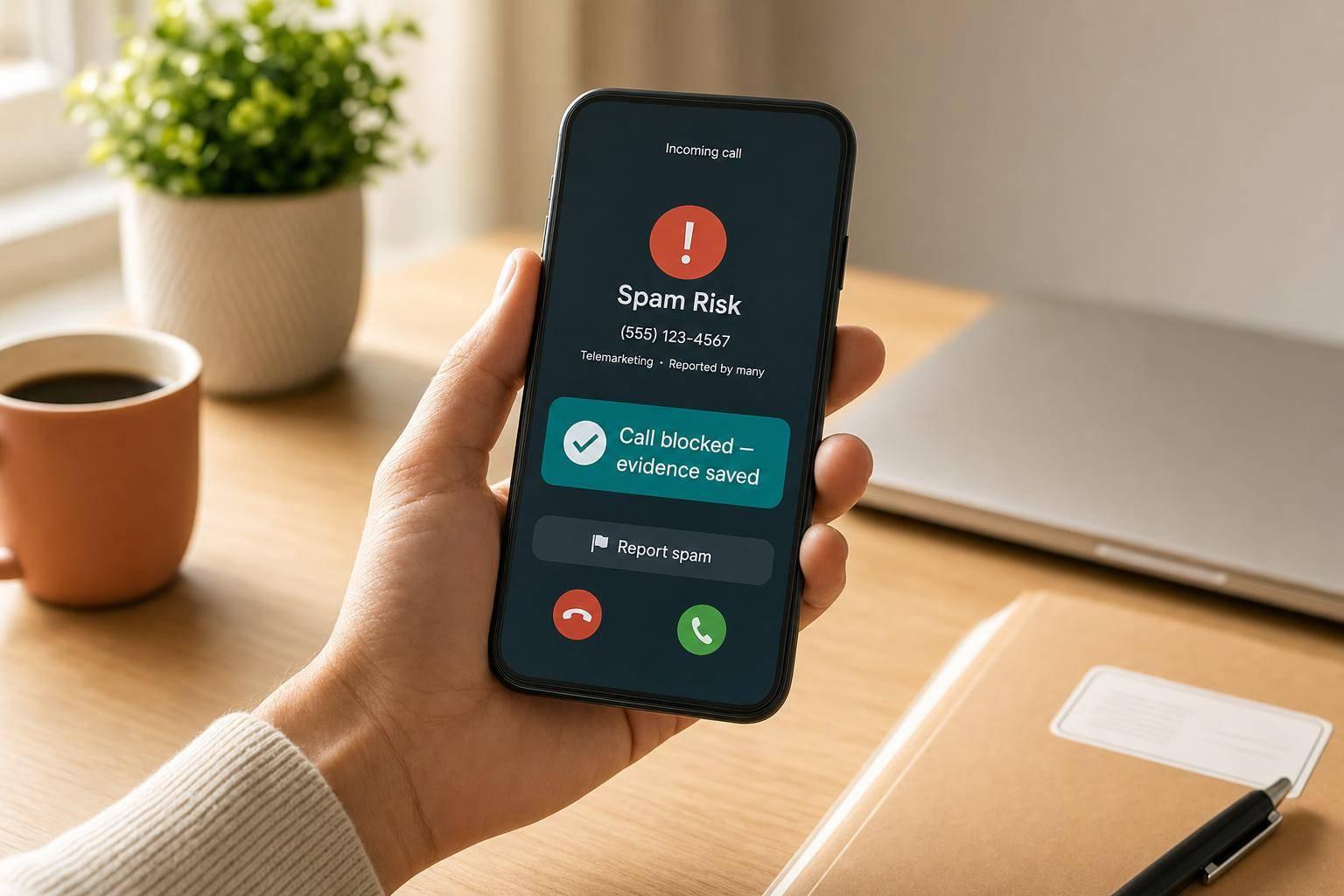
- For consumers, the takeaway is simple: save call logs, screenshots, voicemails, and opt-out messages
What changed after those cases?
- Consent had to be tied more clearly to one seller at a time
- Companies had to keep better records, such as form language, timestamps, and lead source data
- Opt-outs had to be handled across systems within 10 business days
- Vendor checks became a bigger part of TCPA compliance
If I had to put the whole article into one sentence, it would be this: 2025 showed that sloppy telemarketing practices can lead to class action risk at a scale many businesses could not ignore.
10 Most Expensive TCPA Lawsuit Settlements and How to Avoid Them with Compliance Tools
Telemarketing Practices Before the 2025 Lawsuits
Before the 2025 lawsuits, a lot of telemarketers leaned on broad consent, weak suppression systems, and light vendor checks. Those weak spots showed up all over the industry – and once cases started piling up, they got expensive fast.
Broad Consent and Weak Recordkeeping
Many companies used bundled opt-in language on web forms and quote tools. Instead of naming the actual seller or saying how the consumer would be contacted, they often used vague terms like "marketing partners." In many cases, people had no clear notice that the consent covered autodialed or prerecorded marketing.
That may sound like a small wording issue. It wasn’t. Once lawsuits forced companies to hand over consent records, the paper trail often fell apart.
Many businesses could not show:
- the exact form language the consumer saw
- which version of that language was live at the time
- basic proof like a timestamp or IP address showing when the opt-in happened
Without those records, defending a TCPA claim got much harder. The FCC‘s one-to-one consent rule, adopted in December 2023, was meant to curb this bundled-consent setup.
That missing consent trail later turned into a major weak point in court.
Calling-Time and Opt-Out Failures
Calling-time violations kept coming up. The TCPA generally limits telemarketing calls and texts to between 8:00 a.m. and 9:00 p.m. local time, but many automated systems relied on bad local-time data. The result was pretty simple: messages went out at 7:45 a.m. or 9:30 p.m. local time when they shouldn’t have.
Opt-out handling had the same kind of weak spots. A STOP request might remove someone from one system, but not from every dialer, CRM, or vendor list. Suppression lists often moved slowly across vendors, so messages sometimes kept going even after the consumer had opted out.
In class actions, plaintiffs pointed to text threads showing repeated STOP requests followed by more marketing messages. That gave them a direct way to argue the problem was systemic, not a one-off mistake.
Those records made it easier to paint a picture of repeated compliance failures.
Limited Oversight of Lead Generators and Vendors
Many brands weren’t placing the calls themselves. They were buying leads from outside lead generators and vendors, often with little more than a contract clause saying the seller would follow TCPA rules. On paper, that might have looked fine. In practice, many companies never reviewed the actual consent forms, never checked the source of the lead, and never looked at how many times a phone number had already been sold or reused.
Courts and the FCC had been warning for years that sellers can face vicarious liability for third-party marketing calls. By 2025, those oversight gaps sat at the center of many class action claims.
These breakdowns set the stage for the lawsuit patterns that followed in 2025.
2025 TCPA Class Action Case Studies That Changed Industry Standards
Common Lawsuit Patterns in 2025
When weak consent records, late-night calls, ignored STOP requests, and poor vendor controls ended up in court, 2025 TCPA cases started to look very similar.
The SiriusXM case is a clear example of the Do Not Call issue. The company agreed to a $28 million nationwide settlement over repeated sales calls to non-subscribers and consumers who had already opted out, including numbers on the NDNCR and SiriusXM’s internal do-not-call list. Kaiser Permanente obtained preliminary approval in October 2025 for a $10.5 million TCPA settlement over texts sent to consumers who had already replied "STOP" or a similar opt-out instruction. Gen Digital, the parent of Norton and LifeLock, settled for $9.95 million after a class action alleged it placed prerecorded calls to people who did not have a LifeLock or Norton account.
A smaller real estate case showed the same thing at street level. In Nicotra v. Bayside NY Homes LLC d/b/a Keller Williams Realty Landmark (Case No. 1:24-cv-04459, E.D.N.Y.), a brokerage trained agents to use third-party tools like Vulcan7 and RedX to cold-prospect expired listings, contacting NDNCR numbers with no prior relationship to the firm. The case settled for $400,000 and covered 1,019 unique phone numbers. That case showed how vicarious liability can reach firms that train agents, provide the tools, and push the calling activity.
These smaller cases still carried weight because they exposed the same compliance gaps found in normal sales workflows. The same pressure showed up in both consumer and B2B campaigns.
Why Settlements Reached Multi-Million-Dollar Levels
The math behind these cases adds up fast. The TCPA allows $500 per unlawful call or text, and that can climb to $1,500 per violation if the conduct was willful or knowing. Once a case turns into a nationwide class action, exposure can snowball.
SiriusXM’s class covered U.S. residents who received more than one telemarketing call within any 12-month period between April 27, 2019, and October 31, 2025, and that period led to more than 427,000 claims. QuoteWizard.com settled for $19 million over texts to NDNCR numbers, with payouts set at $76 for two texts plus $38 for each additional text. Across the market, the top 10 TCPA settlements in 2025 totaled about $69.1 million.
| Case | Settlement Amount | Class Size / Scope |
|---|---|---|
| SiriusXM | $28 million | 427,000+ claims, nationwide |
| Kaiser Permanente | $10.5 million | Nationwide, texts after STOP |
| QuoteWizard.com | $19 million | NDNCR numbers, multiple texts |
| Gen Digital (Norton/LifeLock) | $9.95 million | Non-customers, nationwide |
| American Income Life Insurance | $14 million | 49,695 unique numbers on the NDNCR |
| Register.com | $1.5 million | Disconnected and reassigned cell phone numbers |
Per-person payments in large settlements may look small, often $40 to $300 per person, but the total exposure is what brings companies to the negotiating table.
How Consumers Documented Harm and Sought Relief
The proof behind these settlements was pretty straightforward. Consumers used:
- Call logs and carrier records to show volume and timing
- Screenshots of text messages to show STOP messages were sent and then ignored
- Voicemail recordings to show prerecorded voices
- Copies of complaints or other correspondence to show requests for no further contact
- In Do Not Call cases, proof of NDNCR registration and no customer relationship with the caller
That evidence had a direct effect on payouts. In the Kaiser Permanente case, claims administrators used qualifying message counts to calculate each person’s share, with payments of up to $75 per text. In the GoldCo robotext settlement, a $2 million fund for 19,280 class members worked out to about $103.73 per person.
Those settlements pushed telemarketers to rewrite consent rules, process STOP requests faster, and put tighter controls around vendors.
sbb-itb-a8d93e1
Before and After: How Telemarketing Practices Changed in 2025
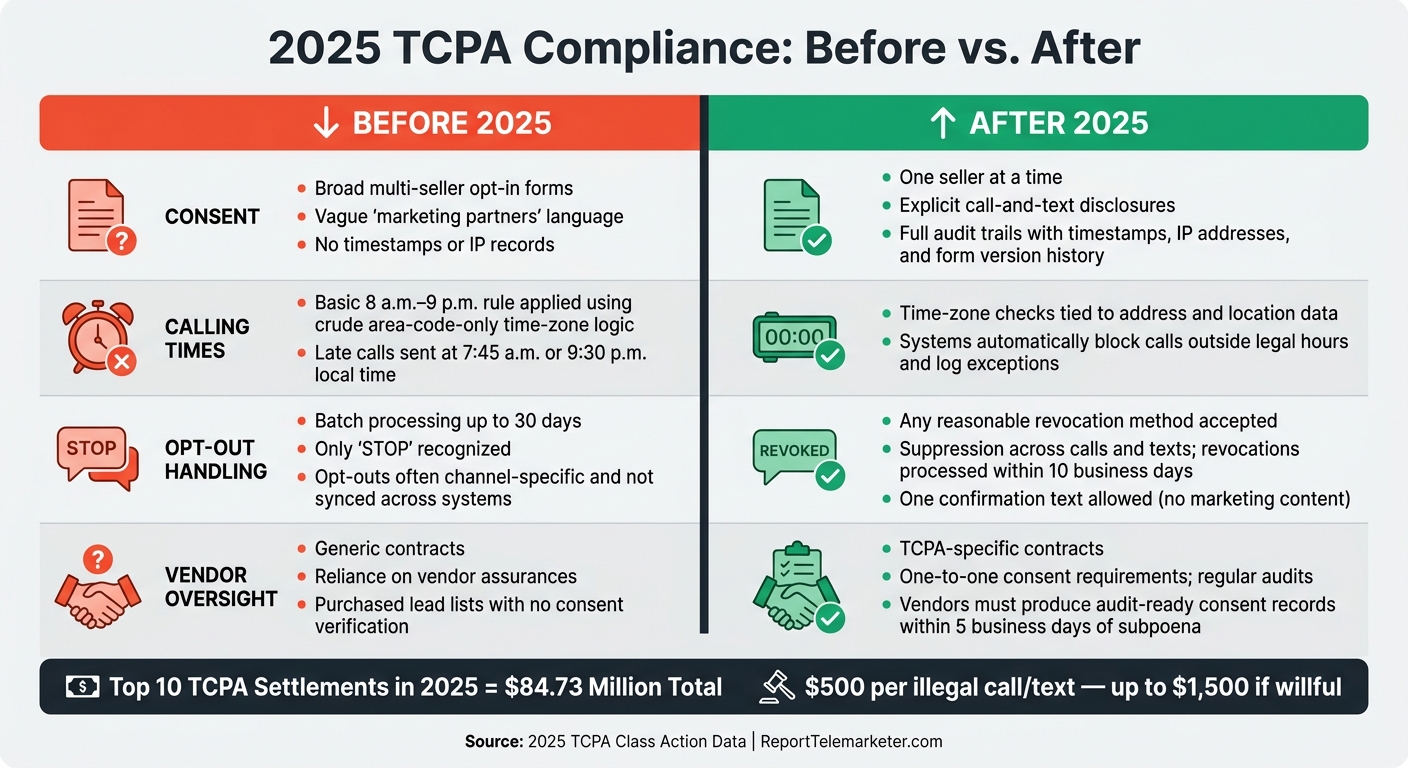
2025 TCPA Class Action Settlements: Before vs. After Compliance Standards
Those lawsuits pushed three plain changes: tighter consent records, faster opt-out handling, and tougher vendor control. This wasn’t academic. Companies had to prove consent, stop late calls, handle revocations faster, and keep a close watch on outside vendors.
| Area | Before 2025 | After 2025 |
|---|---|---|
| Consent | Broad, multi-seller forms; minimal documentation; consent inferred from prior business relationships or generic webforms | Consent for one seller at a time; call-and-text disclosures; full audit trails |
| Calling Times | Basic "8 a.m. to 9 p.m." rules applied with crude area-code-only time-zone logic | Time-zone checks based on address and location data; systems block calls outside legal hours and log exceptions |
| Opt-Out Handling | Batch processing within up to 30 days; many systems recognized only "STOP"; opt-outs were often channel-specific | Any reasonable revocation method accepted; suppression across calls and texts; revocations processed within 10 business days |
| Vendor Oversight | Generic contracts; limited audits; reliance on vendor assurances and purchased lead lists | Detailed TCPA-specific contracts, one-to-one consent requirements, regular audits, ongoing monitoring, and clear recordkeeping responsibilities |
Consent Rules Became Narrower and Easier to Audit
Litigation pushed companies to show exactly who agreed to hear from which seller. Again and again, class actions exposed businesses that couldn’t produce individual consent records: exact timestamps, IP addresses, the precise disclosure language a consumer saw, and the seller named in that agreement.
New FCC rules that took effect on January 27, 2025, shut down the lead-generator loophole by requiring consent for one seller at a time. So the bar moved. Compliant companies now keep a consent evidence bundle for every opt-in and store it for years. Third-party verification tools that independently document consent events have also become standard practice for companies that want a defensible record in court.
After consent records became easier to inspect, regulators and courts looked just as hard at call timing.
Systems Now Block Late Calls and Process STOP Requests Faster
Courts treated weak time-zone logic as a system flaw, not a one-off error. After 2025, compliant operations use time-zone checks tied to address and location data, and their systems won’t queue or place a call once the legal window closes.
The same pressure also sped up revocation handling. FCC amendments that took effect on April 11, 2025, require businesses to honor revocation requests as soon as practicable and no later than 10 business days, using any reasonable method the consumer chooses. That means businesses can’t hide behind narrow rules like recognizing only one magic word.
Companies may now send only one confirmation text within five minutes of a revocation request, and that message can’t include marketing content. Its only purpose is to clarify the scope of the opt-out. Compliance teams now track opt-out timing and error rates, because delays and mistakes leave a paper trail.
Vendor Management Became a Core Compliance Function
The final pressure point was third-party dialing. The Nicotra case showed that training, tools, and lead access can create vicarious liability even when the caller is labeled an independent contractor.
That idea now shapes how companies set up vendor contracts across the industry. Agreements with lead generators and third-party telemarketers must spell out how consent is captured, require the sharing of consent language and lead source for each record, assign recordkeeping duties, and include indemnification for TCPA breaches.
Vendors are also expected to produce an audit-ready consent record within five business days of a subpoena or discovery request. That record must cover the disclosure language, timestamp, IP address, device data, and seller identification.
What These 2025 Class Actions Mean for Consumers Today
Class Actions Made TCPA Violations Too Expensive to Ignore
After the 2025 updates tightened consent and vendor rules, the effect on consumers started showing up in settlement totals. The top 10 TCPA settlements in 2025 added up to $84.73 million, a clear sign that compliance failures now create company-level risk.
That kind of cost changes the math for telemarketers. Compliance isn’t just a back-office task anymore. It’s part of doing business. And that pressure doesn’t stop with one sector. It reaches any company that depends on outbound calls and texts.
For consumers, that shift matters in a practical way. It can mean better evidence trails and faster action against repeat contact.
Consumers Still Need Records
Stronger rules don’t mean unwanted calls and texts are gone. If they keep coming, your records still matter most. Save screenshots, call logs, STOP replies, voicemails, and any follow-up messages. Hold on to the STOP message and any later texts so you can show that your revocation was ignored.
If your number is on the National Do Not Call Registry, write down the date you registered. DNC claims usually begin 30 days after registration. Repeated contact from the same number or company over time is the kind of pattern that can strengthen a TCPA claim. That’s what turns a nuisance into something you can prove.
Key Takeaways and Next Steps
The main lesson is pretty simple: the 2025 cases showed that two weak spots kept showing up – consent records and vendor control. In February 2025, UnitedHealthcare agreed to a $2.5 million settlement affecting more than 12,000 individuals.
Under the TCPA, each illegal call or text can lead to statutory damages of $500, which can increase to $1,500 if the violation is proven willful. If unwanted calls or texts continue, ReportTelemarketer.com offers a free report and investigation, along with cease-and-desist support when warranted.
FAQs
How do I prove I never gave valid consent?
Keep records of unwanted calls or texts. Save the dates, times, phone numbers, recordings, and screenshots. Also check whether your number has been on the National Do Not Call Registry for at least 31 days.
If you report the contacts to ReportTelemarketer.com, the site can review your records and check whether the telemarketer can show prior express written consent. If they can’t, or if you opted out earlier, that can help show a violation.
What should I save after replying STOP?
After you reply STOP to a telemarketing message, save every related record, including:
- Screenshots of the messages
- Call logs that show the date and time
- A record of the STOP request you sent
Those details help show the timeline, document your attempt to revoke consent, and back up any claim you may decide to make. You can send them to ReportTelemarketer.com for review and help pursuing action at no cost to you.
Can a company be liable for its telemarketing vendors?
Yes. A company can be held liable for telemarketing violations committed by third-party vendors or contractors acting on its behalf, especially when it authorizes, directs, or profits from those calls.
Outsourcing doesn’t make that risk go away. If a business controls a vendor’s telemarketing activity, or simply fails to supervise it with enough care, it can still face steep financial penalties.

