
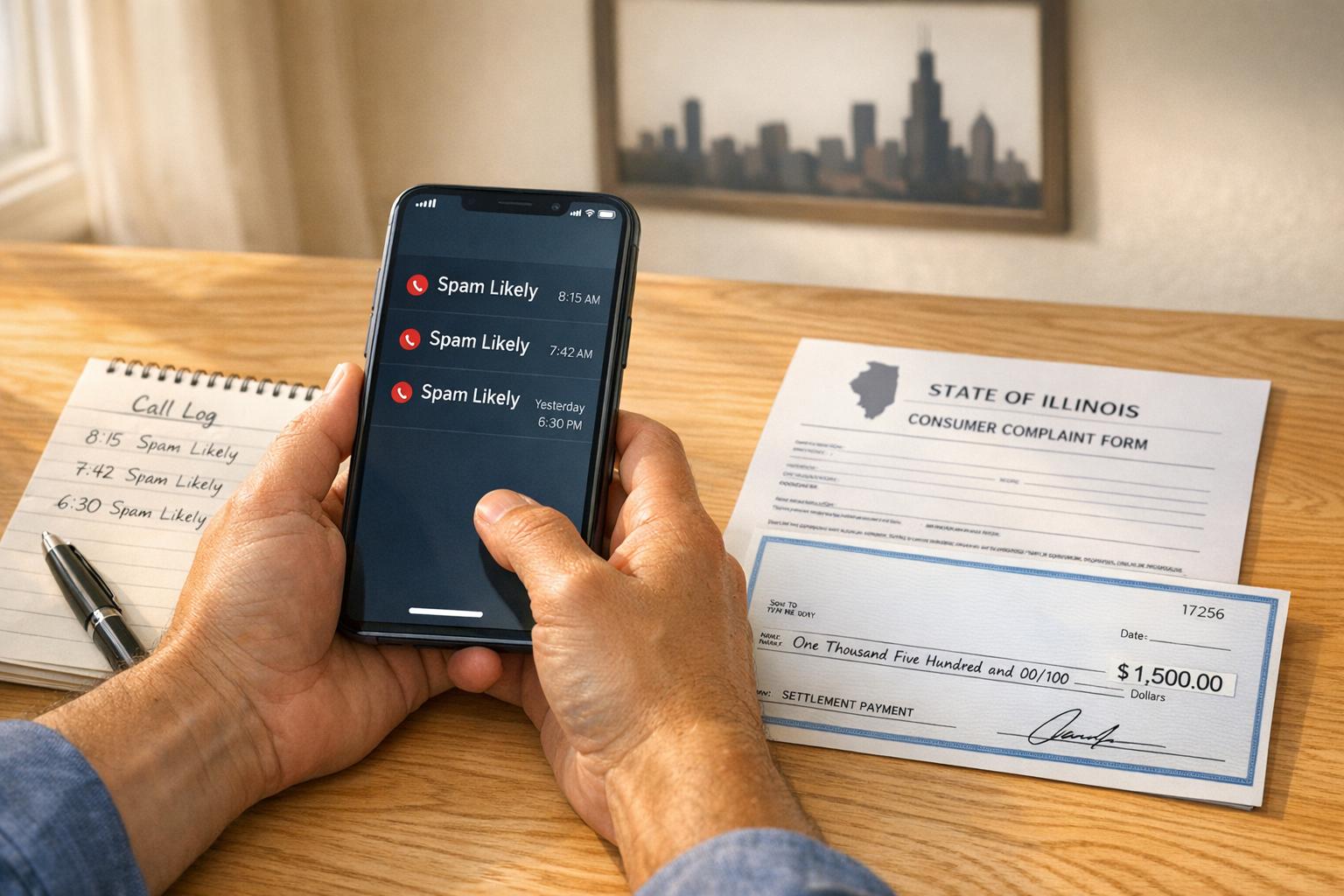
If you’re tired of telemarketing calls, here’s how Illinois residents can fight back and even get paid:
- Illegal Practices: Telemarketers can’t call numbers on the National Do Not Call Registry, use autodialers without consent, or call outside 8 a.m.–9 p.m. Violations can result in fines.
- Your Rights: Federal and Illinois laws let you sue for $500 per illegal call or text. Willful violations can pay up to $1,500 each.
- Recent Cases: Settlements like Campbell v. Everything Breaks, Inc. and Niemczyk v. Pro Custom Solar LLC have awarded millions to consumers.
- How to Act:
- Keep a call log of dates, times, and caller IDs.
- File complaints with the Illinois Attorney General or use services like ReportTelemarketer.com.
- Consider legal action in small claims court or federal court.
Take Action: Register your number at donotcall.gov, document calls, and explore your legal options to stop harassment and recover damages.
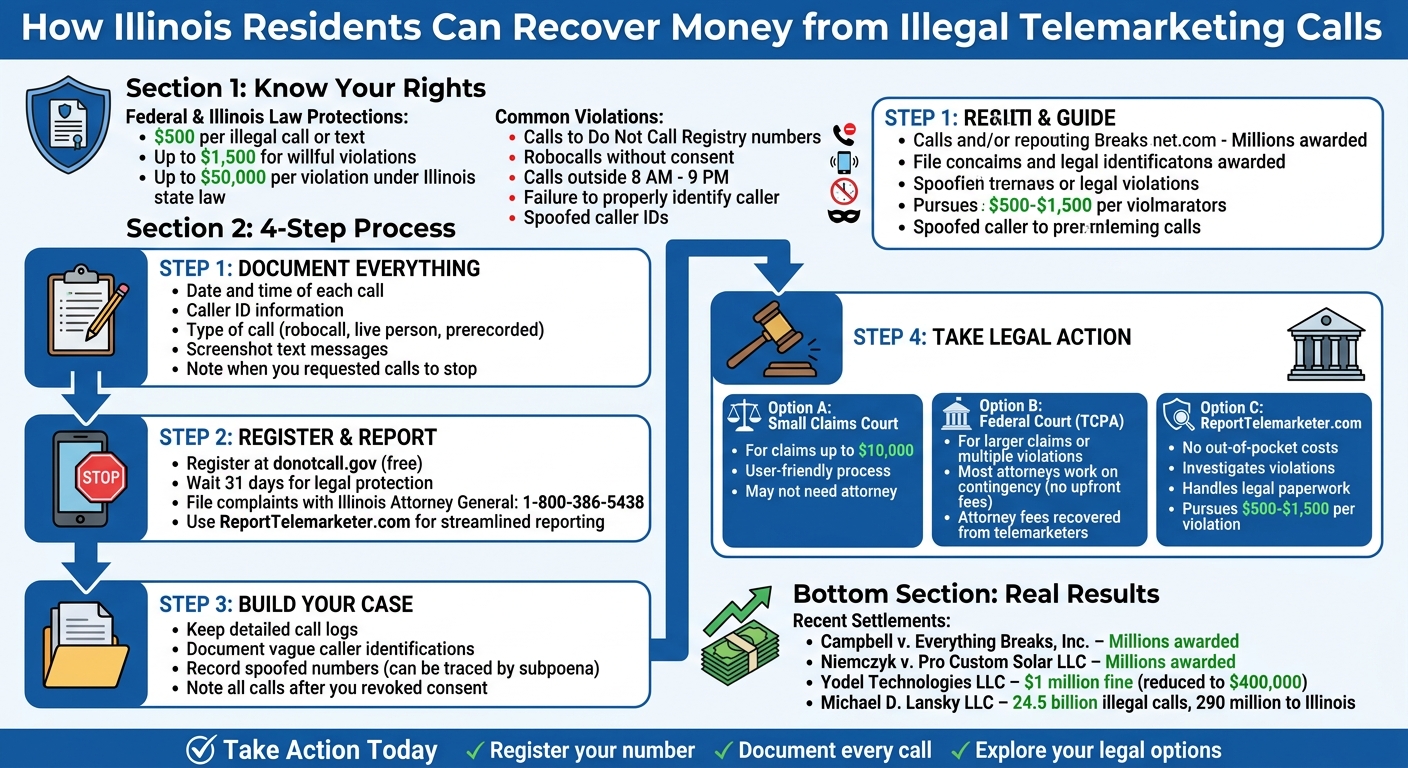
How Illinois Residents Can Recover Money from Illegal Telemarketing Calls
Complete guide to sue telemarketers: $1500 per violation
sbb-itb-a8d93e1
Recognizing Telemarketing Violations
Understanding legal protections is crucial for identifying when telemarketing practices cross the line.
Common Violation Examples
Some of the most frequent violations include:
- Calls made to numbers listed on the Do Not Call Registry after the grace period.
- Robocalls sent out without obtaining prior written consent.
- Calls placed outside the legally allowed hours – before 8:00 a.m. or after 9:00 p.m.
For instance, in May 2023, the Anti-Robocall Multistate Litigation Task Force took legal action against Michael D. Lansky LLC, operating as Avid Telecom. The company was accused of transmitting a staggering 24.5 billion calls, including 290 million directed at Illinois numbers. Allegedly, they used 8.4 million spoofed caller IDs, many impersonating government agencies. Notably, 90% of these calls lasted less than 15 seconds, raising further red flags.
Another significant case occurred in July 2023, involving Yodel Technologies LLC. The company faced penalties for initiating 1.4 billion calls, with over 500 million targeting numbers registered on the National Do Not Call Registry. These calls reportedly relied on leads from "consent farms", resulting in a $1 million fine, later reduced to $400,000.
How to Identify Illegal Calls
There are several ways to spot unlawful telemarketing practices:
- Check the timing: Calls made before 8:00 a.m. or after 9:00 p.m. are a clear violation of Illinois law.
- Caller identification: Illinois law requires telemarketers to immediately identify themselves, explain the purpose of the call, and seek permission to continue. Phrases like "Vehicle Warranty Department" without a proper company name are red flags.
A notable ruling in January 2026 by the Southern District of Illinois in Showers v. Pelican Investment Holdings Group backed this point. The court found that vague identifications violated the Illinois Telephone Solicitation Act (ITSA). Claims were allowed to proceed against telemarketers who called numbers on the National Do Not Call Registry without properly identifying themselves.
- Spoofed caller IDs: Numbers that appear local but don’t match legitimate businesses are often fraudulent.
- Robocalls without consent: Prerecorded or robotic messages sent without prior written permission are illegal.
Gathering Evidence for Your Claim
Once you’ve identified violations, the next critical step is collecting evidence to strengthen your case for compensation. Proper documentation not only validates your claim but also enhances your chances of securing a favorable outcome. Start by recording all relevant details about each violation to build a strong foundation for your case.
Recording Evidence of Violations
Keep a detailed call log. Report unwanted phone calls and document every call, noting the date, time, and caller ID. Pay attention to whether the call featured a prerecorded message, an artificial or AI-generated voice, or if it connected you to a live person after a noticeable pause or click. These specifics can help demonstrate the use of illegal autodialers.
Note any failure to properly identify the caller. Telemarketers are required under the Illinois Telephone Solicitation Act to immediately disclose their identity and purpose. If they use vague or misleading identifiers like "Vehicle Warranty Department" instead of their actual company name, make a note of it. This type of omission played a pivotal role in the January 2026 Showers v. Pelican Investment case, where the court allowed claims to move forward based on such disclosure violations.
Take screenshots of unsolicited text messages. Be sure to capture the sender’s number and the full content of the message. Additionally, record the date and time when you requested the calls or texts to stop. Any communication received after you’ve revoked consent is considered a willful violation, potentially increasing damages from $500 to $1,500 per call or text.
Thorough documentation not only captures the details of each violation but also strengthens your claim for higher compensation.
Why Documentation Strengthens Your Case
Comprehensive evidence significantly boosts your potential recovery. Federal law allows for damages ranging from $500 to $1,500 per illegal call or text, while Illinois state penalties can reach up to $50,000 per violation. A strong paper trail can maximize these recovery amounts.
Even if the caller ID displays a spoofed or fake number, make sure to document it. Legal professionals can subpoena phone carriers to trace the actual caller. As seen in past cases, detailed records can uncover patterns of violations that attorneys and regulators use to identify offenders. This level of evidence not only supports enforcement actions but also strengthens your personal claim.
Steps to Recover Money from Telemarketers
If you’re tired of dealing with unwanted telemarketing calls, there are clear steps you can take to not only stop these calls but also potentially recover compensation. Illinois residents have several avenues to address this issue, from filing complaints to pursuing legal action.
Reporting Violations to Authorities
Start with the National Do Not Call Registry. Adding your number to this free registry creates a legal safeguard. Telemarketers are required to check the registry every 31 days. If you receive calls after being on the registry for over 31 days, it strengthens your case for a violation claim.
File official complaints with enforcement agencies. You can contact the Illinois Attorney General at 1-800-386-5438 or other relevant organizations. While these complaints may not directly lead to personal compensation, they create an official record of violations and help authorities take broader enforcement actions.
Use ReportTelemarketer.com for streamlined reporting. This platform simplifies the process by investigating your claims, identifying potential legal violations, and filing cease-and-desist letters or formal complaints on your behalf. The best part? There’s no upfront cost for using this service.
Filing Legal Claims for Damages
If reporting violations doesn’t resolve the problem, you can escalate to legal action. Both federal and state laws allow you to sue telemarketers directly, so you don’t need to rely on government intervention to seek compensation. Under the federal Telephone Consumer Protection Act (TCPA), you can claim damages based on the nature of the violation. For calls made after you’ve explicitly asked telemarketers to stop, courts may award up to $1,500 per violation.
Illinois Small Claims Court is an option for cases involving amounts up to $10,000. It’s designed to be user-friendly, with simpler rules than most court proceedings, and you may not even need an attorney. For larger claims or multiple violations, filing in federal court under the TCPA might be a better choice.
Most TCPA attorneys work on a contingency basis, meaning you only pay if you win your case. This arrangement makes legal representation more accessible, even if you can’t afford upfront fees.
Getting Help from ReportTelemarketer.com
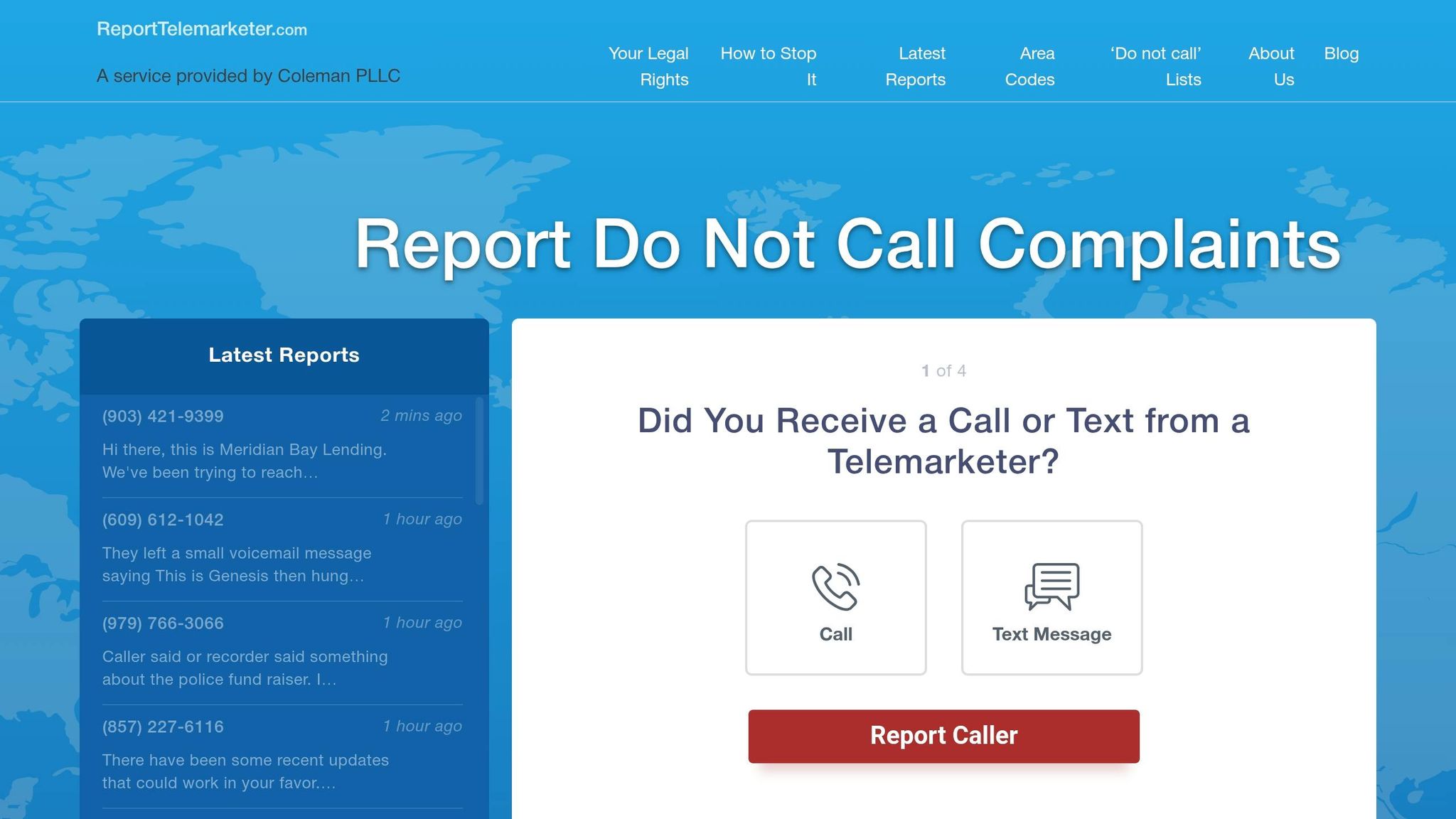
If you need expert guidance, ReportTelemarketer.com is a valuable resource for Illinois residents. The platform helps investigate telemarketers, identifies violations under the TCPA and the Illinois Telephone Solicitation Prohibition Act (815 ILCS 413), and assists in pursuing statutory damages of $500 to $1,500 per violation.
The service operates at no out-of-pocket cost to you. Instead, attorney fees are recovered from the telemarketers when applicable. Beyond identifying violations, the platform also handles the legal paperwork, making it easier for you to take action without the hassle of navigating the legal system alone.
Conclusion
What Illinois Residents Should Remember
If you’re tired of unwanted telemarketing calls, you have the legal power to fight back. Thanks to the federal Telephone Consumer Protection Act (TCPA) and the Illinois Telephone Solicitation Prohibition Act (815 ILCS 413), you can sue telemarketers directly and seek statutory damages. You don’t have to wait for government agencies to step in – you can take control yourself.
To build a strong case, keep a detailed record of every call. Note the date, time, caller ID, and the company behind the call. This documentation is essential for proving violations in court.
For a simpler approach, consider using ReportTelemarketer.com. They investigate violations, handle the legal paperwork, and charge no upfront fees. Their legal team specializes in federal and Illinois telemarketing laws, making it easier for you to seek compensation without the hassle of navigating the legal system alone.
Take Action Today
Your rights are protected by clear legal standards, and there are straightforward steps you can take to stop telemarketing violations. Start by registering your number at donotcall.gov – it’s free and provides legal protection after 31 days. If you’re already receiving illegal calls, document them carefully and file a complaint with the Illinois Attorney General at 1-800-386-5438.
Don’t delay. Every call you document strengthens your case and helps authorities track down repeat offenders. Whether you decide to file complaints, take legal action, or use the services of ReportTelemarketer.com, acting now protects your rights and helps restore your peace of mind. Take the first step today to reclaim control over your phone and safeguard your consumer rights.
FAQs
What counts as “prior written consent” for robocalls or texts?
“Prior written consent” refers to a consumer’s explicit, written permission granted before receiving robocalls or texts. This consent must align with both Illinois law and federal regulations, ensuring it is clear and obtained ahead of time.
How can I prove a call was illegal if the caller ID was spoofed?
Establishing that a spoofed call violated Illinois law isn’t always straightforward, but it can be done with proper documentation. Start by noting down key details like the date, time, and any misleading messages or recordings you encountered. If you’re in a situation where recording the call is permitted by law, this can serve as additional evidence.
Under Illinois law, spoofing becomes illegal when it’s used with the intent to defraud or cause harm. To take action, report the call to local authorities or consumer protection agencies. These reports can help them investigate potential violations and uncover illegal telemarketing activities.
What’s the best court to sue in for telemarketing calls in Illinois?
The Circuit Court of Cook County, Illinois, has become a popular venue for filing lawsuits related to telemarketing calls. This court has jurisdiction over such cases and has seen a track record of successful filings, making it a go-to option for many plaintiffs.
If you’re considering legal action for telemarketing violations, it’s essential to consult with legal professionals or trusted resources to ensure you’re taking the right steps for your specific situation.

