
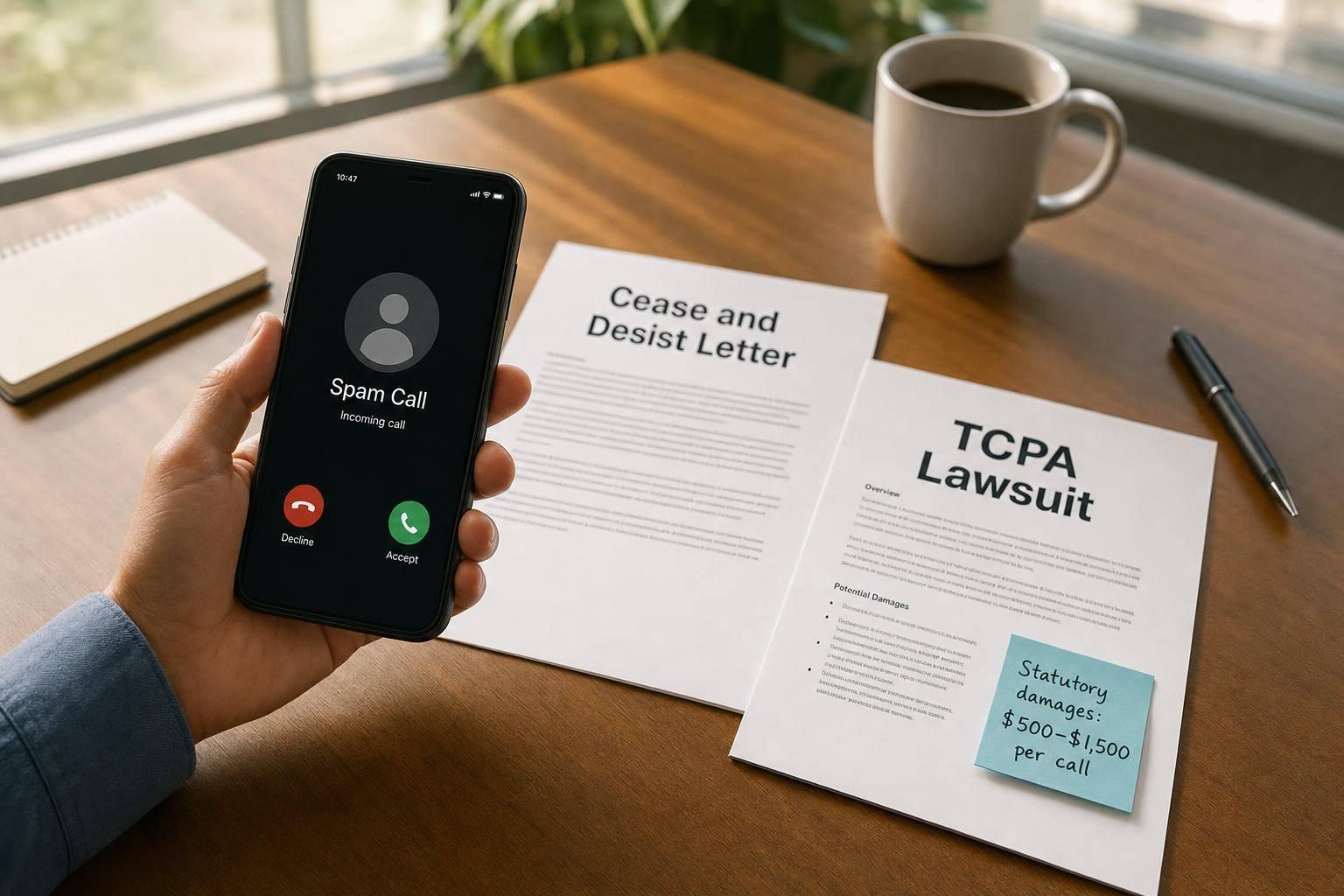
If illegal telemarketing calls or texts keep hitting your phone, I’d look at two main options: send a cease and desist letter or file a TCPA lawsuit. One is low-cost and meant to stop the contact. The other is harder, but it can lead to $500 to $1,500 per call or text under federal law.
Here’s the short version:
- A cease and desist letter is best if you want to tell a company to stop and make a dated paper trail.
- A TCPA lawsuit is best if the calls or texts keep coming, you can identify the business, and you want money damages.
- Proof matters either way: call logs, text screenshots, voicemails, and opt-out records can make or break your next step.
- Caller type matters too: known businesses may stop after a letter; spoofed or scam callers often will not.
- Repeated contact after you say “stop” can matter a lot because it may support higher damages of up to $1,500 per violation.
If I were choosing between the two, I’d keep it simple: start with notice if the caller is a real business; move to legal action if the contact continues and the proof is there.
TCPA Lawsuit vs. Cease and Desist Letter: Which Should You Choose?
Make Them Pay YOU…. $500–$1500 Per Call Under the TCPA
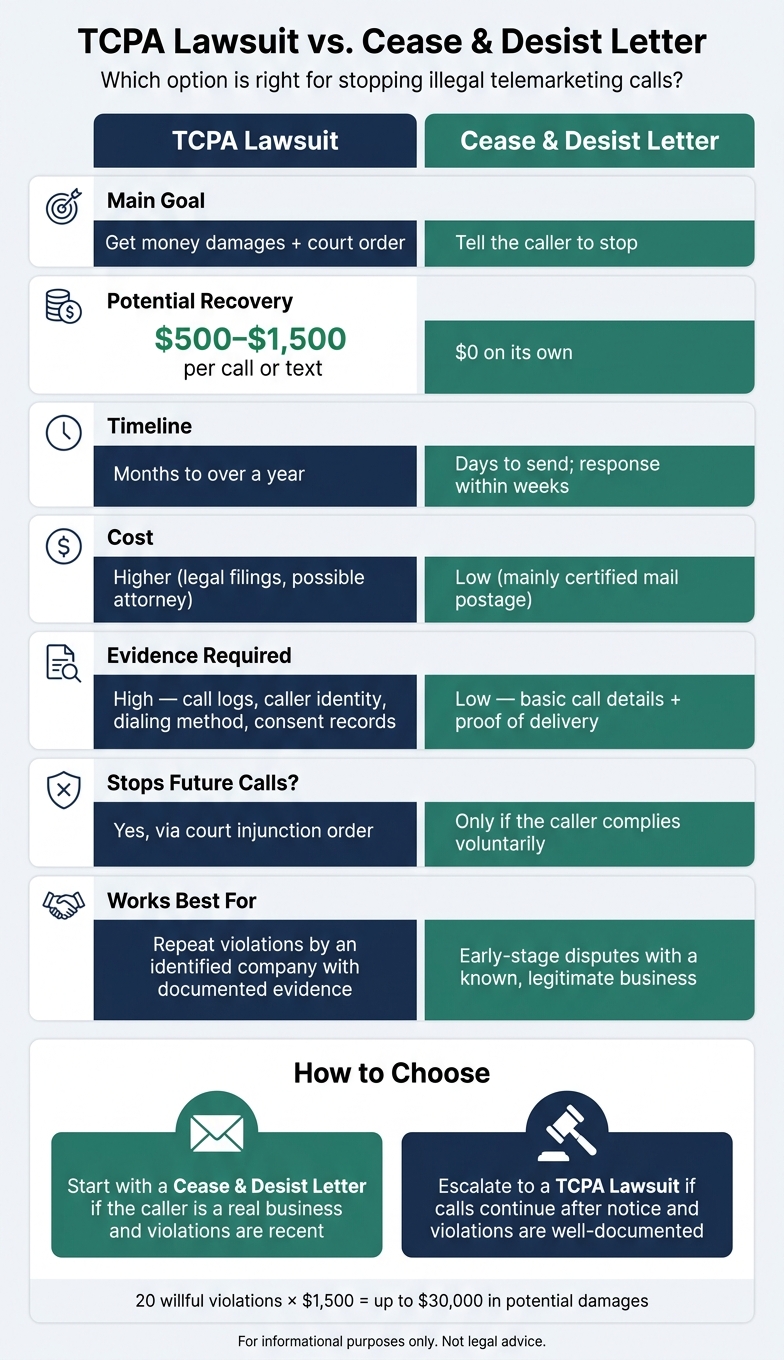
Quick Comparison
| Aspect | TCPA Lawsuit | Cease and Desist Letter |
|---|---|---|
| Main goal | Get money and court help | Tell the caller to stop |
| Cost | Higher | Low |
| Time | Months or more | Days to send |
| Recovery | $500 to $1,500 per call or text | $0 by itself |
| Proof needed | More | Less |
| Works best for | Repeat violations by an identified company | Early-stage disputes with a known business |
| Stops future calls? | Maybe, through a court order | Only if the caller listens |
Bottom line: a letter is a warning. A lawsuit is enforcement. If you have solid records and repeat violations, the lawsuit route has more force. If you want the simplest first move, send the letter and document everything from that date forward.
TCPA Lawsuits Against Telemarketers
A TCPA lawsuit is the option you use when you want money damages and a court order. The TCPA lets consumers sue telemarketers directly in court. That can lead to a payout, but it also takes time, records, and patience. The tradeoff is pretty simple: more leverage, more work.
How A TCPA Lawsuit Works
Start by saving your evidence. That means call logs, text screenshots, voicemails, and proof that you revoked consent, such as a STOP reply to a text or a written request telling the sender not to contact you again. If you don’t have that paper trail, your case gets a lot weaker.
You also need to connect the calls or texts to a specific company. A court needs a named defendant, not just a phone number. Company names mentioned during a call, website URLs in texts, and follow-up emails can help make that link. From there, your claim needs to match the violation itself, whether that means unauthorized autodialed calls, prerecorded calls or texts, Do Not Call breaches, or more contact after you clearly revoked consent.
Once your records are in order, you can file in state or federal court. In some states, small claims court may also be an option. That’s a big reason lawsuits are tougher than sending a warning letter. The court process asks for proof, not just a complaint.
What A Successful Lawsuit Can Result In
A successful case can lead to TCPA statutory damages, usually $500 to $1,500 per violation. You do not have to prove that you lost money.
Those numbers can stack up fast. If you got 20 unlawful robocalls and the court found the conduct willful, that could mean $30,000 in potential damages. A court can also issue an injunction ordering the company to stop contacting you. Of course, those remedies depend on proving your case.
Pros And Cons Of Filing A TCPA Lawsuit
| Pros | Cons |
|---|---|
| Higher recovery: $500–$1,500 per call or text | Harder to prove: must identify the responsible defendant |
| You do not need to prove actual monetary loss | Procedures, deadlines, and court rules can be hard to handle |
| Courts can order the caller to stop future contact | Proving willful or knowing violations for higher damages requires strong evidence |
| Strong deterrent – businesses take TCPA exposure seriously | Litigation can take months or years with no guaranteed outcome |
Why Lawsuits Are Hard For Most Consumers
The hardest part for many people is tying the calls to the right company. A lot of telemarketers use spoofed caller ID numbers, outside call centers, or third-party lead generators. That can make it tough to name the right defendant. And if you can’t make that connection, even a well-documented case can stall.
Missing records can also hurt. Deleted messages, partial call logs, or no written proof that you revoked consent can weaken the claim. If you want the higher $1,500 amount per violation, you also have to show the caller acted willfully, meaning they knew what they were doing and kept going anyway.
Then there are the court-side problems: filing deadlines, discovery fights, and the chance that a judge reads a TCPA rule differently than you expected. That’s why many consumers start with a cease and desist letter and save a lawsuit for repeat violations.
sbb-itb-a8d93e1
Cease And Desist Letters To Telemarketers
If a lawsuit feels like too much, a cease and desist letter is often the fastest, lower-cost first move.
A cease and desist letter is a written demand telling a telemarketer to stop calling or texting your number. The goal is simple: revoke consent and create a dated record showing the company was told to stop.
What A Cease And Desist Letter Does
A solid letter lists your phone number, points to sample call dates, and explains why the contact breaks the TCPA. That could mean you never gave consent, or the company kept calling after you opted out. It should also demand that all future telemarketing calls and texts stop right away.
Consumers can revoke consent in a reasonable way, and sending the letter by certified mail gives you proof that notice was delivered if the caller keeps contacting you. That paper trail matters most when the calls or texts continue after notice.
When A Cease And Desist Letter Can Help
This step works best when the caller is a legitimate, identifiable business with compliance procedures and a strong reason to avoid TCPA damages.
These companies often have internal do-not-call procedures. So when they get a clear written notice, they may decide it’s not worth the risk to keep calling.
A letter also helps if you’ve already tried informal opt-outs, like replying STOP to a text, and the calls still didn’t stop. Putting your revocation in writing removes gray areas. It also makes it much harder for a company to say it didn’t know.
And if you’re already thinking about a TCPA lawsuit, this gives you a clean starting line: the exact date the company was on notice, plus a record of every call that came after.
Pros And Cons Of Sending A Cease And Desist Letter
| Pros | Cons |
|---|---|
| Fast and simple – no court filing required | No automatic monetary recovery |
| Low cost; main expense is certified mail postage | No legal force on its own |
| Creates a written record of revoked consent and company notice | Scam callers and spoofed numbers may ignore it |
| Legitimate businesses often comply to avoid TCPA liability | Enforcement still requires escalation if calls continue |
| Strengthens future claims by showing willful or knowing violations | Less effective when the caller cannot be identified |
Where This Approach Falls Short
A cease and desist letter only works if the recipient cares enough to respond. Scam operations, spoofed numbers, and overseas call centers often don’t.
Once the calls keep coming, you’re no longer in warning territory. You’re in enforcement territory. At that point, filing a complaint with the FCC or FTC, or bringing a TCPA claim, carries more weight.
If the caller ignores the letter, the next move is usually complaint filing or a TCPA claim.
TCPA Lawsuits vs. Cease And Desist Letters: A Direct Comparison
A cease and desist letter gives a warning. A TCPA lawsuit gives the warning teeth.
Differences In Outcome, Effort, And Enforcement
After looking at the pros and cons of each path, the side-by-side view below makes it easier to see which one fits your situation.
| Aspect | TCPA Lawsuit | Cease And Desist Letter |
|---|---|---|
| Legal authority | Federal private right of action under 47 U.S.C. § 227; court-enforceable judgment | Written demand before a lawsuit; not legally binding |
| Typical timeline | Months to over a year from filing to resolution | Sent quickly; response or behavior change may come within days or weeks |
| Potential monetary recovery | $500–$1,500 per violation, per call or text | No automatic recovery; $0 without further legal action |
| Ability to stop future calls | A court order to stop future contact | Depends on the caller’s willingness to comply |
| Evidence requirements | High – call logs, proof of no consent, caller identity, dialing method | Low – basic call details and proof the letter was delivered |
| Consumer effort and complexity | High – legal filings, possible attorney involvement, court deadlines | Low – draft, send, and keep a copy |
A letter still matters because it creates notice. That can help later. If the calls keep coming, your record of sending that letter may support higher damages.
How The Type Of Caller Affects Your Best Option
The kind of caller you’re dealing with often points you toward the better move.
Legitimate, established businesses – like banks, insurance companies, national retailers, or known lead generators – tend to have compliance systems in place. They’re also easier to identify and contact. In many cases, a cease and desist letter is enough to make the calls stop fast. For a company making calls at scale, the risk of $500–$1,500 per violation is hard to ignore.
Anonymous or deceptive callers are a different problem. If the number is spoofed, the caller ID keeps changing, or the company name is fake, sending a letter may go nowhere. You can’t expect much from a demand letter if you can’t pin down who is behind the calls. But if the actual business can be identified, a TCPA lawsuit may still work – even when the calls came through a third-party call center.
In plain terms, low call volume often doesn’t justify a lawsuit. Repeated violations can change that fast. That split usually tells you which option makes more sense.
How To Choose Between A TCPA Lawsuit And A Cease And Desist Letter
Pick the path that fits your proof, your goal, and the amount of pressure needed to stop the calls. At its core, this comes down to fast notice versus enforceable recovery. The simplest way to decide is to match the remedy to the caller and to the proof you already have.
When To Start With A Cease And Desist Letter
A cease and desist letter makes sense when the calls are recent, the caller can be identified, and you want the fastest low-effort move. A documented letter can revoke consent, put the caller on notice, and create a paper trail without taking the fight to court.
When A Lawsuit Makes More Sense
If the calls keep coming after notice, the issue changes. Now it’s less about asking the caller to stop and more about enforcing your rights. A lawsuit makes more sense when the violations are repeated, well documented, and tied to a specific caller. If a cease and desist letter was ignored, that prior notice can support higher damages for willful or knowing violations.
Key Takeaways
Start with notice, then escalate if the calls continue.
If you need help documenting the calls, the next step should be simple and organized. ReportTelemarketer.com can help organize call evidence, identify the caller, and send cease and desist letters or formal complaints.
FAQs
Can I sue without a cease and desist letter?
Yes. You can sue under the TCPA without first sending a cease and desist letter.
A cease and desist letter can help show that you asked for the calls to stop, but it is not required before filing a TCPA claim. ReportTelemarketer.com can help document violations and guide you through these steps.
What proof do I need for a TCPA claim?
To support a TCPA claim, document both the violation and whether you gave consent. The more detail you keep, the better.
Hold on to records like:
- Call logs with the date, time, and phone number
- Caller details, such as the company name and callback number
- Screenshots, voicemails, or call recordings
- Your consent history, including prior business relationships and opt-out attempts
ReportTelemarketer.com can help identify violations and file complaints.
What if the caller is spoofing the number?
If a caller is spoofing a phone number, finding out who’s behind it can be harder. But you can still do something about it.
Start by keeping detailed records of every unwanted call. Write down the date, time, and any information shared during the call. That paper trail can help a lot later.
ReportTelemarketer.com can look into reports and help identify the telemarketers behind the calls, even when the number is masked. It can also support formal complaints or cease and desist letters.

