
Even if your number is on the National Do Not Call Registry, you can still get sales calls – and state law often decides what happens next. In 2025, the federal rules still set the base line: most telemarketing calls cannot come before 8:00 a.m. or after 9:00 p.m., companies must check the national list at least every 31 days, and the FTC can seek up to $53,088 per violation. But many states go further with their own call windows, state do-not-call lists, call-attempt caps, and consumer lawsuits.
Here’s the short version:
- Federal law is only the starting point.
- Some states keep their own do-not-call lists, so checking the national list alone may not be enough.
- Penalty amounts vary a lot by state, from a few hundred dollars to $50,000 per violation in some cases.
- Many states let you sue on your own, not just file with an agency.
- Since January 27, 2025, sellers need separate written consent and cannot rely on one checkbox for many sellers.
- If calls continue after you opt out, your records matter: screenshots, voicemail, dates, times, and past stop requests.
If I had to boil the guide down to one point, it would be this: your rights depend on both federal rules and where you live. So the best move is to know your state’s extra limits, keep proof of each call or text, and report the problem to the right place.
The Do Not Call Registry & the Telemarketing Sales Rule
Quick comparison
| Topic | Federal Rule | State Add-Ons You Should Watch For |
|---|---|---|
| Calling hours | 8:00 a.m. to 9:00 p.m. local time | Some states use tighter hours or block calls on Sundays/holidays |
| DNC list checks | National Registry every 31 days | Some states require checks against a state list too |
| Consent | Separate written consent per seller | Some states add their own telemarketing consent rules |
| Penalties | FTC: up to $53,088 per TSR violation; TCPA lawsuits: $500 to $1,500 per call/text | State fines can be much higher, and some states add treble damages or criminal risk |
| Consumer action | TCPA claims may allow private suits | Many states also give a private right of action |
| Reporting | FTC, FCC | State AGs and state consumer agencies |
A few state patterns stand out. Florida, Indiana, Missouri, Oklahoma, Texas, and Wyoming are listed as states with their own do-not-call systems in this guide. Florida, Maryland, and Oklahoma also limit repeat call attempts on the same topic. And states like Connecticut, Illinois, Maryland, New York, Texas, Virginia, and Washington show how far state penalties and call rules can differ from the federal base line.
So if you want the plain-English takeaway: register your number, save proof, know your state rules, and file complaints in the right channel. That gives you the best shot at stopping repeat callers and building a claim if the calls keep coming.
Federal Do Not Call Rules That Apply in Every State
Federal rules set the national baseline.
The National Do Not Call Registry, TCPA, and Telemarketing Sales Rule
Two federal laws are at the center of Do Not Call protection. The Telephone Consumer Protection Act (TCPA), enforced by the FCC, covers autodialed calls, prerecorded sales messages, and unsolicited marketing texts sent to cell phones. The Telemarketing Sales Rule (TSR), enforced by the FTC, applies to sellers making telemarketing calls across state lines.
The National Do Not Call Registry is the main tool behind this system. You can register both landline and cell numbers for free at DoNotCall.gov or by calling 1-888-382-1222. Registration is permanent, so you don’t need to renew it. Telemarketers have to pay to access the list, and they must scrub their calling lists against it at least every 31 days.
There have also been recent updates to consent rules. Since January 27, 2025, each seller must get separate written consent for robocalls. And starting April 11, 2026, if you revoke consent for one automated channel, the caller must honor that revocation across its other automated channels too.
Still, the registry has limits. It does not stop calls from debt collectors, political groups, charities, or purely informational surveys. And if you’ve done business with a company, it may still call under the established business relationship (EBR) rule for up to 18 months after a purchase, or 3 months after an inquiry.
Federal Penalties and Consumer Rights
These rules have teeth. The FTC can seek civil penalties of up to $53,088 per TSR violation. Under the TCPA, consumers can sue and recover $500 per illegal call or text. If the violation was willful or knowing, that amount can jump to $1,500 per call or text.
That’s why paper trails matter. If you plan to file a complaint, the more proof you have, the better.
What to Document Before Filing a Complaint
Before you report a call or text, gather as much detail as you can:
- Caller ID screenshot with the date and time
- Voicemail recording or transcript if it names the caller or product
- Marketing texts and any STOP replies
- Log of earlier opt-out requests with the date and method used
- Proof your number is on the National DNC Registry
One more thing: if you get a suspected scam robocall, do not press any buttons to "opt out." That can signal that your number is active.
With that federal baseline in place, the next section looks at how states add tighter rules, steeper penalties, and different complaint paths.
sbb-itb-a8d93e1
How States Differ on Registration, Enforcement, and Penalties
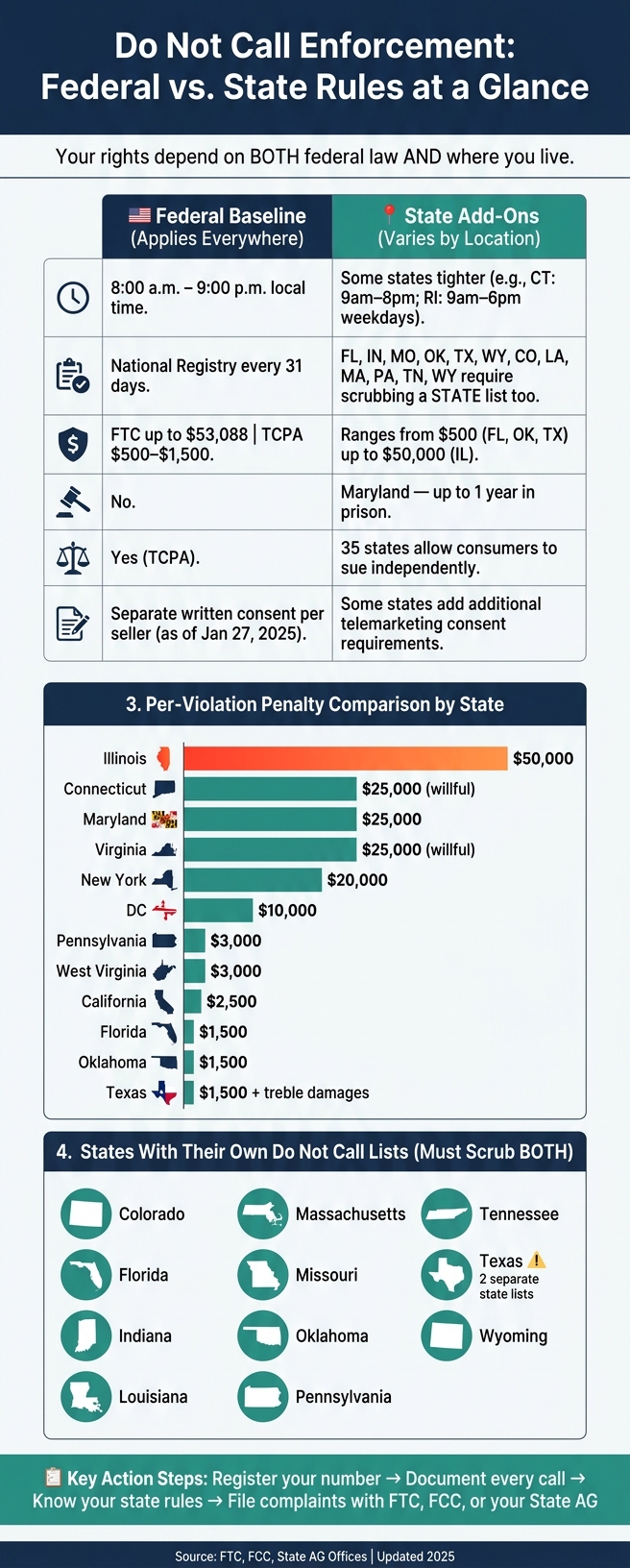
State vs. Federal Do Not Call Rules: Penalties & Key Differences 2025
States often go beyond federal telemarketing rules. That means compliance can shift from one state line to the next, sometimes in a big way. The tables below show where the sharpest differences show up: registration, enforcement, and penalties.
State Lists vs. the National Do Not Call Registry
Some states keep their own Do Not Call lists. That group includes Florida, Indiana, Missouri, Oklahoma, Texas, and Wyoming. If a telemarketer calls people in those states, checking the National Do Not Call Registry isn’t enough. They also need to scrub against the state list.
Other states rely only on the National Do Not Call Registry and police violations through their general consumer protection laws. On top of that, many states make telemarketers register with a state agency before placing calls, and some also require a surety bond or yearly renewal.
Calling hours are another place where the rules split. Federal law allows calls from 8 a.m. to 9 p.m. local time. States can narrow that window. Connecticut allows calls only from 9 a.m. to 8 p.m., while Rhode Island cuts weekday calling hours down to 9 a.m. to 6 p.m.. Florida, Maryland, and Oklahoma also limit call attempts to three within a 24-hour period when the calls concern the same subject.
And the patchwork doesn’t stop there. 35 states have enacted TCPA-style telemarketing laws, and 35 states give consumers a private right of action, which means people can sue on their own instead of waiting for a state agency to step in.
State Comparison Tables
Table 1: Selected State DNC Registration and Enforcement Overview
| State | DNC List | Primary Enforcer | Telemarketer Registration Required | Bond Amount |
|---|---|---|---|---|
| Alabama | National Only | Attorney General | Yes | $50,000 |
| California | National Only | Dept. of Justice (AG) | Yes | $100,000 |
| Connecticut | National Only | Dept. of Consumer Protection | Yes | $50,000 |
| Florida | State Registry | Dept. of Agriculture & Consumer Services | Yes | $50,000 |
| Illinois | State Registry | Attorney General | Yes | $50,000 |
| Indiana | State Registry | Attorney General | Yes | None |
| New York | National Only | Department of State | Yes | $25,000 |
| Oklahoma | State Registry | Attorney General | Yes | None |
| Pennsylvania | State Registry | Attorney General | Yes | $25,000 |
| Texas | 2 State Registries | Secretary of State | Yes | $10,000 |
Penalty exposure is just as uneven.
Table 2: Selected State Penalty Structures
| State | Per Violation | Willful/Knowing Violation | Private Right of Action | Criminal Penalties |
|---|---|---|---|---|
| Connecticut | $20,000 | $25,000 | Yes | No |
| Florida | $500 | $1,500 | Yes | No |
| Illinois | $50,000 | $50,000 | Yes | No |
| Maryland | $10,000 | $25,000 | Yes | Yes (up to 1 year in prison) |
| New York | $2,000 | $20,000 | Yes (Limited) | No |
| Oklahoma | $500 | $1,500 | Yes | No |
| Pennsylvania | $1,000 | $3,000 | Yes | No |
| Texas | $500 | $1,500 + treble damages | Yes | No |
| Virginia | $5,000 | $25,000 | Yes | No |
| West Virginia | $500 | $3,000 | No | No |
Illinois is the eye-opener here: its penalty can hit $50,000 per violation. Maryland stands apart for another reason. In that state, telemarketing violations can trigger criminal prosecution, with penalties that include up to 1 year in prison. The state profiles below use this setup for each jurisdiction.
State-by-State Do Not Call Enforcement Guide
How Each State Profile Is Organized
Each profile points to the rules that go beyond the federal baseline. The goal is simple: show where state law gets tighter on registration, calling hours, disclosures, list scrubbing, or damages.
Start with the states that impose the toughest add-on rules.
States A–M
- Alabama: Penalties up to $10,000 per violation; consumers have a private right of action; calls are barred on Sundays and holidays.
- California: Penalties up to $2,500 per violation; consumers have a private right of action; the CCPA adds data rights tied to how lead generators use contact information.
- Colorado: Keeps its own state DNC list separate from the National Registry; telemarketers must scrub against both lists before calling Colorado residents.
- Connecticut: Calling hours are limited to 9 a.m.–8 p.m.; penalties up to $20,000 per violation; consumers have a private right of action; telemarketers must disclose identity and purpose within the first 10 seconds of a call.
- Florida: Penalties run $500–$1,500 per violation, with treble damages for willful violations; telemarketers may make no more than 3 call attempts in 24 hours; Florida presumes calls to Florida area codes reach Florida residents; consumers have a private right of action.
- Georgia: Penalties range from $1,000–$2,000 per violation; consumers have a private right of action; a 2024 law expanded vicarious liability so advertisers can be held liable for third-party call center violations.
- Illinois: Has the highest per-violation penalty in the country at $50,000; autodialers are limited to 9 a.m.–9 p.m.; consumers have a private right of action.
- Indiana: Expanded vicarious liability rules hold advertisers accountable for violations committed by third-party call centers.
- Louisiana: Keeps its own state DNC list; telemarketers must scrub against it along with the National Registry.
- Maryland: Penalties range from $10,000–$25,000 per violation; consumers have a private right of action; telemarketers may make no more than 3 call attempts in 24 hours; violations can trigger criminal prosecution, including up to 1 year in prison.
- Massachusetts: Keeps its own state DNC list; consumers have a private right of action.
- Missouri: Keeps its own state DNC list; telemarketers must scrub against it along with the National Registry.
The next group covers the rest of the states listed here plus D.C. This is where the patchwork gets even trickier, with sharp swings in penalties, scrubbing duties, and disclosure timing.
States N–W and the District of Columbia
- New York: The Department of State and Attorney General enforce the rules; penalties up to $20,000 per violation; consumers have a private right of action; telemarketers must disclose identity and purpose within the first 10 seconds of a call.
- Oklahoma: Penalties run $500–$1,500 per violation; consumers have a private right of action; requires a DNC scrub every 30 days.
- Pennsylvania: Keeps its own state DNC list; telemarketers must scrub against it along with the National Registry.
- Tennessee: Keeps its own state DNC list; telemarketers must scrub against it along with the National Registry.
- Texas: Keeps two state DNC lists; penalties run $500–$1,500 per violation, with treble damages for willful violations; consumers have a private right of action; callers must post a $10,000 security bond.
- Virginia: Penalties run $500–$5,000 per violation; consumers have a private right of action; businesses must honor STOP or unsubscribe requests for 10 years.
- Washington: Penalties run $100–$2,000 per violation; consumers have a private right of action; telemarketers must disclose identity and purpose within 30 seconds.
- Wyoming: Keeps its own state DNC list; telemarketers must scrub against it along with the National Registry.
- District of Columbia: Consumers have a private right of action with penalties up to $10,000 per violation under the DC Consumer Protection Procedures Act.
How to Report Violations and What to Do Next
Step-by-Step Reporting Process
Reporting is what turns an annoying call or text into a complaint that an agency can act on.
After your number has been on the registry for 31 days, start documenting each unwanted contact. Write down the date, time, duration, caller ID, the phone number used, the company name, and the product or service they pitched. If it was a text, save a screenshot. If you can, keep call recordings or transcripts. You should also note the date, time, and method of any earlier do-not-call request, whether you made it by phone, text, or email.
Under current FCC rules, companies must honor opt-out requests within 10 business days. If they keep calling or texting after that window, that may count as a separate violation.
Once you know what rule was broken, send the complaint to the agency that handles that type of case.
| Reporting Channel | Best Used For |
|---|---|
| FTC (reportfraud.ftc.gov) | National Do Not Call Registry violations and Telemarketing Sales Rule issues |
| FCC | Robocalls, autodialed calls, and texts |
| State Attorney General / Consumer Protection Agency | State TCPA-style violations, state DNC list issues, or calling-hour restrictions |
How ReportTelemarketer.com Can Help You Document and Escalate Complaints
If the calls keep coming, document the pattern and move the complaint up the chain. ReportTelemarketer.com looks into who is behind the number, spots possible TCPA or DNC violations, and goes after the telemarketer with cease-and-desist letters or formal complaints. The service is free for users, and attorney fees are claimed from telemarketers when that applies.
Key Takeaways for Stopping Unwanted Telemarketing
Document every contact, file with the right agency, and escalate if the calls continue.
FAQs
Do state do-not-call laws override federal rules?
No. State do-not-call laws don’t override federal rules. In most cases, they add stricter requirements on top of them.
That means businesses need to follow both the federal Do Not Call rules and any state laws that apply. If a state rule is more restrictive, telemarketers must meet that higher standard to avoid penalties.
What calls are still allowed if I’m on the registry?
Being on the National Do Not Call Registry doesn’t stop every call.
You may still get calls from:
- Companies you gave prior express written consent to
- Businesses you have an established relationship with
- Charities, political groups, and survey researchers
- Other businesses
These calls are generally exempt from National DNC Registry restrictions.
Can I sue for repeated telemarketing calls?
Yes, in many cases. Many U.S. states let consumers sue telemarketers directly for things like calling numbers on the Do Not Call Registry, ignoring opt-out requests, or using banned calling tech.
Possible damages can range from $500 to more than $10,000 per call, depending on the state and the type of violation. To back up your claim, keep records of call dates, times, and any opt-out requests.

