
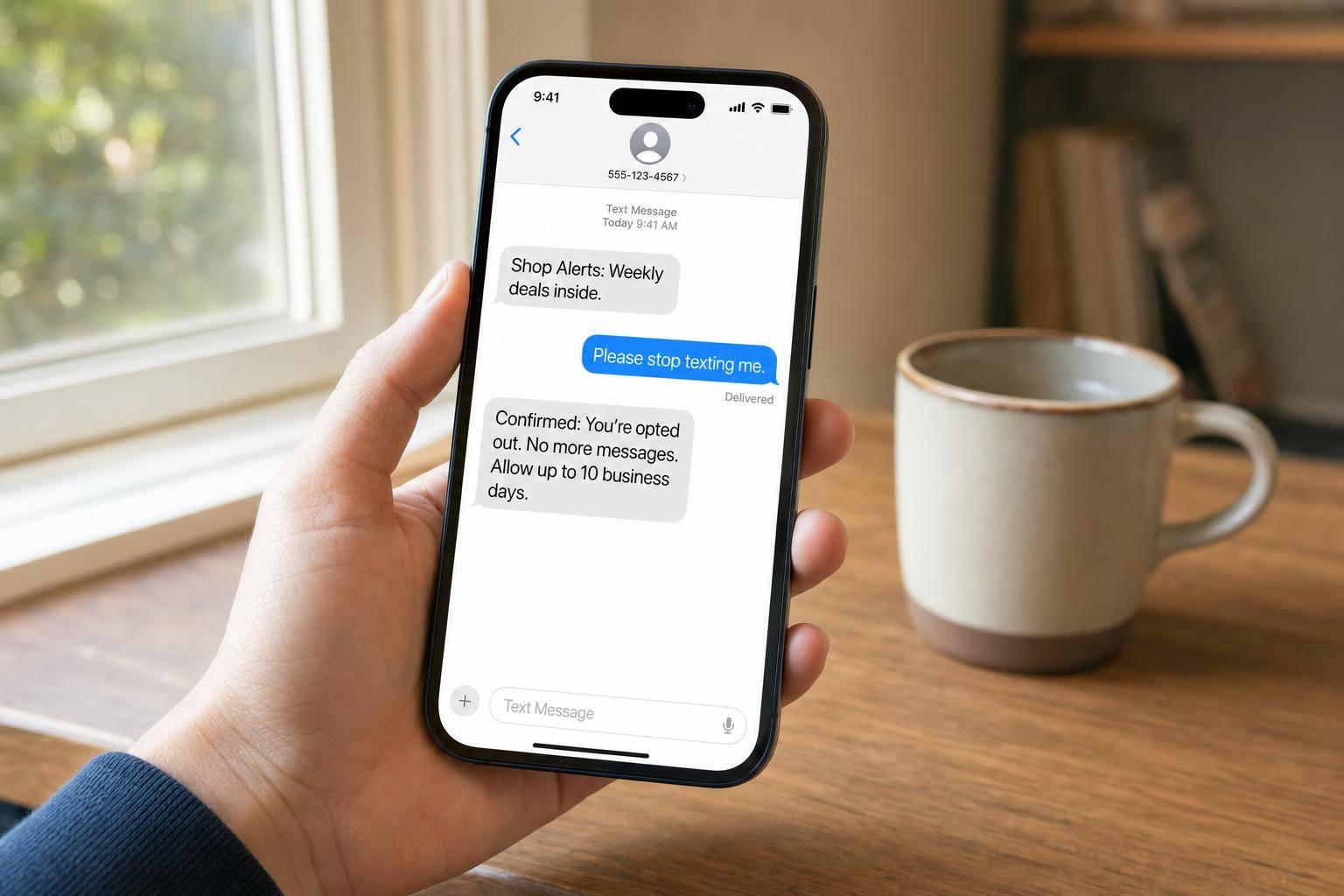
If you tell a company to stop calling or texting, it now has 10 business days to stop. Since 04/11/2025, the FCC says you can revoke consent by any reasonable means, not just a company’s favorite method.
Here’s the short version:
- You can opt out in plain English.
“STOP,” “END,” “CANCEL,” “UNSUBSCRIBE,” or even “take me off your list” can work. - Companies get less time to act.
The old window was 30 days. The new window is 10 business days. - One final text may still come through.
It must be a single confirmation sent within 5 minutes, and it cannot include marketing. - Not every message stops.
Marketing texts and calls should stop after you revoke consent, but fraud alerts, emergency notices, and some debt-related calls may follow other rules. - A bigger company-wide stop rule starts later.
On 01/31/2027, one opt-out is set to apply across a company’s departments and contact channels. - Each illegal call or text may count on its own.
That can mean $500 per call or text, or up to $1,500 if the violation was knowing or willful.
| Rule | What it means for me |
|---|---|
| Any reasonable opt-out works | I do not have to use one exact form or keyword if my request is clear |
| 10-business-day deadline | Calls or texts after that window may be a TCPA violation |
| One confirmation text allowed | The text must be non-marketing and sent fast |
| Revoke All starts 01/31/2027 | One stop request should later apply across the same company |
| Per-message damages | Each bad call or text may increase what I can claim |
My takeaway: if I revoke consent and messages keep coming after 10 business days, I should save screenshots, call logs, voicemails, and my original stop request right away. That record can matter if I report unwanted phone calls or take legal action.
FCC/TCPA Compliance 2025: New Rules for Lead Generation & Automated Messages Simplified
sbb-itb-a8d93e1
What Changed Under the FCC’s New TCPA Rules
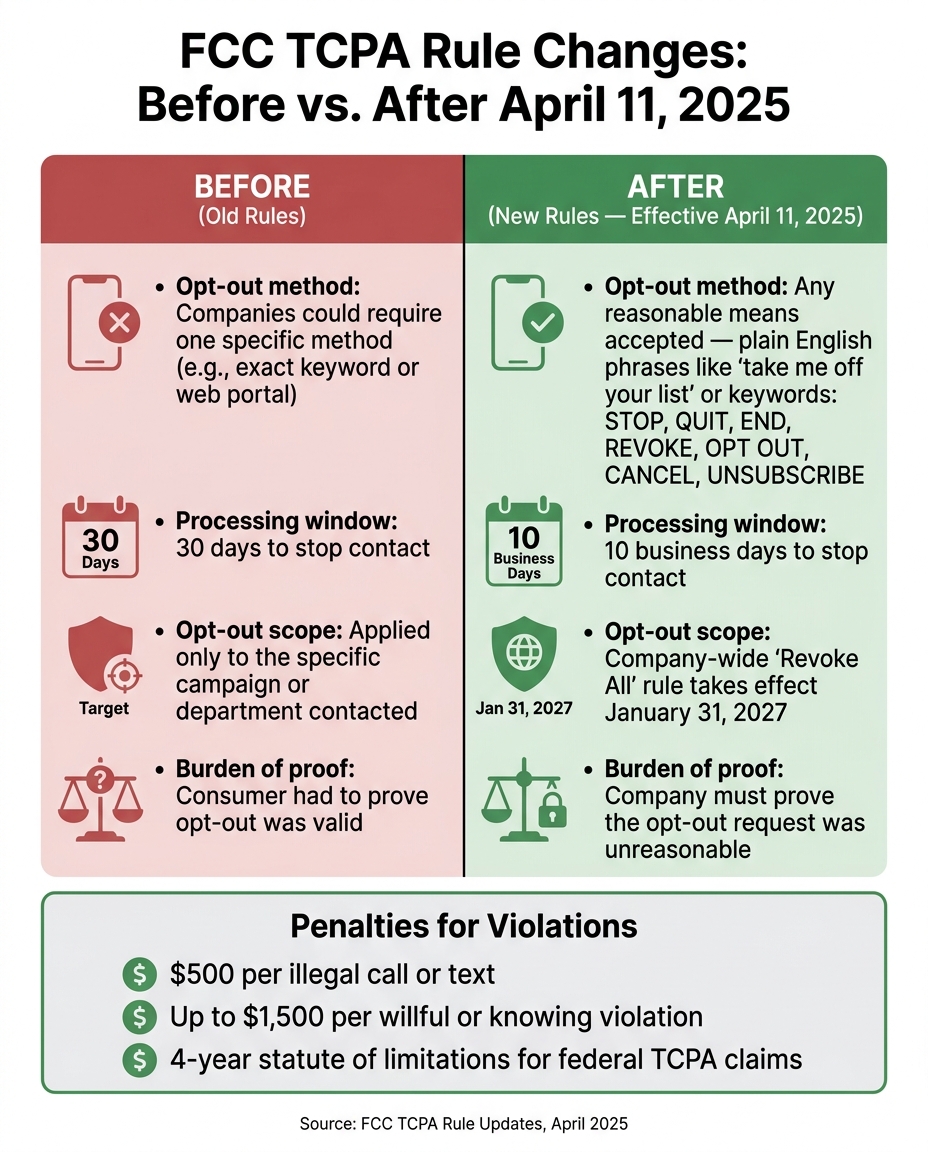
FCC TCPA Rule Changes 2025: What’s New vs. What Was
The new rules come down to three consumer protections.
The FCC updated TCPA rules on April 11, 2025. The big shift is simple: you can take back consent by any reasonable means, and businesses have less time to act.
You Can Opt Out in Any Reasonable Way
Before these updates, businesses could often make people use one specific opt-out method, like a web portal or an exact keyword. That’s no longer allowed. Now, you can revoke consent through any reasonable means that clearly tells the business you want calls or texts to stop.
The FCC also says seven reply-text keywords count as valid opt-outs: STOP, QUIT, END, REVOKE, OPT OUT, CANCEL, and UNSUBSCRIBE. Plain-language requests like "take me off this list" or "no more texts" count too, as long as the meaning is clear.
If a business claims your request was unreasonable, the burden is on that business to show why.
Telemarketers Must Honor Opt-Out Requests Within 10 Business Days
Once you make a clear opt-out request, companies have 10 business days to process it and stop contacting you. They may send one last confirmation text within five minutes of your opt-out, but that message can’t include marketing content.
If messages keep coming after that 10-business-day window, that may violate the TCPA.
A Company-Wide Opt-Out Rule Takes Effect Later
Another major change kicks in later. A single opt-out will eventually cover more than one department or contact channel inside the same company. This "Revoke All" rule takes effect on January 31, 2027, and it will make one opt-out request apply across all communication channels and departments within a company.
Here’s a simple example: if you tell a bank to stop texting you about mortgage offers, it wouldn’t be able to keep calling you about credit cards.
Until that date, though, a stop request may still apply only to the campaign or department that got it.
Next, see what companies can still send after you say stop.
What to Expect After You Tell a Company to Stop
Once you opt out, the big question is simple: what can still show up before the company fully stops? The answer depends on the type of message and the timing. Some contact may still be allowed for a short period. Other contact is not.
A One-Time Confirmation Text May Still Be Sent
A sender may send one confirmation text within five minutes of your opt-out request. But that message has limits. It cannot include marketing, sales, or promotional language, and it cannot pressure you to stay opted in.
There’s one extra wrinkle. If the same sender offers more than one type of message, it may send one clarification text asking which messages you want to stop. If you don’t respond, treat your request as revoking non-emergency robocalls and texts from that sender.
Not Every Message Follows the Same Rule
This is where people often get tripped up. Opting out of one type of contact does not always stop every kind of message from that company.
Promotional calls and texts need prior express written consent and must stop within 10 business days after you revoke that consent. But informational alerts, emergency messages, and some debt-collection calls follow different TCPA rules. So a fraud alert or utility notice may still be allowed even after you opt out of marketing.
Keep Basic Records If Calls or Texts Continue
If the calls or texts keep coming after the 10-business-day window, your records matter. A lot.
Save:
- Screenshots that show the sender, timestamp, and full message
- Voicemails as original audio files, plus written transcripts
- The date in MM/DD/YYYY format, the phone number used, and what the message said
- A copy of your original stop request, whether that was a “STOP” text, an email, or a written letter, along with any proof of delivery
If messages keep coming, those records are what you’ll need next.
How the Rules Are Enforced and What Your Rights May Be Worth
Once a company misses the opt-out deadline, the next issue is enforcement.
FCC Enforcement and Common Violation Triggers
TCPA violations can lead to FCC action or private lawsuits filed by individuals in federal or state court. Both can bring penalties. In most cases, enforcement starts when a company keeps contacting someone after a valid opt-out or sends messages without the consent the law requires.
Potential TCPA Damages Per Illegal Call or Text
This matters because each call or text can count as its own claim. Every unlawful call or text can trigger $500 in statutory damages. If a court finds the violation was willful or knowing, that amount can be tripled to $1,500 per violation.
That can add up fast. If a company keeps contacting you after a valid stop request, each new contact can increase what it may owe. Consumers may also seek their actual monetary loss if that amount is more than the statutory $500 per violation.
A federal TCPA claim is generally subject to a four-year limit. Proof of willfulness can matter here. For example, a company that keeps calling after a clear revocation, or one that has faced prior lawsuits over the same conduct, may give a court reason to award the higher amount.
"The TCPA already carries severe statutory penalties: $500 per violating call or text, up to $1,500 per willful violation. Class action exposure under the TCPA can quickly reach millions of dollars."
If you want help taking action on those violations, the next section explains how ReportTelemarketer.com can help.
How ReportTelemarketer.com Can Help You Take Action
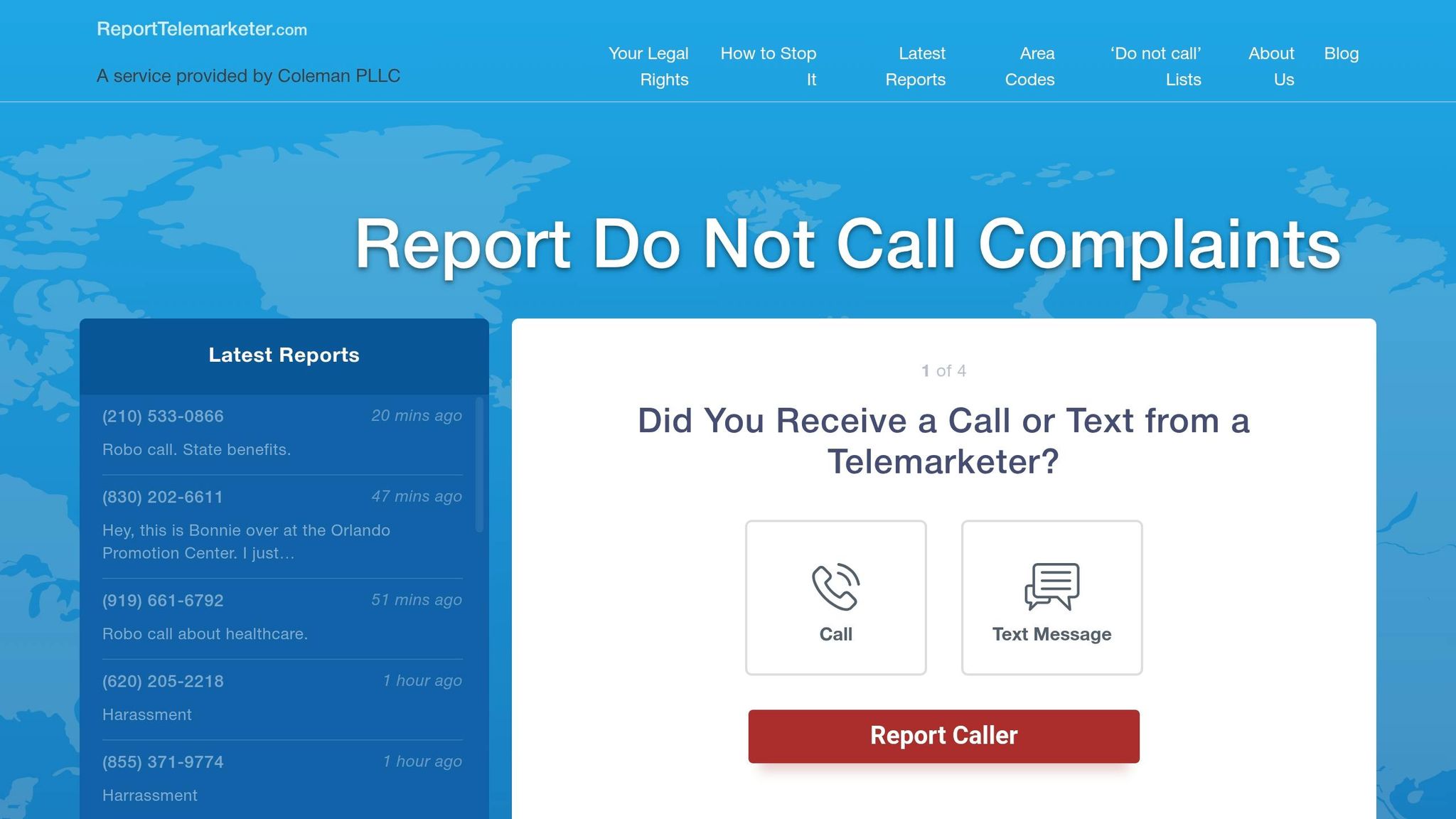
If a company keeps contacting you after the deadline, put every call and text in one place. That paper trail matters.
Report Unwanted Calls and Texts in One Place
If calls or texts keep coming after the 10-business-day window, use ReportTelemarketer.com to document them in one place. When you submit a report, include the dates, phone numbers, message content, and your opt-out request.
Before you file anything, keep each record in its original form. Don’t crop screenshots. Save the full message thread so the timestamps and sender details stay visible. It also helps to keep a dated log of each contact.
Get Help When a Company Ignores Your Stop Request
ReportTelemarketer.com investigates the company you report. The service works to identify the sender and can send a cease-and-desist letter or file a complaint when appropriate. The service is free to users. Attorney fees may be recovered from telemarketers when allowed.
The business bears the burden of showing that a revocation request was unreasonable or that it had valid consent. If a company claims your opt-out wasn’t valid, your saved records can help back you up. A screenshot of a "STOP" text, an email, or a call log can show that you made a clear request to stop.
Common Telemarketing Problems and How ReportTelemarketer.com May Respond
These are the problems the service most often helps document.
| Consumer Problem | How ReportTelemarketer.com May Help |
|---|---|
| Texts continue after the 10-business-day deadline | Documents the timeline of messages received after the deadline |
| Company says your opt-out wasn’t received | Uses saved screenshots or logs to confirm a valid revocation was made |
| Multiple "confirmation" texts sent after opt-out | Identifies each additional message as a potential separate violation |
| Robocalls continue after you revoked consent | Builds a record of repeated contact and identifies the sender |
| Different departments keep calling after opt-out | Tracks which departments were notified to keep the opt-out record organized |
Conclusion: Key Takeaways From the FCC’s New TCPA Rules
Once your record is complete, the next step is to escalate the violation. If a company ignores your opt-out, report it with your records so the violation can be documented and pursued. ReportTelemarketer.com offers a free way to report what’s happening, investigate the sender, and pursue cease-and-desist letters or complaints without any out-of-pocket cost.
FAQs
When does the 10-business-day clock start?
The 10-business-day clock starts the moment the telemarketer gets your opt-out request.
You can revoke consent using any reasonable method. That includes replying STOP or UNSUBSCRIBE, sending an email, or making a phone call. Once the company gets that request, it must honor it within 10 business days.
If the calls or texts keep coming after that window, you can report the violation to ReportTelemarketer.com.
Does one STOP request cover all company numbers?
No. Right now, a single STOP request does not apply to every message type from a company across all channels.
That’s because the FCC’s unified opt-out rule has been delayed until January 31, 2027.
For now, companies still have to honor opt-out requests within 10 business days. If the unwanted messages or calls keep coming after that, ReportTelemarketer.com can help look into the issue and take formal action at no cost to the user.
What should I save if messages keep coming?
Keep an evidence file for every unwanted contact. Save full-screen screenshots of texts that show the sender, phone number, date, time, and the full message. Keep call logs, voicemail audio, voicemail transcripts, and any messages where you told them to stop contacting you or revoked consent.
It also helps to keep a simple timeline with:
- Each contact
- How you responded
- Which saved files go with that contact
ReportTelemarketer.com can help investigate these telemarketers, identify violations, and take action to stop the calls.

