
If you want to file a TCPA class action, you need more than a stack of robocall screenshots. I’d focus on Rule 23, a clear class definition, proof of one shared calling or texting campaign, and records that can help identify class members later.
Here’s the short version:
- I need facts that show the same company contacted many people in the same way
- I need to meet Rule 23(a) and, for damages, usually Rule 23(b)(3)
- I need records like call logs, texts, screenshots, voicemails, timestamps, and opt-out proof
- I need a class definition based on objective limits like phone number, date range, and message type
- I need to watch for the biggest problem in TCPA class cases: person-by-person consent disputes
- I need a filing plan that covers federal court papers, venue, service, damages, and notice
A TCPA claim can lead to $500 per violation or up to $1,500 per violation for willful conduct. But a class case often turns on a simpler issue: can one set of records and one set of facts answer the main questions for the whole group?
What I take from this article is simple: the calls or texts matter, but the records and class structure matter just as much.
What Makes a TCPA Claim Eligible for Class Treatment
A TCPA claim can move forward as a class action only if it meets Rule 23(a) and at least one part of Rule 23(b).
Numerosity, Commonality, Typicality, and Adequacy Explained
Rule 23(a) has four required parts. If even one is missing, class certification fails.
Numerosity means the group is big enough that filing separate lawsuits doesn’t make much sense. Courts often treat classes of 40 or more as large enough. In TCPA cases, that bar is often easy to clear because one calling or texting campaign may reach thousands of people.
Commonality asks a simple question: can one shared set of facts or proof answer the claim for the whole class? For instance, if the defendant used the same dialing system for every recipient, that issue may be decided once for everyone.
Typicality and adequacy often rise or fall together. Both focus on whether the named plaintiff lines up with the rest of the class.
- Typicality often breaks down when consent has to be shown person by person.
- Adequacy means the class representative and class counsel must fairly protect the group’s interests. If the named plaintiff has odd consent facts or credibility problems, adequacy can fail.
For damages classes, Rule 23(b)(3) adds two more hurdles: predominance and superiority.
- Predominance means shared issues must matter more than individual ones.
- Superiority means a class action must be the best way to handle the case.
That point matters a lot in TCPA suits. If the court has to dig into consent one class member at a time, the case can stop looking like a class action and start looking like hundreds or thousands of mini-trials.
How to Define the Proposed Class with Clear Limits
A loose class definition can sink certification before the case gets off the ground. Courts want the class to be ascertainable. In plain English, that means class members must be identifiable through objective criteria, without heavy person-by-person fact work.
One common mistake is using a failsafe class definition. That’s a class definition where membership depends on proving the defendant broke the law. Courts don’t like that.
Use clear, objective limits instead:
- the phone number involved
- the date range
- the type of call or text
For example: "all persons in the United States who received a text message from [Number] between January 1, 2023, and December 31, 2023."
The Hudson-Bryant v. OCMBC Inc. d/b/a LoanStream ruling from May 2026 drove this home. The Central District of California denied certification in part because disputes over who actually subscribed to the phone number made the proposed class too hard to work with.
The safer move is to define the class with facts the court can test both when the case is filed and again at certification. A narrow, objective definition also helps with common proof. If the class is built around one number, one campaign, and one time period, it’s much easier to show the same evidence applies across the board.
After defining the class, gather records that connect the calls or texts to one campaign.
sbb-itb-a8d93e1
Evidence and Records to Collect Before Filing
Strong evidence gives a TCPA class action a better shot at moving ahead. It also helps later when you need to show that the case fits class certification. The records you gather before filing do two jobs at once: they support the complaint and help show a pattern that goes beyond one person.
Save Call Logs, Texts, Screenshots, and Times
Once the class is narrowly defined, start pulling together records that show the same campaign reached many people.
Take a screenshot of each unwanted call or stop spam text messages right away. Each image should clearly show the phone number, message content, date, and time. Keep a simple log with the date, time, sender, message type, and any consent revocation.
For voicemails, save the audio files and back them up with a service like Google Voice or YouMail. If the message uses a prerecorded or artificial voice, that can help support a prerecorded-message claim. It also helps to request records from your wireless carrier. Those records give third-party proof of how many contacts came through and when they happened.
Document Consent, Opt-Out Efforts, and Do-Not-Call Evidence
Save a screenshot of every "STOP" reply you sent and any confirmation message you got back. If you made a verbal request during a call, write down the date, time, and what you said as soon as the call ends.
If your number is on the National Do Not Call Registry, note the registration date. Some protections do not kick in until your number has been on the registry for 31 days, so that date can matter a lot. Also record any request you made straight to the company asking to be added to its internal do-not-call list. Ignoring that request can be a separate violation.
These records carry the most weight when they connect repeated contacts to the same defendant.
Connect the Calls or Texts to a Common Campaign
The strongest filings connect each call or text to one defendant’s campaign. Write down details that link each contact to the same sender. That includes any company name, brand mention, callback number, or reference number that shows up in the calls or texts. Those details help tie the conduct to a specific defendant.
Save any URLs included in spam texts too. A landing page can help identify who sent the message.
How to Prepare and File the Complaint in Federal Court
After you’ve gathered records that point to a shared campaign, the next step is to turn that material into a federal complaint. When CAFA applies, TCPA class actions often belong in federal court.
State the TCPA Violations and Class Allegations Clearly
The complaint is the main filing. It should name the lead plaintiff, describe the proposed class, and lay out what the defendant did, whether that involved auto-dialed calls, prerecorded messages, faxes, or texts. It should also point to the TCPA provisions at issue and allege lack of consent based on the records collected before filing.
If you’re bringing a Do-Not-Call claim, plead the registry facts and the residential-subscriber facts too. Then connect those allegations to the records already in hand. Call logs, screenshots, and timestamps aren’t just background material. They help support the factual claims in the complaint.
Use the same objective class definition that you plan to use at certification. Allege that the proposed class meets Rule 23. And make sure the lead plaintiff actually fits the class. That part matters more than it may seem. In Hudson-Bryant v. OCMBC Inc. (May 2026), a California federal court denied certification because the plaintiff’s unusual facts created individualized defenses.
Once the complaint sets up the class and the claims, the next piece is the filing package.
Filing Documents, Venue, and Damage Allegations
After drafting the claims, what’s left is filing and service. In federal court, that usually means putting together the complaint, civil cover sheet, summonses, and filing fee. The core documents are:
- Complaint – states the TCPA violations, class definition, and relief sought
- Civil Cover Sheet – a required administrative form
- Summons – formally notifies the defendant of the lawsuit
- Filing Fee – $400 to $500
- Supporting Exhibits – call logs, screenshots, and consent records
File in a proper federal venue, usually where the plaintiff lives or where the defendant does business. Before filing, identify the defendant’s registered agent. Then use that registered agent for service.
Be direct about damages. The TCPA allows $500 per violation, and courts may award up to $1,500 per violation for willful or knowing misconduct. Ask for statutory damages and injunctive relief.
Supporting Class Certification and Planning Notice
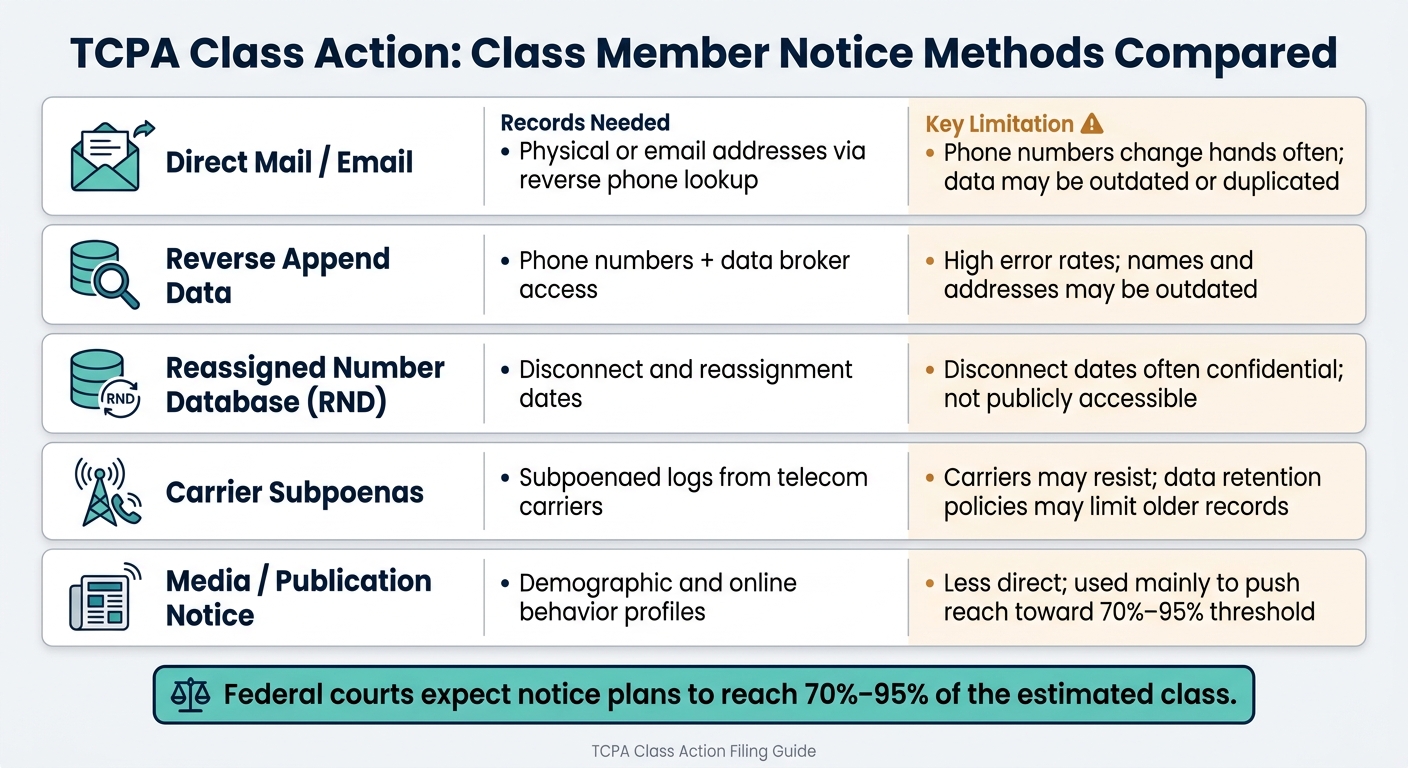
TCPA Class Action Notice Methods: Records, Reach & Limitations
How to Show the Class Should Be Certified
After filing, the complaint needs proof that one common campaign can support classwide treatment. The focus should stay on a single campaign, not a pile of contact-by-contact disputes.
The best certification arguments usually come from shared conduct. If the defendant used the same prerecorded script or worked from the same call list across the class, that common conduct helps show that common proof matters more than person-by-person issues. That point matters a lot because consent disputes are where many class cases fall apart. When the court would need to check each person’s consent one at a time, certification is often denied.
In Sharfman M.D.P.A. v. Precision Imaging St. Augustine LLC, the court rejected certification when consent had to be tested person by person – even with nearly 5,000 potential class members.
Notice Methods and Class Member Identification
Once the certification theory is set, The next job is linking records to actual people, often starting when victims report unwanted phone calls to build a database of violations. Notice depends on identifying class members through objective records. Courts want a class definition that can be applied from records, not from individual interviews.
The same records used to show a single campaign also shape whether the class can be identified for notice. A common workflow looks at defendant and carrier records, checks the Reassigned Number Database (RND) to see whether a number was reassigned, and then uses reverse append data to match phone numbers with names and addresses.
The notice method should match the quality of the records you have.
| Notice/Identification Method | Records Needed | Common Limitations |
|---|---|---|
| Direct Mail/Email | Physical or email addresses obtained via reverse lookup of phone numbers | Phone numbers change hands often; data may be outdated or duplicate |
| Reverse Append Data | Phone numbers, data broker access | Can have high error rates; names and addresses may be outdated |
| Reassigned Number Database (RND) | Disconnect and reassignment dates | Disconnect dates are often confidential and not accessible through public interfaces |
| Carrier Subpoenas | Subpoenaed logs from telecommunication carriers | Carriers may resist, or data retention policies may limit older records |
| Media/Publication | Targeted demographic data and online behavior profiles | Less direct; used mainly to improve reach toward 70%–95% |
A class can also fail when record review shows that too many proposed members were already consented customers, as the Fourth Circuit confirmed in Davis v. Capital One, N.A. (August 2025).
Federal judges generally expect a notice plan to reach 70% to 95% of the estimated class. If direct records don’t get you there, media or online notice can help push reach higher.
Conclusion: Key Filing Requirements to Remember
A strong filing package needs two things working together: a class theory the court can certify and a practical way to identify class members. For a TCPA class filing, that usually means a precise class definition, common proof, solid records, and a notice plan that can work in practice.
FAQs
How do I know if my TCPA claim can be filed as a class action?
You usually need two things: a valid, well-documented individual TCPA claim and a lawyer who has handled class certification and federal civil procedure.
A court will certify a class only if Rule 23(a) is satisfied. That means the proposed class must meet numerosity, commonality, typicality, and adequacy of representation.
The class also has to be defined in an objective way. Put simply, membership can’t turn on whether the plaintiffs win the case.
What evidence should I save before filing a TCPA class action?
Save proof that shows who contacted you, how they contacted you, and that you didn’t give consent.
That means keeping:
- Screenshots of call logs
- Text threads with timestamps, sender details, and message content
- Any voicemails
It also helps to keep a clear timeline of each contact, along with phone carrier records, proof that your number was on the National Do Not Call Registry, and any opt-out records or removal confirmations.
For example, save copies of:
- "STOP" texts
- Emails
- Letters
The goal is simple: keep a paper trail that shows what happened and when it happened.
Can a TCPA class action fail because of consent issues?
Yes. A TCPA class action can fall apart when consent has to be reviewed person by person.
Courts often deny class certification if class members may have given consent in different ways, or if they were contacted under different facts. When that happens, the court may decide the case can’t be handled on a class-wide basis because each person’s situation needs separate review.

